A Class 3000 forged fitting is a pipe joining component — elbow, tee, coupling, bushing or plug — made of forged carbon steel per ASTM A105/A105M-24, with wall thicknesses, dimensions and marking defined by ASME B16.11-2021. Its allowable pressure is not a fixed number: by rule, a threaded Class 3000 fitting must withstand the same pressure as Schedule 160 seamless pipe of equivalent material, and a socket-weld Class 3000 fitting the same as Schedule 80/XS pipe. That is why it is the standard fitting for steam, process lines and high-pressure service in small bores.
Verdict: for steam, condensate, hydrocarbons and high-pressure air or gases in 1/8" to 2" sizes, use Class 3000 forged fittings: NPT threaded when the line must be dismantled, socket weld when permanent tightness comes first. For water, general-service compressed air and low-pressure networks, Class 300 malleable iron or Class 150 black iron fittings cost less and are sufficient. TECTUL stocks the threaded Class 3000 carbon steel forged line: 90° elbows, 45° elbows, tees, couplings and union fittings.
Unlike cast or malleable iron fittings, which are made by pouring liquid metal into a mold, a forged fitting starts as a steel bar or billet that is hot-formed by pressing or die forging and then machined. Forging compacts the material, removes internal porosity and orients the grain flow, which yields higher mechanical strength and toughness than a casting of the same steel.
The material specification is ASTM A105/A105M-24, Standard Specification for Carbon Steel Forgings for Piping Applications, covering carbon steel forgings for flanges, fittings and valves in pressure systems at ambient and elevated temperature. Its main requirements:
| Property (ASTM A105/A105M-24) | Requirement |
|---|---|
| Tensile strength, min. | 485 MPa (70 ksi) |
| Yield strength, min. | 250 MPa (36 ksi) |
| Elongation, min. | 22 % |
| Hardness, max. | 187 HBW |
| Carbon, max. | 0.35 % |
The fitting body must be marked with the manufacturer's symbol, the material (A105), the class (for example 3000 or "3M") and the size, per the marking section of ASME B16.11-2021. A fitting with no embossed or stamped marking is not traceable to the standard.
The class of a forged fitting is not its working pressure in psi. ASME B16.11-2021 publishes no pressure-temperature tables like those for flanges: it defines each class by equivalence to a pipe schedule. The fitting must withstand the same pressure as seamless pipe of that schedule, of equivalent material, computed per the applicable design code (ASME B31.1 or B31.3). The correlation is:
| Class | End type | Equivalent seamless pipe for rating (ASME B16.11-2021) |
|---|---|---|
| 2000 | Threaded | Schedule 80 / XS |
| 3000 | Threaded | Schedule 160 |
| 6000 | Threaded | XXS (double extra strong) |
| 3000 | Socket weld | Schedule 80 / XS |
| 6000 | Socket weld | Schedule 160 |
| 9000 | Socket weld | XXS (double extra strong) |
In practice, the ambient-temperature rating of a threaded Class 3000 A105 fitting is that of Schedule 160 seamless pipe of the corresponding size: it varies with diameter and comes from the code wall-thickness formula, not from a single number. The useful takeaway for purchasing: if your line is designed with Schedule 80 or Schedule 160 carbon steel pipe, a Class 3000 fitting will never be the weak link. To understand what pressure each pipe schedule implies, see the guide on pipe schedules and pressure.
Class 3000 is the most commercial of the six combinations because it covers, with margin, the typical steam and process services that use Schedule 40 and Schedule 80 pipe. Classes 6000 and 9000 are reserved for true high pressure — hydraulics, chemical injection, very high pressure steam — where the line runs Schedule 160 or XXS pipe.
The threaded end uses NPT taper thread per ASME B1.20.1-2013 (R2018), with a 1:16 taper and 60° flank angle; sealing is achieved by flank interference plus a sealant (PTFE tape or anaerobic compound). Choose threaded when the installation must be dismantled without cutting or welding, when no qualified welder is available, or in plants where hot work requires costly permits. Its limits: every thread is a potential leak point and threading reduces the effective pipe wall, so codes restrict threaded joints in severe cyclic or high-temperature service. Thread details are covered in the NPT thread guide.
A socket-weld fitting has a socket into which the pipe bottoms out and is secured with an external fillet weld. ASME B31.3 directs inserting the pipe to the bottom of the socket and withdrawing it approximately 1.5 mm (1/16 in) before welding, so pipe expansion during welding does not crack the weld root. Choose socket weld when you need permanent tightness — high-pressure steam, hydrocarbons, hazardous fluids — easy alignment of small-bore runs, and better fatigue behavior than threads. Its limits: it is not dismountable, it requires a qualified welder, and the gap between pipe and socket can trap fluid, so it is avoided in corrosive services with crevice-corrosion risk or in lines requiring complete drainage.
The most expensive confusion in purchasing is treating malleable iron threaded fittings as interchangeable with forged ones. They are different standards, materials and pressure levels:
| Criterion | Class 3000 forged | Class 300 malleable | Class 150 malleable |
|---|---|---|---|
| Dimensional standard | ASME B16.11-2021 | ASME B16.3-2021 | ASME B16.3-2021 |
| Material | Forged steel ASTM A105 | Malleable iron | Malleable iron |
| Ambient-temperature rating | That of equivalent Schedule 160 seamless pipe (threaded) | 13.8 MPa (2,000 psi) at NPS ≤ 1, decreasing with size | 2.07 MPa (300 psi) |
| Joint | NPT thread or socket weld | NPT thread only | NPT thread only |
| Weldable | Yes (socket weld) | No | No |
| Typical service | Steam, process, high pressure | Medium-pressure steam and water | Water, air, general networks |
Practical rule: if the line is calculated under ASME B31.1 or B31.3 with carbon steel, the threaded fitting must be forged A105 Class 2000 or 3000; malleable iron per ASME B16.3-2021 belongs in utility networks. The companion guides on Class 300 malleable iron and Class 150 black iron cover those two tiers in detail.
Not necessarily: the class is a designation and the real rating is that of Schedule 160 (threaded) or Schedule 80 (socket weld) seamless pipe of equivalent size and material, computed per ASME B31.1 or B31.3. In small sizes that value can exceed 3,000 psi and in other cases differ: it is always verified against the code.
ASME B16.11-2021 covers fittings from NPS 1/8 through NPS 4 (DN 6 to DN 100); commercial availability concentrates between 1/8" and 2", the range where threaded and socket-weld joints compete with flanges and butt welding.
Socket weld if the installation is permanent and a qualified welder is available: it eliminates thread leaks. NPT threaded with a temperature-rated sealant if you need to dismantle equipment frequently; in that case install union fittings at maintenance points.
Define the service and the pipe first: if the line carries steam, process fluids or high pressure on Schedule 80 carbon steel pipe, buy ASTM A105 Class 3000 forged fittings per ASME B16.11-2021 and require material and class marking on every piece. For dismountable sections use couplings and Class 3000 unions; for direction changes, 90° and 45° elbows; for branches and reductions, tees and bushings. If the service is low-pressure water or air, save with Class 150 or 300 malleable iron and reserve forged fittings for where pressure and temperature demand them. The TECTUL technical team can cross-check your bill of materials against the correct class before you order.
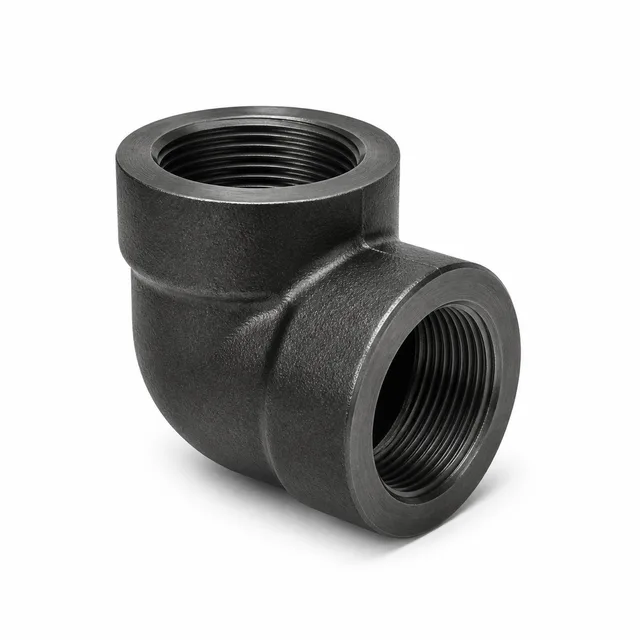 codo acero carbon 3000 lbs roscado
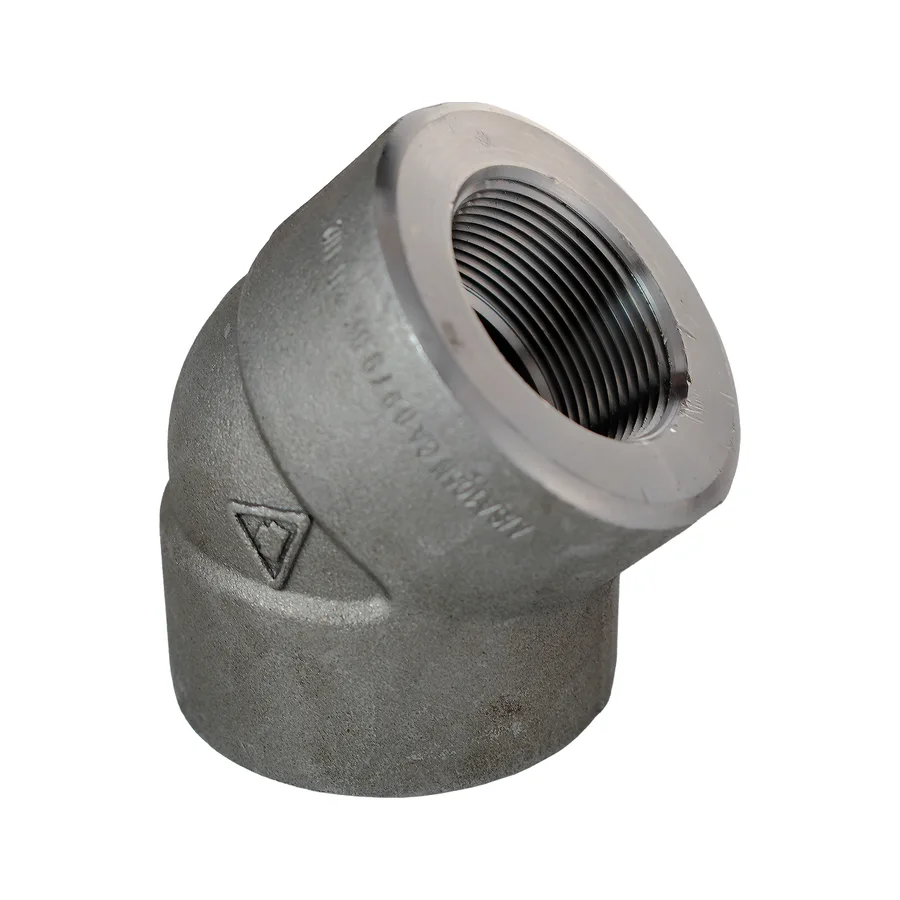 semicodo acero carbon 3000 lbs roscado
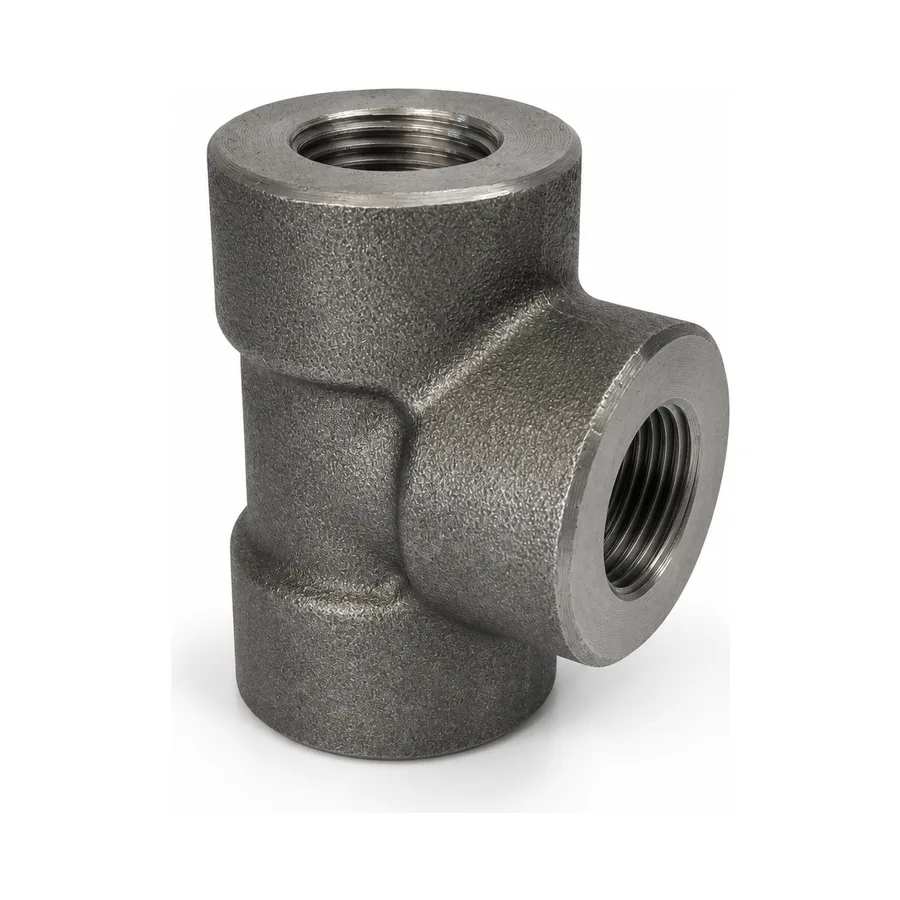 tee acero carbon 3000 lbs roscado