A bearing reference condenses critical information: type, dimensional series, bore diameter, sealing, internal clearance, cage and bore geometry. Reading it correctly prevents buying a bearing that fits the shaft but cannot carry the load, reach the speed or survive the temperature. TECTUL supplies 6200 series deep groove ball bearings, 6300 series bearings and 22200 series spherical roller bearings.
Verdict: to identify a common metric bearing, read the main numeric block first; from code 04 onward, the last two digits give the bore by multiplying by 5, while 00, 01, 02 and 03 are exceptions: 10, 12, 15 and 17 mm. Then check suffixes such as 2Z, 2RS, C3 and K because they change protection, internal clearance and mounting.
For metric radial bearings, ISO 15 defines boundary dimension plans for standardized series. Manufacturers use designations that follow that logic for many families, although they may add their own prefixes and suffixes. The main part does not describe the brand; it describes an approximate interchangeable geometry within the same family.
| Reference | Main reading | Bore | Purchasing interpretation |
|---|---|---|---|
| 6204 | Type 6, dimensional series 2, code 04 | 20 mm | 6200 series deep groove ball bearing |
| 6305 | Type 6, dimensional series 3, code 05 | 25 mm | More robust deep groove ball bearing than 6205 |
| 22216 EK | Series 222, code 16, suffixes E and K | 80 mm | Spherical roller bearing with tapered bore |
| 6004-2RS-C3 | 6000 series, 2RS seals, C3 clearance | 20 mm | Ball bearing, sealed both sides and larger internal clearance |
The most useful rule is the bore code. From 04 to 96, the nominal bore diameter in millimeters is obtained by multiplying the code by 5. Therefore 04 is 20 mm, 05 is 25 mm, 16 is 80 mm and 20 is 100 mm. Small codes are exceptions: 00 equals 10 mm, 01 equals 12 mm, 02 equals 15 mm and 03 equals 17 mm.
The rule identifies nominal bore, not tolerances, fit or internal clearance. The final fit between shaft and inner ring depends on load, relative rotation, material, temperature and manufacturer recommendation. Buying by bore alone is insufficient if the bearing carries high radial load, misalignment or high speed.
| Final code | Nominal bore | Example | Note |
|---|---|---|---|
| 00 | 10 mm | 6000 | Standard exception |
| 01 | 12 mm | 6001 | Standard exception |
| 02 | 15 mm | 6202 | Standard exception |
| 03 | 17 mm | 6203 | Standard exception |
| 04 | 20 mm | 6204 | Code ×5 applies from here |
| 05 | 25 mm | 6305 | Code 05 × 5 |
| 16 | 80 mm | 22216 EK | Code 16 × 5 |
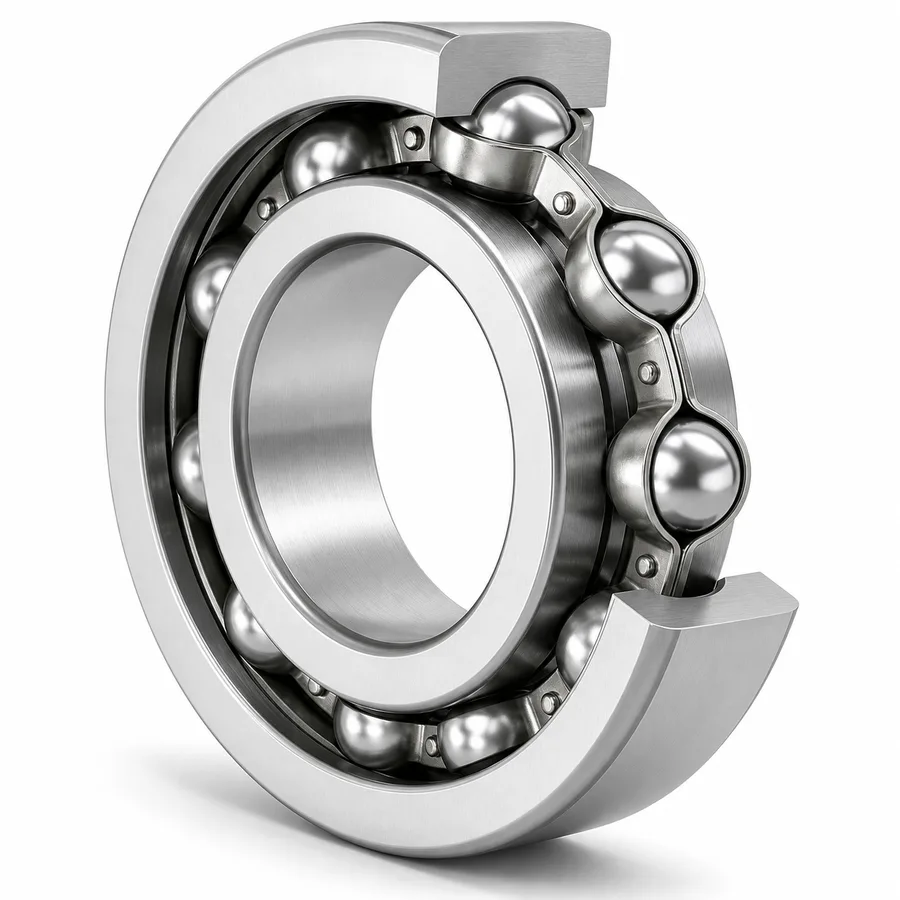
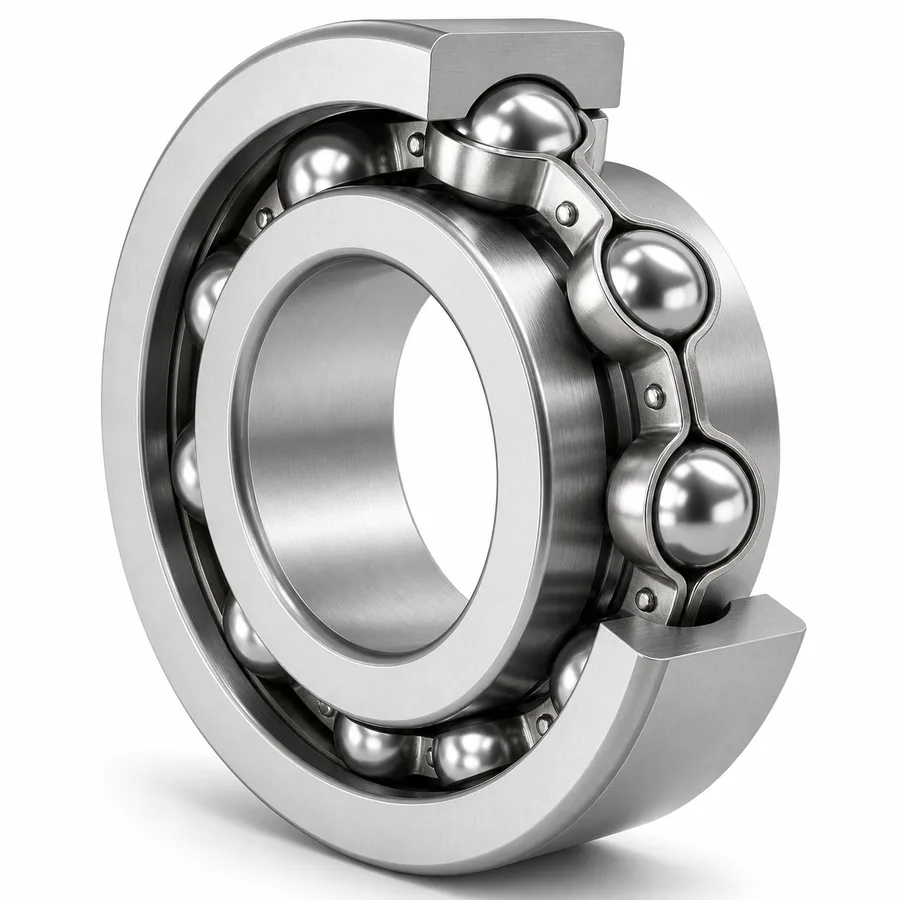
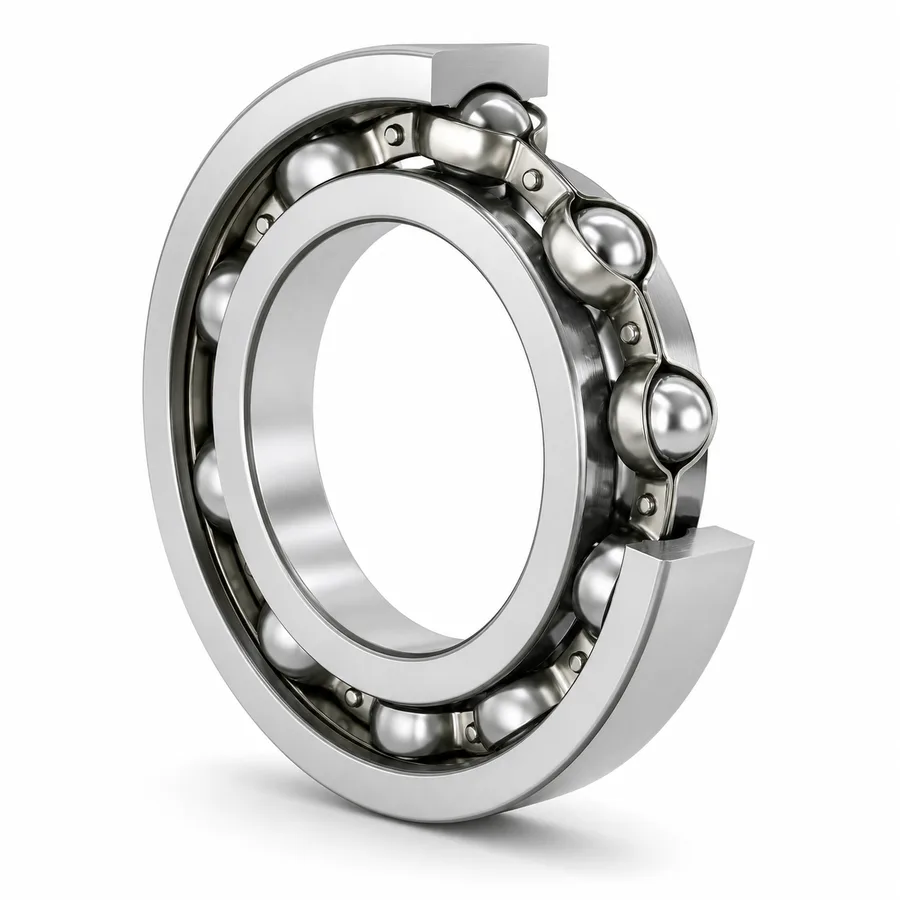
In deep groove ball bearings, the 6000 family is usually lighter, the 6200 series is a very common intermediate-capacity series, and the 6300 series has a larger section for higher radial capacity at the same nominal bore. For example, 6204 and 6304 may have the same 20 mm bore, but they do not share outside diameter or width.
That difference is essential in purchasing: if the housing was machined for a 6204, a 6304 will not fit even though the shaft is the same. When the reference is unreadable, measure bore, outside diameter and width; those three data points narrow the dimensional series. Then confirm seals, internal clearance and cage.
Suffixes modify the base bearing. 2Z indicates two non-contact metal shields; 2RS indicates two rubber or elastomer seals, normally with better contamination protection and more friction than a shield. C3 indicates radial internal clearance greater than normal; it is used when mounting, temperature or speed reduce clearance during operation. K indicates tapered bore, typical in bearings mounted on sleeves or tapered seats.
| Suffix | Technical meaning | When to order it | Confusion risk |
|---|---|---|---|
| 2Z | Metal shield on both sides | Relatively clean environment and low friction | Assuming it seals like rubber |
| 2RS | Seals on both sides | Dust, light moisture or retained grease | Higher drag than open bearing |
| C3 | Radial internal clearance greater than normal | Temperature, interference or speed | Do not use if normal clearance is specified |
| K | Tapered bore, often 1:12 in many series | Sleeve or tapered-seat mounting | Will not mount directly on a cylindrical shaft without the correct system |
6204 identifies a deep groove ball bearing, series 62, with 20 mm bore. 2RS adds seals on both sides. C3 indicates greater than normal internal clearance. It is common in motors, fans and equipment where the environment needs protection and the mounting may reduce clearance.
6305 identifies a 63 series deep groove ball bearing with 25 mm bore. ZZ is a commercial form equivalent to metal shields on both sides in many catalogs; confirm whether the manufacturer uses 2Z or ZZ. Compared with a 6205, the 6305 has a larger section and requires a different housing.
22216 belongs to a spherical roller bearing series; code 16 gives an 80 mm bore. The E suffix often indicates an enhanced internal design depending on the manufacturer, and K indicates tapered bore. In purchasing, define sleeve, initial clearance and mounting method, not only the base reference.
Beyond universal or widely used suffixes, each manufacturer may use letters to indicate cage, internal design, product generation, seal material or grease. Therefore an apparently short reference may not be enough when the equipment operates near its speed or temperature limit. Cross-brand equivalence must be done with catalogs, not by replacing numbers only.
Cages may be pressed steel, machined brass, polyamide or other materials depending on series and application. The cage affects limiting speed, temperature, lubrication and vibration resistance. In common electric motors, pumps and fans, many standard designations work well; in screens, gearboxes, rolls or hot equipment, cage selection is no longer a minor detail.
Radial internal clearance is measured before mounting. When the inner ring is fitted with interference on the shaft, it expands and reduces clearance. When equipment runs hot, thermal gradients also change clearance during operation. C3 therefore does not mean “better” or “more precise”; it means greater initial clearance for a condition that needs it.
If a normal-clearance bearing is mounted with excessive interference or in hot equipment, it may run with no operating clearance, increase temperature and fail. If C3 is used where normal clearance was required, noise, vibration or poor precision may appear. Purchasing should respect the original suffix when the equipment has already been designed and proven.
Two bearings with the same base reference share nominal dimensions, but they can differ in precision, sealing, grease, capacity and finish. For precision machinery, spindles or high rpm, tolerance class may be as important as series. For general machinery, main dimensions and correct suffixes solve most replacement cases.
To buy an industrial bearing, give TECTUL the complete reference, main dimensions, application, rpm, temperature and contamination condition. If the suffix is missing, do not ignore it: an open 6204, a 6204-2RS and a 6204-C3 can have the same size and behave differently in service.
 rodamiento rigido de bolas serie 6200
 rodamiento rigido de bolas serie 6300
 rodamiento rigido de bolas serie 6000