The question “stick or wire” appears in maintenance, fabrication, installation and repair work. The correct answer is not a brand or a machine: it depends on thickness, position, access, wind, productivity, base metal cleanliness, applicable code, welder skill and weld length per shift. SMAW, or shielded metal arc welding, remains highly competitive in field work. GMAW, commonly called MIG/MAG, and FCAW with flux-cored wire provide higher continuity and productivity when conditions are controlled.
This guide compares SMAW, MIG and FCAW for industrial purchasing. TECTUL supplies consumables such as E6013 electrodes, E7018 electrodes, ER70S-6 MIG wire and E71T-1 flux-cored wire. The final selection must be validated against procedure, base metal and project specification, especially for structures, vessels, piping, lifting devices or fatigue-loaded equipment.
SMAW uses a coated consumable electrode. The coating stabilizes the arc, generates shielding gas and forms slag. Each electrode is consumed, creating pauses for changing rods and cleaning slag. GMAW uses continuously fed solid wire and an external shielding gas; this supports long welds, fewer stops and better repeatability in a shop. FCAW uses tubular wire with internal flux; depending on type, it may require external shielding gas or be self-shielded. Flux-cored wire combines high deposition with greater tolerance to some field conditions, but polarity, gas and classification must be selected correctly.
| Criterion | SMAW stick electrode | MIG/MAG solid wire | FCAW flux-cored wire |
|---|---|---|---|
| Productivity | Medium; pauses for electrode changes and cleaning | High in shop due to continuous feed | High deposition, especially in fillets and medium thickness |
| Outdoor wind | Good when the arc is protected from extreme conditions | Sensitive to wind because of external gas | Self-shielded wire is better for field; gas-shielded wire still needs protection |
| Equipment | Simple and portable power source | Power source, feeder, gas, torch and consumables | Similar to MIG; gas may or may not be required |
| Cleanliness | Tolerates light rust depending on electrode | Requires cleaner base metal for stability | Often more tolerant than solid MIG in selected applications |
| Quality and code | Common in field and repair; skill dependent | Repeatable with controlled parameters | Productive, but fumes, slag and parameters require control |
Consumable price per kilogram does not define welding cost. SMAW has stub losses, lower deposition efficiency than continuous processes and slag cleaning time. MIG wire can be efficient because it is continuous, but it adds gas, nozzles, contact tips, drive rolls and higher sensitivity to preparation. FCAW can provide high deposition rates, but many wires generate slag, more fumes and ventilation requirements. In repetitive shop work, MIG or FCAW often wins by weld length per hour. In dispersed repair and field work, SMAW can win because logistics are simple.
A serious comparison includes preparation, tacking, positioning, preheat, consumable changes, interpass cleaning, inspection and rework. A fast process used incorrectly may cost more than a slower robust one. When AWS D1.1 or another specification applies, the WPS, welder qualification and approved consumable matter more than shop preference.
E6010 and E6011 electrodes are used for root passes and deep penetration in many field applications; E6013 is a smooth-running electrode for sheet, light repair and general work; E7018 is a low-hydrogen electrode widely used in structures when storage and procedure are controlled. They are not interchangeable for all positions. AWS classification indicates usable positions, current type and coating characteristics.
Solid-wire MIG is excellent in flat and horizontal production with clean parts. Vertical-up, overhead or irregular access requires stable technique and parameters. FCAW, especially all-position wires, can be very productive in structures and field fabrication, but slag must be removed between passes. For tight spaces, repairs far from support equipment or work at height, an electrode holder and SMAW power source remain hard to beat.
GMAW relies on a shielding gas envelope. Air drafts can displace the gas and cause porosity even when the arc appears stable. This is why MIG is strongest in shops, booths, repetitive production or field work with wind screens. SMAW generates shielding from the coating and usually handles open environments better, although rain, moisture, contamination and extreme wind still affect quality. Self-shielded FCAW was developed for work where external gas is impractical, but not every flux-cored wire is self-shielded.
For structures and higher-strength steels, diffusible hydrogen can be critical. Electrodes such as E7018 are low-hydrogen products, but they maintain that advantage only when stored and reconditioned according to manufacturer instructions and procedure. Opening a package, leaving it in a humid environment and welding days later can remove the benefit. MIG and FCAW also require moisture control, clean wire, correct gas and protected spools. Purchasing should define package, lot, diameter, AWS classification and jobsite storage conditions.
Productivity has little value if it increases rework. In SMAW, variation between welders can be higher because each restart, electrode angle and interpass cleaning step affects the result. In MIG, repeatability improves when wire feed speed, voltage, gas flow and stick-out remain stable. In FCAW, high deposition requires discipline in slag cleaning and parameter control to avoid inclusions. If visual inspection, liquid penetrant, magnetic particle, ultrasonic testing or radiography will be used, the process should be chosen with likely defects and the shop control capability in mind.
Labor availability also matters. A welder highly skilled in stick welding will not automatically perform well with pulsed MIG or flux-cored wire, and a production MIG operator may not solve an open root in the field. Consumable purchasing should be paired with training, procedures and start-up trials whenever the process changes.
If the order supports a shutdown with scattered work fronts, prioritize portability, simple inventory and tolerance to real surfaces. If the order supports repetitive production, prioritize continuity, parameter control and reduced cleaning. If the order is for outdoor construction, ask first about wind, screens, gas availability and power access. If the order is for code structural work, start from the approved WPS rather than the welder preferred process.
For mixed work, many plants keep both routes: stick electrodes for field response and wire processes for controlled production. That split is often more reliable than forcing one process into every job.
For a shop fabricating repeated clean carbon steel parts, MIG with ER70S-6 is often the most efficient process. For industrial maintenance, repairs and open-site installation, SMAW with E6011, E6013 or E7018 according to the application remains robust. For structures with many fillet welds and a need for deposition rate, FCAW may justify the additional equipment and control. For TECTUL support, specify base metal, thickness, position, environment, code and monthly volume; with those inputs, the recommendation becomes technical rather than a preference.
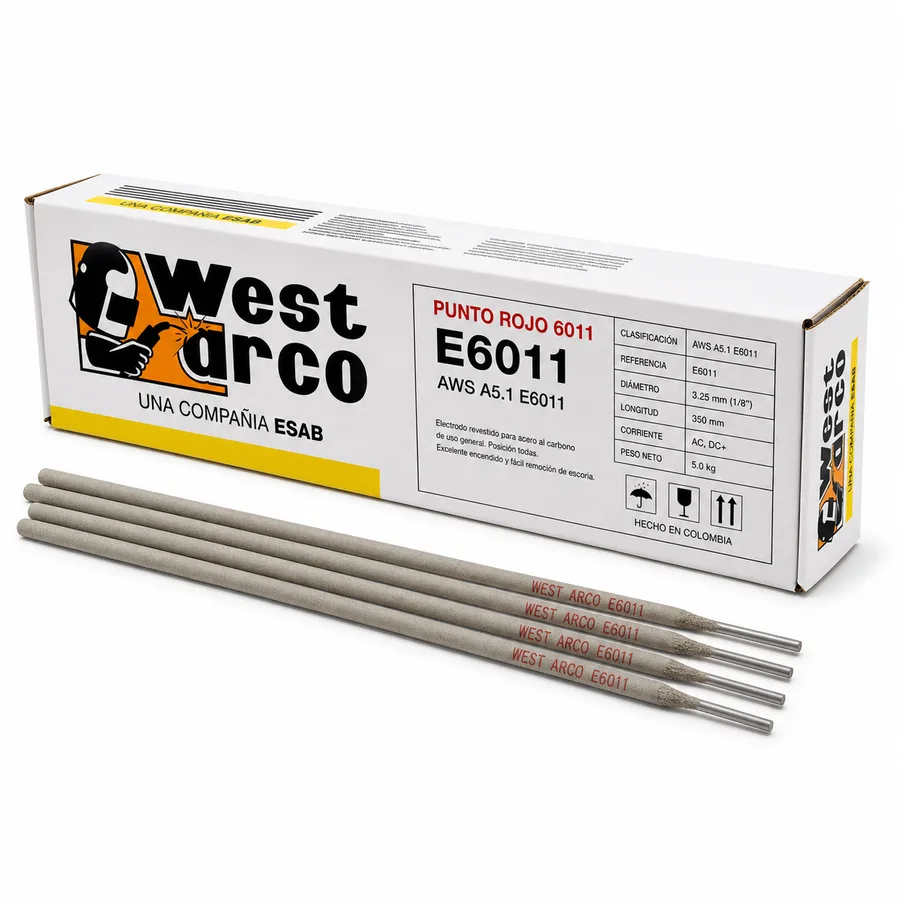 electrodo e6011 acero carbono west arco
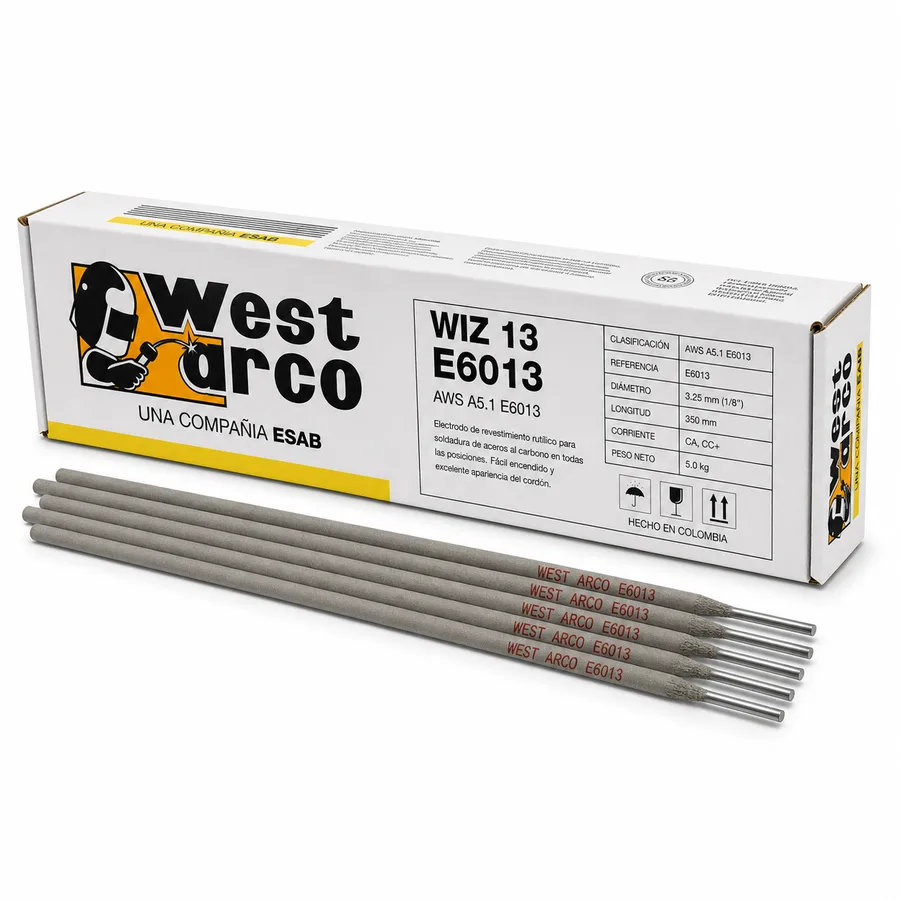 electrodo e6013 acero carbono west arco
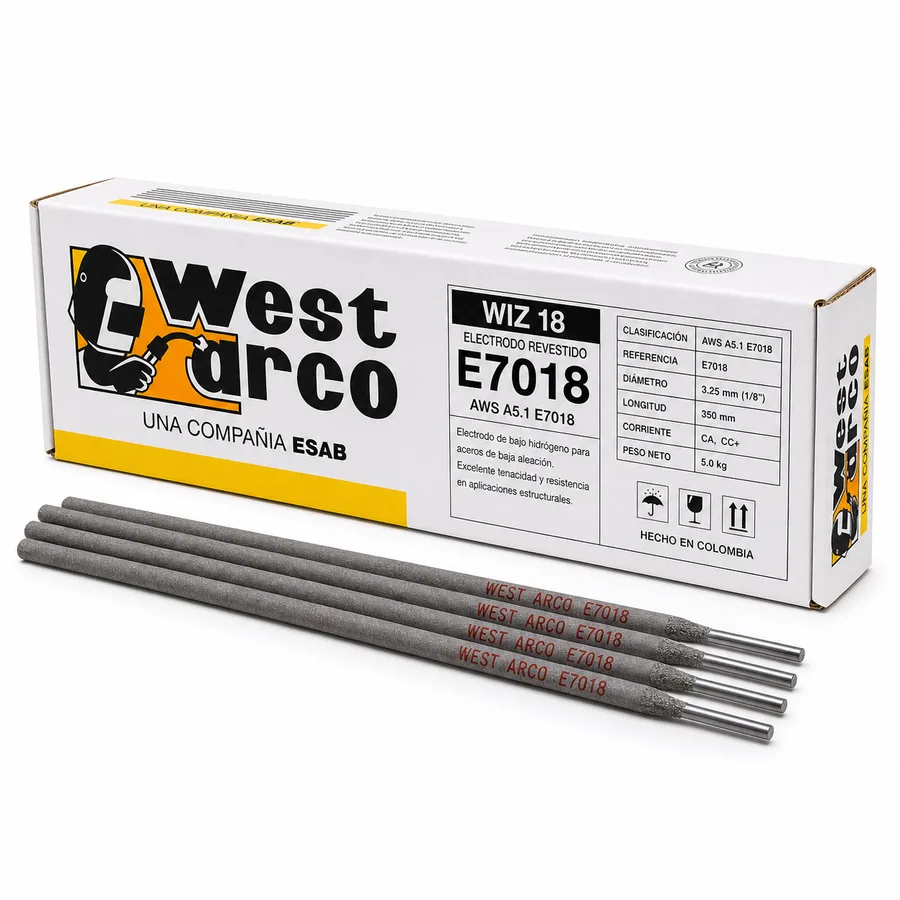 electrodo e7018 estructural west arco