A ball bearing places steel balls between two rings with ground raceways to replace sliding friction with rolling motion. Under that definition live four families with distinct behavior: deep groove ball bearings (the most widely used in industry), angular contact, self-aligning and thrust bearings. TECTUL stocks the deep groove 6000, 6200 and 6300 series, the double row self-aligning ball bearing and the special dimension series 6100/6400/6700/6800/6900.
Verdict: for predominantly radial load at high speed use a deep groove ball bearing, and pick the series — 6000, 6200 or 6300 — by required capacity and housing space; for combined radial plus axial load use angular contact, with a 15°, 25° or 40° angle depending on how heavy the thrust is; for shafts that deflect or housings that end up misaligned use a self-aligning bearing; for pure axial load at low speed use a thrust ball bearing. No single type covers all four scenarios well: buying “the one that fits the shaft” is the most common cause of premature replacement.
Radial load acts perpendicular to the shaft (the weight of a pulley, the tension of a belt); axial load pushes along the shaft (a propeller, a worm screw, the hydraulic thrust of an impeller). Each ball bearing type solves one combination: the deep groove type carries high radial and moderate axial load in both directions; the angular contact type is designed for combined load; the self-aligning type prioritizes misalignment tolerance with moderate radial load; the thrust ball bearing only accepts thrust and must not carry radial load.
References are compared with two catalog values: the dynamic load rating C, which feeds the basic rating life L10 = (C/P)³ in millions of revolutions for ball bearings per ISO 281:2007, and the static load rating C0 per ISO 76:2006, which governs when the bearing rotates very slowly or is loaded at rest. P is the equivalent dynamic load, combining the radial and axial components at the support point.
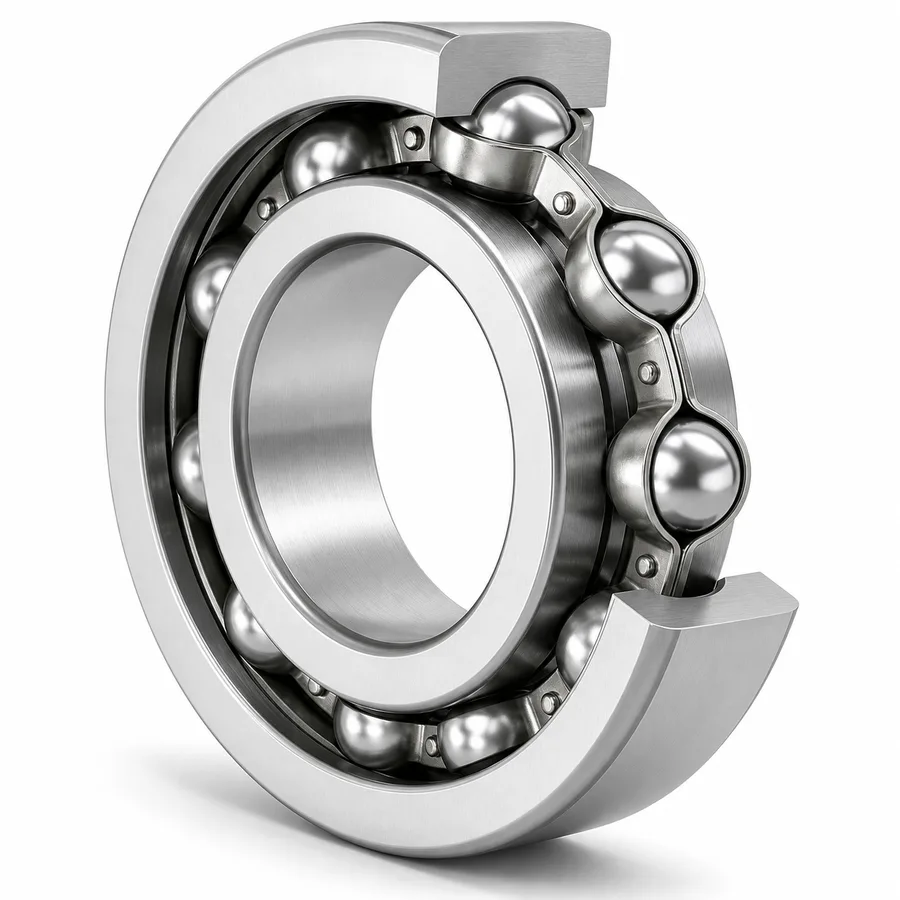
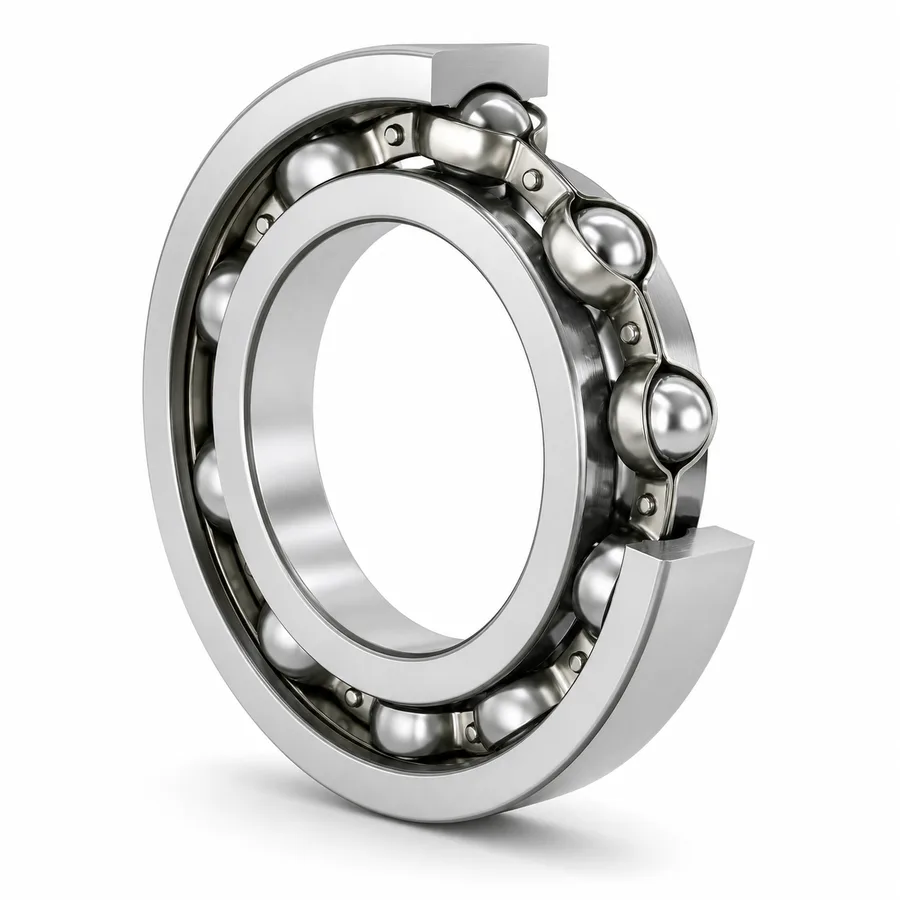
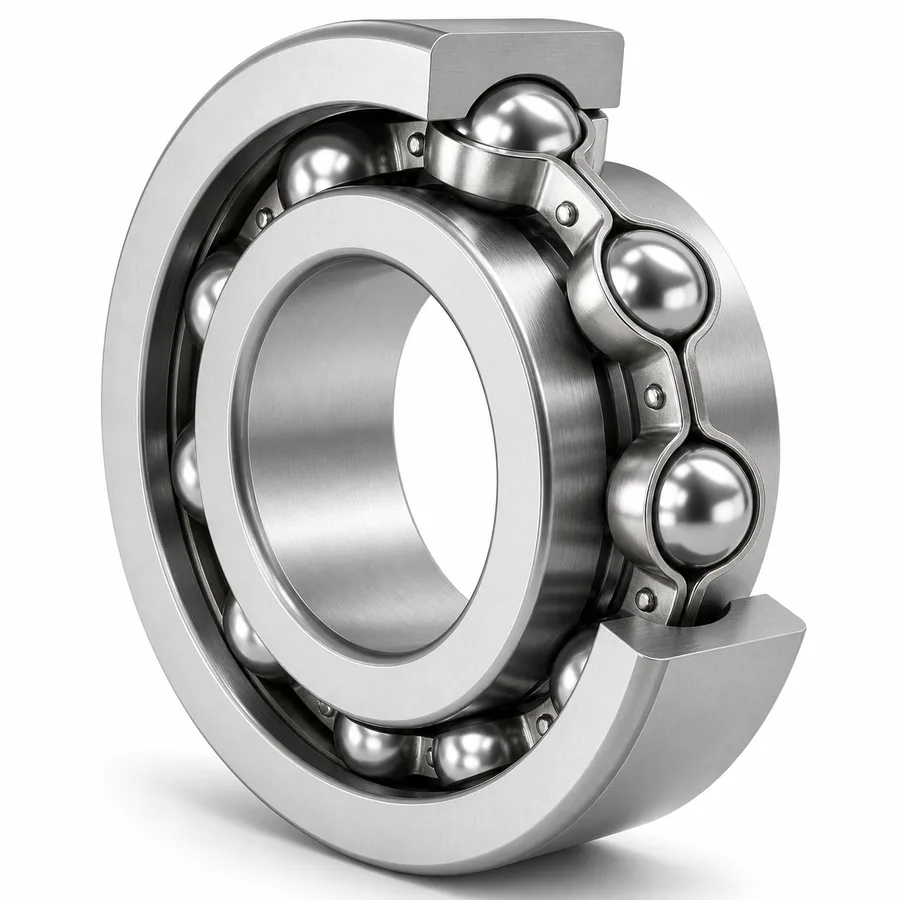
The three series share the same design — a single row of balls and deep raceways — and differ in the dimension series defined in ISO 15:2017: for the same bore, the 6200 series uses a larger outside diameter and width than the 6000, and the 6300 more than the 6200. A larger section allows bigger balls: load capacity rises and limiting speed drops. The bore stays the same, but the housing does not: the three series are not interchangeable without machining the housing.
| Reference (20 mm bore) | Dimensions d×D×B | Dynamic rating C (SKF catalog) | Use profile |
|---|---|---|---|
| 6004 | 20×42×12 mm (0.79×1.65×0.47 in) | ≈9.95 kN | Tight space and high speed |
| 6204 | 20×47×14 mm (0.79×1.85×0.55 in) | ≈13.5 kN | General use in motors and transmission |
| 6304 | 20×52×15 mm (0.79×2.05×0.59 in) | ≈15.9 kN | Higher radial load on the same shaft |
The practical rule: choose the 6000 series when radial space is limited or speed governs; the 6200 series is the standard for electric motors, pumps and fans; the 6300 series is used when more capacity is needed without changing the shaft diameter. Beyond these three, the special series group the thin 6800 and 6900 sections for minimum space and the larger-section 6400 for high load. To read the full reference — the ×5 bore rule, the K suffix, worked examples 6204 and 6305 — see the guide How to identify a bearing by its reference.
In an angular contact ball bearing, the contact line between balls and raceways forms an angle with the radial plane. That angle converts part of the capacity into axial capacity: the larger the angle, the more thrust it carries and the less speed it admits. The standardized catalog angles are 15° for high speed with light thrust, 25° as the intermediate point and 40° for heavy thrust; in common catalog nomenclature, suffix C indicates 15°, AC indicates 25° and B indicates 40°, with variants by manufacturer.
A single row angular contact bearing carries thrust in one direction only and must be mounted adjusted against another bearing that takes the reaction. That is why it is installed in pairs: back-to-back (DB), which provides rigidity against tilting moments; face-to-face (DF), which tolerates slightly more misalignment; and tandem (DT), which adds axial capacity in the same direction. The typical single row series are 7200 and 7300, following the same ISO 15 dimensional logic as their deep groove equivalents. TECTUL supplies them on request in the required arrangement.
The self-aligning bearing has two rows of balls and a spherical outer raceway: the shaft and inner ring assembly can tilt without straining the balls. Manufacturer catalogs allow misalignments of 1.5° to 3° depending on the series, against the 2 to 10 minutes of arc a deep groove ball bearing tolerates. It is the choice for long shafts that deflect under load, welded housings without precision machining and equipment where fine alignment is not feasible.
Its limit is axial load: the spherical raceway geometry gives little support to thrust, so it is applied with predominantly radial load. The 1200 and 2200 series are offered with a cylindrical or tapered bore (K suffix) for adapter sleeve mounting on plain shafts. The TECTUL data sheet for the 1200/2200 series self-aligning ball bearing covers bores from 35 to 65 mm (1.38 to 2.56 in).
The thrust ball bearing consists of a shaft washer, a housing washer and a ball and cage assembly between them. It carries axial load only: series 511, 512, 513 and 514 in one direction, and series 522, 523 and 524 in both directions, with boundary dimensions standardized in ISO 104:2015. It must not carry radial load and requires perpendicularity between the washers and the shaft.
Two service conditions define it: it requires a permanent minimum axial load so the balls roll without sliding — a critical condition as speed increases — and its limiting speed is lower than that of a radial bearing of the same size because of the centrifugal effect on the balls. Typical applications: turntables, crane hooks, steering columns and low speed vertical spindles.
Three suffixes concentrate most purchasing decisions on ball bearings: 2Z, two non-contact metal shields, for clean environments and low friction; 2RS, two contact rubber seals, for dust and moisture; and C3, radial internal clearance greater than normal, for interference fits or equipment that runs hot. The suffix must be respected on replacement: an open 6204, a 6204-2Z and a 6204-2RS share dimensions but not service behavior. The full reading of prefixes and suffixes, with worked examples, is in the guide on identifying bearings by their reference.
| Type | Radial load | Axial load | Permissible misalignment | Relative speed | Typical application |
|---|---|---|---|---|---|
| Deep groove | High | Moderate, both directions | 2 to 10 minutes of arc | The highest | Electric motors, fans, pumps |
| Angular contact | High | High in one direction; in pairs, both | Minimal, requires aligned mounting | High | Spindles, centrifugal pumps, gearboxes |
| Self-aligning | Moderate | Low | 1.5° to 3° | High | Long shafts, agricultural equipment, conveyors |
| Thrust ball | None | High, one or two directions | Requires perpendicularity | Low | Turntables, crane hooks, vertical spindles |
For replacement in general machinery, the short route is this: radial load with a standard housing, 6200 series; tight space or high speed, 6000 series; more load on the same shaft, 6300 series; visible misalignment or a long shaft, 1200/2200 self-aligning; pure thrust at low speed, thrust ball bearing. Give TECTUL the complete reference with suffixes — or the d×D×B dimensions if it is unreadable — together with load, rpm, temperature and contamination level at the point: with that data the correct series, seal and clearance are confirmed before dispatch to any city in Colombia.
 rodamiento rigido de bolas serie 6200
 rodamiento rigido de bolas serie 6000
 rodamiento rigido de bolas serie 6300