Roller bearings replace balls with cylindrical, tapered, needle-shaped or barrel-shaped rolling elements. By changing the ball's point contact into line contact, the load spreads over more surface and capacity grows substantially without increasing size. That is why they dominate in gearboxes, rolling mills, vibrating screens, industrial wheels and any support where the load exceeds what a ball bearing can carry. TECTUL quotes by reference NU/NJ/NUP cylindrical roller bearings, 30xxx metric tapered roller bearings, NA/NK/HK needle roller bearings and 22200 series spherical roller bearings.
Verdict: for pure radial load and high stiffness with well-aligned shafts, use NU/NJ/NUP cylindrical bearings; for combined radial and axial load with adjustable preload, 30xxx tapered bearings mounted in pairs; when radial space is minimal, NA/NK/HK needle bearings; where there is misalignment or severe vibration, 22xxx/23xxx spherical roller bearings; and for heavy axial load on vertical shafts, 292xx/294xx spherical roller thrust bearings. If your load is light and speed is high, start with the ball bearing guide.
The roller's advantage is geometric: line contact distributes pressure over a strip instead of a point. Comparing references with the same bore and dimensional series in manufacturer catalogues, the dynamic load rating of a roller bearing typically sits between 1.5 and 3 times that of the equivalent ball bearing, depending on type and series. In addition, rating life is calculated with a 10/3 exponent for roller bearings versus 3 for ball bearings (ISO 281), so with a favourable capacity-to-load ratio the calculated life grows faster.
The cost of that capacity: higher friction and lower limiting speed than a ball bearing of the same size, more sensitivity to misalignment (except for spherical types) and, in most radial types, little or no axial capacity. For light load and high speed — small motors, fans, minor pumps — the ball bearing remains the first choice; this guide covers the rest of the cases.
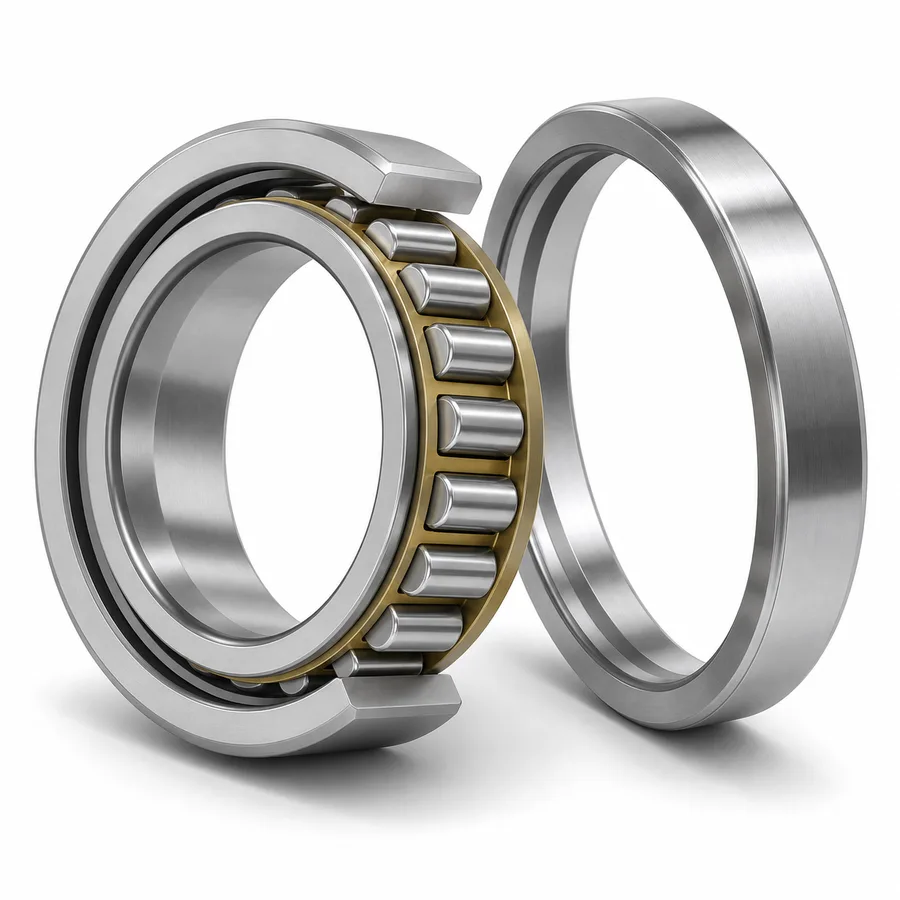
In a cylindrical roller bearing the leading letters are not cosmetic: they describe where the flanges that guide the rollers are located and, with that, whether the bearing can locate the shaft axially. The basic configurations under ISO 15 are NU, N, NJ and NUP; the HJ angle ring turns an NJ into a support located in both directions.
| Type | Outer ring flanges | Inner ring flanges | Axial location of the shaft |
|---|---|---|---|
| NU | Two | None | Non-locating; free support that allows axial shaft expansion |
| N | None | Two | Non-locating; free support, displacement on the outer raceway |
| NJ | Two | One | Locates in one direction; accepts light axial load in that direction |
| NUP | Two | One fixed plus a loose thrust washer | Locates in both directions; light axial load in both |
| NJ + HJ | Two | One plus HJ angle ring | Locates in both directions |
Two usage rules. First: the axial load an NJ or NUP accepts is light and intermittent, because it passes through sliding contact between the roller end and the flange, not through rolling; the dominant load must always be radial. Second: cylindrical bearings demand careful alignment — permissible catalogue misalignment is on the order of 2 to 4 minutes of arc; if the shaft deflects or the housings are not aligned, move to a spherical type. The TECTUL series page covers bores from 17 to 220 mm in brands such as SKF, FAG and NSK, with references like NJ312 ECP or NU2313 ECP; the E suffix marks a reinforced internal design with higher capacity.
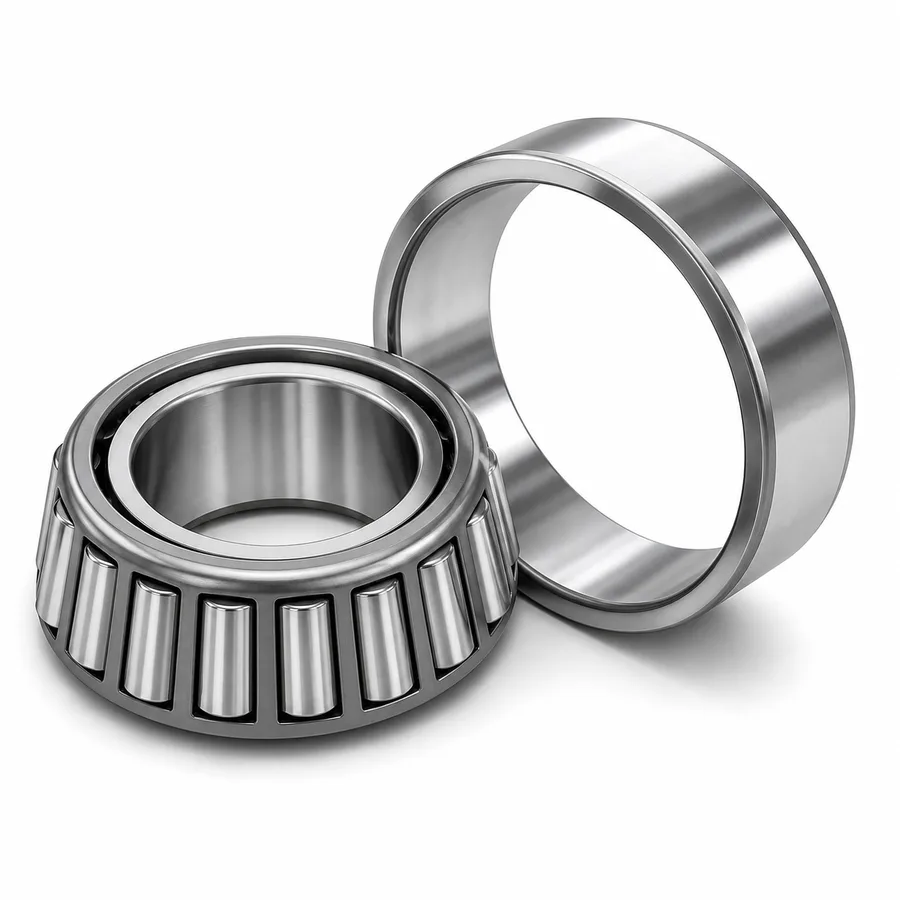
The tapered roller bearing works with tapered rollers and raceways whose generating lines converge at a point on the shaft axis: by geometry it supports combined radial and axial load in a single support. It is separable: the cone (inner ring, rollers and cage) and the cup (outer ring) mount independently. The metric series under ISO 355 — 302xx, 303xx, 313xx, 320xx, 322xx, 323xx — differ in section and contact angle: the steeper the angle, as in the 313xx series, the higher the admissible proportion of axial load.
A single tapered bearing locates the shaft in only one direction, so it is mounted in opposed pairs. In X (face-to-face) mounting the pressure lines converge toward the shaft: the effective distance between supports is reduced, the arrangement tolerates small alignment errors somewhat better and adjustment is usually made on the outer rings with a cover. In O (back-to-back) mounting the pressure lines diverge: the effective support base is wider and stiffness against tilting moments is higher, which is why it is the typical arrangement for pinions, spindles and wheels.
In a paired arrangement the axial clearance is not factory-set: it is established during tightening. You can leave residual clearance or apply preload (negative clearance) to increase stiffness and running precision. Preload is set following the manufacturer's method — nut tightening torque, measured displacement or rotational torque of the assembly — and verified through temperature after start-up: a tapered support that heats up steadily is suspect for excessive preload or insufficient lubrication.
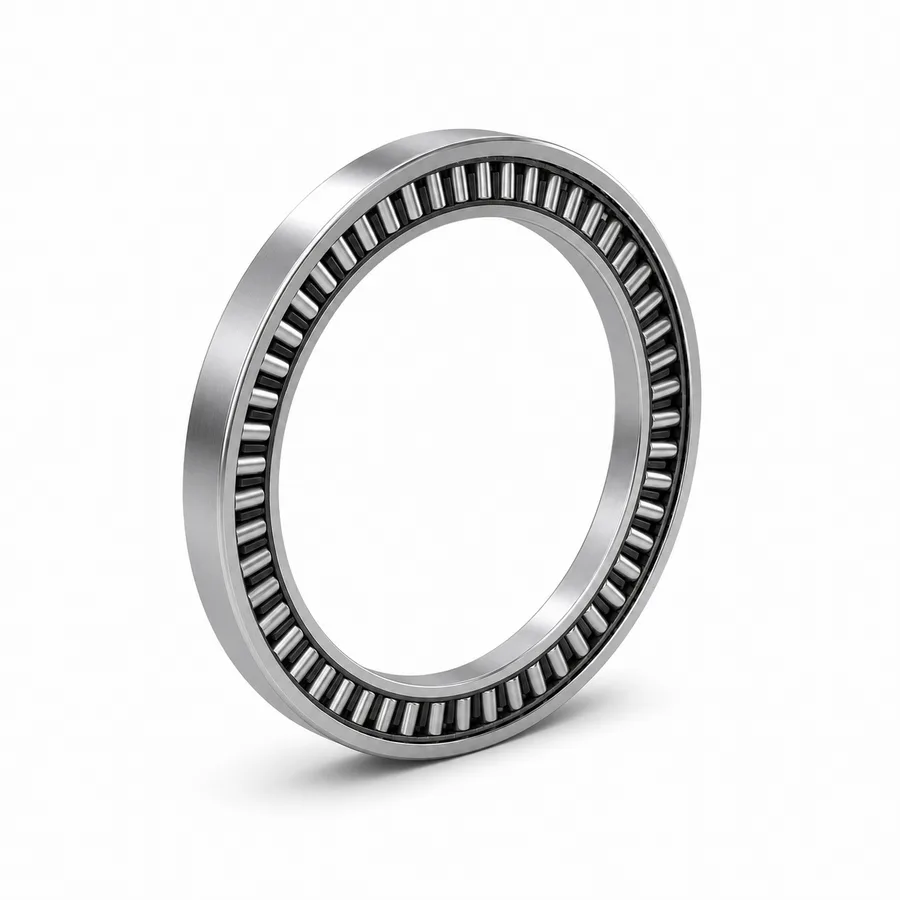
The needle roller bearing uses rollers of small diameter with a length of at least 2.5 times their diameter (ISO 5593 vocabulary). The result is the highest possible radial capacity per millimetre of section: it is the correct type when the available radial space is measured in a few millimetres, as in transmissions, connecting rods, idler pulleys, linkages and oscillating mechanisms.
The three families solve different spaces. NA carries a machined inner ring and works as a complete bearing. NK omits the inner ring and rolls directly on the shaft, which saves section but requires a hardened and ground shaft: as catalogue guidance, hardness of 58 to 64 HRC and roughness Ra of 0.2 µm or better, because the shaft becomes the raceway. HK is the open-end drawn cup with minimum section and press-fit mounting (BK is the closed-end version). None of the three accepts axial load or appreciable misalignment.
The spherical roller bearing mounts two rows of barrel-shaped rollers on a common spherical outer raceway: the inner ring can tilt relative to the outer ring without damaging the contact. It accepts misalignment on the order of 1° to 2.5° depending on series and load condition — catalogue values — versus minutes of arc for cylindrical and tapered types. It is the bearing to buy when the shaft deflects, the supports do not end up perfectly aligned or the equipment vibrates.
The series are read by section: 222xx is the general-purpose series; 223xx has a more robust section for heavy load and severe vibration; 230xx, 231xx, 232xx and 239xx cover width and section combinations for large bores. For vibrating screens and vibratory machinery, manufacturers offer specific executions — such as VA405 at SKF or T41A/T41D at FAG — with internal clearance, cage and tolerances prepared for high accelerations: for vibratory service do not buy the standard execution. The K suffix (tapered bore) with an adapter sleeve makes mounting and dismounting on long shafts easier, a frequent combination in plummer blocks.
When the dominant load is axial, radial types do not work and thrust bearings take over. The cylindrical roller thrust bearing (811xx and 812xx series) supports very high axial loads at low speed, but accepts no radial load or misalignment. The 292xx/294xx spherical roller thrust bearing is more versatile: with barrel rollers and an inclined contact, in addition to thrust it accepts a limited simultaneous radial load — the SKF catalogue rule caps it at 0.55 times the acting axial load — and self-aligns like its radial counterpart. It is the bearing for vertical shafts, extruders, presses and cranes; the TECTUL page covers bores from 70 to 170 mm in the 292, 293 and 294 series.
| Typical application | Determining condition | Recommended type |
|---|---|---|
| Gearboxes, pinions, industrial wheels | Combined radial and axial load; stiffness with adjustable preload | 30xxx tapered in pairs: O for tilting stiffness, X for cover adjustment |
| Rolling mills, gear cases, free side of long shafts | High pure radial load; misalignment under 4 minutes of arc | Cylindrical NU on the free side; NJ or NUP if it must locate |
| Compact transmissions, connecting rods, pulleys, linkages | Available radial section of a few millimetres | Needle HK, NK or NA depending on the available inner ring |
| Vibrating screens, mills, heavy fans, plummer blocks | Misalignment above 0.5° or severe vibration | Spherical 22xxx/23xxx; on screens, the manufacturer's vibratory execution |
| Vertical shafts, extruders, presses, cranes | Dominant axial load with limited radial component | Spherical roller thrust 292xx/294xx |
| Light load and high speed | Priority on low friction and rpm | Ball bearing: see the companion guide |
The table solves preselection by type; the final reference depends on bore, dimensional series, internal clearance and suffixes, which are validated against the catalogue before buying.
Buy by complete reference including suffixes: in roller bearings, letters such as E, ECP, K, C3, C4 or J2 change internal design, cage, bore form and clearance, and are not interchangeable without validation. If the marking is worn, measure bore, outside diameter and width and apply the method in how to identify a bearing by its reference. When quoting with TECTUL, state the application, rpm, temperature, load direction and whether the support is locating or non-locating: with that data the correct type, series, clearance and execution are defined, and availability is validated by brand according to each series page.