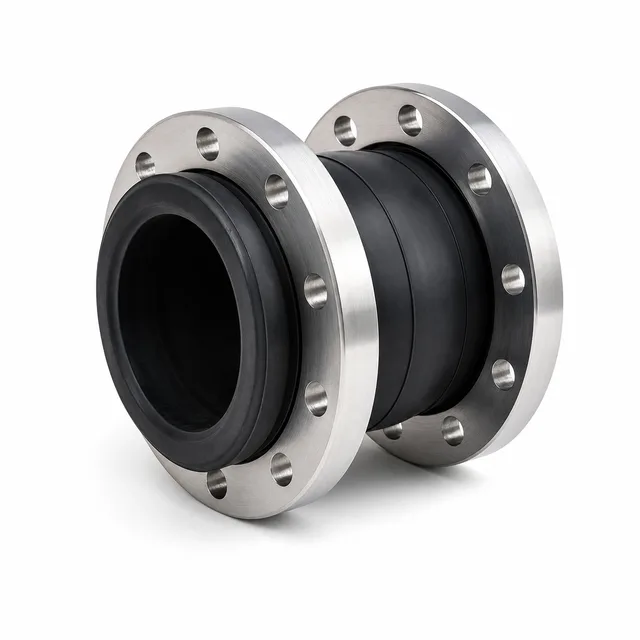
To isolate vibration from pumps, compressors and chillers, use a rubber vibration-absorbing joint installed at the suction and discharge of the equipment. To compensate thermal expansion in a line, use an expansion joint: a rubber arch joint if the service temperature does not exceed 150 °C (300 °F), the limit of the EPDM construction per Garlock's technical manual (the standard chlorobutyl construction is rated to 120 °C), and a stainless steel metal bellows above that temperature or when the fluid is steam, condensate or hot gas.
This guide summarizes the types of expansion and vibration-absorbing joints according to the EJMA (Expansion Joint Manufacturers Association) standards and ASME B31.3, compares rubber against metal bellows with numerical thresholds, works through a thermal expansion calculation example and explains the two installation rules that prevent the most failures: anchors and guides.
An expansion joint is a flexible element installed between two pipe sections to absorb movements that rigid piping cannot take without overstress. The EJMA standards define three basic movements:
Torsion (rotation about the joint's own axis) is not an allowable movement: EJMA states it must be avoided because it generates shear stresses the bellows is not designed to resist. When several movements occur together, the EJMA rule is to express each one as a fraction of its rated capacity and verify that the sum of fractions does not exceed 1.0.
The spool-type rubber joint consists of an elastomer tube, embedded textile or metal reinforcement, an outer cover and integral full-face flanges drilled to match the mating flange, usually ASME B16.5 Class 150. The central arch is what provides the flexibility.
| Elastomer | Typical service | Temperature (manufacturer's materials guide) |
|---|---|---|
| EPDM | Water, hot water, air, dilute chemical solutions | Up to 150 °C (300 °F) |
| NBR (nitrile) | Oils, fuels and hydrocarbons | Compound-dependent: take it from the manufacturer's data sheet |
| Neoprene (CR) | General service with moderate oils, refrigerants, outdoor exposure | Compound-dependent: take it from the manufacturer's data sheet |
As a catalog-traceable pressure reference: the Garlock Style 204 arch joint is rated up to 165 psi (11.4 bar) and the 204HP version up to 200 psi (13.8 bar); the rating decreases as diameter and temperature increase, so the working pressure for each size is taken from the manufacturer's table.
The metal joint uses a multi-convolution bellows formed in austenitic stainless steel (AISI 304, 321 or 316L), with flanged or butt-weld ends. Its design —thickness, number of plies, number of convolutions, allowable pressure and cycle life— is calculated per the EJMA standards, and its temperature limit is set by the bellows alloy, far above the reach of any elastomer.
The life of a metal bellows is not expressed in years but in fatigue cycles: EJMA establishes the method to calculate it from the movement amplitude per convolution, and the manufacturer certifies it for each design. Reducing the movement per cycle —for example, by splitting it between two joints— multiplies the expected life.
The vibration-absorbing joint is a rubber joint —spherical or short-arch— whose purpose is to cut the transmission of vibration and structure-borne noise from pumps, compressors and chillers into the piping, while tolerating small assembly misalignments. It is installed directly at the suction and discharge flanges of the equipment. TECTUL offers it flanged: see the vibration-absorbing joint product page.
The thermal expansion joint, on the other hand, is sized from a calculation: first the expansion ΔL of the run is determined, then a joint whose rated axial capacity covers it is selected. Using a short vibration-absorbing joint to absorb the expansion of a long line forces it to work beyond its rated travel and shortens its life.
| Criterion | Rubber joint | Metal bellows joint |
|---|---|---|
| Maximum temperature | 150 °C (300 °F) with EPDM (120 °C for standard chlorobutyl) | Set by the bellows alloy; covers steam and hot gases far above 150 °C |
| Typical pressure | Up to 165–200 psi (11.4–13.8 bar) in arch styles, per catalog; drops with diameter and temperature | Per EJMA design: from vacuum up to ASME Classes 150, 300 and higher |
| Movements | Axial, lateral and angular combined within short lengths | Axial, lateral or angular depending on configuration (single, universal, hinged, gimbal) |
| Vibration and noise isolation | Yes: the elastomer interrupts structure-borne transmission | Limited: metal transmits vibration |
| Chemical resistance | Depends on the elastomer (EPDM, NBR, neoprene) | Depends on the alloy (304, 321, 316L) |
| End of life | Elastomer ageing; requires periodic visual inspection | Bellows fatigue; life calculated in cycles per EJMA |
The expansion of a straight run is calculated with the formula ΔL = α · L · ΔT, where α is the linear thermal expansion coefficient, L the run length and ΔT the difference between operating and installation temperature. For carbon steel, the mean value tabulated in ASME B31.3 Appendix C for the moderate temperature range is α ≈ 11.7 × 10⁻⁶ /°C (6.5 × 10⁻⁶ /°F).
If lateral misalignment is also present, apply the EJMA combined-movement rule: (axial used / axial rated) + (lateral used / lateral rated) ≤ 1.0.
The most frequent cause of premature expansion joint failure is not the product but the layout. An untied joint turns internal pressure into a thrust that tends to pull the pipe apart; that thrust equals the gauge pressure multiplied by the effective area of the bellows and must be resisted by anchors. Minimum rules per EJMA:
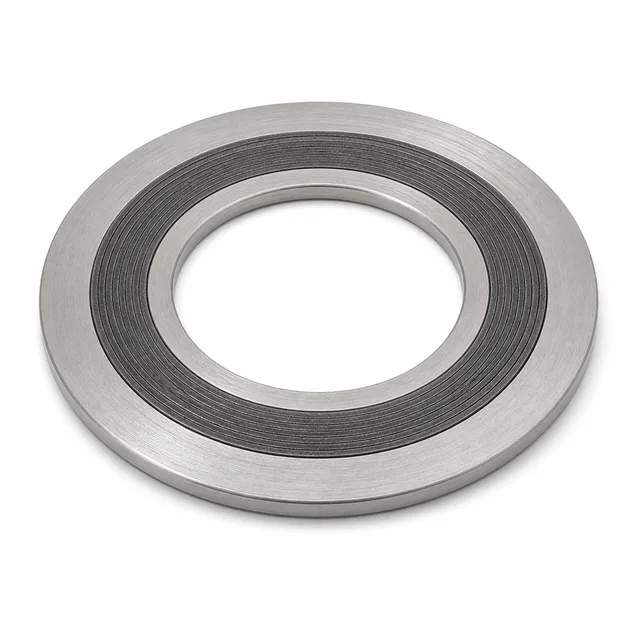
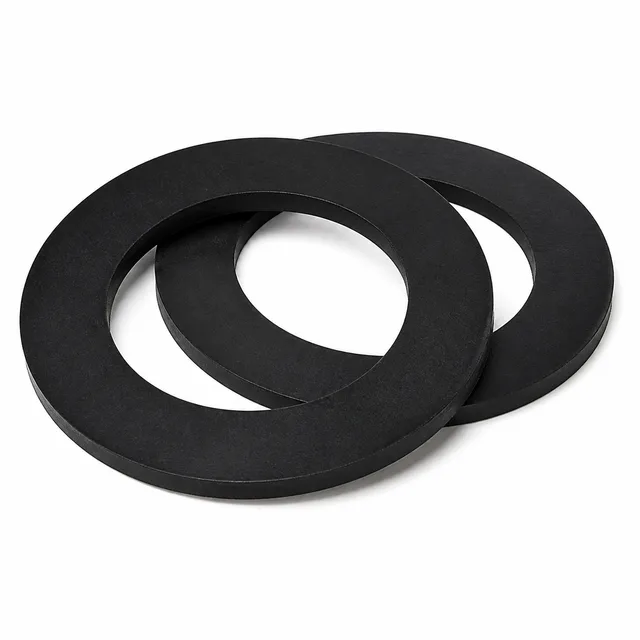
To request a quotation, define six data points: nominal diameter, fluid, working gauge pressure, operating temperature, required movement in mm (calculated with ΔL = α · L · ΔT) and connection type (flanged ASME B16.5 Class 150 or weld ends). TECTUL supplies the flanged vibration-absorbing joint together with the connection and sealing package: certified Class 150 spiral wound gaskets, neoprene gaskets, Class 150 carbon steel weld neck flanges and flange stud bolts. Write to us on WhatsApp with the six data points and we will reply with availability and price.