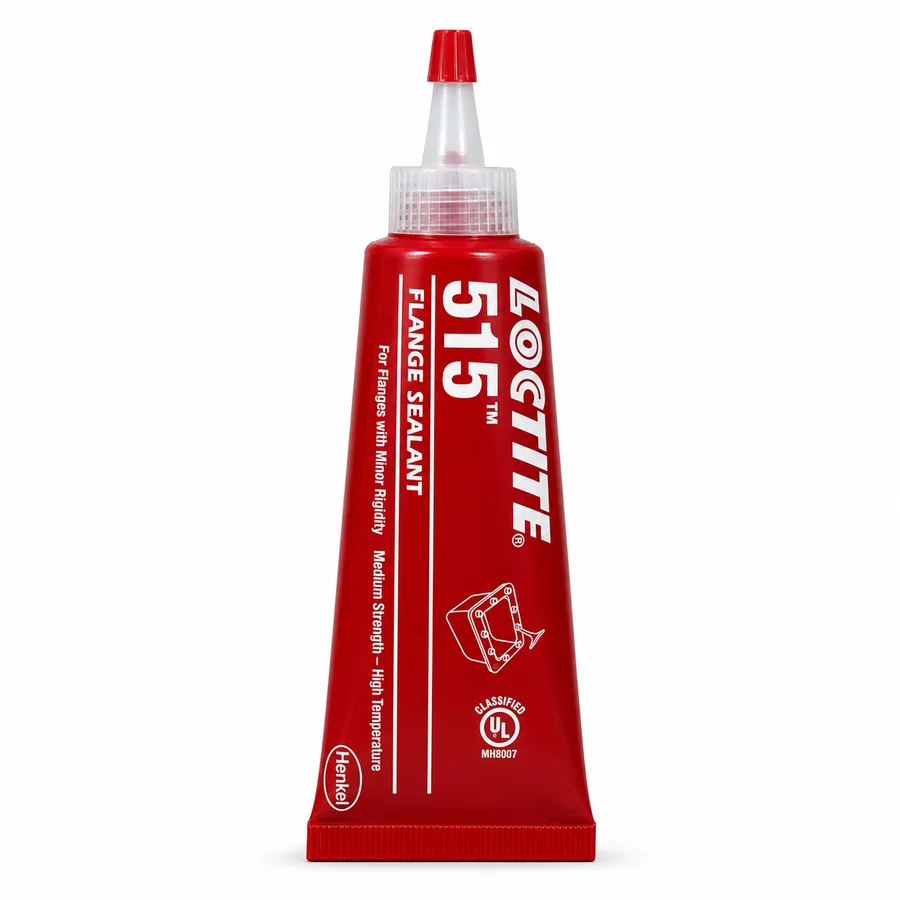
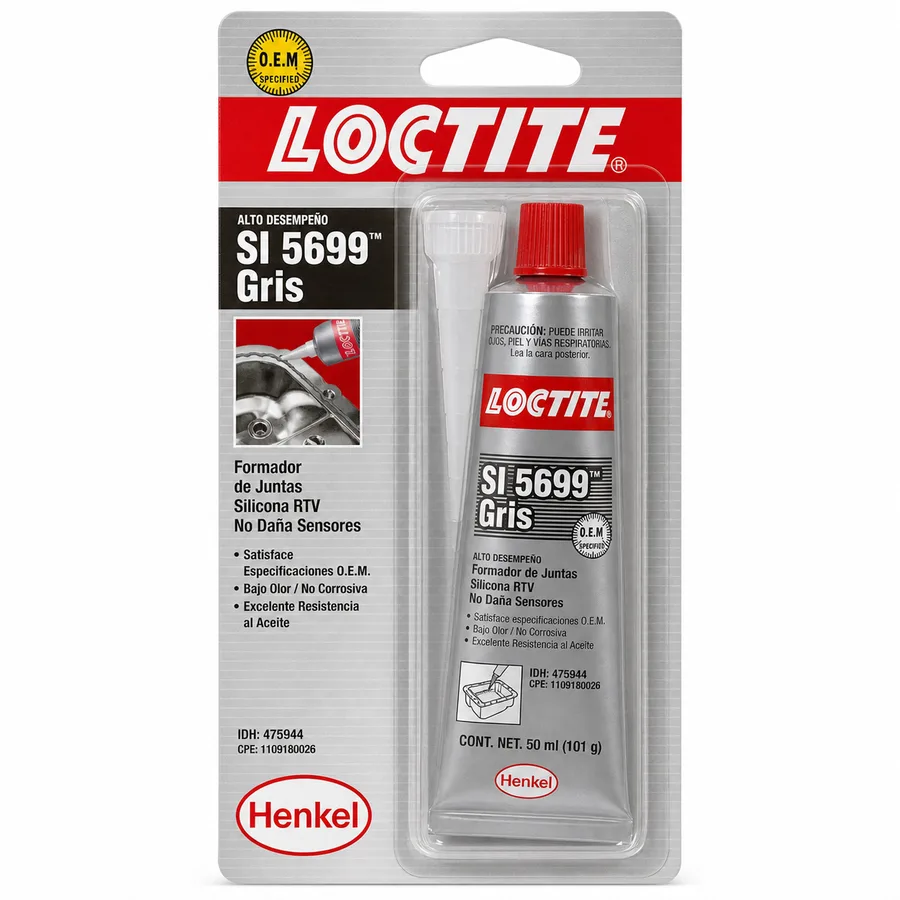
Loctite® 515 is an anaerobic methacrylate flange sealant for sealing rigid, machined metal flanges. It cures when confined without air between two close-fitting metal faces, forms the gasket in place and replaces the pre-cut gasket. It fills gaps up to 0.25 mm (0.01 in), fixtures in about 30 minutes and withstands a service temperature of -55 to +150 °C. It is medium strength, so flanges can later be separated with hand tools.
Quick verdict: for rigid, machined metal flanges with a small gap (≤0.25 mm) —pumps, compressors, transmission housings, axle covers— use Loctite® 515. For flanges that flex, with a larger gap or service up to 200 °C, use an RTV silicone such as Loctite® 5699 grey. This guide explains what it is, how to apply it step by step and when to choose 515 over a solid gasket or a silicone.
Loctite® 515 is a flange sealant of acrylic technology, chemically a single-component methacrylate ester that needs no mixing. Its cure is anaerobic: it hardens when confined, in the absence of air, between two close-fitting metal surfaces. While exposed to air it stays liquid; on tightening the flange, the product trapped between the faces polymerises and forms a solid, made-to-fit gasket.
The uncured material is an opaque dark-purple paste, fluorescent under UV light, which allows visual inspection of the applied bead. Its function is to seal close-fitting joints between rigid metal faces and flanges, flexing with minor flange movement. Typical applications stated by the manufacturer: pumps, thermostats, compressors, transmission housings and axle covers. It replaces the pre-cut cork, paper or fibre gasket, removing the relaxation and re-torque problems those materials suffer.
Values taken from the official Henkel Technical Data Sheet for LOCTITE® 515™:
| Property | Value | Standard / condition |
|---|---|---|
| Chemistry | Methacrylate ester (acrylic) | 1 component |
| Cure | Anaerobic | Confined without air between metals |
| Appearance (uncured) | Opaque dark purple, UV fluorescent | — |
| Specific gravity at 25 °C | 1.1 | — |
| Viscosity (Brookfield HBT, 25 °C) | 700,000–1,700,000 mPa·s (0.5 rpm) | Spindle TB, Helipath |
| Maximum gap fill | 0.25 mm (0.01 in) | Close-fitting flanges |
| Fixture time | ≈ 30 min on steel | Henkel data |
| Lap shear strength | 6.0 N/mm² (870 psi) | ISO 4587, grit-blasted steel, 24 h/22 °C |
| Compressive shear strength | 5.0 N/mm² (725 psi) | ISO 10123, steel pins and collars |
| Tensile strength | 14 N/mm² (2,030 psi) | ISO 6922, grit-blasted steel |
| Service temperature | -55 to +150 °C | Cold strength tested to -75 °C |
It is a medium-strength sealant: it seals firmly but allows the flange to be disassembled with standard hand tools, the cured residue then being removed mechanically or with cleaner. It is classified by Underwriters Laboratories (MH8007; ignition temperature 467 °C) and holds a regional Australian Gas Association approval (certificate 2590, class II).
The sequence recommended by Henkel for best sealing is:
Cure speed depends on the substrate. On carbon steel the cure is fast; on inactive or passivated metals (stainless steel, anodised aluminium, plated surfaces) or when the gap approaches the maximum, the cure slows down. In those cases Henkel recommends applying an activator SF 7471™ or SF 7649™ to the surface to speed polymerisation without losing final strength.
There is no universal sealant. The choice depends on flange rigidity, gap, temperature and how disassembly will be done:
| Criterion | Loctite® 515 (anaerobic) | Pre-cut solid gasket | RTV silicone (e.g. 5699) |
|---|---|---|---|
| Working gap | ≤ 0.25 mm | 0.5–3 mm (by thickness) | Up to several mm |
| Joint rigidity | Rigid flanges, minimal movement | Compressible, relaxes | Elastic, absorbs flex |
| Temperature | -55 to +150 °C | By material | Up to 200 °C (5699) |
| Cure / return to service | Anaerobic, fixtures ≈30 min | Immediate (mechanical) | Moisture, ≈24 h full |
| Disassembly | Hand tools + cleaning | Sheet is replaced | Cut / peeled off |
| Re-torque risk | None: does not relax | High: needs re-torque | Low |
A pre-cut solid gasket makes sense when the design gap is large or the joint is separated and reassembled frequently. RTV silicone is the choice when the flange flexes, the faces are not precisely machined, the gap exceeds 0.25 mm or service goes above 150 °C. Loctite® 515 wins when the faces are metallic, rigid, flat and machined, with a minimal gap between them.
Loctite® 515 is formulated for metals: carbon steel, cast iron, aluminium, brass and their combinations are common substrates. After cure it resists motor oils and water/glycol mixtures; against gasoline the TDS reports a severe strength loss (15-20 % of initial after 500-1,000 h at 22 °C), and with DEF (AdBlue®) fluid retention is partial (≈60 %). It is not recommended for pure oxygen or oxygen-rich systems, nor as a sealant for chlorine or other strong oxidisers. It is also not advised on plastics —especially thermoplastics where it may cause stress cracking—; on those materials confirm compatibility before use.
Fixture time on steel is about 30 minutes, though it depends on the substrate, the gap and the ambient temperature. Full strength develops over the following hours; the Henkel Technical Data Sheet reports shear strength measured after 24 h at 22 °C. On inactive metals the cure is slower and an activator SF 7471™ or SF 7649™ should be used.
Loctite® 515 fills gaps up to 0.25 mm (0.01 in) between close-fitting flanges. If the gap between faces exceeds that value, the product will not cure or seal reliably and an RTV silicone or a solid gasket should be used instead.
Yes. Being medium strength, the flange separates with standard hand tools; the cured residue is then removed mechanically or with cleaner. It needs no heat or impact tools like high-strength anaerobic adhesives.
It works on metals: steel, cast iron, aluminium and brass. It is not recommended on plastics (stress-cracking risk in thermoplastics) nor in pure-oxygen systems or with strong oxidisers such as chlorine.
Choose Loctite® 515 for rigid, machined metal flanges with a small gap (≤0.25 mm): pumps, compressors, gearboxes and transmission housings, thermostats and axle covers. It seals in place, removes the pre-cut gasket and eliminates re-torque because it does not relax. If the flange flexes, the gap is larger or service exceeds 150 °C, move to the Loctite® 5699 grey silicone, which cures by moisture, keeps elasticity and resists up to 200 °C.
At TECTUL, Loctite® 515 is offered in a 50 ml pack, in stock and shipped throughout Colombia. It is genuine Loctite® (Henkel) product with a downloadable official Technical Data Sheet (TDS). For volume orders or the complementary RTV silicone reference, request a quote with itemised VAT. Updated 14 July 2026.