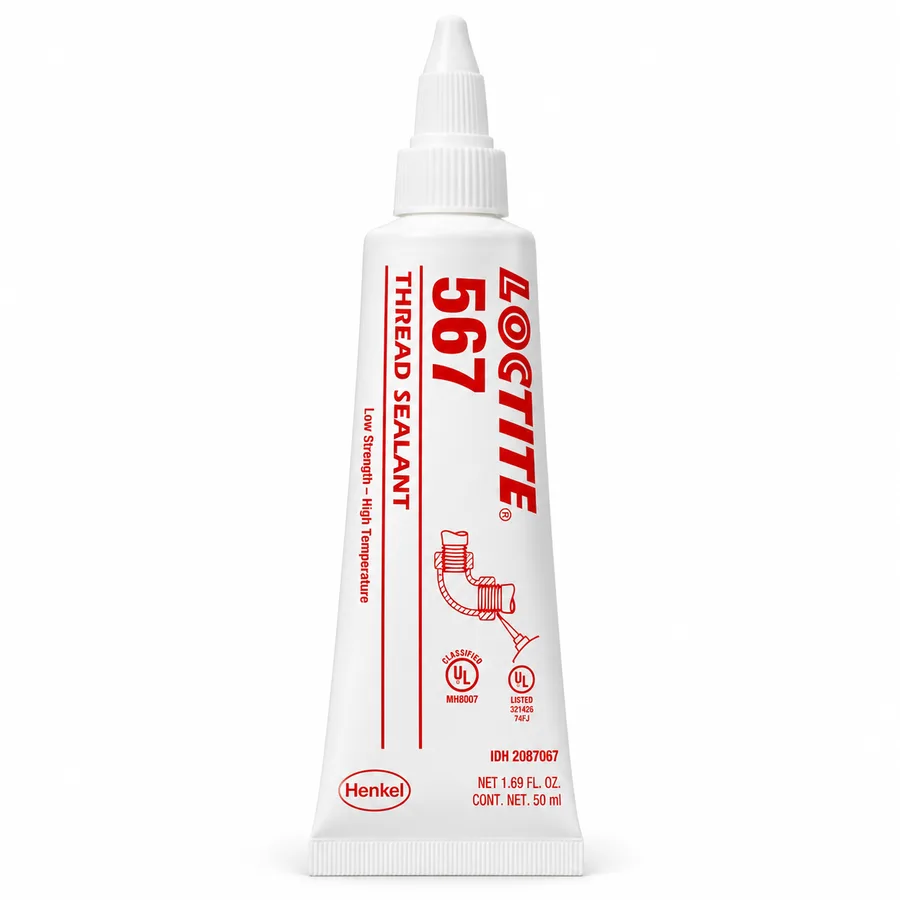
LOCTITE® 567 is a one-part anaerobic thread sealant from Henkel's PST (Pipe Sealant with PTFE) line, formulated to seal and lock tapered metal pipe threads —NPT, BSPT (R) and equivalents— in hydraulic, pneumatic and process systems. It is a methacrylate ester that cures in the absence of air when confined between close-fitting metal threads: it forms a pressure-resistant seal and, thanks to its PTFE lubricating solids, prevents galling on stainless steel, aluminum and brass. Its strength is low, so the fitting can later be removed with hand tools.
Verdict. For tapered metal pipe threads, coarse pitch (up to R3″ / M80), in high-temperature service or on stainless steel where preventing galling matters, use LOCTITE® 567. For quick joints on small threads or when there is no cure time available, PTFE (Teflon) tape is still valid. For fine hydraulic and pneumatic threads that must seal immediately, a low-viscosity anaerobic sealant is better. The comparison table below decides by thresholds.
Per Henkel's technical data sheet (TDS), LOCTITE® 567 is an acrylic-technology, methacrylate-ester chemistry, single-component product with anaerobic cure. It is supplied as a thixotropic off-white paste of high viscosity and low strength. Its function is thread sealing: it cures when confined, without air, between close metal surfaces, and prevents loosening and leakage from shock and vibration. Its high lubricating properties prevent galling on stainless steel, aluminum and all other metal pipe threads and fittings.
It is designed to lock and seal tapered metal threads and fittings. It works on active metals (brass, copper, steel) and on passive substrates (stainless steel, plated surfaces), and offers high-temperature performance and oil tolerance, tolerating minor surface contamination from cutting, lubrication or protection fluids. Henkel recommends it for chemical processing, petroleum refining, pulp and paper, waste treatment, textile, power generation, marine, automotive, industrial equipment, and gas compression and distribution, as well as fluid-power systems. A properly tightened joint seals instantly to moderate pressures; for maximum pressure and solvent resistance, allow a minimum of 24 hours of cure.
Values taken from Henkel's official TDS for LOCTITE® 567 (current edition) and from the product listing at TECTUL.
| Property | Value |
|---|---|
| Technology / chemistry | Acrylic — methacrylate ester (anaerobic) |
| Appearance (uncured) | Off-white thixotropic paste |
| Components | One component, no mixing required |
| Strength | Low — hand-tool removable |
| Viscosity (Brookfield RVF, spindle 7, 2 rpm, 25 °C) | ≈ 540,000 mPa·s (cP) |
| Specific gravity @ 23 °C | 1.1 |
| Maximum thread size | Up to M80 / R3″ (≈ 3 inch, coarse pitch) |
| Service temperature | Approx. −55 °C to +200 °C (cold strength tested to −75 °C) |
| Pressure | Seals to the strength of the fitting; ULC gas approval up to 13,790 kPa |
| Breakaway torque (ISO 10964, 3/8×24, 24 h @ 22 °C) | ≈ 1.7 N·m (low strength) |
| Cure / pressurization | Seals instantly to moderate pressure; cure min. 24 h for maximum pressure |
| Test methods | ISO 10964, ASTM D6396 |
| Approvals | UL (MH8007), ULC (MH27131), NSF/ANSI 61 (potable water ≤82 °C), Australian Gas Association (Class III), GASTEC QA AR-214 (hydrogen) |
The procedure follows the assembly instructions in Henkel's TDS. The goal is a clean thread, product on the engaging flanks, and cure time before pressurizing.
For disassembly, use standard hand tools. On large diameters (over 1″) or long engagement lengths, apply localized heat to about 250 °C and disassemble while hot.
Good practice. Apply enough product to fill the engaging threads; on large threads, a continuous bead on both male and female avoids unsealed spots. Do not combine 567 with PTFE tape on the same thread: the tape leaves air between the flanks and reduces the metal-to-metal contact that triggers the anaerobic cure. 567 seals tapered threads (NPT, BSPT); on large straight or parallel threads, where the seal relies on a gasket, consider a face-sealing product. A 50 ml bottle covers many small connections, since only a few covered threads are needed per joint. Wipe off any excess before it cures; uncured product cleans up with a LOCTITE® solvent.
All three methods seal threads, but they solve different problems. PTFE tape is a mechanical seal that is wrapped on; the liquid anaerobic cures chemically and fills the voids. LOCTITE® 567 is the high-viscosity, high-temperature anaerobic for large tapered threads.
| Criterion | LOCTITE® 567 | PTFE (Teflon) tape | Low-viscosity anaerobic |
|---|---|---|---|
| Service temperature | −55 to +200 °C | Material tolerates heat, but the seal depends on tightening and can relax | Typically up to ≈ +150 °C |
| Thread size | Coarse pitch up to R3″ / M80 | Any size; best on small threads | Fine, small threads |
| Anti-galling on stainless | Yes — high lubricity, prevents galling | Partial; can tear or shred | Limited |
| Disassembly / reuse | With hand tools (low strength) | Must be removed and replaced at each assembly | With hand tools |
| Fluid contamination risk | None: cures confined, sheds no fragments | Can shed pieces that clog valves and instruments | Low: leaves no fragments |
| Vibration and shock | Resists; locks the thread | Can loosen | Resists |
| Pressurization | Instant to moderate pressure; 24 h for maximum | Immediate | Instant; fast cure |
LOCTITE® 567 works on active metals (brass, copper, carbon steel) and on passive substrates (stainless steel and plated surfaces). On stainless steel, aluminum and low-temperature assemblies, activator speeds the cure. It is not recommended for plastics or thermoplastics, due to the risk of stress cracking, nor for pure oxygen or oxygen-rich systems, chlorine or other strong oxidizers. It holds UL and ULC approvals for fuel gases, NSF/ANSI 61 for potable water (up to 82 °C), Australian Gas Association (Class III) and GASTEC QA AR-214 for hydrogen; verify the regional validity of each approval with the manufacturer before a regulated application.
Choose LOCTITE® 567 when the joint is a coarse-pitch tapered metal pipe thread, runs at high temperature (up to about 200 °C) or is on stainless steel where galling would ruin the fitting. It is the option for hydraulic and pneumatic fittings, gas lines and process equipment where no tape fragments can enter the fluid. For small threads or quick assemblies with no cure time, PTFE tape does the job; for fine threads that must seal immediately, a low-viscosity anaerobic. At TECTUL, LOCTITE® 567 is offered in a 50 ml presentation, with the official Henkel technical data sheet (TDS) available for download: see the LOCTITE® 567 listing for price, availability and quotation.
Updated: July 14, 2026.