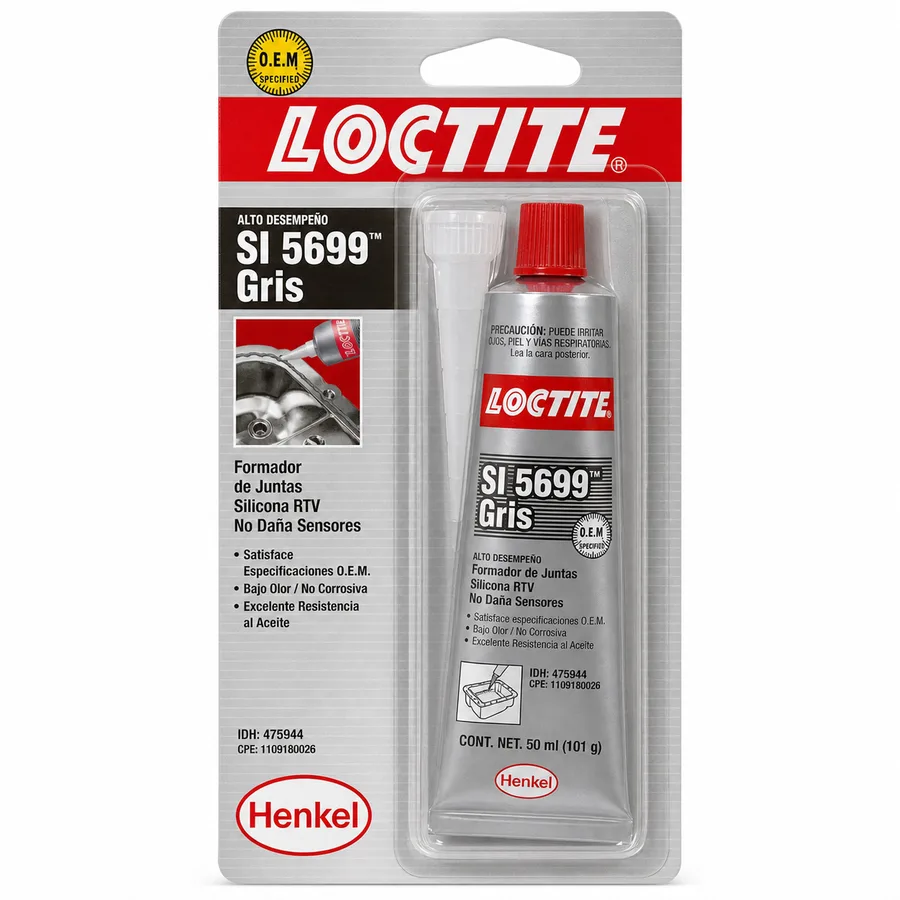
Loctite® 5699 (Henkel reference SI 5699) is a grey RTV silicone gasket maker that cures on exposure to atmospheric moisture to form a flexible rubber gasket. It is used to seal flanges that move —valve covers, oil pans, pump housings, gearboxes and cast-metal housings— where there is thermal expansion, vibration or machined and cast surfaces, on metal or plastic, with resistance to oil and water/glycol.
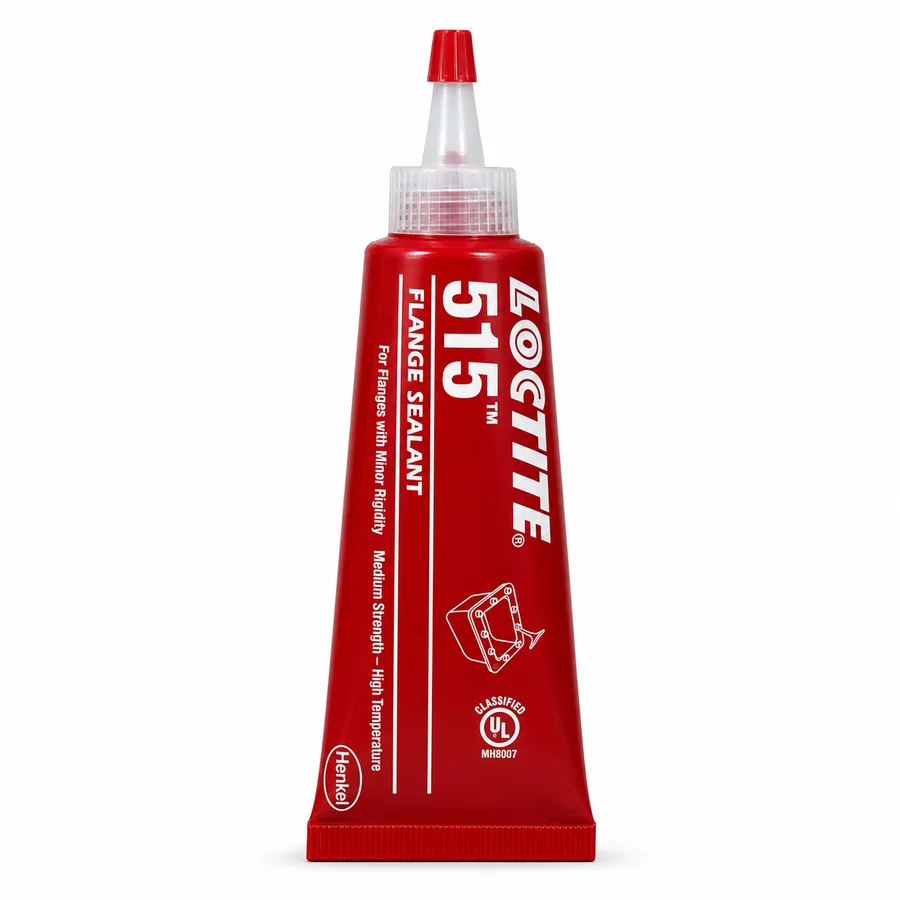
Quick verdict, 5699 vs 515: use the 5699 when the flange flexes, the gap is large or the substrate is plastic; use the Loctite 515 (anaerobic) for rigid, machined metal flanges with a small gap (up to 0.25 mm) that must resist pressure as soon as they are assembled. Flexible silicone for movement; anaerobic for metal rigidity.
According to the Henkel technical data sheet (TDS), LOCTITE® SI 5699 is a one-component oxime silicone (neutral, non-corrosive cure) that cures by room-temperature vulcanization (RTV). It needs no mixing: you dispense a bead and it cures by reacting with ambient humidity. It is grey and is NSF category P1 registered for use as a sealant where there is no possibility of food contact.
It is designed primarily for flange sealing with excellent oil resistance on rigid flanges such as transmissions and cast-metal housings, but because it cures to an elastic rubber it also tolerates flange flexing, vibration and large gaps that an anaerobic cannot. It suits machined or cast surfaces, metal or plastic.
| Property | Value (Henkel TDS) |
|---|---|
| Technology / chemistry | Silicone, oxime type (neutral, non-corrosive cure) |
| Cure | RTV, moisture cure |
| Colour (uncured) | Grey, thixotropic paste |
| Components | One (no mixing) |
| Specific gravity at 20 °C | 1.45 |
| Tack-free (skin-over) time, 25 °C / 50 % RH | ≤ 30 min |
| Depth of cure | Increases with humidity and time; measured up to 10 mm |
| Full cure before service loads | ~7 days |
| Shore A hardness (ISO 868) | 45 to 75 |
| Elongation at break (ISO 37) | ≥ 100 % |
| Tensile strength (ISO 37) | ≥ 2.4 N/mm² (≥ 348 psi) |
| Service temperature | −55 to +200 °C (−65 to +400 °F) |
| Fluid resistance | Oil, ATF, multi-grade oil and water/glycol 50/50 |
| Pack size at TECTUL | 70 ml tube |
Figures are taken from the LOCTITE® SI 5699 TDS (December 2013) and Henkel product data; tests follow ISO 868 (hardness), ISO 37 (tensile and elongation) and ISO 4587 (shear strength).
The principle is simple: clean, lay a continuous bead, assemble within the open time and let atmospheric moisture cure the sealant.
Henkel does not recommend the 5699 in contact with gasoline, nor in pure or oxygen-rich systems, and it should not be chosen as a sealant for chlorine or other strong oxidizers. For hydraulic or pneumatic metal threads use an anaerobic thread sealant, not a gasket maker.
Thanks to its combination of flexibility, oil resistance and temperature range, the 5699 is a universal gasket maker for mechanical and industrial maintenance. Common cases:
As a dosing guide, depth of cure advances from the skin inward as moisture penetrates: a thin bead and high ambient humidity speed curing, while a very thick bead or a dry environment slow it down. That is why it is best not to exceed the bead thickness needed and to wait for full cure before pressurizing the joint.
Both are form-in-place gasket makers, but they solve opposite problems. The 5699 is a flexible silicone that fills large gaps and flexes with the flange; the 515 is a rigid anaerobic for machined metal joints with a minimal gap.
| Criterion | Loctite 5699 (RTV silicone) | Loctite 515 (anaerobic) |
|---|---|---|
| Chemistry | Oxime silicone, moisture cure | Methacrylate ester, anaerobic cure |
| Flexibility | High (elastic rubber, elongation ≥ 100 %) | Low: flexes only with minor flange movement |
| Allowable gap | Large (thick bead; cure measured up to 10 mm) | Small, up to 0.25 mm (0.010 in) |
| Service temperature | −55 to +200 °C | Up to +150 °C |
| Speed | Skin ≤ 30 min; full cure ~7 days | Resists low pressure immediately; cure depends on metal and gap |
| Substrates | Metal or plastic, machined or cast | Rigid metal only (not recommended on plastics) |
| Colour | Grey | Purple |
Verdict: for flanges that flex, large gaps, plastic surfaces or assemblies with vibration and thermal expansion (up to 200 °C), choose the Loctite 5699 grey silicone. For rigid, machined metal flanges with a gap ≤ 0.25 mm that must seal and hold pressure right after assembly —pumps, thermostats, compressors, transmission housings— choose the Loctite 515.
It skins over tack-free in ≤ 30 minutes at 25 °C and 50 % humidity; full cure of the bead body takes on the order of 7 days and progresses faster at higher humidity.
Its service range is −55 to +200 °C (−65 to +400 °F) per Henkel data, covering valve covers, oil pans and pump housings.
Yes: it can be used on machined or cast surfaces, metal or plastic, unlike the anaerobic 515, which is limited to rigid metals.
Yes: the TDS documents strength retention against multi-grade oil, automatic transmission fluid (ATF) and water/glycol 50/50, which is why it is used on transmissions and water pumps.
The grey 5699 is the high-performance variant for flange sealing with oil resistance and a non-corrosive cure; red or clear silicones cover other temperature ranges and general-purpose uses.
Keep it in its closed container in a dry place: optimal storage is 8 to 21 °C, and storing it below 8 °C or above 28 °C can adversely affect its properties. Do not return leftover product to the original container, as it may have been contaminated during use.
For maintenance of engines, pumps and gearboxes where the joint moves or the gap is wide, the Loctite 5699 grey silicone in a 70 ml tube is the direct choice. If your application is rigid, flat metal flanges with a minimal gap, order the Loctite 515. At TECTUL we ship both genuine Loctite® (Henkel) references across Colombia; if you need another reference from the portfolio, we quote it too.