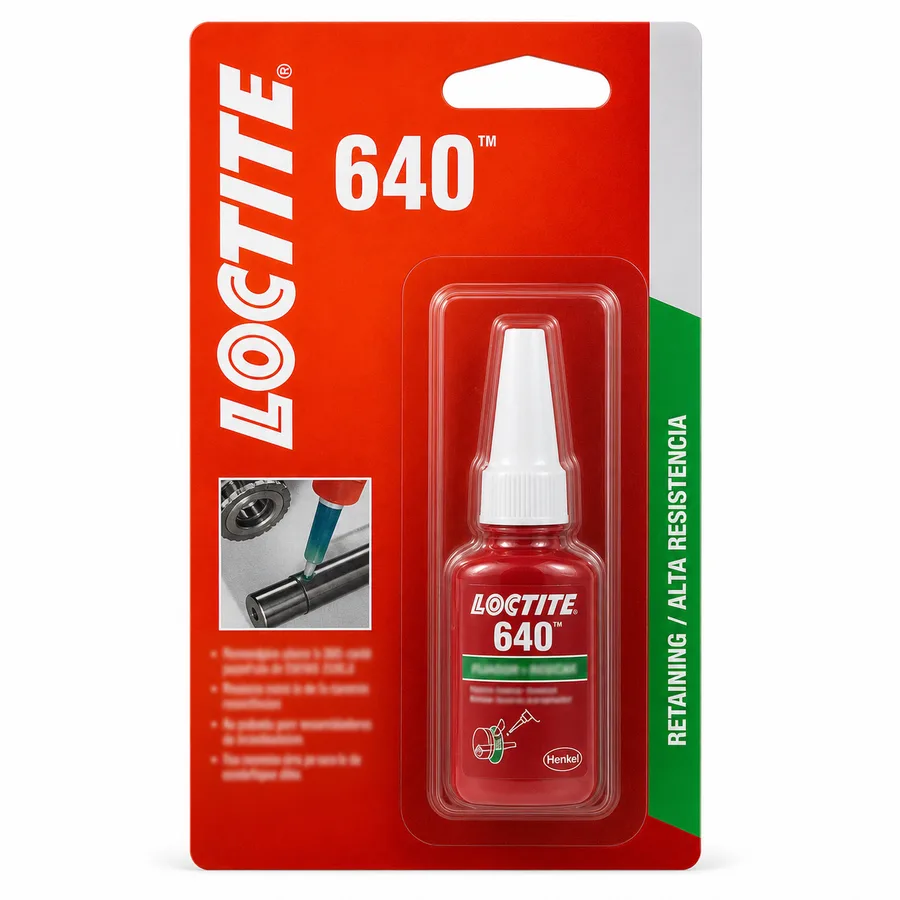
Loctite 640 is a high-strength, slow-cure anaerobic retaining compound that bonds coaxial cylindrical parts — bearings on shafts, bushings, sleeves, liners, rotors and gears — by filling the clearance between both surfaces and transmitting load over the full 360°. It replaces the forced interference fit: instead of pressing the bearing onto the shaft, the retainer cures inside the gap between the metals and locks out slippage, vibration and leakage through clearance.
Direct verdict: use LOCTITE® 640 when you need high strength together with a long time to position the part (large assemblies, critical alignment, or active metals such as brass); if you need fast fixturing, choose a quick-setting retainer; if you must fill larger gaps, choose a retainer with higher gap-filling capacity. The 640 is made for assembly that cannot be rushed and still must hold. This article explains what an anaerobic retainer is, how to apply it, and when the 640 wins over an interference fit or a key.
A retaining compound is a single-part adhesive that stays liquid while exposed to air and cures (hardens) only when it is confined between two metal surfaces with no oxygen present. That reaction is anaerobic curing: the metal ions of the parts trigger polymerization of the monomer — in the 640, a urethane-methacrylate base — and the liquid becomes a rigid thermoset that completely fills the diametral gap between shaft and housing.
The mechanical outcome is the point: while an interference fit bears only on the roughness peaks of two pressed metals, the retainer forms a continuous film contacting 100 % of the overlap surface. Load is spread around the whole circumference (360°), the micromovements that cause fretting wear are eliminated, and the joint is sealed against moisture, preventing corrosion at the interface. That is why a retained assembly usually withstands more torque and more axial push-out than the same assembly held by mechanical grip alone.
The values below come from Henkel's official technical data sheet (TDS) for LOCTITE® 640 and from testing per ISO 10123 (shear strength on pin-and-collar specimens). The compressive shear strength shown is on steel, cured 24 h at 22 °C.
| Property | Value | Standard / condition |
|---|---|---|
| Chemistry | Urethane methacrylate, anaerobic, 1-part | Henkel TDS |
| Appearance | Green liquid, fluorescent under UV light | Henkel TDS |
| Viscosity @ 25 °C | 450 to 750 mPa·s (low) | ISO 3104 (Cannon-Fenske) |
| Compressive shear strength | 22 N/mm² (3,190 psi) | ISO 10123, steel, 24 h @ 22 °C |
| Maximum diametral clearance | 0.1 mm (0.004") | Henkel TDS |
| Fixture time on steel | Approx. 2 h | Henkel TDS (slow cure) |
| Full functional cure | 24 h at 22 °C | Henkel TDS |
| Service temperature | -55 °C to +175 °C | Henkel TDS |
| Secondary cure | Activator 7471 / 7649 | Inactive metals or large gaps |
The 640 is deliberately slow-curing: fixture time on steel is about 2 hours, which gives time to place and align the part before the adhesive grabs. It is the opposite of a fast retainer, which locks the position within minutes and does not forgive an assembly error.
The procedure is short, but every step drives the final strength. Cleanliness and clearance are the factors that matter most.
Within the family of high-strength Loctite® retainers, the choice is decided by three variables: fixture speed, gap to fill, and the positioning time the assembly needs. The 640 sits at the end of maximum strength with the longest positioning time.
| Criterion | LOCTITE 640 | Fast-setting retainer | High gap-fill retainer |
|---|---|---|---|
| Strength | High | High | High |
| Fixture on steel | Slow (approx. 2 h) | Fast (minutes) | Medium |
| Time to position | Long | Short | Medium |
| Best for | Large parts, active metals (brass), critical alignment | Series production, fast assembly | Worn or out-of-tolerance parts |
Practical rule: if the assembly needs unhurried positioning or alignment, or the part is large-diameter or brass, use 640. If line speed is the priority, choose a fast-setting retainer. If the clearance exceeds what the 640 allows because the parts are worn, choose a retainer formulated for higher gap fill. When unsure of the exact reference, always verify the manufacturer's TDS; retainers do not all share the same maximum gap or speed.
All three methods fix a hub to a shaft, but they behave differently in allowable clearance, concentricity, disassembly and cost. The retainer does not always replace the others: it often complements them (for example, a press fit reinforced with 640).
| Aspect | Retainer (LOCTITE 640) | Interference fit | Key |
|---|---|---|---|
| Allowable clearance | Tolerates gap up to 0.1 mm; fills it | Requires controlled negative allowance | Requires a machined keyway |
| Concentricity | High; 360° contact | High if the fit is uniform | Lower; the keyway adds imbalance |
| Load distribution | Whole overlap surface | Roughness peaks | Localized at the key |
| Disassembly | With heat (approx. 232 °C) and separation | With press or puller | By removing the key |
| Cost / machining | Low; looser tolerances | High; tight tolerances | High; keyway machining |
| Anti-fretting sealing | Yes; seals the interface | Partial | No |
An interference fit demands tight tolerances and a press; a key transmits torque but decenters and bears at a single point. The retainer achieves concentricity and load spread with looser tolerances and no extra machining, in exchange for waiting out the cure. That is why the 640 is common to mount bearings on shafts and in housings, retain bushings and sleeves, and restore the fit of worn parts without re-machining.
Choose LOCTITE® 640 when the job calls for high strength and slow cure to position: bearings and bushings on large shafts, brass or other active-metal assemblies, and repairs where alignment leaves no room for error. For that profile, its 22 N/mm² shear strength (ISO 10123), the up-to-0.1 mm clearance and the -55 to +175 °C range cover most industrial assemblies. When ordering, state the real diametral clearance, the metal type (active or inactive) and whether you need activator. At TECTUL you will find the Loctite 640 page with a downloadable official TDS; if your assembly needs a different set speed or higher gap fill, confirm it before buying so you do not lock the part in the wrong position.