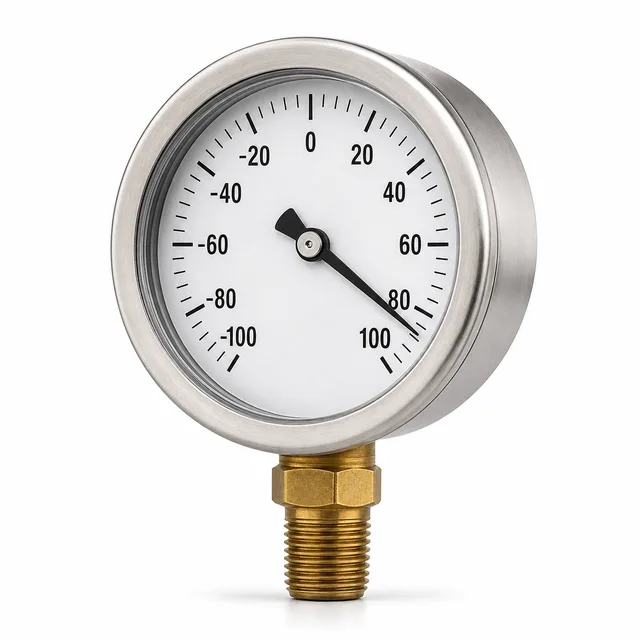
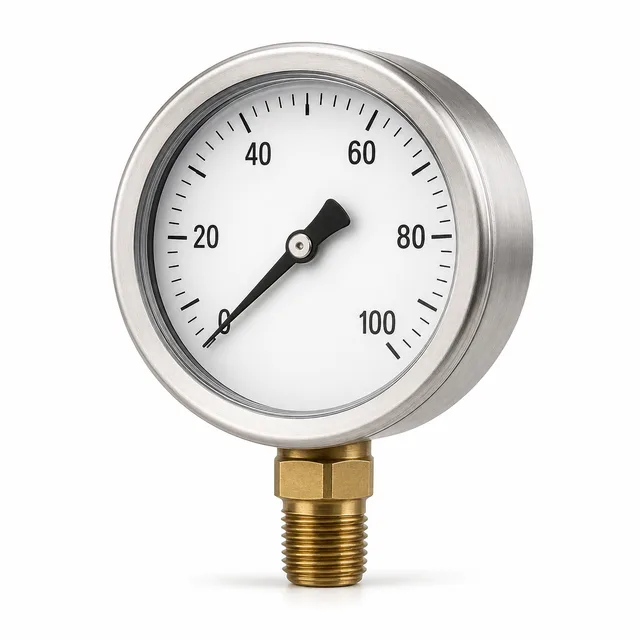
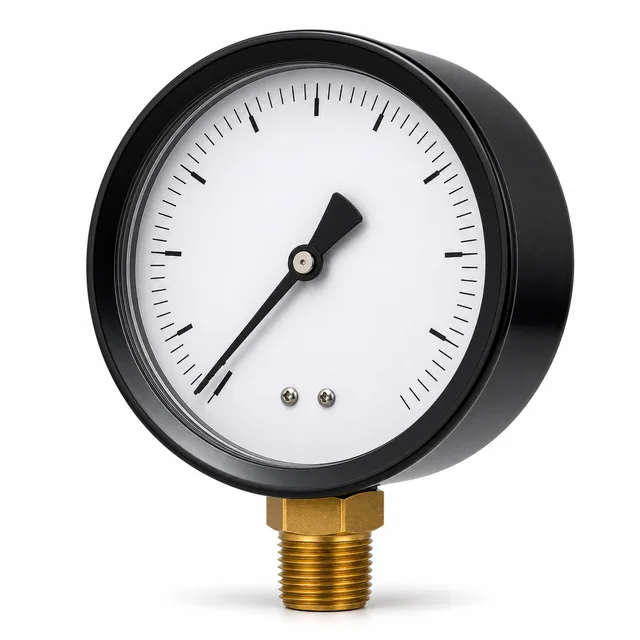
A compound gauge is a dial instrument with an elastic Bourdon tube element that reads both positive gauge pressure and vacuum (pressure below atmospheric) on a single dial. Typical imperial scales run from −30 inHg to a positive value in psi (for example, 30 inHg–0–15 psi); metric scales run from −1 bar to a positive value (for example, −1 to +3 bar). ASME B40.100-2022 covers these instruments as compound gauges; the European standard EN 837-1:1996 covers them as Bourdon tube pressure-vacuum gauges.
Selection verdict: if the measuring point can swing from vacuum to positive pressure — pump suction, the low side of a refrigeration circuit, intake filters, reactors with vacuum cycles — use a compound gauge. If pressure never drops below zero, use a pressure gauge; if it never rises above zero, a vacuum gauge. A standard pressure gauge exposed to vacuum operates outside its range: the pointer hits the stop below zero and the instrument can drift out of calibration.
The sensing element is the same as in a pressure gauge: a C-shaped Bourdon tube (helical in high ranges) that deforms with pressure. Under positive pressure the tube tends to straighten and the pointer moves clockwise; under vacuum the tube curls the opposite way and the pointer drops below zero into the section graduated in inHg, cmHg or negative bar. A sector-and-pinion movement amplifies the motion across the graduated dial.
Accuracy is expressed as a percentage of the full span (vacuum section plus pressure section). ASME B40.100-2022 classifies it in grades: 2A (±0.5%), 1A (±1%), A (±1% over the middle half of the scale, ±2% over the outer quarters) and B (±2% middle, ±3% outer), among others. EN 837-1 uses numeric classes equal to the percentage error of span: 1, 1.6, 2.5 and 4 are the usual classes in 2.5 in and 4 in industrial instruments.
Perfect vacuum equals −101.3 kPa (−14.7 psi; −29.92 inHg; −760 mmHg): no vacuum scale can go lower, which is why the negative section always ends at −30 inHg or −1 bar and only the positive section changes between models. EN 837-1 standardizes the metric series, and manufacturer catalogs such as Ashcroft's offer the corresponding imperial series:
| Metric scale (EN 837-1 series) | Usual imperial catalog scale | Typical use |
|---|---|---|
| −1 to +0.6 bar and −1 to +1.5 bar | 30 inHg–0–15 psi | Pump suction, filter checks |
| −1 to +3 bar and −1 to +5 bar | 30 inHg–0–30 psi and 30 inHg–0–60 psi | Liquid transfer, pneumatic systems with vacuum generation |
| −1 to +9 bar and −1 to +15 bar | 30 inHg–0–100 psi and 30 inHg–0–150 psi | Refrigeration low side, processes with sterilization cycles |
| −1 to +24 bar | 30 inHg–0–300 psi | Systems alternating vacuum with high pressure |
The metric and imperial columns are not exact conversions of each other: they are the closest standardized scales in each system. When buying, specify the unit your plant personnel read, or order a dual scale (psi + bar), common on 2.5 in and 4 in instruments.
| Instrument | Range covered | Use it when | Typical installation points |
|---|---|---|---|
| Pressure gauge | 0 to +X psi (positive pressure only) | Process pressure never drops below 0 psig | Pump and compressor discharge, water and air networks |
| Vacuum gauge | −30 inHg to 0 (−1 to 0 bar) | Pressure never rises above atmospheric | Vacuum lines, packaging, dedicated intake filters |
| Compound gauge | −30 inHg to +X psi (crosses zero) | The point can sit in vacuum or positive pressure depending on operating conditions | Pump suction with variable head, refrigeration low side, reactors with vacuum cycles |
The criterion is the sign of the pressure at the measuring point across the whole operating cycle, not its average value. If a single condition (start-up, cleaning, draining, shutdown) makes pressure cross zero, the correct instrument is the compound gauge.
In service with vibration or pulsation — pumps, compressors, lines near motors — glycerin filling dampens pointer movement and lubricates the mechanism, which stabilizes the reading and extends instrument life. WIKA specifies an admissible ambient temperature of −20 °C to +60 °C for its glycerin-filled models; below −20 °C, silicone oil filling is specified. Dry instruments are reserved for points without vibration (panels, static tanks), where their lower cost makes them the rational choice.
For pump suction and services that cross zero, TECTUL offers the 2.5 in stainless steel case compound gauge with vertical connection; for vacuum-only lines, the 2.5 in stainless steel vacuum gauge. If the point only sees positive pressure with vibration, choose the 2.5 in all-stainless glycerin-filled pressure gauge, 1/4 NPT; without vibration, the 2.5 in black case dry pressure gauge or, when a larger dial and on-site adjustment are required, the 4 in stainless steel dry recalibratable gauge, 1/2 NPT. Before ordering, confirm three items: range (2 times the operating pressure), connection thread, and whether the service calls for glycerin filling.