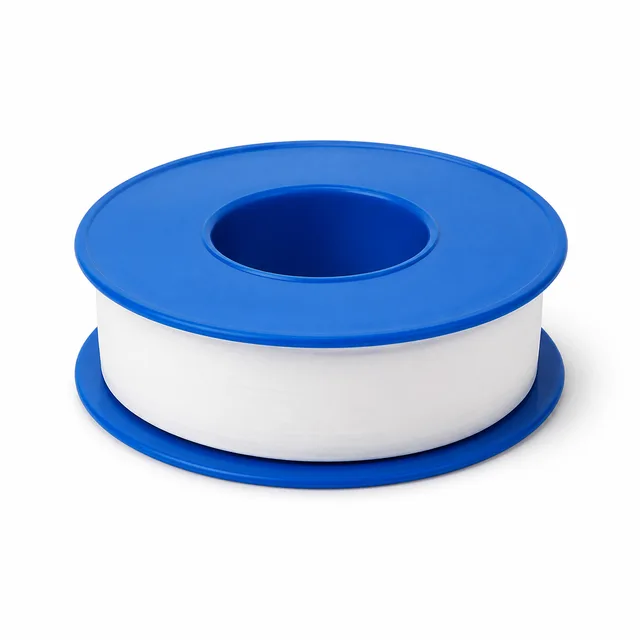
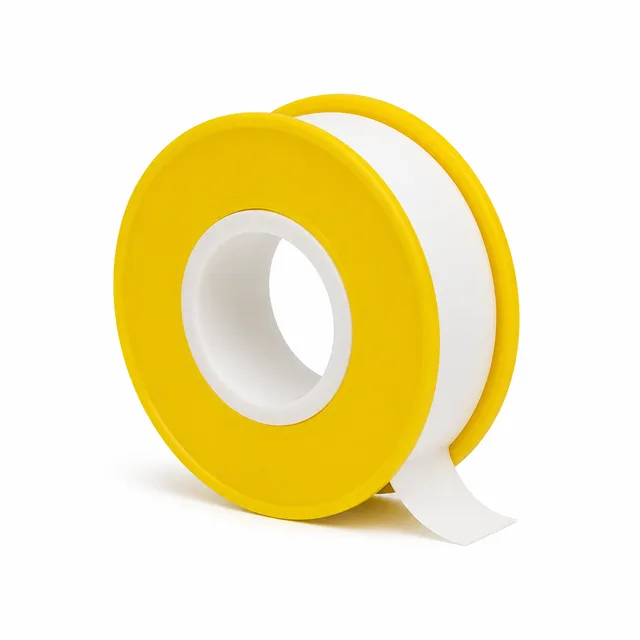
Measuring “Teflon” means two different things depending on the product. For thread seal tape, the relevant dimensions are width, thickness and density; for machinable PTFE rod and sheet, they are diameter, plate thickness and length. The quick verdict: to seal threads for water, air and general services use white PTFE tape 1/2 or 3/4 inch wide; for gas threads use full-density yellow tape listed for fuel gas; to machine parts such as bushings, seats and gaskets use PTFE rod or sheet, virgin or glass-filled depending on the mechanical load.
Teflon is the common name for polytetrafluoroethylene (PTFE); strictly speaking it is a trade name for the material, and technical standards always refer to PTFE. TECTUL carries both families: industrial PTFE thread seal tape, yellow PTFE gas tape and liquid PTFE thread sealant for thread sealing, and virgin PTFE rod, glass-filled PTFE rod and PTFE sheet for machining.
PTFE tape is sold in rolls 1/2, 3/4 and 1 inch wide. The width should not exceed the useful thread length: tape wider than the thread hangs over the first thread and can shred into the line. Manufacturer guidance states that 1/2 inch width covers threads up to 1-1/2 inches in diameter; 3/4 and 1 inch widths reduce the number of passes needed on larger threads.
| Tape width | Equivalent | Typical use |
|---|---|---|
| 1/2 in | 12.7 mm | Threads up to 1-1/2 in; plumbing and general services |
| 3/4 in | 19.1 mm | Medium and large threads with fewer passes; usual gas tape width |
| 1 in | 25.4 mm | Large threads in industrial assembly |
Two tapes of the same width can be very different products. The variable that separates them is density. Commercial item description A-A-58092, which superseded military specification MIL-T-27730A, requires a minimum thickness of 3.5 mils (0.089 mm), a minimum density of 1.2 g/cm³ and a minimum PTFE purity of 99 %. Cheap low-density tapes are thinner and more porous: they seal small, low-demand threads, but need more wraps and tear easily. For industrial service, specify tape that meets the A-A-58092 values or the manufacturer's equivalent data sheet.
| Tape type | Reference thickness | Reference density | Service |
|---|---|---|---|
| Low density (economy) | Under 0.089 mm | Under 1.2 g/cm³ | Small low-demand threads; needs more wraps |
| Full density (A-A-58092) | ≥ 0.089 mm (3.5 mil) | ≥ 1.2 g/cm³ | General industrial use with PTFE ≥ 99 % |
| Yellow gas tape (manufacturer data) | 0.081 to 0.097 mm | 1.25 to 1.5 g/cm³ | Natural gas and LPG on threads up to 1-1/2 in |
The yellow color of gas tape does not come from ASME A13.1: that standard defines color identification for labeled piping, not for seal tapes. The correct references for gas thread tape are different. In Europe, EN 751-3:2022+A1:2023 covers unsintered PTFE tapes for metallic threaded joints in contact with 1st, 2nd and 3rd family gases (manufactured gas, natural gas and LPG) up to 500 kPa, with GRp and FRp classes by thread type. In North America, fuel gas product listings such as CAN/ULC-S642 and the UL listings declared by each manufacturer are used. As reference data, a leading manufacturer's yellow gas tape reports 99.5 % PTFE, 0.081 to 0.097 mm thickness and 1.25 to 1.5 g/cm³ density.
Two warnings from that same manufacturer: gas tape is intended for threads up to 1-1/2 inches using 1/2 inch width, and conventional PTFE tape must not be used on oxygen lines, which require products formulated and certified for that service. For residential or commercial gas installations, the authority having jurisdiction may require a specific listed sealant: confirm the requirement before buying.
The citable manufacturer rule of thumb: 2 to 3 wraps with standard-density tape; if the tape is thin (low density), 4 to 5 wraps; on gas, a minimum of 3 wraps with full-density yellow tape. The larger the diameter and thread depth, the more wraps within that range. Technique matters as much as the count: always wrap in the direction of thread rotation (clockwise seen from the pipe end on right-hand threads), keep constant tension, cover the full thread and leave the first thread bare so excess tape cannot enter the line. The tape works on tapered NPT threads made to ASME B1.20.1: it acts as a lubricant and clearance filler, and does not fix damaged threads.
| Situation | Indicative wraps | Criterion |
|---|---|---|
| Standard-density tape, threads up to 1/2 in | 2 to 3 | Manufacturer guidance |
| Thin low-density tape | 4 to 5 | Compensates lower thickness |
| Yellow tape on gas threads | Minimum 3 | Manufacturer specification |
| Large or worn threads | High end of range | More clearance to fill; consider liquid sealant |
For joints that are assembled and disassembled often, small threads and general maintenance, PTFE tape is economical and needs no curing. For permanent metal joints, vibration, large diameters or where tape shreds are unacceptable (instrumentation, fine-seat valves), anaerobic thread sealant seals by filling the space between threads and curing inside the assembly. TECTUL offers liquid PTFE thread sealant, and the guide Loctite 567: what it is for and how to use it covers the PTFE anaerobic sealant case in depth.
PTFE rod is purchased by outside diameter and length, and machined on a lathe or milling machine. Extruded rod is manufactured to ASTM D1710-15(2021), from resins meeting ASTM D4894-19 (granular resin) or ASTM D4895-18(2023) (dispersion resin). The TECTUL catalog of virgin PTFE rod covers diameters from 3/16 to 6 inches in a standard 1 meter length, with 7, 8 and 9 inch diameters made to order.
| Diameter range | Catalog sizes | Availability |
|---|---|---|
| 3/16 to 1/2 in | 3/16, 1/4, 5/16, 3/8, 1/2 | Stock, 1 m length |
| 5/8 to 2 in | 5/8, 3/4, 1, 1-1/4, 1-1/2, 1-3/4, 2 | Stock, 1 m length |
| 2-1/4 to 6 in | 2-1/4, 2-1/2, 2-3/4, 3, 3-1/2, 4, 4-1/4, 4-1/2, 5, 5-1/2, 6 | Stock, 1 m length |
| 7 to 9 in | 7, 8, 9 | Made to order |
PTFE sheet is used for die-cut gaskets, flange joints, seats and slide plates. The catalog carries thicknesses from 0.5 to 50 mm in a standard 1.22 m width, imported to order: 0.5, 1, 1.6, 3, 5, 6.35, 10, 12.7, 15, 20, 25, 35, 40 and 50 mm. Thin gauges (0.5 to 1.6 mm) are supplied in rolls; heavier gauges as plates. For flange gaskets, thickness is chosen according to the flange face finish and the available bolt load; thicker is not always better, because PTFE cold-flows under load.
The figures below come from the resin manufacturer's properties handbook and from the ASTM material specifications. They are the reason PTFE dominates in sealing and low-friction parts.
| Property | Value | Source |
|---|---|---|
| Continuous service temperature | −200 °C to +260 °C (−328 °F to +500 °F); remains useful down to cryogenic temperatures | PTFE resin manufacturer properties handbook |
| Coefficient of friction | 0.05 to 0.10, the lowest of any unfilled engineering plastic | PTFE resin manufacturer properties handbook |
| Chemical resistance | Inert to almost all industrial acids, bases and solvents | PTFE resin manufacturer properties handbook |
| Specific gravity | 2.13 to 2.22 | ASTM D4894 / manufacturer handbook |
| Extruded rod material | Resin per ASTM D4894 or D4895 | ASTM D1710-15(2021) |
Virgin PTFE is the choice for aggressive chemical contact, electrical insulation and food-contact applications, but it cold-flows under sustained load and wears faster in continuous sliding. Glass-filled PTFE rod (typical fill contents of 15 % to 25 % per technical data sheet) improves compressive strength, dimensional stability and wear life, in exchange for lower chemical inertness against acids that attack glass, such as hydrofluoric acid. The TECTUL catalog includes glass-filled PTFE rod in diameters from 3/4 to 4 inches by 1 meter, plus graphite-, bronze- and carbon-filled versions for specific friction and wear requirements.
| Application | Product | Typical size |
|---|---|---|
| Sealing water, air and general service threads | White standard-density PTFE tape | 1/2 or 3/4 in; 2 to 3 wraps |
| Sealing natural gas or LPG threads | Full-density yellow PTFE tape listed for gas | 3/4 in; minimum 3 wraps |
| Permanent threaded joint with vibration | Anaerobic sealant (liquid PTFE) | 50 ml presentation |
| Bushings, valve seats, turned parts | Virgin PTFE rod | Diameters 3/16 to 6 in × 1 m |
| Parts under mechanical load or wear | Glass-filled PTFE rod | Diameters 3/4 to 4 in × 1 m |
| Die-cut gaskets and flange joints | PTFE sheet | Thicknesses 0.5 to 50 mm × 1.22 m wide |
Before ordering “Teflon”, define which of the two products you need. If it is tape: width (1/2 or 3/4 inch), service (water and air, or gas with listed yellow tape) and density per A-A-58092 for industrial use. If it is machinable stock: rod diameter or sheet thickness, length, and whether the part requires virgin or glass-filled PTFE for the mechanical load. With that data, TECTUL quotes the exact size and confirms stock availability or import to order, with delivery throughout Colombia.