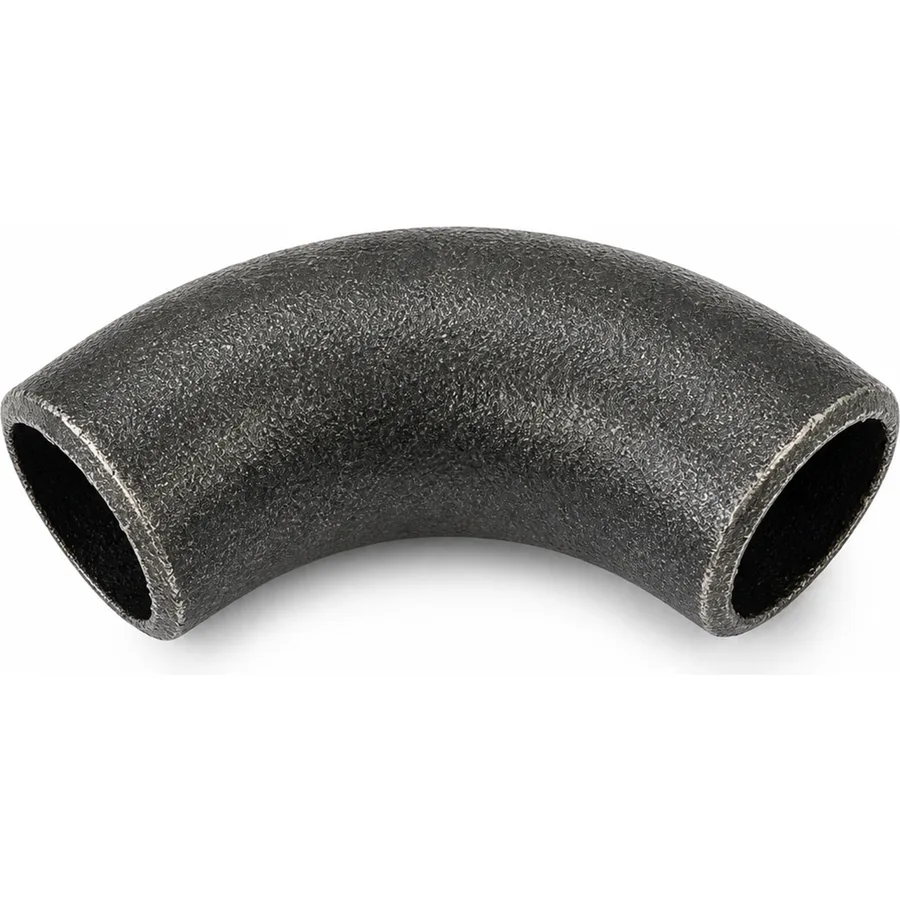
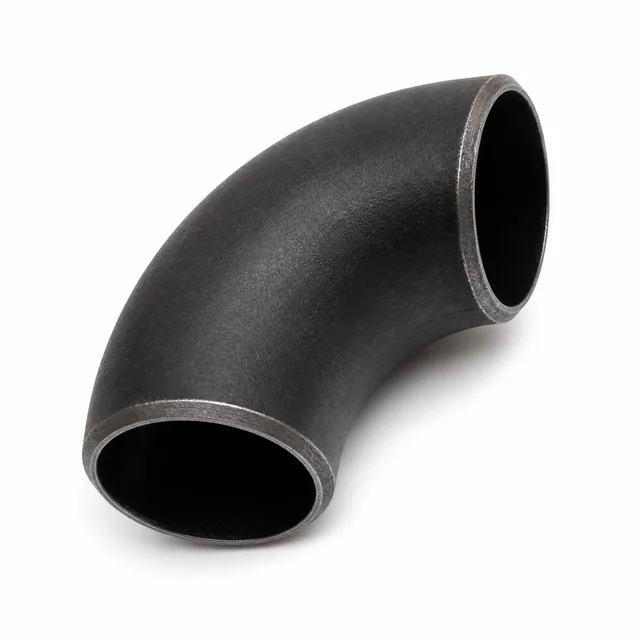
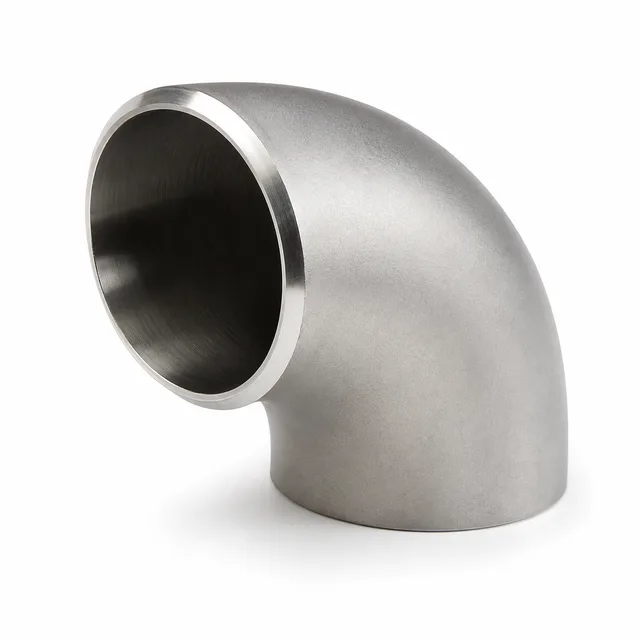
The critical dimension of a pipe elbow is not just “3 inch” or “4 inch”. Industrial fittings require NPS, angle, long or short radius, end type, schedule, material and standard. TECTUL supplies carbon steel Sch 40 butt-weld elbows, Sch 80 elbows, stainless butt-weld elbows and 3000 lb threaded elbows.
Verdict: for welded process lines, use ASME B16.9 long-radius elbows unless space forces a short-radius elbow; for small threaded connections, use ASME B16.3 or ASME B16.11 fittings according to class and material; to change direction with lower pressure drop, prefer long radius. A 4-inch long-radius butt-weld elbow has a center-to-end A dimension of 152 mm; a short-radius elbow has A of 102 mm.
NPS is nominal pipe size. It is not always the outside diameter measured with a tape, and it is not the actual inside diameter. In steel pipe, outside diameter is fixed by NPS and schedule changes wall thickness and inside diameter. Therefore an elbow order must state NPS 4, material, schedule and end type; “4-inch elbow” is not enough.
For ASME B16.9 butt-weld elbows, key dimensions include center-to-end for 90 degrees and center-to-center or center-to-end depending on geometry. For quick purchasing of 90-degree elbows, dimension A identifies the distance from the fitting center to the end face.
| NPS | 90° long-radius elbow A | 90° short-radius elbow A | Approximate relation | Common use |
|---|---|---|---|---|
| 1/2 | 38 mm | Not standardized in B16.9 | 3D / — | Instrumentation and small branches |
| 1 | 38 mm | 25 mm | 1.5D / 1D | Utility services |
| 2 | 76 mm | 51 mm | 1.5D / 1D | Water, air and process |
| 3 | 114 mm | 76 mm | 1.5D / 1D | Medium lines |
| 4 | 152 mm | 102 mm | 1.5D / 1D | Headers and process |
| 6 | 229 mm | 152 mm | 1.5D / 1D | Main lines |
| 8 | 305 mm | 203 mm | 1.5D / 1D | Higher flow |
For an NPS 3 ASME B16.9 90-degree butt-weld elbow, long-radius center-to-end A is 114 mm and short-radius A is 76 mm. That difference affects space, pressure drop and spool fabrication. Long radius occupies more room but softens the change of direction; short radius saves space and can increase losses and turbulence.
Schedule does not change the B16.9 A dimension for the same NPS, but it changes wall thickness, weight, inside diameter and pipe compatibility. A Sch 40 and a Sch 80 elbow of the same NPS may share the same general outside geometry and have different wall thickness.
For NPS 4, a 90-degree long-radius butt-weld elbow has A of 152 mm and a short-radius elbow has A of 102 mm. If the buyer needs a carbon steel Sch 40 butt-weld elbow for a common line, the drawing must confirm long radius, schedule 40 and compatible material. For greater wall thickness, a Sch 80 elbow may apply when the design requires it.
| NPS 4 data | Long radius | Short radius | Selection comment |
|---|---|---|---|
| Center-to-end A | 152 mm | 102 mm | Key fabrication dimension |
| Nominal geometric radius | 1.5D | 1D | Criterion used to compare losses |
| Relative pressure drop | Lower | Higher | Confirm by hydraulic calculation |
| Space required | Higher | Lower | Short radius only when layout justifies it |
Butt-weld elbows are used where continuity, mechanical strength and qualified welding are required. ASME B16.9 applies to factory-made wrought butt-welding steel fittings. In low-pressure or thin-wall stainless service, MSS SP-43 may appear depending on specification.
Threaded elbows are used in smaller diameters, utility services or removable assemblies. ASME B16.3 covers Class 150 and 300 malleable iron threaded fittings; ASME B16.11 covers forged threaded and socket-welding fittings. NPT pipe thread is controlled by ASME B1.20.1. A 3000 lb forged threaded elbow should not be compared with a 150 lb malleable elbow as if they were the same product.
| Elbow type | Usual standard | End type | When to choose it |
|---|---|---|---|
| Butt-weld | ASME B16.9 | Beveled ends | Process, steam, industrial water, permanent lines |
| Malleable threaded | ASME B16.3 | NPT thread | Utility services of low or medium demand by class |
| Forged threaded | ASME B16.11 | NPT thread | Higher robustness in small diameters |
| Socket-welding | ASME B16.11 | Socket end | Small diameters with fillet weld |
Crane TP-410 treats fittings as sources of local loss. A long-radius elbow usually generates lower loss than a short-radius elbow because the change of direction is smoother. The difference matters in pumping, steam, compressed air and long networks, where several accumulated elbows can move a pump operating point or increase energy consumption.
In purchasing, pressure drop is not solved by nominal diameter alone. Flow rate, fluid, roughness, schedule, temperature and number of fittings must be known. When the drawing does not state radius, the prudent practice in welded industrial lines is to confirm with engineering before substituting short radius to save space.
Schedule defines nominal wall thickness. In a butt-weld elbow, the end must be compatible with the pipe to allow correct bevel, alignment and welding. If an elbow of different thickness is installed without transition or procedure, internal mismatch, stress concentration or inspection rejection may appear.
In carbon steel, Sch 40 is common in general services and Sch 80 appears when the design requires greater thickness or pressure, always subject to piping code, material and temperature. In stainless steel, Sch 10 and Sch 40 are common depending on service, corrosion and pressure. Schedule should not be used as a substitute for calculation.
Although the search often focuses on 90-degree elbows, many assemblies use 45-degree elbows or butt-weld half elbows to soften direction changes or solve spool geometry. A 45-degree fitting gives less angular deviation per accessory and can be combined in pairs for offsets. Selection must consider space, additional welds and total loss.
If the line requires drainage, cleaning or solids passage, several abrupt changes can accumulate material. In those cases, radius, angle and elbow orientation have operational impact. For maintenance, record whether the removed elbow was 45 or 90 degrees, long or short radius and schedule; those differences are not always visible in a front photo.
On inspected projects, also confirm marking, heat number, material certificate and end-finish requirements. An elbow that is dimensionally correct can still be rejected if it does not meet the documentation required by the piping specification. For plant shutdowns, that validation should be completed before the existing line is cut or the spool is released for welding, inspection, controlled assembly and pressure testing.
For 3 and 4 inch welded lines, buy ASME B16.9 long-radius elbows as the first option and move to short radius only for approved space constraints. For threaded fittings, specify class, standard and NPT thread. Send TECTUL the NPS, schedule, material, angle and radius; those data prevent buying an elbow that is nominally the right size but wrong for installation.