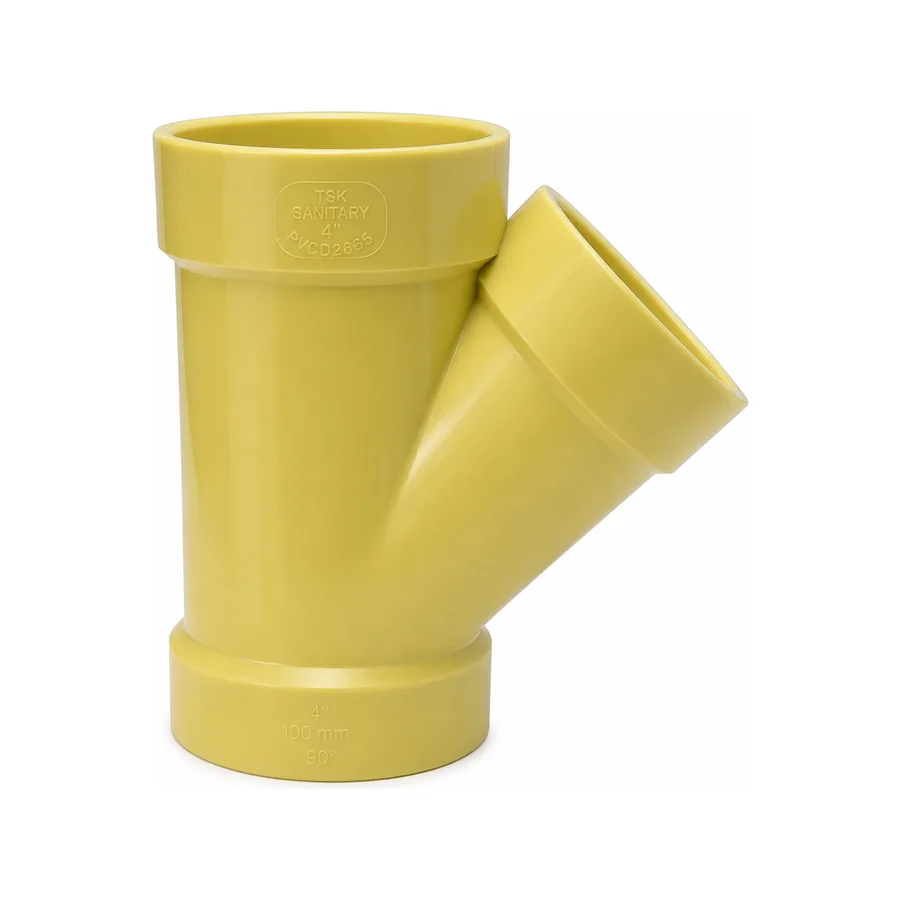
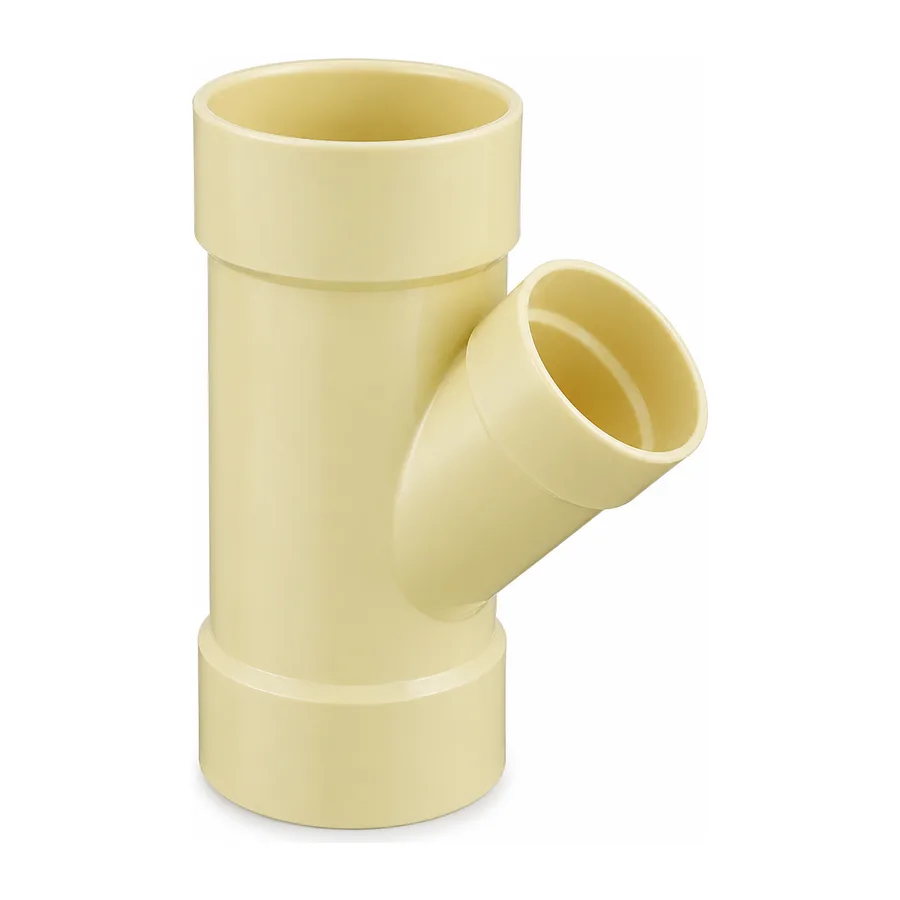
The 4-inch sanitary PVC wye is the fitting that connects a drainage branch to a main run with a 45° inlet. Its three openings are hubs (H×H×H) sized for sanitary pipe with a 114.3 mm outside diameter — the 4-inch size of the Colombian NTC 1087 system — and it is made straight (4″×4″×4″) or reducing (4″×3″ and 4″×2″). Joints are solvent-cemented per NTC 576.
The selection verdict depends on where the branch sits: to connect a branch into a horizontal drain, or the base of a stack into a building drain, use a wye; the sanitary tee is only allowed to take a horizontal branch into a vertical stack. If the branch arrives perpendicular to a horizontal drain, the answer is not a tee: it is the wye + 45° elbow combination. TECTUL supplies the sanitary PVC wye in 2″ to 10″ diameters and the reducing sanitary PVC wye in 3″×2″, 4″×2″, 4″×3″ and 6″×4″.
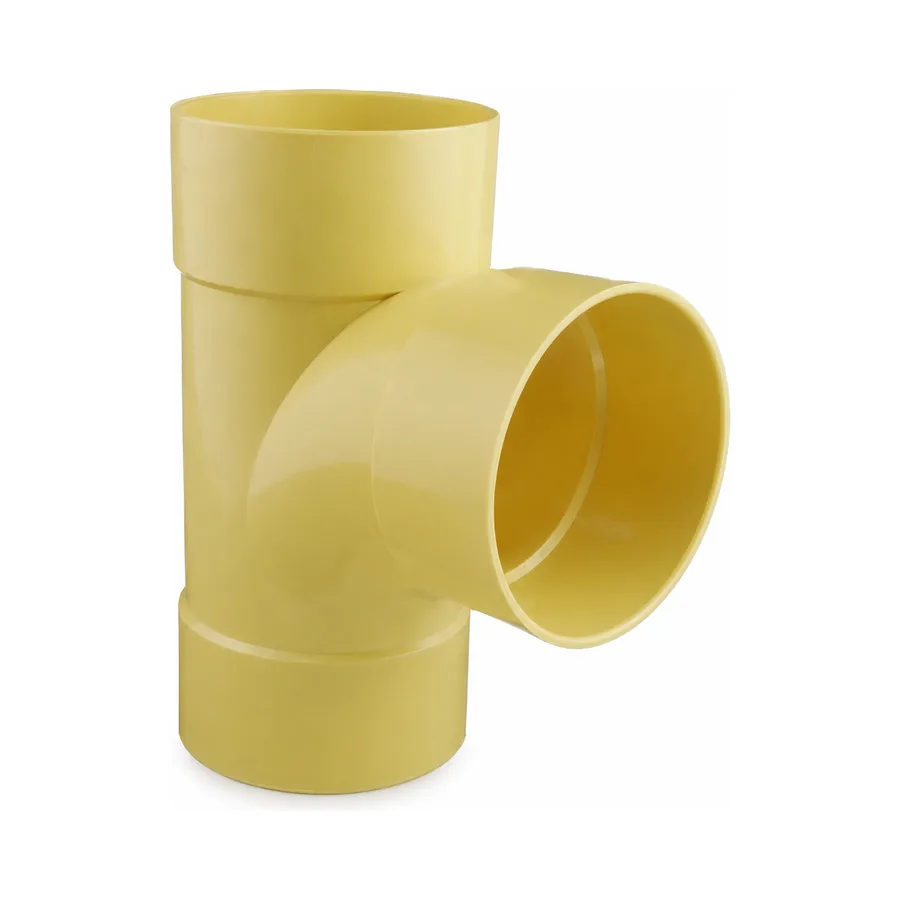
The wye receives the branch at 45° to the axis of the main run; the sanitary tee receives it at 90° with a curved inside radius (that radius is why it is called "sanitary": it is not the square pressure tee). That angle difference governs three things. Hydraulics: at 45° the branch discharge enters aligned with the flow in the main run, with a smaller change of direction and less disturbance at the junction; at 90° the discharge enters perpendicular to the main flow, a condition that DWV fitting patterns (ASTM D3311) reserve for the drop into a vertical stack. Maintenance: the 45° geometry lets a cleaning rod pass from the main run into the branch, while in a tee the rod tends to run straight through. Code: the table of fittings permitted for changes of direction in the International Plumbing Code (Table 706.3), of which NTC 1500 is a modified adoption, allows the wye in every transition and restricts the sanitary tee to the horizontal-to-vertical transition: connecting a horizontal branch into another horizontal drain with a 90° tee is not a permitted installation.
| Fitting | Branch inlet angle | Permitted transitions | Typical use |
|---|---|---|---|
| Sanitary wye | 45° | Horizontal→horizontal, horizontal→vertical and vertical→horizontal | Branches into horizontal drains; stack bases and offsets |
| Sanitary tee | 90° with curved radius | Horizontal→vertical only | Fixture branch entering a vertical stack |
| Wye + 45° elbow (combination) | 90° resolved in two 45° steps | Same as the wye | Branch arriving perpendicular to a horizontal drain |
| Two 45° elbows | No branch: turns the run itself | 90° change of direction of the drain in two steps | Gentle turns of the run, with no branch connection |
The 45° sanitary PVC elbow is the piece that completes both solutions; elbow dimensions by diameter are covered in the guide 4-inch elbow dimensions.
A sanitary fitting has no diameter of its own: its hubs are sized to receive the outside diameter of NTC 1087 pipe. The nominal inch size is a trade name; the physical reference dimension is the outside diameter of the pipe that enters each hub:
| Nominal diameter | Pipe outside diameter (mm) | Pipe outside diameter (in) | Minimum pipe wall (mm) | Reference inside diameter (mm) |
|---|---|---|---|---|
| 2″ | 60.32 | 2.375 | 2.92 | 54.5 |
| 3″ | 82.56 | 3.250 | 3.18 | 76.2 |
| 4″ | 114.30 | 4.500 | 3.30 | 107.7 |
| 6″ | 168.28 | 6.625 | 4.12 | 160.0 |
Two dimensional warnings. First: 3-inch sanitary pipe (82.56 mm) does not match 3-inch pressure pipe (88.9 mm) — in that diameter, fittings from one system do not fit the other. Second: hub depth and overall laying length of the wye are not fixed by a single public table: each manufacturer publishes them in its catalogue and they vary between brands, so they are confirmed against the manufacturer's dimension sheet when quoting. During installation, always dry-fit the pieces to confirm alignment, insertion depth and slope before applying solvent cement.
Commercial configurations of the 4-inch wye are designated run × run × branch:
| Configuration | Openings (run × run × branch) | Branch it receives | Typical use |
|---|---|---|---|
| Straight wye 4″ | 4″ × 4″ × 4″ | 4″ pipe (114.3 mm OD) | Joining two drains of the same diameter; base of a 4″ stack |
| Reducing wye 4″×3″ | 4″ × 4″ × 3″ | 3″ pipe (82.56 mm OD) | 3″ secondary drain branching into a 4″ drain |
| Reducing wye 4″×2″ | 4″ × 4″ × 2″ | 2″ pipe (60.32 mm OD) | Fixture branches (lavatories, sinks, 2″ traps) into a 4″ drain |
| Double wye 4″ | 4″ × 4″ with two 45° branches | Two opposed branches at the same point | Facing fixture groups; availability on request |
The straight wye joins runs of the same diameter and is the piece for stack bases and drain-to-drain junctions. The reducing wye keeps the through bore of the main run and reduces only the branch opening: that is the correct way to receive a smaller branch, because NTC 1500 (clause 8.4.4) forbids reducing the diameter of sanitary piping in the direction of flow — you reduce the incoming branch, never the drain that continues. The double wye concentrates two opposed branches at a single point of the run and saves a pipe segment between two single wyes.
TECTUL availability: straight wye in 2″, 3″, 4″, 6″, 8″ and 10″; reducing wye in 3″×2″, 4″×2″, 4″×3″ and 6″×4″. Double wyes and other configurations are checked when quoting.
Orientation: the wye is installed with the branch inclined in the direction of discharge, so the incoming flow points downstream. Mounted backwards, the branch discharges against the current of the main run and the 45° advantage is lost.
Slope: NTC 1500 assigns 21 mm/m (about 2%) to drains up to 2″ and 10 mm/m (1%) to 3″ and 4″ drains (Table 10.6.1), under the performance criterion of clause 8.4.1 (full-bore velocity between 0.60 and 5 m/s, or tractive force of at least 0.15 kgf/m²). A 4″ drain carries 4.55 L/s at half depth on a 1% slope and 6.4 L/s at 2% (Manning, n = 0.009). The slope must be continuous through the fitting: sanitary pipe is supported along its full length so no back-falls form that hold water and solids.
Solvent-cemented joint per NTC 576:
Before closing the trench or the chase, run the leak-tightness test required by NTC 1500. If the discharge may carry hot water, chemicals or industrial effluent, confirm the permitted temperature and compatibility in the lot data sheet before installation.
The sanitary wye (NTC 1341 fittings, cemented hub) is for gravity drainage inside the building and has no assigned pressure class: it is not used on pressurized lines. For outdoor collector networks there is the sewer PVC wye, a metric-dimension system that is not interchangeable with the sanitary one. The differences between sanitary PVC, pressure PVC and CPVC are covered in the guide types of PVC.
Its three hubs receive sanitary pipe with a 114.3 mm (4.500 in) outside diameter per NTC 1087. Overall length and hub depth vary by manufacturer and are confirmed against the catalogue dimension when quoting.
The branch inlet angle: 45° in the wye and 90° with a radius in the tee. By code, the sanitary tee is only allowed for horizontal-to-vertical transitions; on horizontal drains the branch connects with a wye or with a wye + 45° elbow.
The 4″×2″ reducing wye: it keeps the 4″ through bore of the drain and receives the 2″ pipe (60.32 mm) at the branch opening. Reducing the drain downstream is forbidden by NTC 1500 (clause 8.4.4).
No. The sanitary system (NTC 1087 pipe, NTC 1341 fittings) has no assigned pressure class, and in the 3-inch size the outside diameter does not even match the pressure system (82.56 mm versus 88.9 mm).
Order the wye with the full designation: run diameter × branch diameter, sanitary hub × hub × hub system. For a typical 4″ drain: a straight 4″ wye for junctions and the stack base, a 4″×2″ reducing wye for fixture branches and a 4″×3″ for secondary drains, plus the 45° elbow for branches arriving perpendicular. Complete the order with NTC 576 solvent cement and primer in the same quotation. TECTUL stocks the sanitary PVC wye, the reducing wye, the sanitary tee and the matching sanitary pipe, with delivery across Colombia.