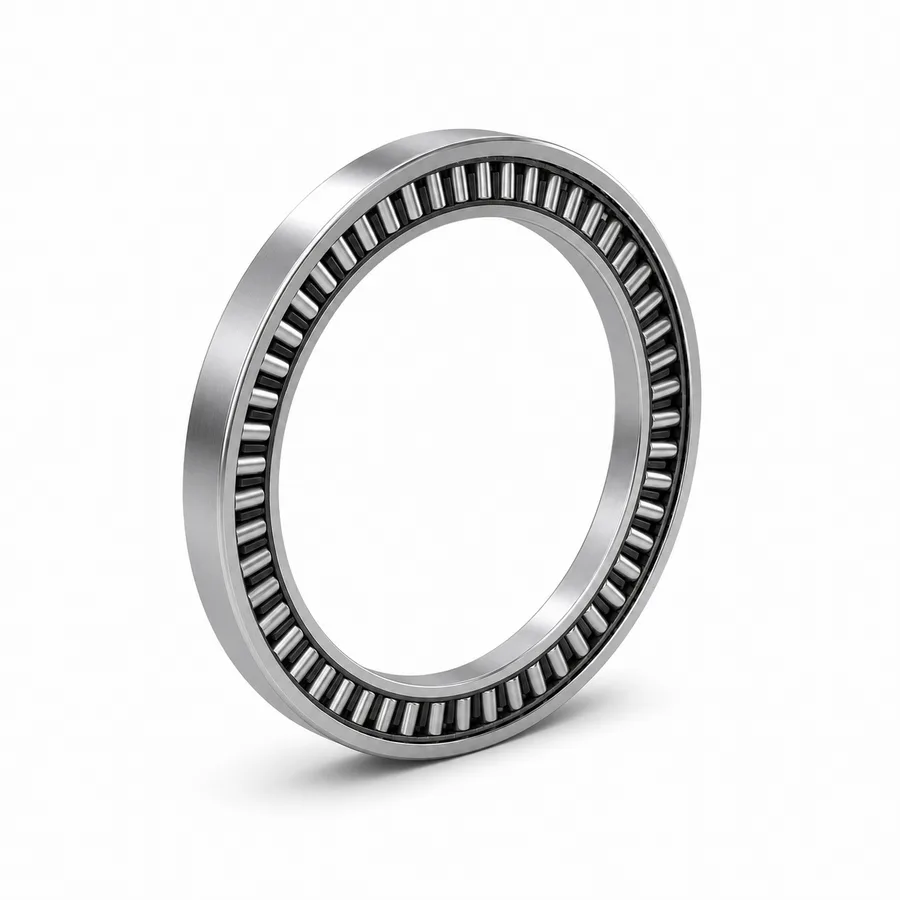
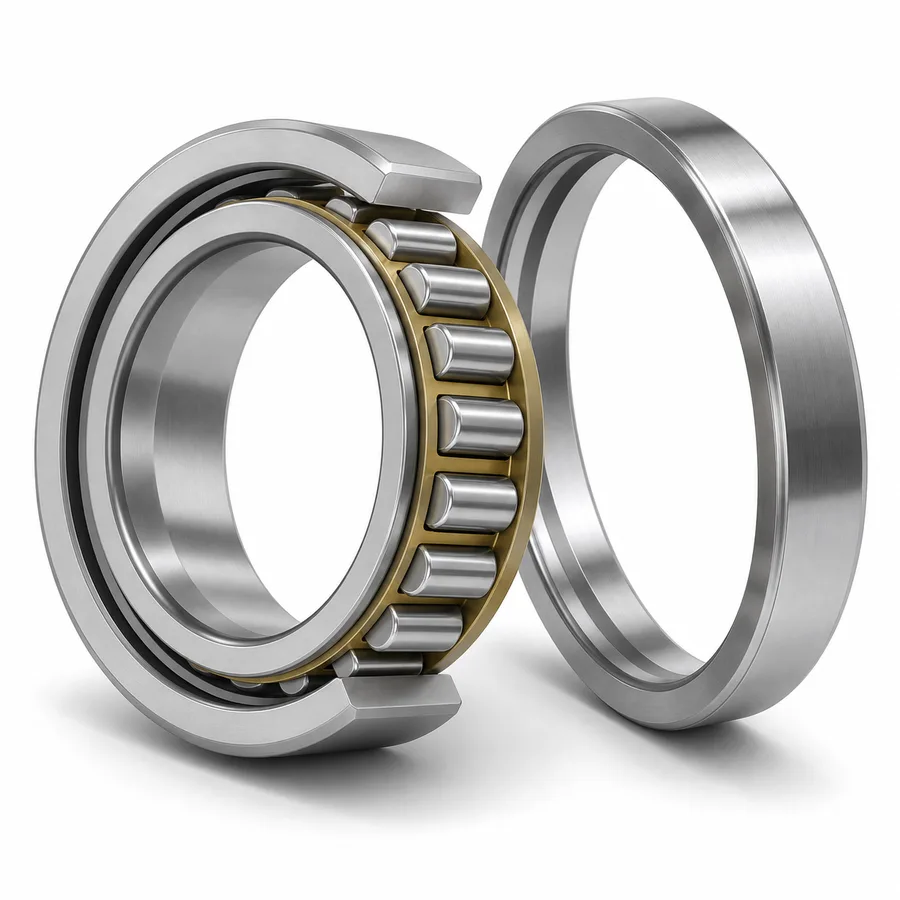
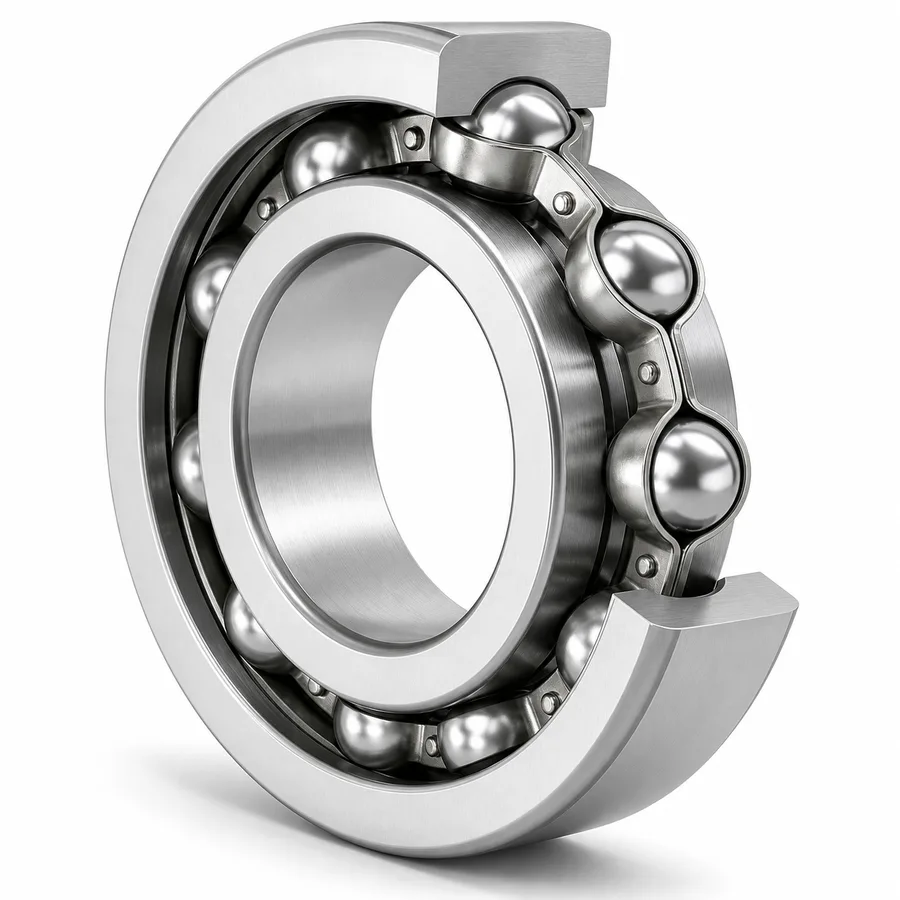
A track roller is a bearing with a thick-walled outer ring designed to run directly on a track, rail or cam, without an intermediate housing. Unlike a conventional bearing, which works confined inside a housing, a track roller takes the load on the outside surface of the ring; that ring is therefore made with a greater wall thickness, able to withstand the bending and shock loads of direct contact. The two main families are yoke-type support rollers (NATR, NATV, NUTR) and stud-type cam followers (KR, KRV, NUKR).
Verdict: for mounting between two supports on a through shaft, use NATR, NATV or NUTR support rollers; for cantilever mounting on a plate or arm, with access from one side only, use KR, KRV or NUKR stud-type cam followers. If you also need to adjust the roller position against the track without moving the support, choose the eccentric-stud variants KRE or NUKRE.
The internal base of a track roller is a needle roller bearing or a set of cylindrical rollers. What changes is the outer ring: it is thick-walled and, in the standard execution, has a crowned running surface, which reduces edge stresses when there is slight misalignment between roller and track. Some catalogs use the suffix X to identify the cylindrical-surface variant, which distributes pressure better on flat tracks when alignment is guaranteed.
One practical consequence defines selection: dynamic and static load capacity are calculated to ISO 281:2007 and ISO 76:2006/Amd 1:2017, but in a track roller the permissible load may be limited by the bending strength of the outer ring on the track, not by rolling-element fatigue. That is why manufacturer catalogs publish, in addition to the C and C0 ratings, a maximum permissible radial load on the track; selection must check both.
Support rollers mount on a through shaft held at both ends, in a fork or yoke. The double-supported mounting is stiffer than a cantilever and takes the highest loads of the family. In the TECTUL range, support rollers cover bores from 5 mm to 50 mm.
The NATR series uses a needle roller and cage assembly, which favors higher rotational speeds; the NATV series uses a full complement of needle rollers (no cage), with more rolling elements in the same space and therefore higher load capacity at lower speed. In both series the outer ring is axially guided by pressed-on side rings that form a gap-type seal; the PP or PPA suffix identifies the execution with polyamide sliding rings that close that gap as a labyrinth seal, for more contaminated environments.
The NUTR series replaces the needles with a full complement of cylindrical rollers, like those of a NU/NJ/NUP cylindrical roller bearing but with a reinforced outer ring. The guiding flanges accept axial guidance loads in both directions, which matters when the track pushes the roller sideways.
| Series | Rolling elements | Axial guidance of the ring | Bore in the range | Reference examples |
|---|---|---|---|---|
| NATR | Caged needle rollers | Pressed-on side rings | 5-50 mm | NATR 10, NATR 25 PPA |
| NATV | Full complement needle rollers | Pressed-on side rings | 6-50 mm | NATV 12, NATV 40 PPA |
| NUTR | Full complement cylindrical rollers | Flanges, accepts axial guidance load | 15-50 mm | NUTR 2052, NUTR 45100 |
A cam follower replaces the inner ring with a solid threaded stud: the bearing arrives ready to bolt in cantilever to a plate, arm or carriage, with a nut on the opposite side. The stud head has a hexagonal socket (or slot, depending on execution) to hold it during tightening, and internal lubrication ducts that allow relubricating the roller once mounted.
Within the family, KR uses caged needle rollers, KRV uses a full complement of needles for higher load, and NUKR uses full complement cylindrical rollers for the highest loads of the group. As with support rollers, the PP and PPA suffixes identify executions with reinforced side sealing.
The KRE and NUKRE variants incorporate an eccentric collar on the stud. Turning the collar shifts the roller center and adjusts the contact against the track or removes system play, without re-machining the support. The eccentricity value depends on size and must be taken from the manufacturer catalog.
| Criterion | Yoke (NATR, NATV, NUTR) | Stud (KR, KRV, NUKR) |
|---|---|---|
| Mounting | Through shaft with double support | Cantilever, bolted with a nut |
| Access required | Both sides of the fork | One side only |
| What the number means | Bore d (NATR 10 = d 10 mm) | Outside diameter D (KR 22 = D 22 mm) |
| Range in stock list | d 5-50 mm | D 16-52 mm |
| Mounting stiffness | Higher, load shared by two supports | Limited by the stud cantilever |
| Adjustment against the track | Requires moving or shimming the support | Available with KRE/NUKRE eccentric |
| Typical replacement | Roller or shaft replaced separately | Complete unit, a single element |
The decision is not a matter of preference but of equipment geometry: if the structure allows a fork with a through shaft, the yoke gives more stiffness and capacity; if only one mounting face is available, the stud type is the intended solution.
The key rule, and the most common source of purchasing errors, is that in cam followers the number indicates the outside diameter, while in support rollers it indicates the bore. This contrasts with conventional radial bearings, whose general dimension plan is defined by ISO 15:2017 and whose bore code is multiplied by 5 from code 04, as explained in our guide how to identify a bearing by its reference.
| Designation | Family | What the number means | Resulting dimension |
|---|---|---|---|
| NATR 10 | Support, caged needles | Bore d | d = 10 mm; D = 30 mm |
| NATV 25 | Support, full complement | Bore d | d = 25 mm |
| NUTR 3580 | Support, cylindrical rollers | Bore and outside diameter | d = 35 mm; D = 80 mm |
| KR 22 | Cam follower, caged needles | Outside diameter D | D = 22 mm |
| NUKR 47 | Cam follower, cylindrical rollers | Outside diameter D | D = 47 mm |
| KRE 47 | Cam follower, eccentric stud | Outside diameter D | D = 47 mm |
Frequent suffixes: PP and PPA indicate additional side sealing with sliding rings; X identifies in some catalogs a cylindrical instead of crowned running surface. For an unknown suffix, the complete reference should be validated against the manufacturer catalog before quoting the replacement.
No: although they share the number 30, the KR 30 has a 30 mm outside diameter and a stud, while the NATR 30 has a 30 mm bore, a through shaft and a larger outside diameter. They belong to different families, with mutually incompatible mounting and dimensions.
Through the internal ducts of the stud, which carry grease to the rolling elements without dismounting the roller. The interval depends on load, speed, temperature and contamination, and is taken from the manufacturer catalog; in dirty environments the PP/PPA sealing extends the useful interval.
The standard crowned profile compensates small misalignments by concentrating contact at the center of the ring and avoiding edge stresses. If the misalignment is permanent and the shaft also transmits it to the support, the answer is not a track roller but reviewing the structure, or considering a housed 22200 series spherical roller bearing, which is self-aligning.
To quote without errors, specify the family (support or cam follower), the complete reference with suffixes, ring profile, sealing and, for cam followers, whether the eccentric version is required. If the reference is not legible, measure bore or stud, outside diameter and width, and describe how the roller is mounted in the equipment. Before buying, confirm which internal bearing family your application uses in our roller bearings guide; and if what failed is a housed unit rather than a roller on a track, review the guide to types of housed bearing units to order the correct spare.