An FRL unit (filter, regulator and lubricator) is the assembly that conditions compressed air right before it enters a tool, cylinder or valve: the filter traps solid particles and condensate, the regulator holds a stable working pressure, and the lubricator meters an oil mist for mechanisms that require it. Without that preparation, air reaches the equipment carrying pipe rust, condensed water and pressure swings that degrade seals, corrode internals and make tools lose torque and speed. That is why the air preparation unit is considered the life insurance of everything consuming air downstream.
Quick verdict: for cylinders, solenoid valves and modern factory-prelubricated tools, a two-piece FR set (filter + regulator) is enough; the full three-piece FRL is only justified when the equipment manufacturer requires continuous lubrication, as in vane air motors, impact wrenches and hammers. For painting, food or instrumentation, the lubricator is forbidden and coalescing filtration is also required. TECTUL supplies the series A/B 2-piece air preparation unit in 1/4" and 1/2" connections.
| Component | Function | Typical specification (manufacturer catalogue) |
|---|---|---|
| Filter (F) | Traps solid particles and separates condensate by cyclonic effect; bowl with drain | 40 µm and 5 µm grades (Festo MS series); 5 µm standard in compact units (SMC AC series); 0.3 µm or 0.01 µm coalescing grades for oil aerosol |
| Regulator (R) | Holds secondary pressure constant through a diaphragm and spring, with overpressure relief | Setting range 0.05 to 0.85 MPa (0.5 to 8.5 bar) depending on series; maximum inlet pressure 1.0 MPa (10 bar) in the SMC AC series and 14 bar (MS4) or up to 20 bar (MS6, manual drain) in the Festo MS series |
| Lubricator (L) | Meters oil mist into the flow by venturi effect, with a visible, adjustable drip | Class 1 turbine oil, ISO VG32 viscosity (SMC catalogue recommendation) |
The standard filter in an FRL unit combines a deflector that spins condensate out into the bowl and a porous element that traps particles. The usual grades are 40 µm for general networks and 5 µm for automation; when the application requires removing compressor oil aerosol, a 0.3 µm or 0.01 µm coalescing filter is added downstream. The bowl must be drained before condensate reaches the marked maximum level; on networks carrying a lot of water, install a dedicated separator upstream such as the water trap filter.
The regulator reduces line pressure to the equipment's working pressure and keeps it constant even when the network fluctuates or consumption varies. It works through a diaphragm balancing outlet pressure against an adjustment spring; relieving models vent the excess when the setpoint is lowered. Most pneumatic tools are catalogue-rated at 90 psi (6.2 bar), so setting the regulator above that value does not increase performance but does increase wear. The air regulator with pressure gauge lets you verify the setpoint at the point of use.
The lubricator atomizes oil into the air flow to lubricate vanes, pistons and seals of tools that demand it. It is filled with ISO VG32 turbine oil and the drip rate is adjusted with the equipment consuming air. Two rules are critical. First: modern cylinders and valves leave the factory prelubricated with grease for life; if oil mist is injected, it washes out the original grease and from that moment the line is forced to lubricate forever. Second: the mist settles along the pipe, so the lubricator must sit close to the point of use and must never feed oil-sensitive equipment (painting, instruments, food packaging, electronics).
ISO 8573-1:2010 classifies compressed air purity with three digits [particles : water : oil]. A designation such as ISO 8573-1 class 1.4.1 means: class 1 for particles (maximum 20,000 particles of 0.1 to 0.5 µm per m³), class 4 for water (pressure dew point of +3 °C or better) and class 1 for total oil (maximum 0.01 mg/m³ including aerosol and vapour).
| Class | Max. particles/m³ (0.1–0.5 µm / 0.5–1 µm / 1–5 µm) | Water: pressure dew point | Total oil (mg/m³) |
|---|---|---|---|
| 1 | 20,000 / 400 / 10 | ≤ −70 °C | ≤ 0.01 |
| 2 | 400,000 / 6,000 / 100 | ≤ −40 °C | ≤ 0.1 |
| 3 | — / 90,000 / 1,000 | ≤ −20 °C | ≤ 1 |
| 4 | — / — / 10,000 | ≤ +3 °C | ≤ 5 |
| 5 | — / — / 100,000 | ≤ +7 °C | — |
| 6 | ≤ 5 mg/m³ (mass concentration) | ≤ +10 °C | — |
A standard FRL with a 5 µm filter does not reach class 1 for particles or oil on its own: that requires chaining a general filter, a fine coalescing filter and, if oil vapour is present, an activated carbon stage. The water class depends on the dryer in the compressor room, not on the FRL unit, which only removes condensate already formed.
| Application | Target air quality (ISO 8573-1) | Recommended configuration |
|---|---|---|
| Painting and coatings | Class 1 for oil (≤ 0.01 mg/m³) | FR + 0.01 µm coalescing filter + activated carbon; no lubricator |
| Impact tools and vane air motors | Particles class 3–4; oil not critical | Full 3-piece FRL with lubricator, if the tool manufacturer requires it |
| Prelubricated cylinders and solenoid valves | Particles class 3–4 | 2-piece FR with 5 µm filter; no lubricator |
| Blow-off and general cleaning | No formal requirement | 40 µm filter + regulator |
| Instrumentation and laboratory | Water class 2–3; oil class 1 | FR + fine coalescing filter + additional drying; no lubricator |
The unit is sized by the equipment's peak flow, expressed in l/min or scfm (1 scfm ≈ 28.3 l/min), not by the thread available on the wall. Commercial bodies run from 1/8" to 1" and each size has a flow versus pressure-drop curve in the manufacturer's catalogue: choose the body whose pressure drop at peak flow is low compared with the regulator setpoint. An undersized unit produces a pressure drop at the moment of highest demand, which shows up as torque loss in impact wrenches and slow strokes in cylinders. When in doubt between two sizes, the larger body with reducing fittings at the connections preserves performance; a reduced body does not. Also check the assembly's maximum inlet pressure (10 bar in the SMC AC series; 14 bar for Festo MS4, 20 bar for MS6 with manual drain) against the actual network pressure.
Use a two-piece filter-regulator when the downstream equipment is prelubricated (cylinders, valves, automation grippers) or when oil is forbidden by the process: painting, food, electronics, instruments. It is the correct configuration for most new installations and takes less panel space. Use the full three-piece FRL only when the tool requires oil mist per its catalogue (vane motors, impact, percussion tools) or when the line was already lubricated and the equipment lost its original grease. Mixing both worlds on the same branch is the most expensive mistake: a single lubricator upstream contaminates the whole branch, including the equipment that must not receive oil.
FRL stands for filter, regulator and lubricator: the air preparation unit that cleans the air, sets the working pressure and, where applicable, meters oil before the pneumatic equipment.
No. The order is filter → regulator → lubricator in the flow direction: if oil passes through the regulator it fouls the diaphragm, disturbs regulation and contaminates the gauge.
Before condensate reaches the bowl's maximum level; in humid climates such as the Colombian tropics that can be daily, so an automatic float drain pays for itself in maintenance.
For a new automation branch or a prelubricated tool, the correct purchase is the series A/B 2-piece air preparation unit (from $ 72,800 COP before VAT, in 1/4" and 1/2") or the integrated filter-regulator with gauge. To get a WhatsApp quote from TECTUL, send four data points: connection size, network pressure, flow or reference of the equipment to be fed, and whether the application tolerates oil. With that, a single reply defines whether your line needs a two-piece FR, a full FRL or an additional coalescing stage, with delivery to Bogotá, Medellín, Cali, Barranquilla and all of Colombia.
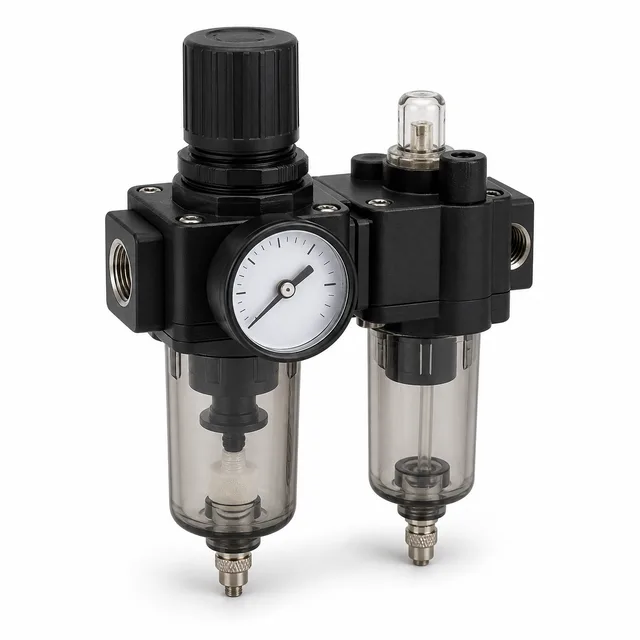 unidad de mantenimiento neumatica 2 partes frl serie a b
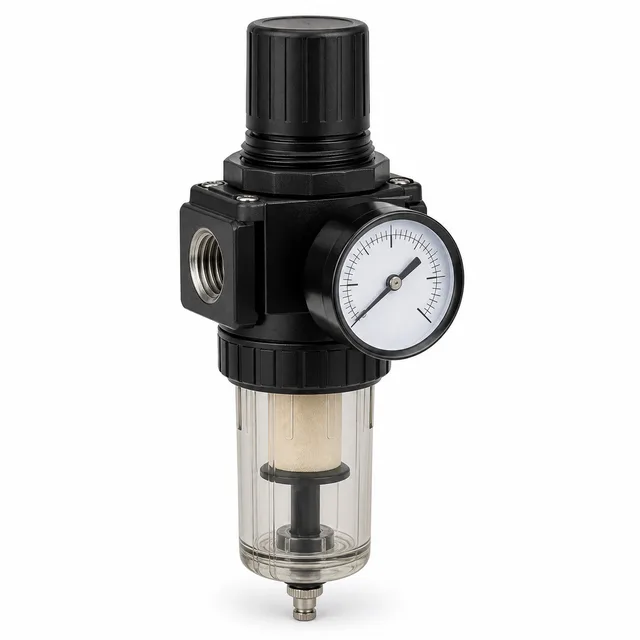 filtro regulador para aire serie a b
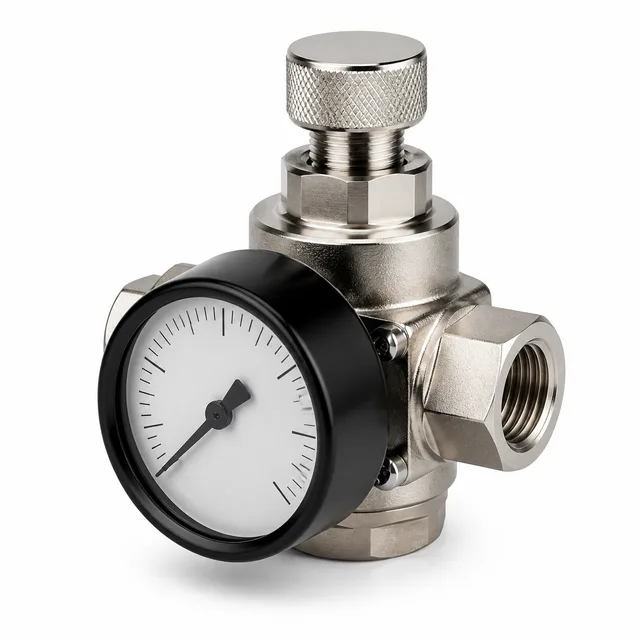 regulador de aire con manometro