Aluminum is hard to weld for one concrete physical reason: the surface is always covered by an aluminum oxide layer (Al2O3) that melts at about 2,072 °C (3,762 °F), while the base metal melts at about 660 °C (1,220 °F). If the process does not break or remove that oxide, the arc melts the metal underneath a solid film and the result is lack of fusion, inclusions and dirty beads. Add to that a high thermal conductivity —approximately 167 W/m·K for 6061-T6 aluminum versus 45-50 W/m·K for carbon steel— and the fact that aluminum shows no color change when heated, so the welder loses the visual warning that steel gives before burn-through.
The practical verdict is direct. For quality work on thin to medium thickness (approx. 0.6 to 6 mm), use TIG with alternating current (AC): it is the standard because of its cathodic cleaning of the oxide. For production above about 3 mm (1/8 in), use MIG with a spool gun or push-pull torch. Reserve the E4043 covered electrode (SMAW) only for repairs where no TIG or MIG equipment is available. For filler metals: on 6061/6063 alloys use ER4043, unless the part will be anodized or requires higher deposit strength (ER5356); on 5052/5083/5086 use ER5356.
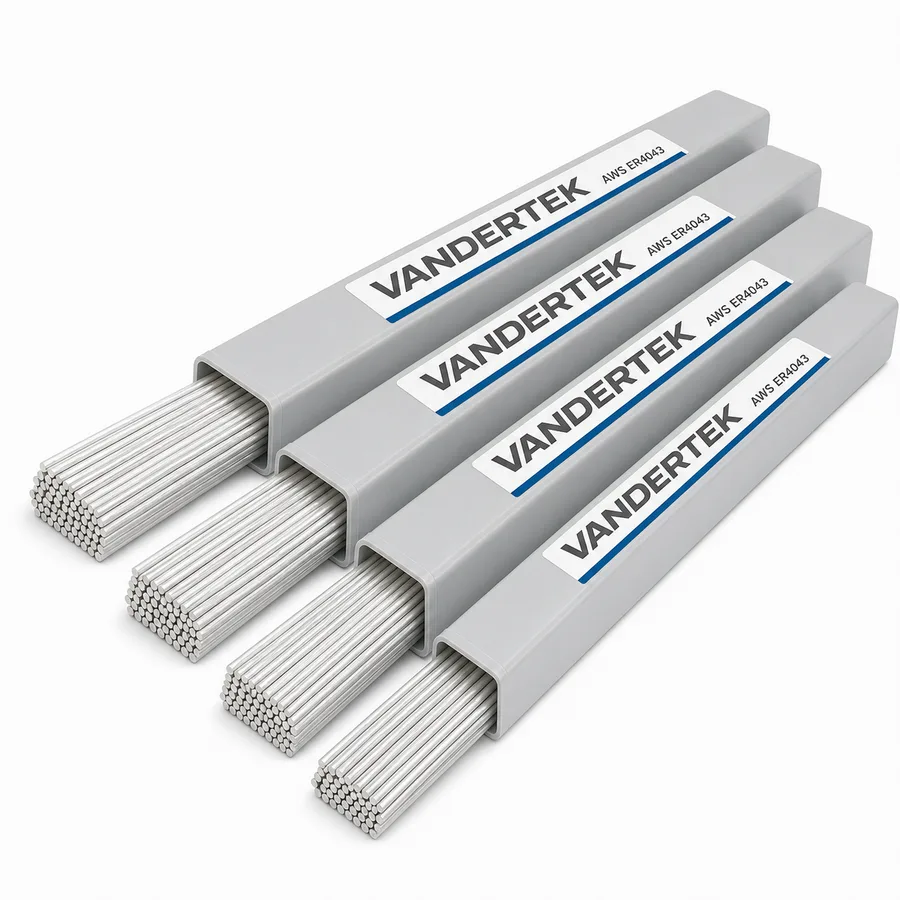
TIG (GTAW) with AC is the reference process for aluminum. During the half-cycle when the electrode is positive, ion bombardment breaks the oxide layer on the puddle (cathodic cleaning); during the electrode-negative half-cycle, heat penetrates the part. Square-wave machines allow adjusting the AC balance: more cleaning for oxidized material, more penetration for well-prepared material. Use pure argon and a filler rod classified under AWS A5.10, such as the ER4043 TIG rod. It is the right process for thin sections, tubing, quality repairs and cosmetic beads.
MIG (GMAW) is the productive process for aluminum from about 3 mm thickness upward, with spray transfer and argon. The problem is wire feeding: aluminum wire is soft and buckles in long steel liners, causing the jam known as a bird nest. There are three solutions, in order of preference by distance: spool gun (small spool mounted on the gun), push-pull system, or a short torch with a PTFE (polytetrafluoroethylene) liner and U-groove drive rolls. Use contact tips sized for aluminum, which compensate for the thermal expansion of the wire.
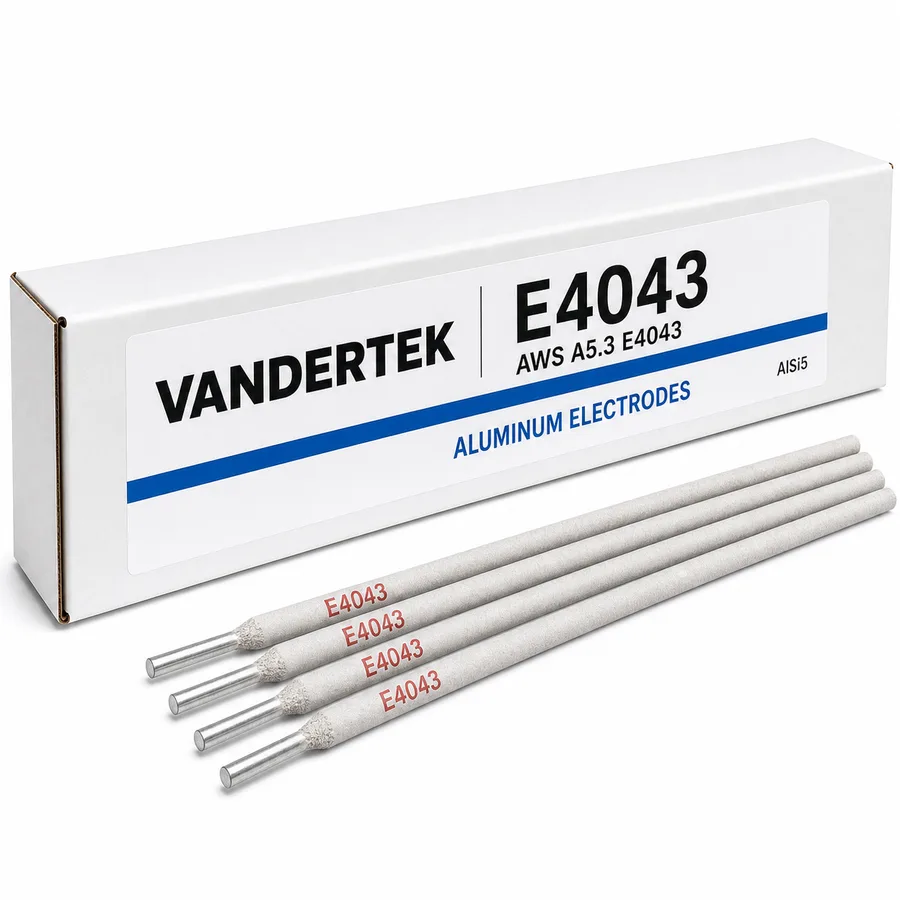
The SMAW process with the E4043 aluminum electrode (AWS A5.3) exists, but it is the last resort: aggressive slag that must be fully removed, a hygroscopic coating that absorbs moisture and generates porosity, and an arc that is hard to control below 3-4 mm thickness. It is justified for field repairs with direct current electrode positive (DC+) when no TIG or MIG equipment is available, never as a fabrication process.
| Process | Practical thickness | Gas / medium | Strength | Limitation |
|---|---|---|---|---|
| AC TIG (GTAW) | 0.6 to 6 mm (up to ~10 mm with preheat) | Argon (helium or mixes on thick sections) | Cathodic cleaning, maximum control and quality | Slow; demands skill and both hands |
| MIG (GMAW) with spool gun | From ~3 mm (1/8 in), no practical upper limit | Argon; argon-helium mixes above ~12 mm | High deposition, suited to production | Wire feeding; difficult below 3 mm |
| SMAW with E4043 | From ~3-4 mm, repair only | Electrode coating (DC+) | Portable, no shielding gas | Corrosive slag, porosity, poor finish |
The two dominant classifications of the current standard AWS A5.10/A5.10M:2023 (ISO 18273:2015 MOD) are ER4043 (aluminum-silicon, 4.5-6.0 % Si) and ER5356 (aluminum-magnesium, 4.5-5.5 % Mg). They are not interchangeable: the choice depends on the base alloy, the service and whether the part will be anodized.
| Criterion | ER4043 (Al-Si) | ER5356 (Al-Mg) |
|---|---|---|
| Typical base alloys | 6061, 6063, Al-Si castings (e.g. A356) | 5052, 5083, 5086, 5456; also 6061/6063 |
| Fluidity and puddle handling | Higher fluidity, more docile puddle, less spatter | Stiffer puddle, better for position welding |
| Deposit strength | Lower; sufficient for the 165 MPa (24 ksi) joint minimum in 6061-T6 per AWS D1.2 | Higher tensile strength and better ductility of the deposit |
| Crack sensitivity on 6xxx | Low: silicon narrows the hot-shortness range | Acceptable with adequate dilution |
| Color after anodizing | Dark gray to black: the bead stands out | Tone similar to the base metal: correct choice for anodized parts |
| Service restrictions | Do not use on 5xxx alloys with more than ~2.5 % Mg (embrittlement by Mg2Si) | Do not use in sustained service above 65 °C (150 °F): stress-corrosion cracking risk |
Decision rule: if the base is 6061 or 6063 and the part will not be anodized or carry high dynamic loads, ER4043 is the choice for handling and low crack sensitivity. If the base is 5052, 5083 or 5086, or the part will be anodized, use ER5356. If the assembly will operate continuously above 65 °C, rule out ER5356 and validate the filler with the welding procedure.
On thick sections (above ~6 mm for TIG, above ~10 mm for MIG) a moderate preheat compensates for heat dissipation and helps evaporate condensed moisture. The limits matter more than the preheat itself: on heat-treatable alloys such as 6061-T6, keep the part temperature below ~120 °C (250 °F) and for short times, because prolonged exposure degrades the temper; on 5xxx alloys with more than 3 % magnesium (5083, 5086, 5456), limit interpass temperature to ~65 °C (150 °F) to avoid sensitizing them to stress-corrosion cracking. AWS D1.2 covers these interpass temperature controls for structural aluminum welding. Never preheat with a carburizing flame: it deposits soot that generates porosity.
For a shop that welds aluminum regularly: AC TIG with argon and ER4043 rod for 0.6 to 6 mm thickness on 6061/6063; a spool gun with wire classified under AWS A5.10 for production above 3 mm; ER5356 when the base is 5052/5083 or the part will be anodized; and the E4043 electrode only as a repair resource. Complete the kit with dedicated stainless steel brushes and degreasing solvent. When requesting a quote from TECTUL, state the base alloy, thickness, available process and whether the part will be anodized or operate above 65 °C: with those four data points the correct filler is defined on the first try.