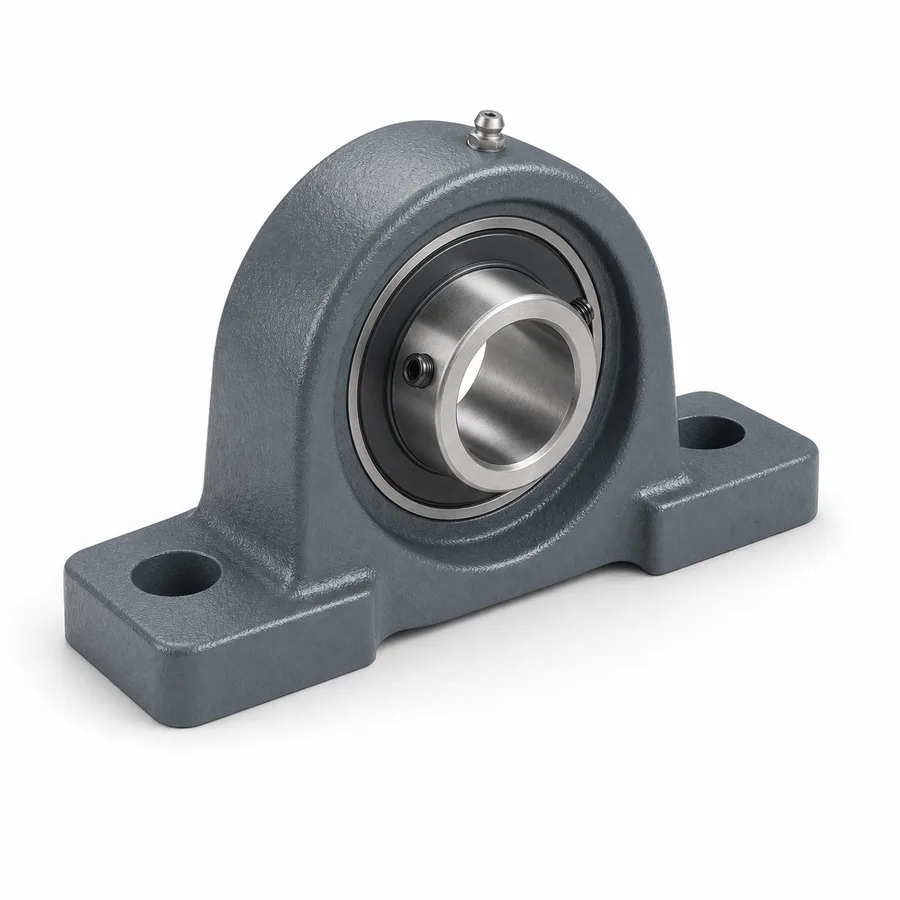
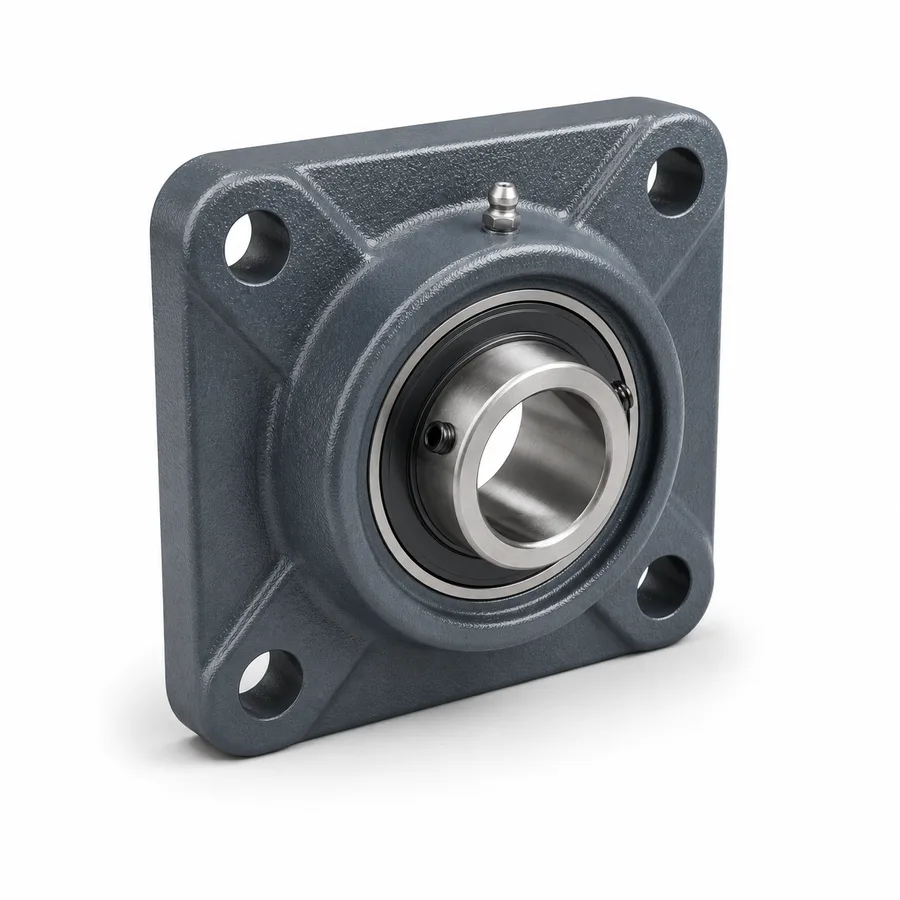
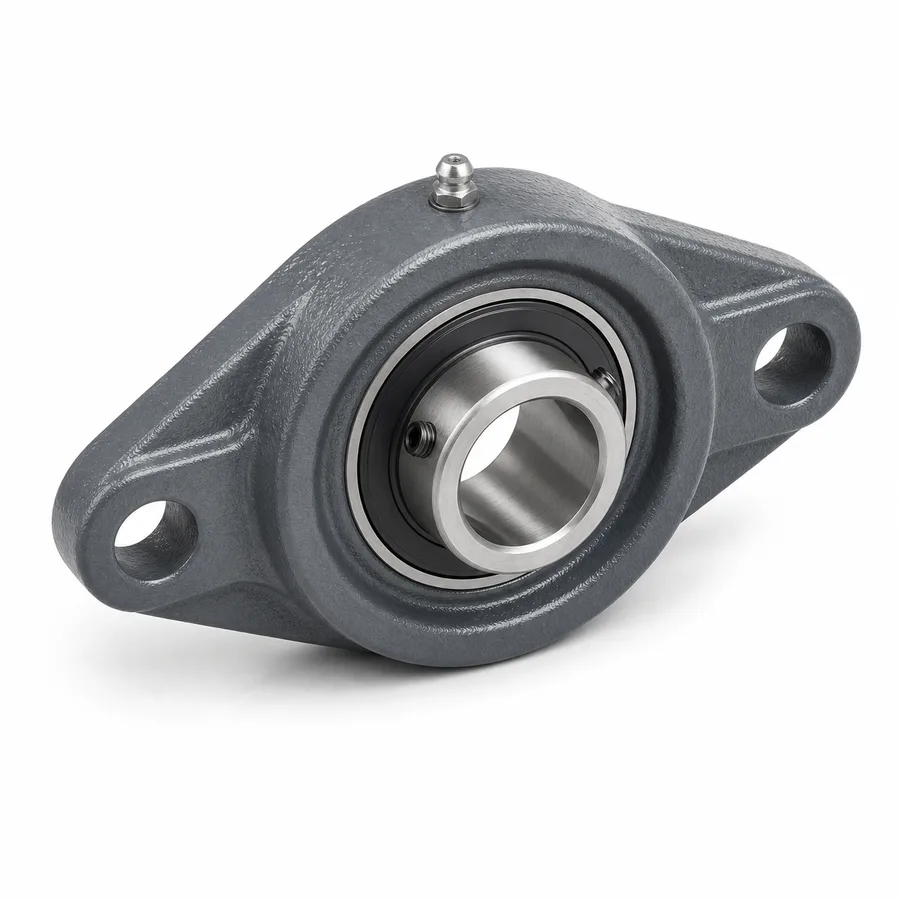
A housed bearing unit combines a bearing and a housing, ready to be bolted to a structure and support a shaft. Correct selection is not limited to shaft diameter: housing type, insert, locking method, allowable alignment, sealing and material must be chosen. TECTUL supplies UCP pillow block units, UCF units, UCFL units, UCT take-up units and bearing inserts.
Verdict: use UCP for floor mounting, UCF for a square flange on a wall or plate, UCFL when a two-bolt oval flange is needed, and UCT for belt or chain tensioning. If only the internal bearing failed and the housing is sound, replace the equivalent UC insert; if the housing is cracked, worn oval or corroded, replace the complete unit.
A typical unit combines a cast or equivalent housing, an insert bearing with a spherical outside ring, seals, grease fitting and shaft locking system. The spherical outside ring compensates small static misalignment between shaft and housing, but it does not correct a bent shaft or an uneven base.
ISO 3228 standardizes boundary dimensions and tolerances for cast and pressed housings for insert bearings. Manufacturer catalogs add material, load, speed, seal and locking method details. In maintenance, the commercial designation is the quick entry point, but confirmation must include base dimensions, bolt spacing and shaft center height.
| Type | Housing form | Fastening | Typical use | TECTUL product |
|---|---|---|---|---|
| UCP | Pillow block | Two base bolts | Conveyors, fans, horizontal shafts | UCP pillow block unit |
| UCF | Square flange | Four bolts | Wall, side plate or compact machine | UCF flange unit |
| UCFL | Oval flange | Two bolts | Side mounting with limited space | UCFL oval flange unit |
| UCT | Take-up slider | Adjustable guide | Belt, chain or moving shaft tension | UCT take-up unit |
| UC | Insert | Set screws or collar by design | Internal replacement of the unit | Bearing insert |
In many metric units, the final insert number follows the ×5 rule from code 04. Therefore UC204 corresponds to 20 mm, UC205 to 25 mm, UC206 to 30 mm and UC207 to 35 mm. A UCP205 unit uses a UC205 insert and therefore corresponds to a 25 mm shaft in a common metric designation.
| Designation | Typical insert | Shaft diameter | Comment |
|---|---|---|---|
| UCP204 | UC204 | 20 mm | Pillow block, small shaft |
| UCP205 | UC205 | 25 mm | Very common in light and medium equipment |
| UCF206 | UC206 | 30 mm | Square flange for plate |
| UCFL207 | UC207 | 35 mm | Oval flange, two bolts |
| UCT208 | UC208 | 40 mm | Take-up unit for longitudinal adjustment |
The UC insert with set screws locks the inner ring to the shaft through grub screws. It is simple, available and fast to install, which is why it dominates conveyors and general machinery. Its limitation is that the screws mark the shaft and depend on correct torque, cleanliness and a suitable seating surface.
For reversing loads, vibration or better concentricity, alternatives may exist with eccentric collar, adapter sleeve or extended inner ring depending on manufacturer. Locking methods should not be mixed without checking space, direction of rotation and axial load.
Housing shape governs selection. UCP works on a horizontal base and provides robust mounting with defined center height. UCF bolts to a vertical plate or machine face with four bolts, improving flange rigidity. UCFL saves space and weight with two bolts, useful on side structures. UCT is used when the shaft must move to tension a belt, chain or conveyor.
| Mounting need | Recommended choice | Data to verify | Common error |
|---|---|---|---|
| Horizontal base | UCP | Center height and bolt spacing | Buying only by shaft size |
| Rigid vertical plate | UCF | Four-bolt square pattern | Confusing it with UCFL |
| Limited side space | UCFL | Distance between the two bolts | Overloading a light flange |
| Tension adjustment | UCT | Travel and take-up frame | Using it as a fixed bearing |
A housed unit with a UC insert is practical, but it does not replace every bearing support. Allowable radial load depends on insert size, housing material, seal type, lubrication and speed. Axial load is usually limited compared with bearings specifically designed for thrust; if the shaft receives continuous thrust, the design must be reviewed.
Speed also conditions the purchase. As rpm increases, balancing, lubrication, concentricity and shaft locking become more important. A set screw on a damaged shaft can create eccentricity; a weak base can amplify vibration. On slow conveyors the unit may tolerate rougher conditions; on fast fans the same practice may fail.
The seal protects the bearing from dust, moisture and particles. In food plants, washdown areas, cement plants, quarries or agribusiness, contamination is often the real failure cause, not bearing size. The grease fitting enables relubrication, but excess grease can raise temperature and push out seals. Grease must be compatible with speed, temperature and contaminants.
When the unit works outdoors, in a corrosive environment or under washdown, housing material, coating and seal type should be reviewed. If a standard cast housing rusts or accumulates material, another material or protection may be required. That decision depends on the environment and should not be made by unit price alone.
The housing needs a flat and rigid surface. If it is installed on a flexible structure, the bearing receives deformation that does not appear in the commercial reference. Bases must be tightened with suitable bolts and, when applicable, washers or plates that distribute load. In pairs of units, alignment between centers defines service life.
A small self-aligning capacity does not authorize mounting bent shafts. The unit compensates moderate static errors, but dynamic misalignment or a shaft that deflects in operation loads seals and raceways. Before blaming the spare part, measure shaft, base and distance between supports.
Replacing only the insert reduces cost and time when the housing keeps its geometry, threads, grease fitting and spherical seat in good condition. If the housing is worn oval, damaged or corroded, the new insert will not be properly supported. In that case, the complete unit is the technically correct purchase even if it looks more expensive. Damaged bolts should also be replaced and the base cleaned so the new unit does not inherit deformation from the previous installation. That review avoids blaming the bearing for a failure caused by structure or mounting.
For safe purchasing, specify UCP/UCF/UCFL/UCT type, shaft diameter, bolt pattern, environment, speed and load. For replacement, bring the complete unit and insert references. If the shaft is marked by set screws, repair the seating surface before installing the new unit; otherwise the failure will repeat even with the correct spare.