A pressure gauge is the instrument that indicates the gauge pressure of a fluid on a graduated dial, almost always through a Bourdon tube that deforms under pressure and drives the pointer through an amplifying movement. Choosing well means deciding five things: measuring principle, dry or glycerin-filled case, materials, dial size with its connection, and accuracy class with the correct range.
Quick verdict: for compressed air, water and oils without vibration use a dry gauge with bronze internals; if there is machine vibration or pump/compressor pulsation, use a glycerin-filled gauge or a dry gauge with an internally dampened movement; for chemicals or corrosive environments, all-stainless-steel case and internals (plus a diaphragm seal if the fluid attacks stainless or clogs); for steam, any gauge always with a siphon; and for very low gas pressures (water-column ranges), a capsule gauge, not a Bourdon.
The classic element is the Bourdon tube: a metal tube of flattened cross-section bent into a C shape that tends to straighten as internal pressure rises. That tip travel — a few millimeters — is amplified by a sector-and-pinion movement that rotates the pointer. For high ranges the tube is made spiral or helical. The European standard for these instruments, EN 837-1, covers nominal sizes from 40 to 250 mm and ranges up to 1,600 bar (23,200 psi).
Below roughly 1 bar the Bourdon loses sensitivity, and the elements of the standard EN 837-3 take over: the diaphragm (also suited to dirty or viscous fluids) and the capsule (two membranes welded at the rim), the standard choice for gas in millibar or inches of water. That case is covered by the 2.5 in gauge in inches of H₂O in the TECTUL catalog.
The difference is not quality but service. A dry gauge has an air-filled case; it is more economical, reads without distortion and accepts any ambient temperature within the instrument's rating. A glycerin-filled gauge has the case filled with glycerin (typically 99.7 %): the liquid damps the pointer, lubricates the movement and absorbs vibration and pressure surges.
There is a third, modern option: the gauge with a dry-dampened movement, an internally dampened mechanism that stops pointer flutter without liquid in the case (Winters markets it, for example, as StabiliZR), with vibration and pulsation performance comparable to a glycerin fill per the manufacturer's testing. Its advantage shows up over the years: glycerin yellows or darkens with UV rays and above about 65 °C (150 °F) — per Ashcroft documentation — until the dial becomes hard to read; the dry-dampened movement delivers the same stability without that aging, with no fill fluid to leak and no draining of the case to service the instrument.
| Criterion | Dry | Glycerin-filled | Dry-dampened |
|---|---|---|---|
| Machine vibration (pumps, compressors, chassis) | The pointer flutters and the movement wears prematurely | The pointer stays steady and the fill lubricates the movement | The pointer stays steady: the dampened movement stops flutter without liquid |
| Fluid pulsation (positive displacement) | Unreadable pointer; requires an external dampener | Damps the reading; under severe pulsation a restrictor or snubber is added as well | Comparable to glycerin fill; restrictor under severe pulsation |
| Ambient temperature | That of the instrument | Glycerin: −20 to +60 °C (−4 to +140 °F); outside that range, a silicone fill (down to −40 °C) per WIKA | That of the instrument: not bound by the limits of a fill liquid |
| Long-term readability | Stable dial | Glycerin yellows or darkens with UV and temperature until the dial becomes hard to read | No liquid to yellow: the window stays clear |
| Humid or condensing environments | May fog internally | The fill prevents internal condensation on the window | May fog like any dry case; a sealed case mitigates it |
| Maintenance and leaks | No liquid | Possible fill leakage; draining and refilling needed for service | No liquid to leak or refill |
| Cost | Lower | Higher (fill and sealed case) | Higher than a conventional dry gauge |
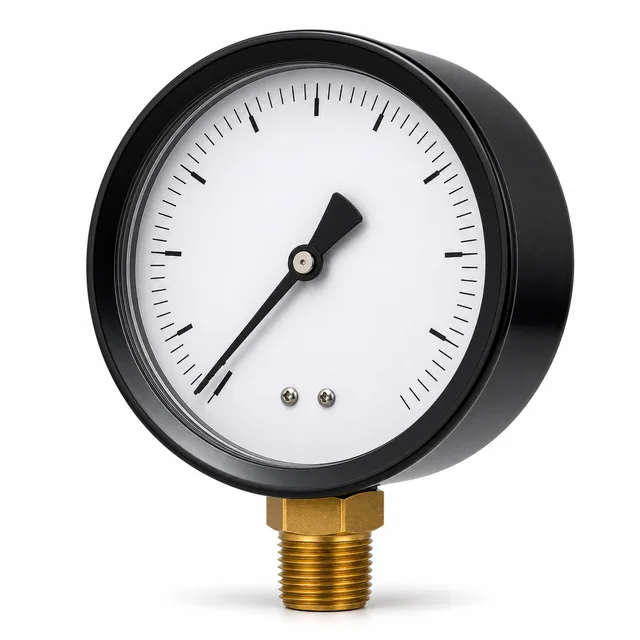
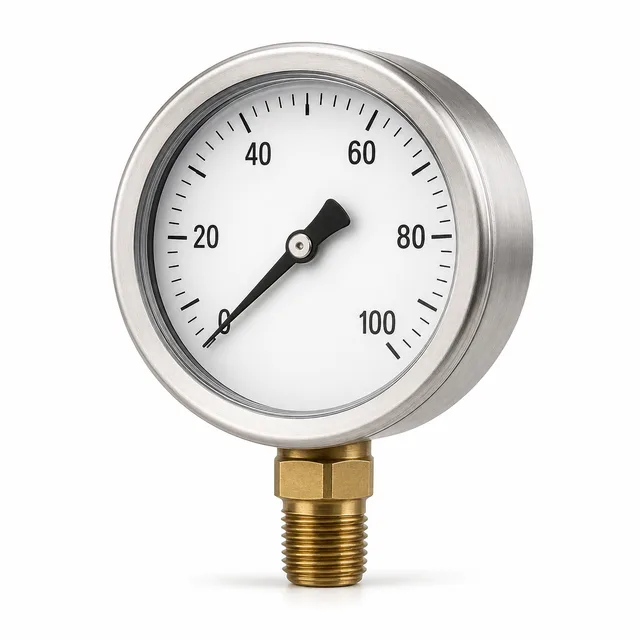
Practical rule: if the gauge mounts on or near rotating equipment, or measures the discharge of a pump or compressor, order glycerin-filled or dry-dampened (prefer dry-dampened when the dial must remain readable for years outdoors or near heat); at a static point of the network, a dry gauge does the job at lower cost. Compare: 2.5 in black-case dry gauge and 2.5 in stainless-case glycerin-filled gauge.
Two separate decisions: the case is chosen by the environment (outdoors, washdowns, corrosive atmosphere) and the wetted parts are chosen by the fluid that enters the instrument.
| Configuration | Case | Wetted parts | Typical service |
|---|---|---|---|
| Black case + bronze | Black-painted carbon steel | Copper alloy (bronze/brass) | Compressed air, water, oils and non-corrosive fluids in dry indoor areas; the most economical option |
| Stainless case + bronze | 304 stainless steel | Copper alloy | Non-corrosive fluid in a demanding environment: outdoors, humidity, frequent washdowns |
| All stainless | 304 stainless steel | 316 stainless steel | Chemicals compatible with 316, steam and ammonia (which attacks copper alloys) |
| All stainless + diaphragm seal | Stainless steel | The fluid only touches the seal's diaphragm | Fluids that corrode even 316, crystallize, polymerize or clog (slurries, resins, hot acids) |
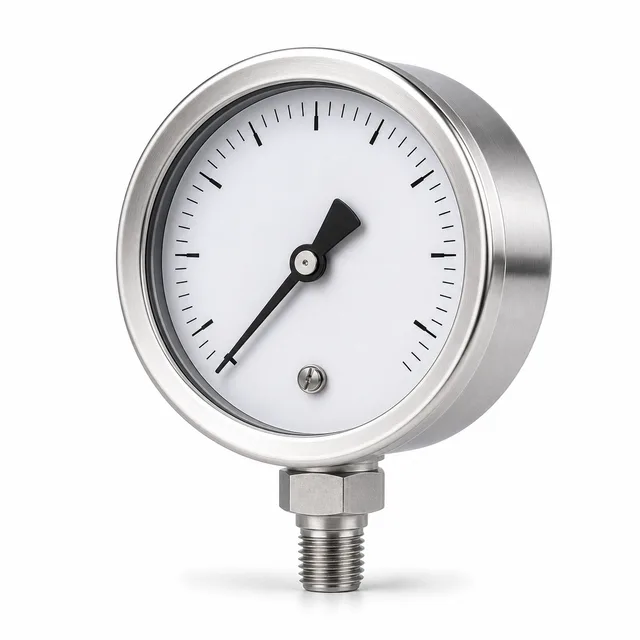
The chemistry rule is direct: bronze for neutral fluids; 316 stainless when in doubt or with corrosion; diaphragm seal when even 316 is not enough or when the fluid would clog the Bourdon's capillary. For the all-stainless line, the catalog reference is the 4 in all-stainless gauge with recalibratable pointer, which allows adjusting zero against a reference without opening the movement.
Commercial dials run from 1.5 to 4 in (equivalent to the 40, 50, 63 and 100 mm nominal sizes of EN 837-1); 6 in (160 mm) dials are used on boiler panels. A larger dial accepts finer graduations and better accuracy classes; a 1.5 in dial cannot carry the graduations a high class would require.
In Colombia the dominant thread is the tapered NPT per ASME B1.20.1. Connection size follows the dial: 1.5-2 in → 1/8 in NPT; 2.5 in → 1/4 in NPT; 4 in and larger → 1/2 in NPT — the matrix of the TECTUL catalog.
Accessories: on steam, a siphon (pigtail) keeps a condensate plug between live steam and the Bourdon; under severe pulsation, a restrictor; and to remove the instrument without shutting the line, an isolation-and-bleed gauge valve. All standardized in ASME B40.100.
Accuracy is expressed as ± % of span. The American standard ASME B40.100-2022 defines grades; in grades A through D the permitted error changes by dial zones (lower quarter - middle half - upper quarter). The European standard EN 837-1 defines classes with a single value over the full span.
| ASME B40.100 grade | Error (± % of span) | Comparable EN 837-1 class | Typical use |
|---|---|---|---|
| 4A | 0.1 | 0.1 | Laboratory reference standards |
| 3A | 0.25 | 0.25 | Test and calibration gauges |
| 2A | 0.5 | 0.6 | Accuracy-demanding process (4 in dials and larger) |
| 1A | 1 | 1 | General industrial process |
| A | 2 - 1 - 2 (by zones) | 1.6 | Standard plant monitoring |
| B | 3 - 2 - 3 (by zones) | 2.5 | General indication on 1.5 to 2.5 in dials |
| C | 4 - 3 - 4 (by zones) | 4 | Basic indication |
| D | 5 - 5 - 5 | — | Visual reference only |
Practical reading: a commercial 2.5 in gauge is usually grade B or class 1.6/2.5. If the reading feeds quality control or a report, specify grade 1A/class 1 or better on a 4 in dial, and verify the class marked on the dial face.
The Bourdon works best away from its extremes: the correct range is not the one that just reaches your pressure. The practice recommended by manufacturers in line with ASME B40.100:
Example: compressed-air network at 100 psi (6.9 bar) → 0-200 psi gauge (0-14 bar), not 0-100 psi.
| Application | Recommended configuration | Mandatory accessory |
|---|---|---|
| Compressed air and pneumatics | Dry, black or stainless case, bronze internals, 2.5 in, 1/4 in NPT | None; glycerin-filled if mounted on the compressor |
| Water and pumping | Glycerin-filled or dry-dampened at pump discharge (pulsation); dry at static points | Isolation valve for maintenance |
| Steam | All stainless (316 internals), dry | Siphon always; glycerin fill is not recommended due to temperature |
| Chemicals | All stainless 316; with diaphragm seal if the fluid corrodes, crystallizes or clogs | Diaphragm seal with a compatible fill fluid |
| Low-pressure gas (burners, internal networks) | Capsule gauge with scale in mbar or inches of H₂O | None; verify gas compatibility with bronze |
| Vibrating equipment (chassis, presses) | Glycerin-filled or dry-dampened; back connection if read on a panel | Restrictor under severe pulsation |
To quote a pressure gauge, five data points are enough: fluid, operating pressure (the range will be twice that value), vibration or pulsation (defines dry, glycerin-filled or dry-dampened), dial size and connection (bottom to the line, back to a panel) and the accuracy class if the reading feeds quality or control. The TECTUL catalog covers the full matrix: 2.5 in black-case dry gauge for general services, compact 1.5 in back-connection gauge for panels, 2.5 in stainless-case glycerin-filled gauge for vibration, 4 in all-stainless recalibratable gauge for process and chemicals, and a capsule gauge in inches of H₂O for low-pressure gas. Ranges, dual psi/bar scales and accessories (siphons, gauge valves, seals) are quoted via WhatsApp with the data of the measurement point.