Selecting a water meter is not simply buying the nominal pipe size. Industrial buyers must match minimum flow, normal flow, maximum flow, water quality, allowable pressure loss, reading type, metrological traceability and available installation space. An oversized meter may miss low consumption; an undersized meter may operate outside its range, increase head loss and wear prematurely.
This guide consolidates searches about water meter types: single jet, multi jet, positive displacement, Woltmann and ultrasonic. For supporting hydraulic instrumentation, TECTUL can supply glycerin-filled pressure gauges and industrial thermometers; the meter itself must be selected from the applicable standard and the manufacturer datasheet.
ISO 4064 and OIML R 49 describe meter performance through characteristic flow rates. Q1 is the minimum flow from which the instrument must measure within the permitted error; Q2 is the transition flow; Q3 is the permanent or continuous operating flow; Q4 is the overload flow for limited periods. The Q3/Q1 ratio expresses measuring range: the higher the ratio, the better the ability to register low consumption without losing upper range.
For purchasing, request declared Q3/Q1 range, temperature class, pressure class, permitted orientation, laying length, connection, body material, local or remote reading and calibration certificate when the project requires it. AWWA standards use product families for cold potable water, such as displacement, multijet, turbine and ultrasonic; equivalence with ISO classes must be confirmed in the datasheet, not assumed from the commercial name.
| Type | Principle | Advantage | Limitation | Typical use |
|---|---|---|---|---|
| Positive displacement | Measuring chamber | Very good low-flow registration | Sensitive to solids and dirty water | Residential, small commercial, submetering |
| Single jet | One jet drives a small turbine | Compact and economical | More sensitive to flow profile and installation | Small clean-water services |
| Multi jet | Several jets distribute force | Better hydraulic balance and service life | Not ideal for large diameters | Buildings, commerce, secondary networks |
| Woltmann | Helical turbine, horizontal or vertical axis, at high flow | Low relative loss at high flows | Lower sensitivity at very low flows | Industry, master metering, plant inlet |
| Ultrasonic | Transit time in full conduit | No moving parts and electronic reading | Requires stable hydraulic installation | Districts, telemetry, high-value metering |
Positive displacement meters divide volume into mechanical chambers and totalize cycles. They usually perform well at low flow, dripping or intermittent demand. They are useful when billing depends on capturing small consumption and the water is reasonably clean. In return, particles, scale or sand can block the chamber, affect accuracy or increase maintenance.
When selecting them, check whether the manufacturer allows horizontal or vertical installation, sensitivity to solids, filter requirements, potable-water materials and remote-reading compatibility. If the service has raw water, sediment or frequent water hammer, asking for the “most accurate” meter is not enough; another technology with lower mechanical sensitivity may be more reliable.
Velocity meters convert water velocity into volume. In a single-jet meter, one stream impacts the rotor; in a multi-jet meter, several ports distribute force around the chamber. Multi-jet designs usually provide better mechanical stability because turbine forces are balanced, while single-jet designs support compact equipment.
In both cases, water cleanliness, installation position and available straight length matter. Turbulence from elbows, partially open valves or immediate reducers can affect the velocity profile and the reading. In building projects, submetering or commercial services, multi-jet is common when the target is a balance of cost, robustness and reasonable sensitivity.
Woltmann meters are turbine meters for larger diameters and flows. Their strength is in networks with medium-to-high continuous flow: process inlets, master metering, tank filling, distribution networks or industrial consumption. With a relatively open passage, they can handle high flows with controlled pressure loss compared with small-chamber technologies.
The weakness appears when actual consumption spends many hours below the useful range. In a plant with high peaks but very low night demand, a simple Woltmann may under-register low flow. In those cases, compound meters, wide-range ultrasonic meters or redesign of the measuring point should be evaluated. Purchasing must start from the hourly consumption profile, not the flange size.
Transit-time ultrasonic meters measure the difference between signals travelling with and against the flow in a full conduit. They have no rotor, gears or displacement chamber, reducing mechanical wear and enabling digital output, alarms, communication and diagnostics. They are attractive for telemetry, district metering, water balances and points where data value justifies electronic technology.
Performance depends on a hydraulically stable installation: full pipe, controlled air, reasonable flow profile, grounding or power supply as required, and compliance with mounting instructions. If the line has entrained air, cavitation, nearby throttled valves or very short runs, accuracy may degrade. The supplier should confirm straight length, orientation, ingress protection and communication protocol.
For residential billing or small clean-water submetering, positive displacement and multi-jet meters are often first candidates. For medium commercial networks, multi-jet offers a useful balance of sensitivity and robustness. For industry and master metering with sustained flows, Woltmann and ultrasonic options should be compared by actual range and pressure loss. For advanced telemetry, reverse-flow detection or reduced maintenance, ultrasonic meters gain weight.
Do not publish or buy a flow number unless it is backed by the exact model datasheet. Two meters with the same nominal diameter may have different Q3, Q1, pressure loss, laying length and temperature classes. For TECTUL support, provide fluid, pressure, temperature, expected minimum flow, normal flow, maximum flow, orientation and communication requirement.
Installation defines much of the metrological result. The meter must remain accessible for reading, removal and testing, with isolation valves and, when the manufacturer requires it, an upstream strainer. In mechanical meters, solids increase wear or blockage; in ultrasonic meters, trapped air and flow disturbances may degrade the signal. The line should operate full, without cavitation, and with a mounting arrangement that does not force the meter to act as a pipe support.
Maintenance depends on technology. Positive displacement and multi-jet meters require inspection of chamber, rotor, filter and transmission. Woltmann meters require checking turbine, bearings, dirt and pressure loss. Ultrasonic meters reduce moving parts, but require attention to battery, electronics, communication and diagnostics. In every case, periodic verification should be defined by criticality: billing, water balance, process control or only operational indication.
For industrial purchasing, the requirement should state reference standard, measuring range, permanent flow, connection, material, orientation, reading, communication, certificate and installation conditions. If the meter is part of billing or official balance, confirm whether a specific metrological approval is required. If it is for internal control, repeatability, communication and maintenance access may carry more weight. The purchase order should lock the exact model so it is not substituted by another meter with the same diameter but different performance.
Correct selection starts with the flow profile. If the point measures low consumption and clean water, prioritize positive displacement or multi-jet. If it measures high industrial flows, compare Woltmann and ultrasonic by range, pressure loss and maintenance. If remote data and diagnostics are required, specify electronic output from the beginning. Add a pressure gauge, pressure switch and isolation valves as supporting instrumentation so testing and maintenance can be done without field improvisation.
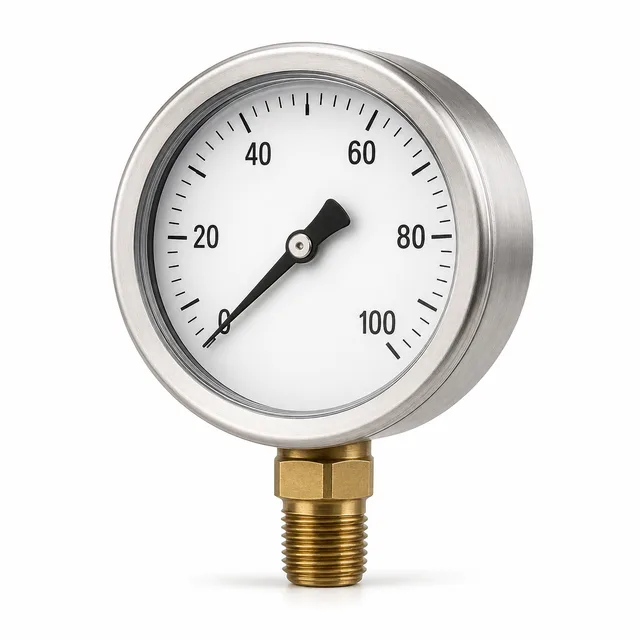 manometro glicerinado inoxidable
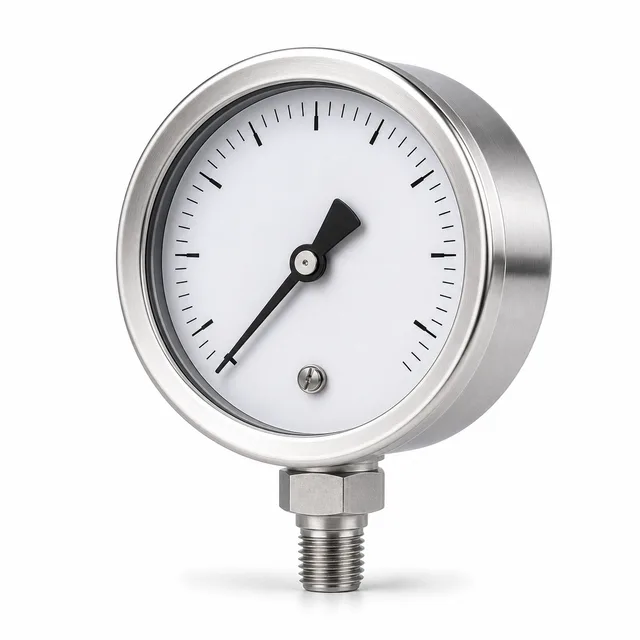 manometro seco inoxidable calibrable
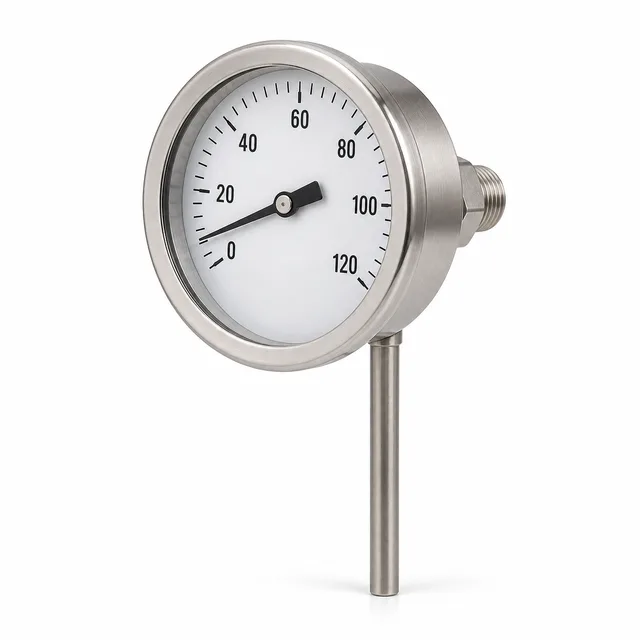 termometro bimetalico inoxidable