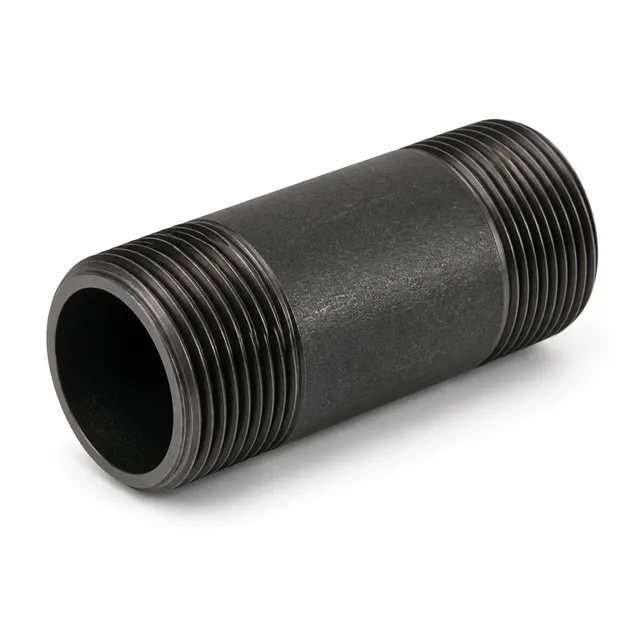
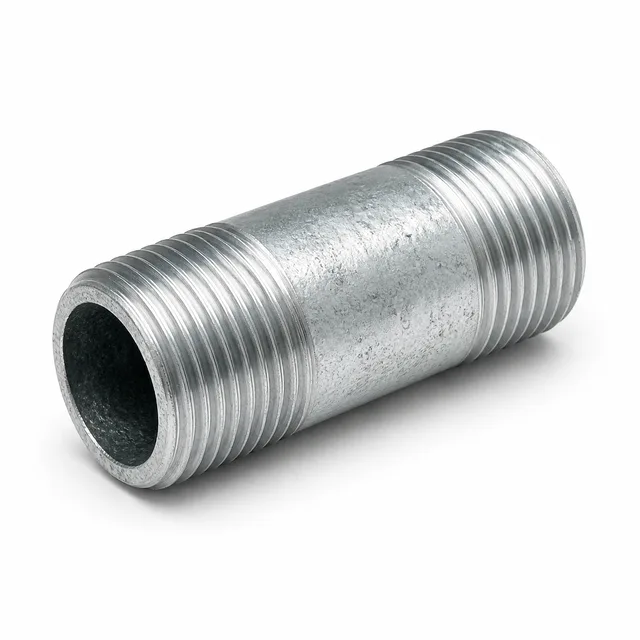
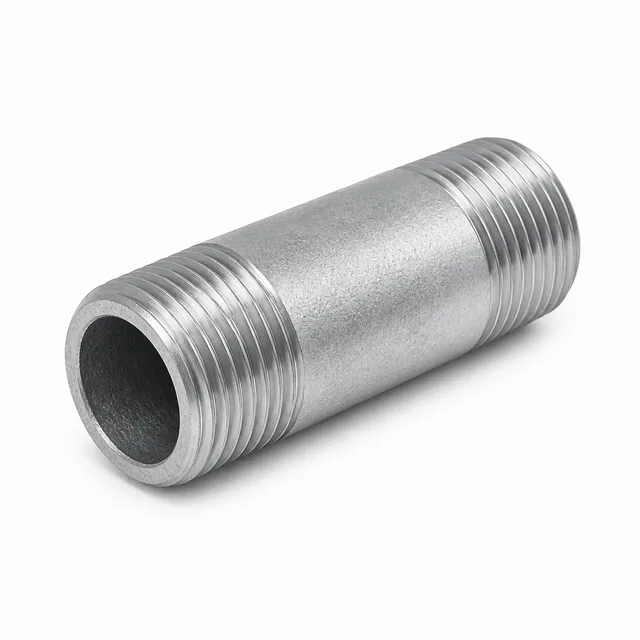
A pipe nipple looks simple: a short piece of threaded pipe. In industrial purchasing, however, a poorly selected nipple can change equipment spacing, limit pressure, create galvanic corrosion, damage a valve or leave insufficient useful thread. Nipple sizes should therefore be ordered with nominal diameter, length, material, schedule, thread type and construction style.
This guide consolidates close nipples, hex nipples, specific-length nipples and common materials. At TECTUL, buyers can review carbon steel SCH40 nipple, galvanized SCH40 nipple, galvanized STD nipple, stainless threaded barrel nipple and bronze hex nipple. Selection must match the pipe, fittings and fluid.
A nipple connects two threaded components, spaces equipment, transitions between fittings or completes a short distance in a network. It may be fully threaded, threaded at both ends with a plain center, hexagonal for wrenching, reducing or made to a defined length. The most common thread in North American-style systems is NPT under ASME B1.20.1; it should not be mixed with BSP or other threads without validation.
The nipple works as part of the pressure system. It is not enough that it screws in. It must have compatible material, sufficient wall thickness, suitable length for tightening and maintenance access. In a vibrating line, a long nipple can act as a lever. In a corrosive line, the wrong material can fail before the main pipe.
| Type | Description | Typical use | Caution |
|---|---|---|---|
| Close nipple | Threaded along its full length | Compact fitting-to-fitting joints | Leaves no plain area for wrenching |
| Barrel nipple | Threaded ends with central body | Controlled spacing between valves and fittings | Confirm overall length and useful thread |
| Hex nipple | Central hex body for wrenching | Instrumentation, fittings, bronze or stainless | Useful where frequent assembly is expected |
| Specific-length nipple | Made or cut to a defined length | Field adjustments, equipment, special assemblies | Must preserve standard thread and wall thickness |
| Reducing nipple | Different diameters at each end | Transition between sizes | Check pressure loss and compatibility |
Sizes are expressed by nominal thread diameter and overall length. Common maintenance diameters run from 1/8 to 2 inches, with larger sizes depending on the system. Commercial length may be short for compact connections or longer to bridge equipment spacing. Do not issue an order only as “half inch nipple”: state 1/2 NPT, material, schedule and length.
| Nominal diameter | Common commercial lengths | Usual use | Comment |
|---|---|---|---|
| 1/8 to 1/4 | Short and hex styles | Instrumentation, drains, air | Check fine thread and material |
| 3/8 to 1/2 | Short, close and extension lengths | Maintenance, small valves, water and air | Very common in plants |
| 3/4 to 1 | Short, barrel and specific lengths | Threaded pipe and general fittings | Confirm schedule and galvanizing if required |
| 1 1/4 to 2 | Lengths by assembly | Medium networks, pumps and manifolds | Higher torque and support needed |
Schedule is a dimensional wall-thickness designation. ASME B36.10M organizes carbon steel pipe dimensions; ASME B36.19M covers stainless pipe. ASTM A733 specifies welded and seamless carbon steel and austenitic stainless steel pipe nipples. A SCH40 nipple should not be replaced by a thinner one when the line was specified with mechanical margin, demanding threading or corrosion allowance.
Threading removes wall material. That is why thickness matters especially in threaded nipples. In small diameters, a schedule difference can change robustness and service life. If the system uses SCH80 pipe, high-pressure fittings or surge service, do not assume any commercial galvanized nipple is equivalent.
Black steel is used in industrial lines where corrosion is controlled by coating, compatible fluid or internal conditions. Galvanized steel adds a zinc coating, useful in non-aggressive water and moderate environments, but not universal for chemicals or high temperature. Stainless steel is selected for corrosion, hygiene or chemical compatibility. Bronze works well in many water and instrumentation connections and is easy to assemble in small fittings. PVC is used only where the plastic system, pressure, temperature and thread design allow it; threaded connections call for Schedule 80 PVC, since plastic SCH40 should not be threaded.
Avoid combinations that create galvanic corrosion or torque problems. Bronze with steel, stainless with carbon steel or PVC with metal may be valid, but fluid, environment and sealant must be reviewed. For potable water or food-related service, request applicable materials and certifications.
Most threaded industrial nipples use NPT. Because it is tapered, the thread creates interference as it tightens, but normally needs compatible sealant. Use PTFE tape, paste or anaerobic sealant according to fluid, temperature and material. Keep tape off the first thread and do not compensate damaged threads with more sealant.
The overall nipple length is not always the free distance between fittings. Part of the nipple enters each female thread, and that engagement changes with tolerance, sealant and tightening torque. When spacing between valves or equipment is critical, measure the installed distance or request a specific length with defined useful thread. On instruments, final orientation may require a hex nipple or an additional union to avoid forcing the equipment body.
Tightening should be progressive. If the nipple runs too easily to the bottom, the thread may be worn or the standard may be wrong. If it locks from the first turn, check for damage or incompatibility. Do not use long wrench extensions on small bronze, thin stainless or PVC fittings; excess torque can crack or deform the part before it seals.
During a plant shutdown, old nipples should not be reused automatically. Check corrosion under the thread, zinc loss, pitting, ovality, damaged threads and wrench marks. An inexpensive nipple can become the weak point of a costly line. If the service is steam, compressed air, chemicals, fuel or potable water, document material and condition.
When changing material, review galvanic compatibility and sealant. Moving from galvanized to stainless, steel to bronze or metal to PVC can be correct, but it must respond to the fluid and environment. In buried systems or washdown exposure, consider external protection and future inspection access.
For general maintenance in water or air, a galvanized or SCH40 carbon steel nipple may be sufficient if fluid and environment are compatible. For corrosion, hygiene or chemicals, evaluate stainless steel or bronze according to service. For tight spaces, use a hex nipple; for compact joints, a close nipple; for precise spacing, a specific length. A complete TECTUL request includes diameter, length, material, schedule, thread and fluid. That prevents buying a nipple that fits but does not work safely as part of the system.
To close a technical purchase, record service condition, requested standard, quoted reference and any installation restriction. That traceability prevents substitutions by appearance when shifts, suppliers or maintenance urgency change. At receiving, compare physical marking with the purchase order and keep the datasheet when the line is critical for safety, production or compliance.
If the product is installed in an existing network, document what was removed, what was installed and what test was performed. A photo of the marking, a pressure note or a material confirmation often saves hours during future shutdowns. At TECTUL, this information supports technically sound equivalents and rejects changes that only appear compatible.