A load pulley supports, redirects or rolls a load: it guides a steel wire rope in a hoisting system, changes the direction of a fiber rope for manual lifting, or rolls along a rail in a gate or moving structure. It is not the same as a power transmission pulley, which works with A, B, SPA or SPB V-belts; that family has its own guide in types of V-belt pulleys. This guide covers the pulley that carries weight, not the one that transmits power between shafts.
Verdict: for steel wire rope, use a sheave with the groove machined to the exact cable diameter and check the D/d ratio; for fiber rope, use a round, smooth, wider groove; for rolling on a rail, angle or rod, use a V-groove rolling pulley; for continuous rotation choose double bearing, for frequent rotation a single bearing, and for slow or occasional rotation a bronze bushing. TECTUL manufactures its own load pulleys in Colombia, with the groove machined to the wire rope, fiber rope or tube that will run through it.
The groove of a wire rope pulley must match the nominal cable diameter. A groove narrower than the rope pinches it and wears the outer wires; a groove that is too wide lets the rope flatten under load and lose its circular section. That is why the pulley is specified with two diameters: the pulley diameter and the rope it houses, for example a 3 in (76.2 mm) pulley for 1/2 in (12.7 mm) wire rope.
The D/d ratio divides the pulley diameter (D) by the nominal rope diameter (d). Every pass over the sheave is a bending cycle: the smaller the pulley, the higher the bending stress on the wires and the shorter the rope's fatigue life. Available strength also drops: test data compiled in the Wire Rope Users Manual of the Wire Rope Technical Board shows that bending a rope over a diameter equal to its own (D/d = 1) reduces its effective strength to about half. The same manual publishes minimum D/d ratios by rope construction:
| Wire rope construction | Minimum D/d ratio | Practical reading |
|---|---|---|
| 6x7 (thick wires) | 42 | Stiff rope: demands large sheaves |
| 6x19 Seale | 34 | General purpose with moderate bending |
| 6x25 Filler Wire | 26 | More fine wires, more flexible |
| 6x36 Warrington-Seale | 23 | The option for smaller sheaves and drums |
Those minimums apply to equipment where the rope bends in a continuous cycle: cranes, winches, hoists and elevators, where design practice uses ratios of 40 or more to extend rope life. In low-speed redirection — guy lines, coffee and cocoa drying equipment, occasional manual lifting — smaller ratios are used, accepting shorter rope life and compensating with the system's design factor. The table also explains why a 6x36 wire rope tolerates smaller pulleys than a 6x19 wire rope of the same diameter: it has more wires, each thinner, and bends with less stress. For continuous wire rope service, TECTUL also offers the wear-resistant pulley with double bearing, manufactured in wear-resistant material to extend the life of the groove and the rope.
Natural or synthetic fiber rope does not behave like wire rope: it deforms more under load and fails by abrasion before fatigue. The rope pulley uses a round, wide groove with a smooth, edge-free surface that spreads the contact over a larger area of the fiber. Running fiber rope in a wire rope groove concentrates the pressure on a narrow band and wears the rope out in a few shifts. Its field of work is manual load lifting on job sites, farms and warehouses, where a person pulls the rope directly or through a simple tackle.
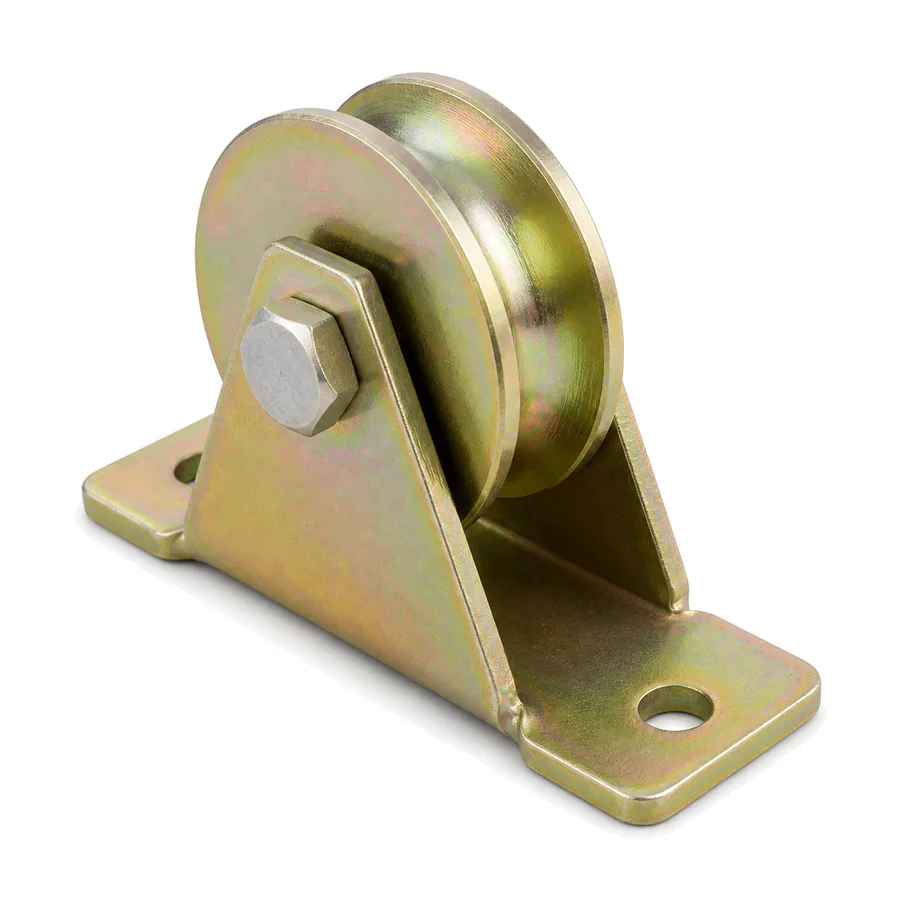
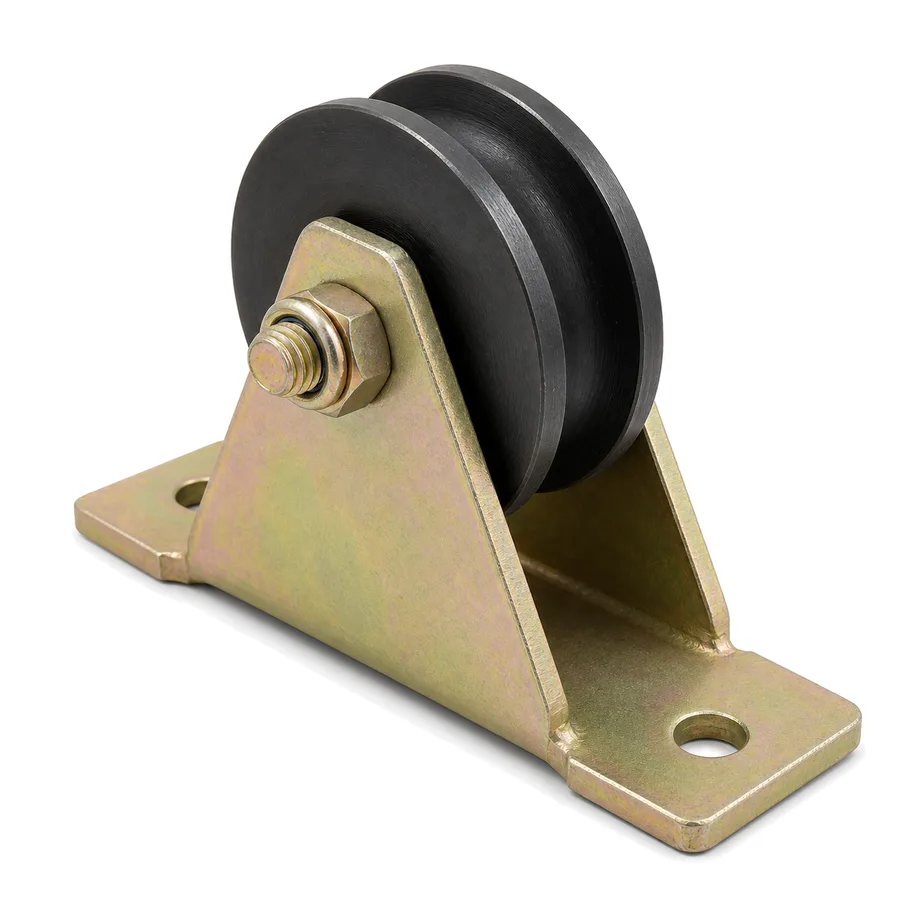
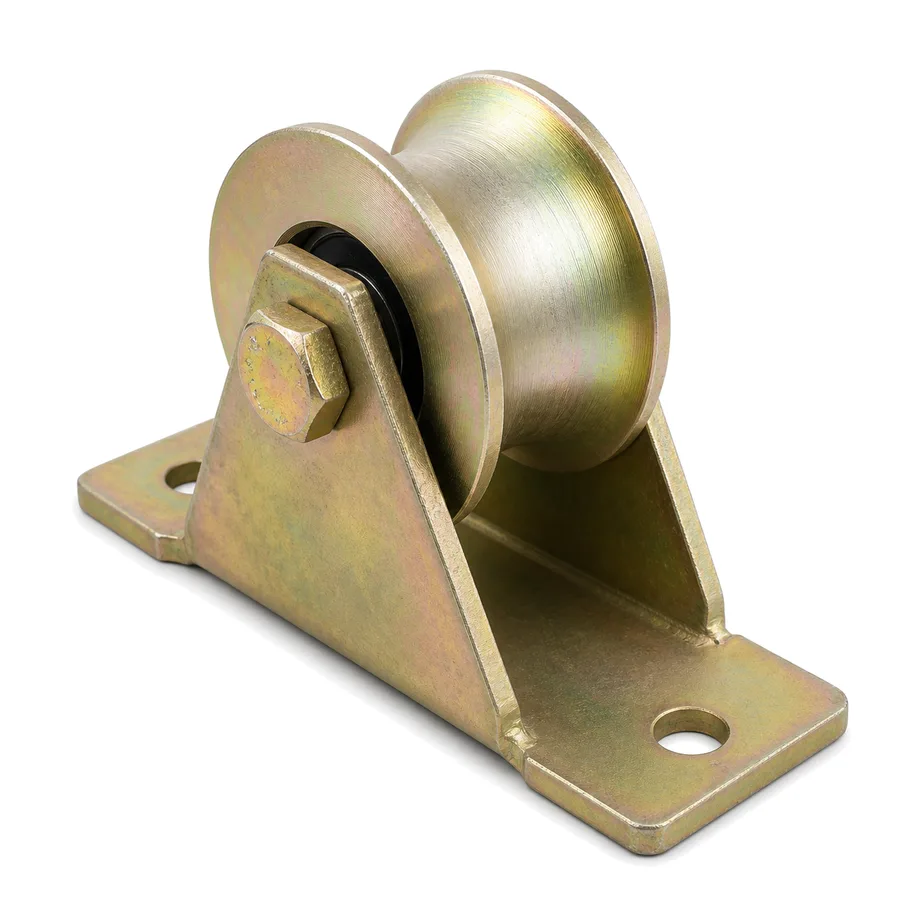
The V-groove rolling pulley is not a transmission pulley even though the name looks similar: it carries the load on its periphery and rolls guided on an angle, a rod or a rail, or guides belts and cables in agricultural machinery. It is manufactured with a V, trapezoidal or semi-trapezoidal groove, and with three rotation options: without bearing (with bushing), with a single bearing or with double bearing. The tube pulley is its variant for rolling on round tube: the groove is machined to the tube diameter (2 and 2 1/2 in) and mounts double bearings, typical in gates and rolling structures.
The rotation element defines friction, the ability to rotate under load and maintenance. The decision is not about price but about duty:
| Rotation element | Friction and rotation | Maintenance | When to choose it |
|---|---|---|---|
| Bronze bushing | Higher sliding friction; slow or occasional rotation | Requires periodic lubrication | Loads with little rotation, dusty or sandy environments, shock service |
| Single bearing | Low rolling friction; frequent rotation | Sealed bearing, replaced by commercial reference | Repeated manual lifting and redirection with regular movement |
| Double bearing | Low friction with two supports; continuous rotation without wobble | Same as single, with higher axial stability | Continuous service, larger pulley diameters and higher loads |
In a multi-pulley tackle, friction accumulates sheave by sheave: every bushing pivot point demands more line force than one with a bearing. If the system is operated by hand, that accumulation is felt directly by whoever pulls the rope or the cable.
Mounting is chosen by the permanence of the anchor point. A latched hook allows the pulley to be hung and removed from a point in seconds, and is the typical mounting of the snatch block or temporary redirection pulley; in blocks with a hinged side plate, the cable is inserted from the side without unreeving its end. An eye with a shackle builds a semi-permanent point that is inspected and disassembled with tools. A base or bracket is bolted or welded to the structure when the pulley stays fixed, as in dryers, gates and guy lines.
The load seen by the pulley and its anchor is not the line tension: it is the vector sum of the incoming and outgoing lines, equal to 2·cos(θ/2) times the tension, where θ is the angle between both lines. With a parallel return (0° angle), a 500 kg line loads the anchor with 1,000 kg:
| Angle between lines | Factor on line tension | Example with a 500 kg line |
|---|---|---|
| 0° (parallel return) | 2.00 | 1,000 kg |
| 45° | 1.84 | 920 kg |
| 90° | 1.41 | 705 kg |
| 120° | 1.00 | 500 kg |
| 150° | 0.52 | 260 kg |
In lifting, you buy by working load limit (WLL), never by breaking load. ASME B30.26-2015 (R2020), chapter 26-5, requires rigging blocks to have a minimum design factor of 4:1 between breaking strength and rated load, and requires each block to be marked with the manufacturer, the rated load and the admitted rope diameters. For wire rope slings, ASME B30.9-2021 establishes a 5:1 design factor. In Europe, hand-powered pulley blocks are covered by EN 13157:2004+A1:2009. The practical consequence: a pulley without a declared rated load must not be used to lift loads over people or equipment, and the line angle from the previous table must stay within that rated load.
| Type | Groove | What runs through it | Available rotation | Buying signal |
|---|---|---|---|---|
| Wire rope pulley | Round, matched to cable diameter | Wire rope from 1/4 to 1 in (6.4 to 25.4 mm) | Single or double bearing | Redirecting or tensioning steel cable |
| Wear-resistant wire rope pulley | Round, wear-resistant material | Steel wire rope | Double bearing | Continuous high-demand service |
| Rope pulley | Round, wide and smooth | Fiber rope or manila | Bearing | Manual lifting on site or farm |
| V-groove rolling pulley | V, trapezoidal or semi-trapezoidal | Rail, angle, rod or belt | Bushing, single or double bearing | Structure that rolls guided |
| Tube pulley | Concave, matched to tube diameter | Round tube of 2 and 2 1/2 in | Double bearing | Gates and structures on tube |
The five series above carry the Fabricación TECTUL seal: they are machined in TECTUL's own plant in Colombia, with the groove cut to the real diameter of the wire rope, fiber rope or tube, not as a rough adaptation of a transmission pulley. That allows ordering sizes outside the table: another pulley diameter, another groove, a bushing instead of a bearing, or double bearings where the standard series carries a single one. The published series cover pulleys from 2 to 4 in (50.8 to 101.6 mm) in diameter for wire ropes from 1/4 to 1 in, with prices published on each product page. TECTUL also supplies the wire rope that works with the pulley: general-purpose galvanized 6x19 and flexible 6x36 per ASTM A1023/A1023M, plus stainless and PVC-coated options.
Specify the pulley with five data points: what runs through the groove and its diameter (wire rope, fiber rope or tube), the working load with the line angle already applied, the rotation frequency (bushing, single or double bearing), the mounting (hook, eye, base or through shaft) and the environment (outdoors, dust, humidity). If the cable bends in a continuous cycle, check the D/d ratio against the table in this guide and prefer 6x36 wire rope on small pulleys. With that information, TECTUL quotes the standard series or manufactures the pulley to measure, together with the wire rope and its anchoring hardware.