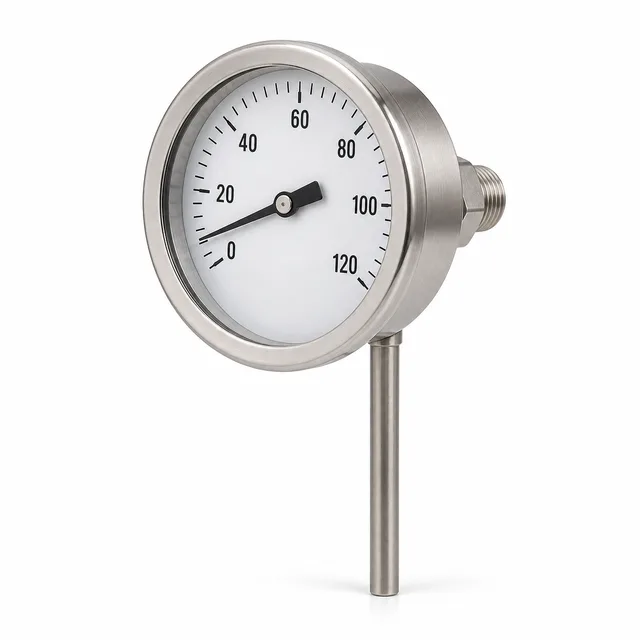
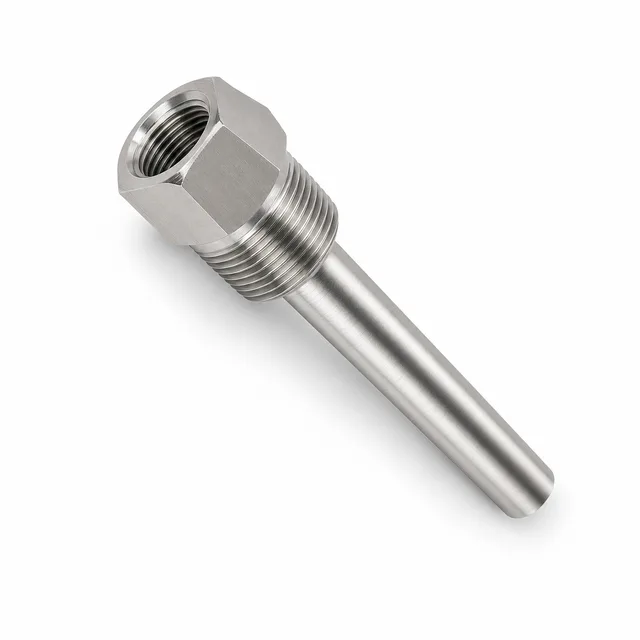
An industrial thermometer measures the temperature of a fluid in a pipe, tank or equipment and either presents it on a local dial or converts it into an electrical signal for the control system. Four technologies cover nearly every application: the bimetal (mechanical dial with no fill fluid), the gas-actuated with capillary (mechanical dial with remote reading), the industrial glass thermometer (liquid column) and the electrical sensors — Pt100 RTD and thermocouple — wired to an indicator or transmitter.
Quick verdict: for local indication on lines or equipment up to 290 °C (550 °F) use a bimetal with ±1 % of span accuracy per ASME B40.200 (Grade A); if you need to read the dial several meters from the measuring point or cover -200 to +700 °C, use a gas-actuated thermometer with capillary per EN 13190; if the temperature must reach the PLC, a recorder or an alarm, move to a Pt100 (accuracy, up to 600 °C) or a type J or K thermocouple (up to 750 and 1,200 °C respectively). In any pressurized process, install the instrument always inside a thermowell.
The sensing element is a helix of two metals with different expansion coefficients bonded together: as temperature changes the helix rotates and drives the pointer. It has no fill liquid in the element, needs no power supply and has nothing to recalibrate in the field beyond the external pointer adjustment offered by industrial series.
The reference standard is ASME B40.200-2008, Thermometers, Direct Reading and Remote Reading, which consolidated the former B40.3 for bimetallic actuated thermometers. Industrial instruments are specified as Grade A: ±1 % of scale span; Grade B allows ±2 %. Typical figures of the industrial reference series (Ashcroft EL): 3 and 5 in (76 and 127 mm) dials, 1/4 in (6.35 mm) stem diameter with lengths from 2.5 to 24 in (63.5 to 610 mm), 1/2 in NPT process connection (thread per ASME B1.20.1) and scales between -40 °C (-40 °F) and 290 °C (550 °F), with case and stem in 304 or 316 stainless steel and silicone filling to damp vibration.
| Connection | Geometry | When to use it |
|---|---|---|
| Back (axial) | The stem exits the rear of the dial, on its axis | Vertical or horizontal piping where the operator faces the measuring point; it is the configuration of the 2, 3 and 5 in TECTUL thermometers |
| Bottom (radial) | The stem exits the bottom of the dial, at 90° | Mounting on a horizontal line with frontal reading at operator height |
| Adjustable (every-angle) | Ball joint that rotates 360° and tilts the dial | When the nozzle orientation does not match the line of sight: one model solves axial, radial and intermediate mountings |
In the TECTUL catalog all three dial sizes are in stock with back connection: 2 in bimetal thermometer with 1/4 NPT connection, 3 in bimetal thermometer with 1/2 NPT connection and 5 in bimetal thermometer with 1/2 NPT connection, plus the adjustable-angle version: 3 in adjustable-angle thermometer.
In this type, a bulb filled with pressurized inert gas connects to the dial through a 2 mm diameter stainless steel capillary; the gas pressure, proportional to temperature, drives the pointer. The industrial reference (WIKA model 73, manufactured per EN 13190) illustrates its real limits: scale ranges of -200 to +700 °C (-328 to +1,292 °F), accuracy class 1 per EN 13190 (for example, ±2 °C on the 0-200 °C scale), capillary up to 60 m (197 ft) long, 100 and 160 mm stainless steel cases, IP65/IP66 ingress protection and up to 25 bar (363 psi) static on the stem.
When to choose it over the bimetal: when the dial must sit on a panel or at floor level away from the measuring point (the bimetal accepts no capillary: dial and stem are one piece), when temperature drops below -70 °C or rises above 290 °C, and under strong vibration with fast-response requirements, because the gas system responds faster than a bimetal helix of equal stem diameter.
The metal-cased glass thermometer — also covered by ASME B40.200, which absorbed the former B40.8 for liquid-in-glass — is a column of colored organic liquid inside a glass capillary with an engraved scale. It has no moving parts or adjustments and its cost is the lowest of the four types, but it is fragile, allows neither remote reading nor alarm contacts, and reading requires facing the column. Its current place: temperature baths, atmospheric tanks, HVAC vessels and spot checks, always in areas free of impact and vibration.
When temperature must be recorded, controlled or trigger alarms, the local dial falls short: an electrical sensor is installed inside the same thermowell and the signal is wired to the control system.
Practical criterion: local dial (bimetal or gas-actuated) where an operator does rounds and the reading feeds no loop; Pt100 where the value enters the control system and accuracy rules (thermal processes, food, pharma); type J or K thermocouple where temperature exceeds 600 °C or the point calls for an economical, fast-response sensor. The frequent plant combination: a bimetal thermometer for the operator and a Pt100 for the system, each in its own thermowell.
The thermometer is not threaded directly into the line: it is installed inside a thermowell, the metal sheath that isolates the sensor from the fluid and allows removing it without depressurizing. Manufacturer practice is explicit: Ashcroft requires a thermowell on every pressurized application above 15 psi (≈1 bar). The standard 1/4 in (6.35 mm) stem fits the standard 0.260 in (6.6 mm) bore of bar-stock thermowells, and the mechanical selection of the well (material, shank form and vibration verification per ASME PTC 19.3 TW-2016) has its own guide: Thermowells: what they are, types and how to choose one. TECTUL stocks the stainless thermowell 1/2 × 1/2 × 4 in, with alternative insertions of 2.5 and 6 in.
| Type | Typical range | Accuracy (standard) | Response | Relative cost | Typical application |
|---|---|---|---|---|---|
| Bimetal | -40 ... +290 °C [-40 ... +550 °F] | ±1 % of span (ASME B40.200, Grade A) | Medium | Low | Local indication on piping, tanks and equipment |
| Gas-actuated with capillary | -200 ... +700 °C [-328 ... +1,292 °F] | Class 1 (EN 13190) | Fastest among mechanical types | Medium | Remote dial up to 60 m, cryogenics, high vibration |
| Industrial glass | Scales bounded by the column liquid | Per scale (ASME B40.200) | Slow | The lowest | Baths, atmospheric tanks, spot checks |
| Pt100 RTD | -200 ... +600 °C (wire-wound) | Class A: ±0.15 °C at 0 °C (IEC 60751:2022) | Medium-fast | Medium-high (sensor + transmitter) | Control and recording with accuracy |
| Thermocouple J / K | J: up to 750 °C; K: up to 1,200 °C (class 2) | Class 1: ±1.5 °C; class 2: ±2.5 °C in the lower band (IEC 60584-1:2013) | The fastest | Low for the sensor; the cost is in the loop | Furnaces, steam, high temperature |
To get a quote, send: fluid, operating and maximum temperature, line pressure, required dial size, nozzle orientation (to decide between back, bottom or adjustable-angle connection), insertion length of the existing or planned thermowell, and whether the reading is local only or must reach the control system. TECTUL stocks stainless steel bimetal thermometers of 2 in (1/4 NPT), 3 in (1/2 NPT) and 5 in (1/2 NPT), the 3 in adjustable-angle version and the 1/2 × 1/2 NPT threaded thermowells that protect them. Gas-actuated thermometers with capillary and Pt100/thermocouple sensors are quoted on request via WhatsApp with the measuring-point data.