A pipe union is a three-piece threaded fitting — male end, female end and ring nut — that joins two pipe runs and allows them to be disconnected without rotating or cutting either one. It is installed next to valves, pumps, meters, steam traps and any equipment that will sooner or later need removal: loosening the nut opens the line at that point and the equipment comes out without dismantling the rest of the run.
Quick verdict: on threaded lines up to 2 in (50 mm), the pipe union is the standard disassembly point; from 3 in (80 mm) upward, switch to flanges per ASME B16.5. As for the seat: for water, air, oils and steam within the class rating, use a brass-to-iron conical seat (the malleable iron standard); for class 3000 forged steel at high pressure, a steel-to-steel conical seat; for PVC and frequently disassembled low-temperature services, a flat seat with gasket.
An ordinary threaded coupling joins two pipes but cannot be taken apart in place: since both of its threads are right-handed, removing it would require rotating one of the two complete pipe runs — impossible once the run is anchored, passes through walls or ends at a piece of equipment. The alternative without a union is to cut the pipe and re-thread it, with the line out of service longer.
The pipe union eliminates that problem because the rotation happens only at the nut: each half stays threaded fixed to its run, and the ring nut draws them together until the seats make contact. That is why standard installation practice places a union on each side of valves, pumps, filters, meters and steam traps: the equipment comes out by loosening two nuts, without touching the piping. To repair installed runs where no thread is available there is a different product family (Dresser-type repair couplings, compression type with gasket), which must not be confused with the threaded pipe union.
The names male and female refer to the seat geometry, not to the pipe threads: both halves receive the pipe with female NPT threads per ASME B1.20.1. The standard that defines the complete malleable iron design is ASME B16.39-2025: classes, allowable pressures and temperatures, dimensions, threads, and the hydrostatic, tensile and air pressure tests every design must pass.
The seat is where the union seals. The NPT thread seals the pipe against each half, but the closure between the two halves is made solely by the seat contact: choosing that contact wrong is the typical cause of a dripping union.
| Seat | How it seals | Where it is standard | Recommended service | Typical leak risk |
|---|---|---|---|---|
| Flat with gasket | Elastomeric gasket or O-ring (typically EPDM or NBR) compressed between flat faces | PVC and polypropylene unions; some metal unions for gas | Water and compatible chemicals up to 60 °C (140 °F) in plastics; frequently disassembled points | The gasket ages, gets cut or lost during disassembly; it must be inspected and replaced |
| Brass-to-iron conical | Brass insert on one half against a conical iron seat: metal-to-metal, self-centering | Class 150 and 300 malleable iron, galvanized or black | Water, compressed air, oils and steam within the class rating | Tolerates slight misalignment; a trapped particle or a knock on the brass marks the seat and it drips |
| Iron-to-iron conical | Conical seats of the same iron, without insert | Malleable iron variants for services where brass is unsuitable | Thermal services or fluids that attack brass (for example ammonia) | Demands better alignment and cleaner surfaces than brass-to-iron |
| Steel-to-steel conical | Machined and ground conical seats, metal-to-metal | Class 3000 forged carbon steel per MSS SP-83; also in stainless steel | High pressure and temperature: steam and process lines in threaded Schedule 80 pipe | Sensitive to scratches and dirt: seats must remain clean, concentric and undamaged |
A rule that crosses all three types: no tape or sealant on the seat. The seat seals by metal-to-metal contact or by its own gasket; any foreign material in between prevents uniform contact and produces exactly the leak it was meant to avoid.
| Material | Reference standard | Usual classes | Where to use it |
|---|---|---|---|
| Galvanized malleable iron | ASME B16.39-2025; malleable iron per ASTM A197/A197M; coating per ASTM A153/A153M | 150, 250, 300 | Water, air and general service systems, especially outdoors or unpainted |
| Black malleable iron | ASME B16.39-2025 | 150, 250, 300 | Steam, air, oils and painted systems; the standard in machine rooms |
| Forged carbon steel | MSS SP-83-2018; paired with ASME B16.11-2021 fittings | 3000 | Threaded Schedule 80/XS pipe: high-pressure steam and process (the class-schedule correlation is given by ASME B16.11) |
| Stainless steel | MSS SP-83-2018 in class 3000; class 150 per manufacturer catalog | 150, 3000 | Corrosive fluids, food and beverage, outdoor service with chlorides |
| PVC pressure | ASTM D2466 (Schedule 40) with compound per ASTM D1784 | Schedule 40 | Cold water and compatible chemicals up to 60 °C (140 °F); solvent-cement socket ends and O-ring seal |
All five families are in the TECTUL catalog with price per size: galvanized threaded pipe union for general services, class 300 malleable iron union when the system demands a higher class (a class 150 black iron union is also available), class 3000 threaded carbon steel union for Schedule 80, threaded stainless steel union for corrosive fluids and solvent-weld PVC pressure union in plastic systems.
The limit is set by the thread, not by the union: threading pipe above 2 in requires larger threading equipment, the torque to tighten pipe and fittings grows with diameter, and the commercial offering of threaded fittings shrinks. Hence the industrial practice: up to 2 in, pipe unions; between 2 1/2 and 3 in, a transition zone where both solutions are viable; from 3 in upward, flanges per ASME B16.5, which additionally distribute the closing load among several studs instead of concentrating it on a single nut. This threshold is a rule of practice, not a code requirement: in high-pressure steam or where a project specification already exists, the specification governs.
To get a quote, send: nominal diameter, system material (galvanized, black iron, forged steel, stainless or PVC), required pressure class, fluid type and temperature, and the number of disassembly points. TECTUL publishes price per size on the pages for the galvanized union, class 300 malleable iron union, class 3000 carbon steel union, threaded stainless steel union and PVC pressure union, with delivery throughout Colombia; sanitary variants, heat-fusion polypropylene unions and repair couplings are quoted through the same channel with the line data.
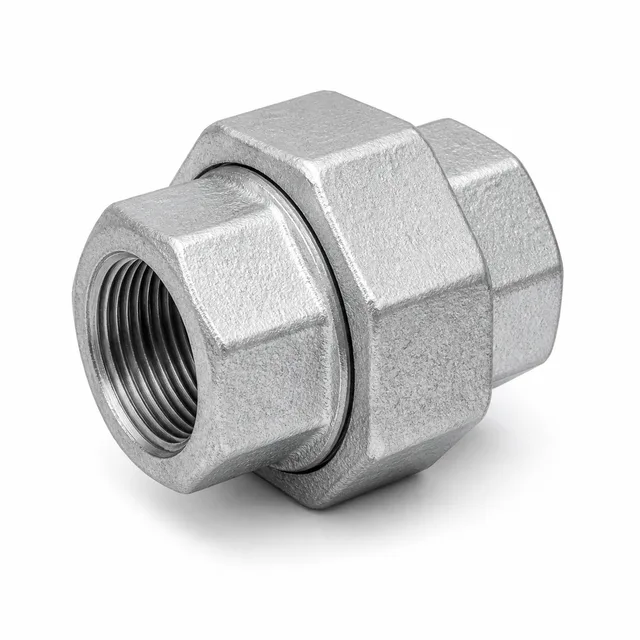 universal galvanizada roscada
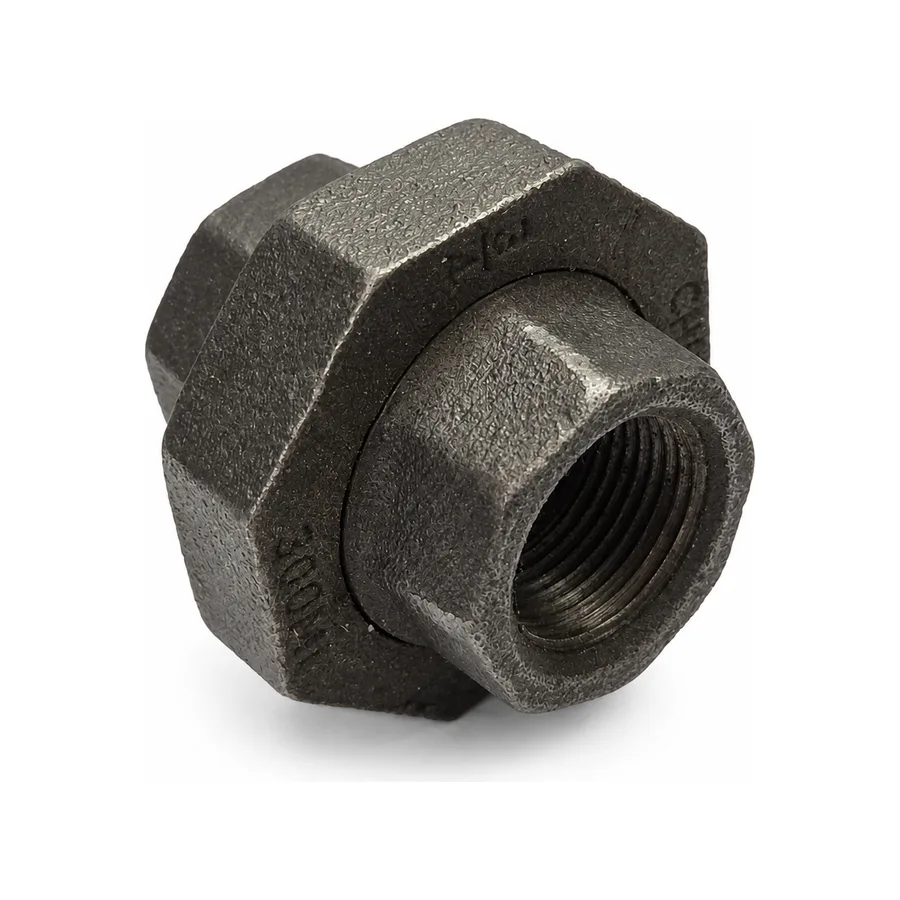 universal hierro maleable 300 lb roscada
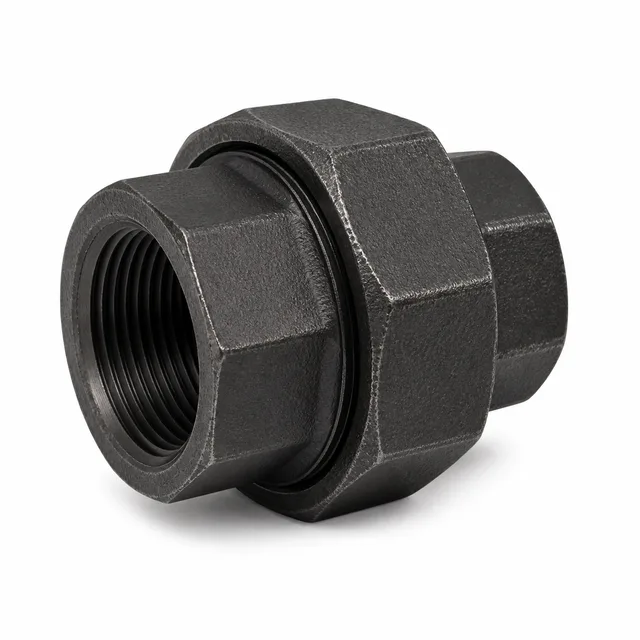 universal acero carbon 3000 lbs roscado