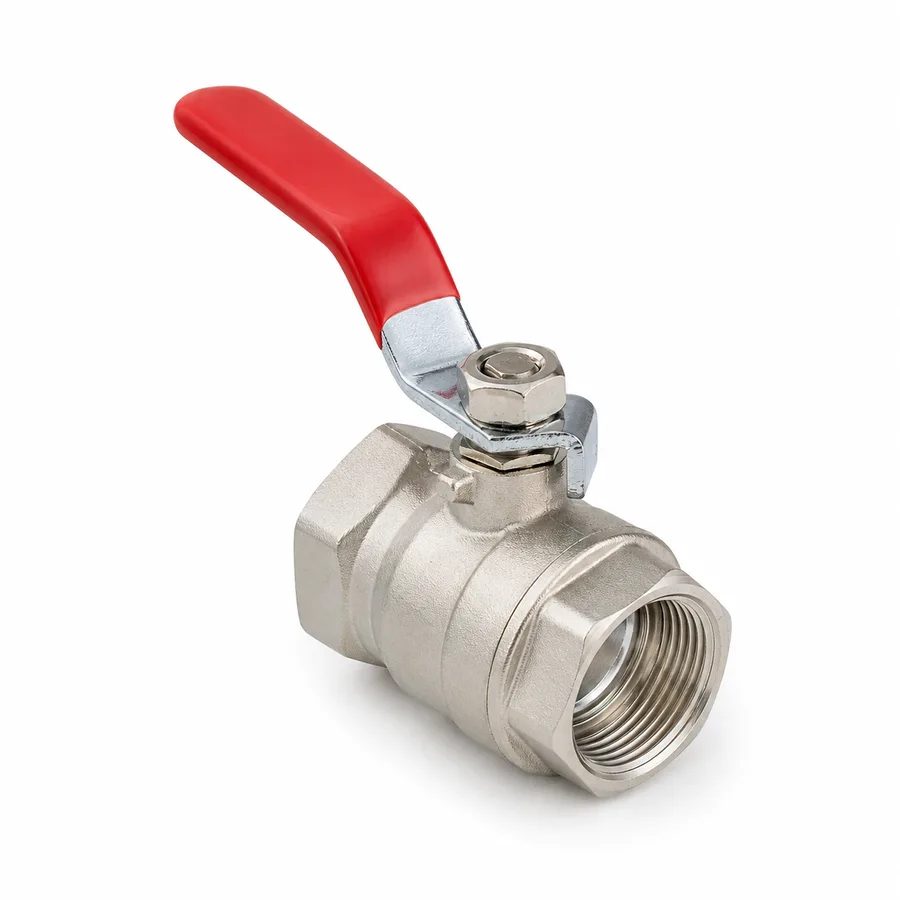
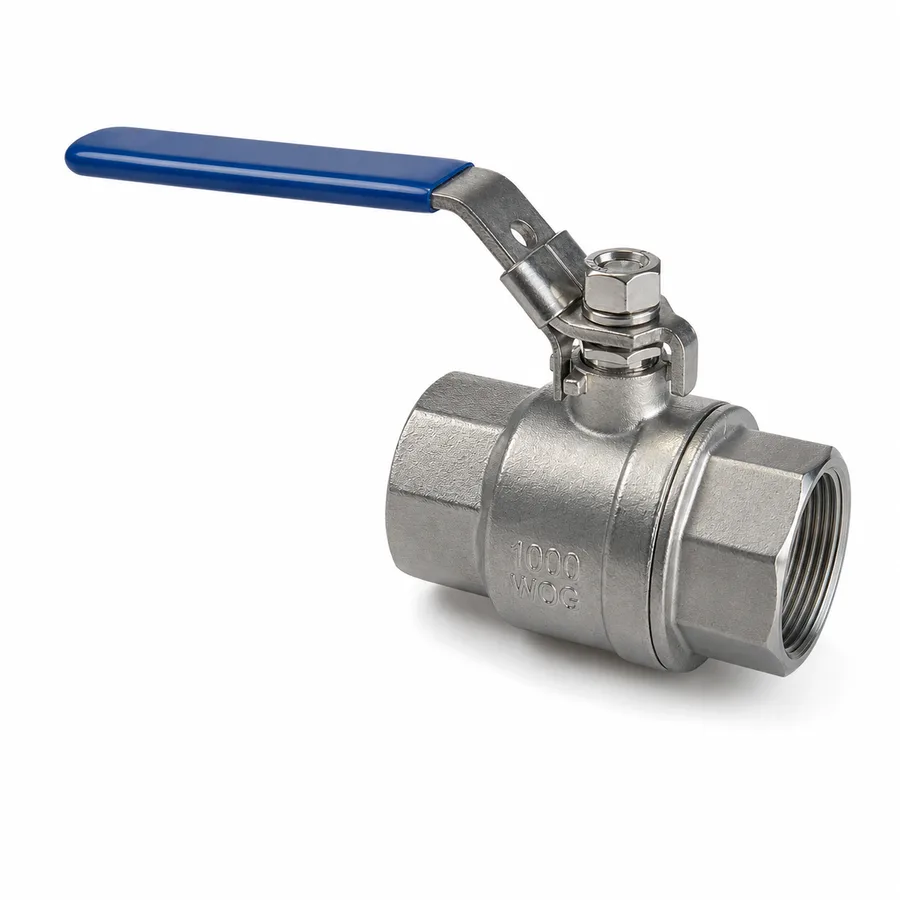
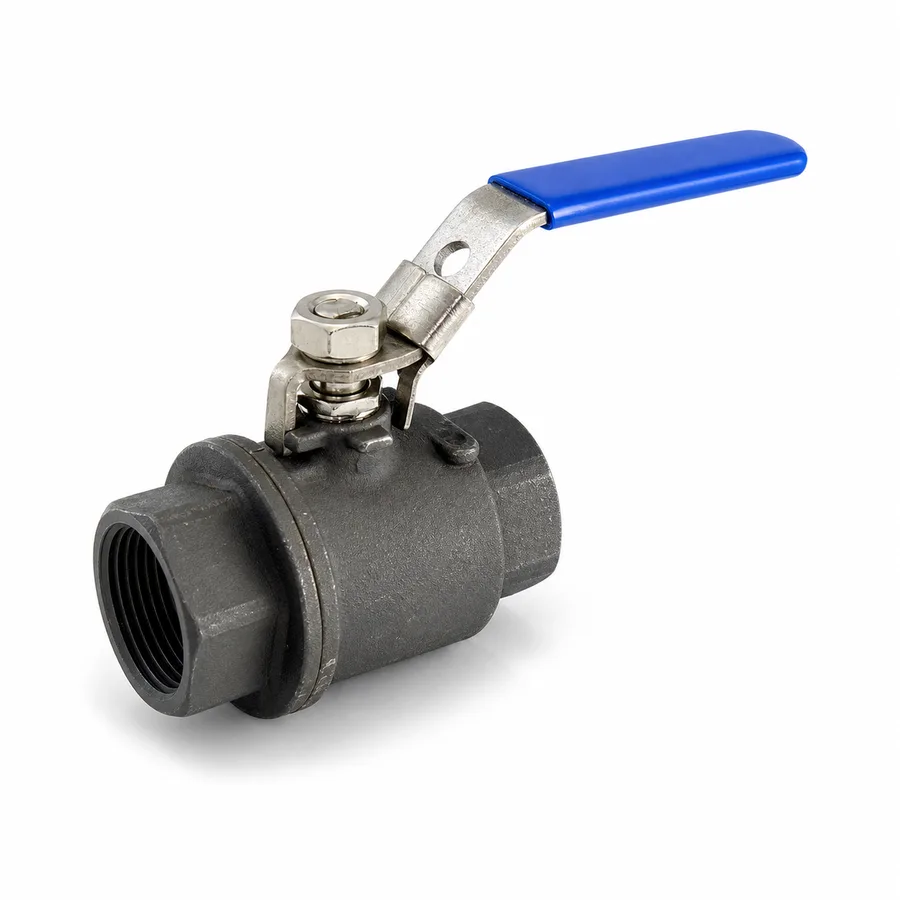
A ball valve is a quarter-turn valve intended primarily to open or shut off fluid flow with low restriction when fully open. Its closure member is a drilled sphere: when the bore is aligned with the pipe, fluid passes; when the sphere turns one quarter turn, the solid side of the ball blocks flow against the seats.
Good purchasing requires more than size and material. At TECTUL, selection should cross-check fluid, temperature, pressure, end connection, body material, seat type, body construction, operating frequency and automation requirements. Relevant options include the Napoli bronze ball valve, the two-piece stainless steel ball valve, the 1000 psi carbon steel ball valve, the PVC solvent-weld ball valve and the polypropylene fusion ball valve for cold fluid.
Shutoff occurs through contact between the ball and the seats. In common valves for process, water, air and compatible services, the seats are soft: PTFE, reinforced PTFE or other polymers defined by the manufacturer. The seat deforms enough to conform to the ball surface and provide tight shutoff with reasonable operating torque. The advantage is tight sealing and easy operation; the limitation is that temperature, fluid, abrasion and differential pressure can attack or deform the seat material.
Metal-to-metal seating is used when a soft seat cannot tolerate temperature, abrasion, solids, erosion or severe cleaning. It should not be understood as better in every service: it normally requires higher torque, hardened or coated surfaces, tighter control of finish and a leakage acceptance criterion by standard or purchase agreement. In industrial purchasing, the key phrase is not only metal seated, but leakage class, ball material, surface treatment, seat test and actual fluid.
One-piece construction is compact and economical, but it usually limits internal access. It is purchased for general services where the whole valve is replaced if the seat fails. Two-piece construction often provides a useful balance of cost, availability and maintainability; it is common in threaded bronze, brass, carbon steel and stainless steel valves. Three-piece construction allows the center body to be removed without dismantling the whole pipe run, useful for maintenance, welding, cleaning and seat replacement.
In flanged valves, the body and end caps are selected by class, flange pattern and project standard. Four-bolt and six-bolt versions appear as robustness and size-related construction criteria, but the number of bolts does not replace verification of standard, material, pressure, temperature and testing. For commercial class 150 flanged lines, TECTUL carries options such as the flanged carbon steel ball valve and the flanged stainless steel ball valve.
| Construction | Main advantage | Typical use | Purchasing caution |
|---|---|---|---|
| One piece | Compact body | Water, air and compatible general services | Limited internal maintenance |
| Two piece | Balanced cost and serviceability | Threaded metallic general process valves | Confirm seat and pressure-temperature limits |
| Three piece | Center body maintenance | Process, cleaning, welding or frequent cycles | Review body seals and spare parts |
| Flanged | Flanged removal and industrial alignment | Medium lines, pumping and process | Class depends on material and temperature |
| Four or six bolts | Higher body clamping depending on design | Stainless or steel valves in larger sizes | Does not replace a design standard |
In a floating ball valve, the ball is not supported by trunnions; fluid pressure pushes the ball toward the downstream seat and helps sealing. It is widely used in small and medium sizes because it has fewer components and simple operation. Its limit appears as size and differential pressure increase: the force on the ball rises, seat loading increases and operating torque can grow significantly.
In a trunnion ball valve, the ball is supported by shafts or trunnions and the seats are energized toward the ball. This arrangement reduces direct seat loading and supports larger sizes and higher classes with more controlled torque. Trunnion is not specified as a trend: it is justified when differential pressure, size, closure weight, operating frequency or automation requirements make a floating ball unsuitable.
Brass and bronze are common in water, air, plumbing networks, point-of-use shutoff and compatible low to medium duty services. Carbon steel is used in industrial service when the fluid and environment do not require stainless steel, and where higher mechanical robustness or compatibility with metallic piping classes is needed. Stainless steel is selected for corrosion, cleanability, food process, compatible chemicals or aggressive environments, but grade, seals and chlorides must still be checked.
PVC, CPVC and polypropylene serve plastic networks and compatible chemicals without metallic corrosion. PVC is commonly associated with cold water and compatible solutions; CPVC is selected when the plastic system requires compatible higher temperature service; fusion polypropylene is used in PP-R networks where thermal fusion is part of the piping system. In plastics, allowable pressure decreases with temperature and depends on manufacturer data, so a generic internet pressure should not be copied into a purchase order.
ASME B16.34-2025 covers requirements for flanged, threaded and welding-end valves, including design, materials, pressure-temperature ratings, testing and marking for metallic valves within its scope. API Standard 608, seventh edition of April 2025, focuses on metal ball valves for petroleum, petrochemical and industrial applications with flanged, threaded and welding ends. ISO 17292:2015 also covers metal ball valves for petroleum, petrochemical and allied industries, including full bore, reduced bore and double reduced bore designations.
MSS SP-110-2010 remains active for metal ball valves with threaded, socket-welding, solder joint, grooved and flared ends in small sizes. The same practice warns that these valves are intended for open-close operation and should be used for modulation only when recommended by the manufacturer. API 598, eleventh edition of February 2023, is a reference for inspection and testing. ISO 5211:2026 defines the quarter-turn actuator interface, critical when a pneumatic or electric actuator is requested.
Full bore and reduced bore affect the flow diameter, pressure loss and local fluid velocity. That subject has its own guide at full bore versus reduced bore in valves; here it is enough to say that full bore more closely approaches the pipe internal diameter, while reduced bore sacrifices area to reduce cost, size or torque.
Torque depends on differential pressure, size, seat type, material, temperature, time without operation, dirt and stem design. The lever should not be extended with improvised pipes: if a manual valve requires excessive force, it may be incorrectly selected, stuck by deposits, exposed to high differential pressure or in need of a gear operator or actuator. For automation, the data sheet should provide breakaway and running torque, and the actuator should be selected with a service margin.
Select a ball valve when you need fast isolation, quarter-turn operation and compact shutoff. For general water and air, bronze, brass or compatible plastic may be enough; for industrial process, prioritize carbon steel or stainless steel under a verifiable standard and test. Define whether maintenance requires one, two or three pieces; if the line is flanged, specify class, material and standard; if it will be automated, confirm ISO 5211:2026, torque and failure position. At TECTUL, a correct request includes fluid, temperature, working pressure, size, connection, material, operating frequency and whether the valve will be manual, pneumatic or electric.