 TECTULby IMR
Threaded check valves in cast stainless steel ASTM A351 CF8M — vertical check, gate check and hydro check
TECTUL · Dispatch across Colombia · Exports to Central & South America
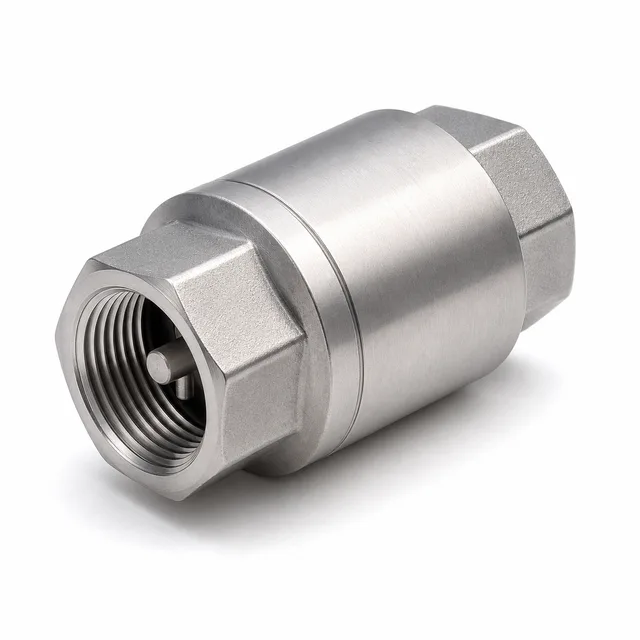
The threaded NPT check valves in cast stainless steel ASTM A351 CF8M from the TECTUL catalog: vertical stainless check —axially guided disc, the only design in the family that accepts vertical mounting with upward flow only—, stainless gate check —gravity gate— and threaded stainless hydro check —spring-loaded piston—. CF8M is the cast equivalent of 316: it is chosen for corrosion resistance against chlorides, chemicals, ammonia and coastal environments, or for material traceability requirements, not for extra pressure. The reference rating published for the stainless line is 200 WOG; the exact MSS SP-80 class per reference is not published by the manufacturer and is confirmed on quotation.
Important: Before using these data in engineering, design or installation decisions on systems exposed to mechanical, pressure, rupture, fatigue, impact or water-hammer risk, it is essential to read the technical notice and limitation of liability at the end of this sheet.
SKU VT-87050 (vertical stainless check) · line of 3 threaded NPT check valve references in cast stainless steel ASTM A351 CF8M
1. Technical specifications
Materials by component (stainless line)
| Component | Material | Designation / source of the data |
|---|---|---|
| Body and bonnet (cap) | Cast stainless steel CF8M — cast equivalent of AISI 316: Cr 18–21 %, Ni 9–12 %, Mo 2–3 %, C ≤0.08 % | ASTM A351/A351M |
| Closure member (axially guided disc, gate or piston, depending on the design) | CF8M or 300-series austenitic stainless steel, per figure | ASTM A351 · grade per figure, manufacturer data |
| Disc guide (vertical check) | Machined integral with the body or cap, in stainless steel | Manufacturer data |
| Seat | Integral with the body (metal-to-metal) or renewable ring, per figure | Manufacturer data |
| Closing spring (stainless hydro check) | 300-series austenitic stainless steel | Exact grade: manufacturer data |
| Cap gasket | PTFE or graphite, asbestos-free | Asbestos-free |
| Ends | Female tapered NPT thread on both ends | ASME B1.20.1 |
CF8M composition and its equivalence with 316 per ASTM A351. The exact grade of the closure member and spring and the seat type per figure are manufacturer data for each reference: confirmed on quotation or in the PDF sheet attached to the product. An NPT thread is not a sanitary connection: for CIP-cleaned service the TECTUL catalog offers a sanitary stainless check reference with clamp ends, outside the scope of this sheet.
Regulatory framework and supply conditions
| Valve type | Check (non-return): operates by itself, driven by the flow; no handwheel or actuator |
| Body material | Cast stainless steel ASTM A351 CF8M (cast equivalent of 316) |
| Product standard | MSS SP-80 as the dual SWP/WOG class framework for this valve type; the class per reference is not published by the manufacturer |
| Reference rating of the line | 200 WOG (13.8 bar) cold, the only value the manufacturer publishes for its threaded stainless line — equivalent to Class 125 of the dual system |
| Ends | Female NPT threaded per ASME B1.20.1 |
| Catalog sizes | 1/2″ to 4″ (DN 15 to DN 100), depending on the design |
| Mounting position | Depends on the closing mechanism — see the matrix in section 3. The vertical check has a single admissible position |
| Usual fluids | Treated and brackish water, condensates, chemicals compatible with 316, and services requiring material traceability |
Threaded stainless check references in the TECTUL catalog
| Reference | Closing mechanism | Sizes offered |
|---|---|---|
| Check Vertical Inoxidable | Axially guided disc, designed for vertical piping | 1/2″ · 3/4″ · 1″ · 1-1/4″ · 1-1/2″ · 2″ · 3″ · 4″ (8 published sizes) |
| Check Compuerta Inoxidable (gate check) | Gate lifted by the flow, falling back by gravity | 1/2″ · 3/4″ · 1″ · 1-1/4″ · 1-1/2″ · 2″ (6 sizes) |
| Cheque Hidro Inoxidable Roscado | Spring-loaded piston | Confirmed on quotation: the catalog lists the reference without a size list |
IMPORTANT
This data sheet is a reference guide to the properties of this product type. The measurements, dimensions and physical or geometric characteristics of the product actually supplied may vary by manufacturer and lot, and may even fall outside the cited standards. If any of these figures is critical to your design or build, it is essential to verify it with one of our advisors against the physical product, so you can be fully certain of what you are buying. · Original data sheet: tectul.com/en/conduccion-de-fluidos/valvulas/ficha-tecnica-check-vertical-inoxidable.html
The vertical check and the stainless gate check have a factory PDF sheet attached to their product page; the stainless threaded hydro check is published without variants, and its sizes, pressure and lead time are confirmed on quotation. Face-to-face dimensions, height and weight are not standardized for threaded valves of this type — each manufacturer sets its own pattern — and are confirmed on quotation.
⚠ Important: this technical data sheet is a reference guide to the product's properties; it is not a quality certificate for the product you are buying. Heats vary from one another and may differ from the values stated here, or even depart from the standards. If your application requires compliance with a standard, always check the quality certificate (mill certificate) of the lot you are buying. If in doubt, ask one of our technical advisors →
2. Rating of the stainless line: 200 WOG within the MSS SP-80 dual system
The only pressure value the manufacturer publishes for its threaded stainless line in this catalog is 200 WOG (13.8 bar cold). It is taken as the reference rating of the line, not as a certified rating of each figure: the exact MSS SP-80 class per reference is not published by the manufacturer and is confirmed on quotation.
Read within the MSS SP-80 dual class system, 200 WOG corresponds to Class 125, which links that cold number to a saturated steam limit of 125 psig:
| Class | SWP (saturated steam) | Saturation temperature at that SWP¹ | WOG (cold, −29 °C to 38 °C) |
|---|---|---|---|
| 125 — the class matching the published rating of the stainless line | 125 psig (8.6 bar) | ≈178 °C (353 °F) | 200 psi (13.8 bar) |
| 150 | 150 psig (10.3 bar) | ≈186 °C (366 °F) | 300 psi (20.7 bar) |
| 200 | 200 psig (13.8 bar) | ≈198 °C (388 °F) | 400 psi (27.6 bar) |
| 300 | 300 psig (20.7 bar) | ≈216 °C (421 °F) | 600 psi (41.4 bar) |
IMPORTANT
This data sheet is a reference guide to the properties of this product type. The measurements, dimensions and physical or geometric characteristics of the product actually supplied may vary by manufacturer and lot, and may even fall outside the cited standards. If any of these figures is critical to your design or build, it is essential to verify it with one of our advisors against the physical product, so you can be fully certain of what you are buying. · Original data sheet: tectul.com/en/conduccion-de-fluidos/valvulas/ficha-tecnica-check-vertical-inoxidable.html
¹ Steam saturation temperature at the stated SWP: a thermodynamic property of water, not of the valve. It is the same reference value used by ASME B16.3-2021 (Table 3-1, note 1) for the 186 °C limit of Class 150 threaded fittings. WOG is not an ASME B16.34 class, and no "Class 200 WOG" exists in that standard: it is a number declared by the manufacturer in accordance with MSS SP-80.
- Cold, between −29 °C and 38 °C and without shock, the valve takes 200 psi (13.8 bar). That is the label figure and it applies only in that range.
- Above 38 °C the allowable pressure drops. If the service is saturated steam, the Class 125 limit is 125 psig (8.6 bar), whose saturation temperature is ≈178 °C.
- On an intermediate line —for example condensate at 90 °C— the allowable value falls between the SWP and the WOG of the class and must be taken from the manufacturer's pressure-temperature curve for that figure, not from the cold label.
- For the three references in this sheet the manufacturer does not publish the class. The 200 WOG figure is the reference rating of the line; the value per figure is confirmed on quotation with the PDF sheet or the factory certificate.
Two ideas that get mixed up in the field should be kept apart: pressure rating and corrosion resistance are independent. Moving from bronze to CF8M does not by itself raise the allowable pressure number —that is set by the class of the figure, not by the metal—; what changes is the range of fluids and environments in which the valve survives. That is the selection criterion in section 4.
3. Mounting position matrix of the three designs
The mechanism that closes the port —axial guiding, gravity or spring— defines the orientation in which each check valve works reliably. This stainless line has one peculiarity compared with the bronze one: it includes a single-position design. This is the matrix of the three threaded CF8M references in the TECTUL catalog.
| TECTUL reference | Closing mechanism | Horizontal | Vertical, upward flow | Vertical, downward flow |
|---|---|---|---|---|
| Check Vertical Inoxidable | Axially guided disc, designed specifically for vertical piping | No — it is the only design in the family with no horizontal variant | Yes — its single design position | No |
| Check Compuerta Inoxidable (gate check) | Gate lifted by the flow, falling back by gravity | Yes — design position, with the cap facing up | Yes | No |
| Cheque Hidro Inoxidable Roscado | Spring-loaded piston | Yes | Yes | The spring does not rely on gravity, so several designs accept it; confirm with the manufacturer's sheet |
Classification by mechanism family (axial guiding, gravity gate and spring-loaded piston), applying general check valve installation practice. The admissible position of each figure and the flow direction are defined by the manufacturer: the arrow cast on the body and the product PDF sheet override this table.
Why the vertical check only works vertically with upward flow
In this design the disc travels along its own axis, guided by the body, and returns to the seat by gravity when the flow drops. That guided travel requires the disc axis to coincide with the vertical: if the valve is laid down, the disc starts sliding sideways on the guide, its weight no longer pushes it against the seat, and closing is left to the push of the return flow; in the worst case the disc jams on the guide and the valve stays open. That is why the reference is called vertical and does not accept horizontal mounting.
Why a gravity check valve installed with downward flow loses its function
On the stainless gate check, the force that returns the gate to the seat is its own weight, and that weight only does its job if it acts opposite to the flow: hence the admissible mounting is horizontal —the gate falls onto the seat— or vertical with upward flow —it falls against the stream—. With downward flow, gravity and the fluid push in the same direction, the opening one: the gate rests on the open stop and, when flow stops, nothing brings it back to the seat. The valve stays permanently open and the return flow passes freely. This is the most common field error with this family and the network pressure test does not reveal it: it shows up when the pump stops or the tank drains through the filling line.
Field rules
- The arrow cast on the body indicates the flow direction, not the mounting position: complying with the arrow does not guarantee correct orientation.
- If the line runs vertically upward, the vertical check is the natural reference; if the line is horizontal, the reference is the stainless gate check or a spring design, never the vertical check laid down.
- Leave a straight run upstream, free of elbows, pumps and immediate reducers, so the disc works with steady flow and does not chatter against the seat.
- Size by the service flow rate and not by the pipe diameter: an oversized check valve works with the disc partly open and wears the seat (Crane TP-410 minimum full-lift velocity principle; the specific coefficient depends on the check type and the manufacturer).
- On stainless steel, avoid thread galling during assembly: suitable sealant, tightening by torque rather than by turns, and clean threads.
- A check valve is not an isolation valve: to work on the line, an isolation valve is installed upstream.
4. When the check valve must be stainless rather than bronze
The reason to move from a bronze check valve to a CF8M one is corrosion resistance, not extra pressure. The rating is set by the class of the figure (section 2), not by the metal: a Class 125 stainless check valve takes the same 200 psi cold as a Class 125 bronze one. What changes is where it survives.
Cases where stainless steel is the right call
| Chlorides and brackish water | The 2–3 % molybdenum in CF8M is what distinguishes 316 from 304 and what gives it resistance to chloride pitting. A common comparative index is PREN (Pitting Resistance Equivalent Number, PREN = %Cr + 3.3 × %Mo + 16 × %N): with the CF8M composition the index falls roughly between 25 and 31, against 18–21 for an austenitic stainless without molybdenum. It is an indicative index for comparing alloys, not a standard requirement nor a service limit. |
| Chemicals and condensates | Dilute acids, process solutions and condensates in which copper and its alloys dissolve or contaminate the product. Bronze also releases copper and lead into the fluid (C83600 contains 4–6 % lead), which in several industries is reason enough to rule it out. |
| Ammonia and ammoniacal compounds | Copper alloys —bronzes and brasses— are prone to stress corrosion cracking in the presence of ammonia. On ammonia refrigeration lines or ammoniacal processes, stainless steel is the choice; bronze is not. |
| Coastal or aggressive industrial environment | External corrosion from salinity, sea spray or industrial atmospheres attacks the outside of the valve first. CF8M keeps the body sound and the guide or spring operable where a bronze body pits and fouls. |
| Sanitary or food traceability | When the specification requires declared stainless material and a heat certificate, bronze is ruled out by specification even if it technically withstands the pressure. The ASTM A351 CF8M certificate is requested on quotation. |
Where stainless steel is not the answer
- It is not extra pressure. If the problem is that the network works above the available class, the answer is not changing metal but moving up a class or to a flanged or forged steel line, each with its own data sheet.
- 316/CF8M is not immune to chlorides. In concentrated brines or hot seawater there is a risk of pitting and chloride stress corrosion cracking; that scenario calls for duplex or superaustenitic alloys and must be defined by the project engineer.
- An NPT thread is not a sanitary connection. For CIP-cleaned service, polished surfaces and finish traceability, a threaded connection does not apply: the TECTUL catalog offers a sanitary stainless check reference with clamp ends.
- Cost. On potable water, compressed air and non-corrosive oils, bronze does the job at lower cost; stainless steel is justified by the fluid or the environment, not by default.
5. Frequently asked questions
Can the vertical stainless check valve be installed horizontally?
No. It is the only design in the family with no horizontal variant: the disc is guided along its axis and returns to the seat by gravity, so the valve only works on vertical piping with upward flow. Laid down, the disc slides sideways on the guide and closing is no longer reliable. For a horizontal line the stainless gate check or a spring design is the right reference.
When is a stainless check valve preferable to a bronze one?
When the fluid or the environment attacks copper: chlorides, brackish water, chemicals and condensates, ammonia, coastal environment, or when the specification requires stainless material with a heat certificate for sanitary or food traceability. On potable water, compressed air and non-corrosive oils, bronze does the job at lower cost. The detail is in section 4.
Does stainless steel take more pressure than bronze?
Not for being stainless. The rating is set by the MSS SP-80 class of the figure, not by the metal: a Class 125 stainless check valve takes the same 200 psi cold as a Class 125 bronze one. The reason to choose CF8M is corrosion resistance.
What pressure does the stainless check valve in this catalog have?
The reference rating published by the manufacturer for its threaded stainless line is 200 WOG (13.8 bar cold, up to 38 °C), equivalent to Class 125 of the dual system, whose saturated steam limit is 125 psig at ≈178 °C. The exact class of each of the three references is not published by the manufacturer and is confirmed on quotation.
Is the threaded stainless check valve suitable for a food line?
It depends on the specification. CF8M is the cast equivalent of 316 and is certified under ASTM A351, but the NPT threaded connection is not a sanitary connection: it allows no CIP cleaning and guarantees no internal finish. If the process requires sanitary design, the catalog's sanitary stainless check reference with clamp ends is the right one.
6. Application notes
Feasibility
The threaded stainless line covers treated and brackish water, condensates, chemicals compatible with 316, coastal and aggressive industrial environments, and services requiring a material certificate, within the 200 WOG cold reference rating and the class the manufacturer confirms for each figure. Out of scope: concentrated brines and hot seawater, where 316/CF8M is susceptible to pitting and chloride stress corrosion cracking and duplex or superaustenitic alloys must be specified; and sanitary service with CIP cleaning, which requires clamp ends rather than NPT threads —the TECTUL catalog has a sanitary stainless check reference for that case—. If the fluid is potable water, compressed air or non-corrosive oils, the ASTM B62 bronze check line does the job at lower cost and has its own data sheet.
Installation
The NPT thread (ASME B1.20.1) seals by tapered metal-to-metal interference; use a sealant compatible with the fluid and the system specification, and tighten by torque rather than by turns to avoid the galling typical of austenitic stainless steel. Before mounting, check the flow-direction arrow cast on the body and the orientation against the matrix in section 3: the vertical stainless check accepts no horizontal mounting under any circumstances, and the stainless gate check is never installed with downward flow. Leave a straight run upstream, free of elbows, pumps and immediate reducers, so the disc does not chatter. Avoid direct contact with uninsulated carbon steel in humid environments, to prevent galvanic corrosion at the joint.
Design
The 200 WOG reference rating applies to the valve cold and without shock: water hammer, piping loads and installation moments are not included and belong to the project's design code (ASME B31.1, B31.3 or the applicable one). Choosing CF8M does not increase the allowable pressure; if the service exceeds it, the answer is moving up a class or to a flanged or forged line. A check valve is sized by the service flow rate and not by the pipe diameter, so the disc is fully open. On the vertical check, the single mounting position must be considered from the line layout onward, not on site: a change of route to horizontal forces a change of reference. The spring design adds permanent head loss and cracking pressure, and that consumption must be included in the pumping system calculation.
7. Technical notice and limitation of liability
The material and class framework in this sheet combine ASTM A351 CF8M and the MSS SP-80 dual class system with the data TECTUL publishes on each product page (sizes). The 200 WOG value is the reference rating published by the manufacturer for its threaded stainless line, not a certified rating per figure: the exact MSS SP-80 class of each of the three references is not published by the manufacturer and is confirmed on quotation with the factory certificate or PDF sheet. The value of another reference or another design must not be assumed.
The mounting position matrix in section 3 classifies by closing mechanism family (axial guiding, gravity gate and spring-loaded piston), applying general check valve installation practice, not a standard table. The flow-direction arrow cast on the body and the product PDF sheet override this table. Face-to-face dimensions, heights and weights are not standardized for threaded valves of this type and are confirmed on quotation. The threaded stainless hydro check is published without variants: its sizes, pressure and lead time are confirmed on quotation.
The PREN index quoted in section 4 is a comparative indicator between alloys, not a standard requirement nor a service limit: CF8M improves on 304 against chlorides, but it is not immune to pitting or stress corrosion cracking in concentrated brines or hot seawater. These values must not be used as the sole criterion in critical or safety applications, or wherever valve failure may compromise people, property or the environment: in such cases material selection and design belong to the project's responsible engineer under the applicable code. Before deciding with these data, consult our technical team.
Sources
- ASTM A351/A351M — Standard Specification for Castings, Austenitic, for Pressure-Containing Parts, grado CF8M (Cr 18–21 %, Ni 9–12 %, Mo 2–3 %, C ≤0,08 %), equivalente fundido del AISI 316
- MSS SP-80 — Bronze Gate, Globe, Angle and Check Valves: sistema de clases duales SWP/WOG (125/150/200/300) usado como marco de lectura del rating de referencia 200 WOG de la línea inoxidable roscada
- ASME B1.20.1 — Pipe Threads, General Purpose, Inch: roscas NPT cónicas de los extremos de esta línea
- ASME B16.3-2021, Tabla 3-1, nota (1) — referencia de la temperatura de vapor saturado a 150 psig (186 °C), consistente con la ficha FT-TC-ACC-MALL-001 del catálogo
- Tablas de vapor saturado (propiedad termodinámica agua/vapor, tipo NIST/ASME Steam Tables) — temperaturas de saturación a 125, 150, 200 y 300 psig
- Índice PREN (Pitting Resistance Equivalent Number, PREN = %Cr + 3,3 × %Mo + 16 × %N) — criterio comparativo habitual de resistencia a la picadura por cloruros entre aceros inoxidables; valor calculado aquí a partir del rango de composición de CF8M de ASTM A351
- Crane Technical Paper No. 410, Flow of Fluids through Valves, Fittings and Pipe — principio de dimensionamiento de válvulas de retención por velocidad mínima de apertura plena (el coeficiente concreto depende del tipo de cheque y del fabricante)
- Práctica general de instalación de válvulas de retención: posición admisible por mecanismo de cierre (guiado axial, gravedad, resorte), consistente entre múltiples fabricantes de válvulas check
- ASME B31.1 / ASME B31.3 — códigos de tubería de potencia y de proceso: marco al que corresponde el análisis del transitorio hidráulico y de las cargas de tubería mencionado en las notas de diseño
- Fichas de producto TECTUL (tectul.com) con PDF de fábrica adjunto: Check Vertical Inoxidable y Check Compuerta Inoxidable — fuente primaria de diámetros; y Válvula Globo Inoxidable 200 Psi, fuente del rating de referencia publicado para la línea inoxidable roscada
- Curaduría interna TECTUL (data/etapas/etapa-1-conduccion-de-fluidos/curaduria.json) — diámetros por referencia, agosto 2026
This data sheet is the property of TECTUL, part of the Industrias IMR group. Reproduction without attribution is prohibited. Original document and updates: tectul.com/en/conduccion-de-fluidos/valvulas/ficha-tecnica-check-vertical-inoxidable.html.