 TECTULby IMR
Carbon steel check valves — Cheque Cortina bolted-cover API 594/BS 1868 class 150, forged Cheque Globo and Cheque Compuerta API 602 class 800
TECTUL · Dispatch across Colombia · Exports to Central & South America
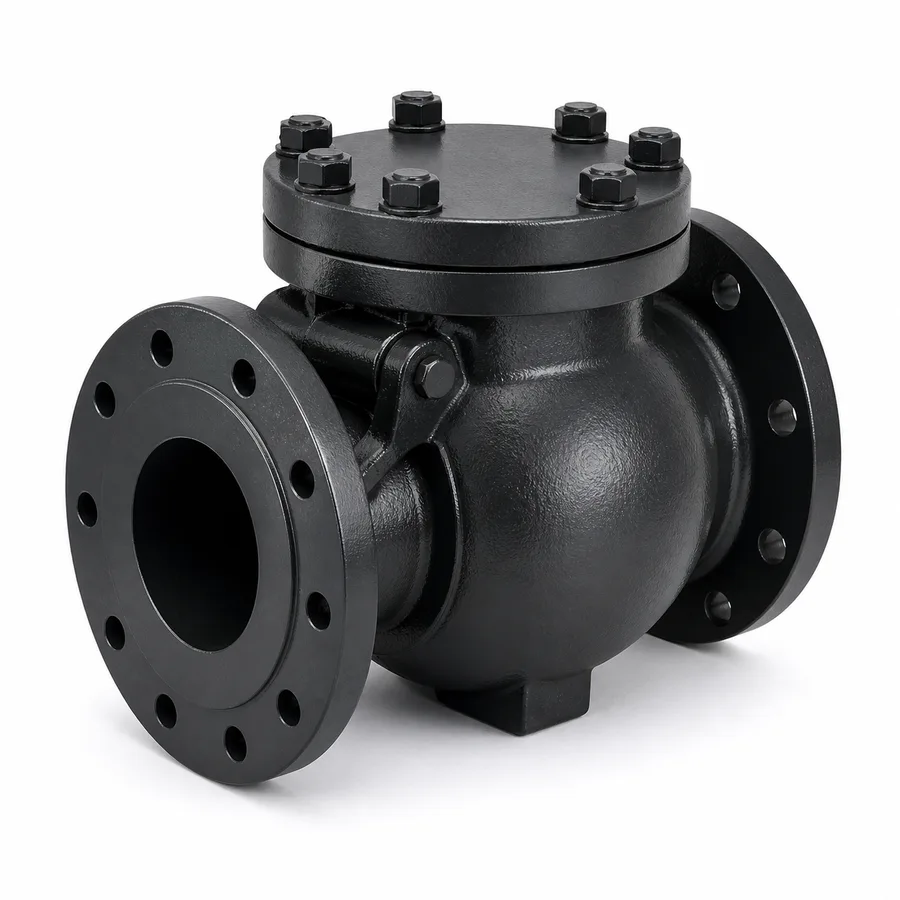
TECTUL's carbon steel check (non-return) valves in two constructions: the Cheque Cortina, a bolted-cover swing type in A216 WCB per API 594 / BS 1868, class 150 (285 psig at 38 °C); and the Cheque Globo and Cheque Compuerta, forged in A105 per API 602, Class 800 (1,973 psig at 38 °C — not "800 psi"), 1/2″ to 2″, with threaded or socket-weld ends. The closing mechanism — gravity swing, spring-loaded piston or gravity gate — sets the orientation each figure works reliably in: this sheet publishes the type-to-admissible-position matrix that no Spanish-language data sheet details, together with the physics of why a swing check slams on closing.
Important: Before using these data in engineering, design or installation decisions on systems exposed to mechanical, pressure, rupture, fatigue, impact or water-hammer risk, it is essential to read the technical notice and limitation of liability at the end of this sheet.
SKU VT-cheque-cortina-acero-al-carbon-bridado · 3 references: Cheque Cortina flanged class 150 (2″–12″), forged Cheque Globo and Cheque Compuerta class 800 (1/2″–2″)
1. Technical specifications
Three references, two constructions
| Cheque Cortina (swing) | Flanged, A216 WCB body, gate-shaped disc hinged and lifted by the flow, falling back by gravity to close. Design standard API 594 / BS 1868, class 150 flanged ends per ASME B16.5. Sizes 2″ to 12″. |
| Cheque Globo (piston) | Forged, A105 body, axially guided piston with a closing spring — flow geometry analogous to a globe valve. Standard API 602, NPT threaded or socket-weld ends, Class 800. Sizes 1/2″ to 2″. |
| Cheque Compuerta | Forged, A105 body, gate lifted by the flow, falling back by gravity — straight flow geometry, analogous to a gate valve. Standard API 602, threaded or socket-weld ends, Class 800. Sizes 1/2″ to 2″. |
IMPORTANT
This data sheet is a reference guide to the properties of this product type. The measurements, dimensions and physical or geometric characteristics of the product actually supplied may vary by manufacturer and lot, and may even fall outside the cited standards. If any of these figures is critical to your design or build, it is essential to verify it with one of our advisors against the physical product, so you can be fully certain of what you are buying. · Original data sheet: tectul.com/en/conduccion-de-fluidos/valvulas/ficha-tecnica-cheque-cortina-acero-al-carbon-bridado.html
Regulatory framework
| Valve type | Check (non-return): operates by itself, driven by the flow; no handwheel or actuator |
| Product standard (flanged) | API 594 (Check Valves: Flanged, Lug, Wafer and Butt-welding), Type B bolted-cover, long face-to-face (BS 1868 is the equivalent British standard for steel check valves of this type) |
| Product standard (forged) | API 602 (Compact Steel Gate, Globe, and Check Valves, DN 100 and smaller) |
| Pressure-temperature rating | ASME B16.34, material group 1.1 across all three references (A216 WCB and A105 share the group): class 150 for the Cortina, Class 800 for the Globo and Compuerta — the same name correction as the other sheets in this family: Class 800 is NOT "800 psi" |
| Ends | Cortina: class 150 flanged per ASME B16.5. Globo and Compuerta: NPT thread (ASME B1.20.1) or socket-weld (ASME B16.11) |
| Tests | Seat and shell per API 598 |
Pressure-temperature table — class 150 (A216 WCB, B16.34 group 1.1)
| Temperature | Allowable pressure |
|---|---|
| −29 to 38 °C (−20 to 100 °F) | 285 psig (19.6 bar) |
| 93 °C (200 °F) | 260 psig (17.9 bar) |
| 149 °C (300 °F) | 230 psig (15.9 bar) |
| 204 °C (400 °F) | 200 psig (13.8 bar) |
| 260 °C (500 °F) | 170 psig (11.7 bar) |
IMPORTANT
This data sheet is a reference guide to the properties of this product type. The measurements, dimensions and physical or geometric characteristics of the product actually supplied may vary by manufacturer and lot, and may even fall outside the cited standards. If any of these figures is critical to your design or build, it is essential to verify it with one of our advisors against the physical product, so you can be fully certain of what you are buying. · Original data sheet: tectul.com/en/conduccion-de-fluidos/valvulas/ficha-tecnica-cheque-cortina-acero-al-carbon-bridado.html
Pressure-temperature table — Class 800 (A105, group 1.1, interpolated 1/3 class 600 + 2/3 class 900)
| Temperature | Allowable pressure |
|---|---|
| −29 to 38 °C (−20 to 100 °F) | 1,973 psig (136 bar) |
| 93 °C (200 °F) | 1,800 psig (124 bar) |
| 149 °C (300 °F) | 1,752 psig (121 bar) |
| 204 °C (400 °F) | 1,690 psig (116 bar) |
IMPORTANT
This data sheet is a reference guide to the properties of this product type. The measurements, dimensions and physical or geometric characteristics of the product actually supplied may vary by manufacturer and lot, and may even fall outside the cited standards. If any of these figures is critical to your design or build, it is essential to verify it with one of our advisors against the physical product, so you can be fully certain of what you are buying. · Original data sheet: tectul.com/en/conduccion-de-fluidos/valvulas/ficha-tecnica-cheque-cortina-acero-al-carbon-bridado.html
Class 150: Table 2-1.1 of ASME B16.34, material group 1.1. Class 800: the 38 °C anchor value (1,973 psig) is verified against API 602 line manufacturers and detailed with the calculation method in the sister gate valve sheet, FT-TC-VAL-COMPUERTA-AC-001, section 2.
Face-to-face dimensions — Cheque Cortina, class 150 (ASME B16.10 swing check pattern)
| Size | Face-to-face (RF) |
|---|---|
| 2″ | 203 mm |
| 3″ | 241 mm |
| 4″ | 292 mm |
| 6″ | 406 mm |
| 8″ | 495 mm |
| 10″ | 622 mm |
| 12″ | 698 mm |
IMPORTANT
This data sheet is a reference guide to the properties of this product type. The measurements, dimensions and physical or geometric characteristics of the product actually supplied may vary by manufacturer and lot, and may even fall outside the cited standards. If any of these figures is critical to your design or build, it is essential to verify it with one of our advisors against the physical product, so you can be fully certain of what you are buying. · Original data sheet: tectul.com/en/conduccion-de-fluidos/valvulas/ficha-tecnica-cheque-cortina-acero-al-carbon-bridado.html
The face-to-face pattern of the flanged swing check matches the globe valve pattern at the same size in ASME B16.10 (both are "long" bolted-bonnet bodies), and is noticeably longer than a gate valve's (for example 4″: 292 mm versus 229 mm). The forged Cheque Globo and Cheque Compuerta have no F2F table in B16.10; their dimension is set by API 602 and the manufacturer — confirmed on quotation.
⚠ Important: this technical data sheet is a reference guide to the product's properties; it is not a quality certificate for the product you are buying. Heats vary from one another and may differ from the values stated here, or even depart from the standards. If your application requires compliance with a standard, always check the quality certificate (mill certificate) of the lot you are buying. If in doubt, ask one of our technical advisors →
2. Check type-to-admissible-mounting-position matrix
The mechanism that returns the closure member to its seat — gravity on a hinge, a spring on a piston, or gravity on a gate — defines the orientation each figure works reliably in. It is the installation datum no Spanish-language commercial sheet publishes as a table.
| TECTUL reference | Closing mechanism | Horizontal | Vertical, upward flow | Vertical, downward flow |
|---|---|---|---|---|
| Cheque Cortina (swing) | Hinged disc, falls by gravity | Yes — design position, hinge on the upper horizontal axis | Yes, on most manufacturers | No |
| Cheque Globo (spring-loaded piston) | Axially guided piston, closing spring | Yes | Yes | Depends on the spring: confirm with the manufacturer's sheet |
| Cheque Compuerta (forged) | Gate lifted by flow, falls by gravity | Yes — design position, cap facing up | Yes | No |
Classification by mechanism family, applying general check valve installation practice. The admissible position of each figure and the flow direction are defined by the manufacturer: the arrow cast on the body and the product PDF sheet override this table.
Why the forged Cheque Compuerta does not accept downward flow
On the Cheque Compuerta, the force that returns the gate to the seat is its own weight, and that weight only does its job if it acts opposite to the flow: hence the admissible mounting is horizontal — the gate falls onto the seat — or vertical with upward flow — it falls against the stream. With downward flow, gravity and the fluid push in the same direction, the opening one: the gate rests on the open stop and, when flow stops, nothing brings it back to the seat. The valve stays permanently open and the return flow passes freely. This is the most common field error with this family and the network pressure test does not reveal it: it shows up when the pump stops.
Why the spring-loaded Cheque Globo tolerates more orientations
Unlike the two gravity designs, the Cheque Globo's piston closes by the force of a calibrated spring, not its own weight: that lets it work in more orientations, because closing does not depend on gravity acting in the correct direction. The condition remains to verify with the manufacturer whether the spring was calibrated to offset the piston's weight or not in the project's specific orientation.
Field rules common to all three references
- The arrow cast on the body indicates the flow direction, not the mounting position: complying with the arrow does not guarantee correct orientation.
- Leave a straight run upstream, free of elbows, pumps and immediate reducers, so the closure member works with steady flow.
- Size by the service flow rate and not by the pipe diameter: an oversized check valve works with the closure member partly open and wears the seat.
- A check valve is not an isolation valve: to work on the line, an isolation valve is installed upstream.
3. Cracking pressure, metal-to-metal seals and why the swing check slams on closing
Cracking pressure
Cracking pressure is the minimum differential pressure the fluid needs to lift the closure member off the seat and start flowing. On the Cheque Cortina, which opens only by the flow's push against the hinged disc's weight, cracking pressure is low — typically a fraction of a psi in large sizes — enough that the disc's weight is not a meaningful restriction in normal operation. On the spring-loaded Cheque Globo, cracking pressure is set by the spring preload, a value calibrated by the manufacturer (typical orders of magnitude of one to several psi, depending on the application) that guarantees the piston closes even in vertical mounting or against small pressure pulsations, in exchange for additional head loss in normal operation compared with the swing type. The exact cracking-pressure value per reference and size is not published by the manufacturer in the general catalog and is confirmed on quotation.
Metal-to-metal seals
All three references in this sheet seal metal against metal: the disc or gate seats directly on a machined body surface, with no elastomeric or PTFE ring. It is the construction consistent with this family's steam and high-temperature service (where an elastomer would degrade) and with the forged Class 800 (where contact pressure is high). The trade-off against a soft seal is a less perfect shut-off tightness at low differential pressure — metal does not conform to surface imperfections the way an elastomer would — and the need for a seat finish in good condition: scratches or fouling open a leak path that no amount of tightening corrects, because a check valve has no bolt-torque adjustment like a flanged joint.
Why the swing check slams on closing
The Cheque Cortina closes by gravity when flow stops or reverses, and its disc has considerable mass and inertia. If flow stops abruptly — a sudden pump trip, for example — the disc takes a moment to fall and close while the fluid has already begun returning: the disc strikes the seat with the fluid still moving in reverse, and that abrupt deceleration of a moving fluid column is exactly the definition of water hammer (a sudden pressure rise from an abrupt change in fluid velocity). The slam is felt as an audible metallic knock in the valve, and in severe installations (large pumps, long fluid columns, frequent start-stop cycles) it can generate overpressures several times the normal operating pressure, with risk of damage to the valve itself, neighboring flanges or supports.
The spring-loaded Cheque Globo mitigates this effect because the spring closes the piston before the flow fully reverses — before the column reaches a significant return velocity — closing with the fluid nearly at rest instead of moving backward. That is why, on lines with large pumps or frequent sudden stops, a spring-assisted fast-closing check valve reduces water hammer compared with a gravity-only swing type; for severe water hammer, specialized damped anti-slam designs also exist (outside the scope of this sheet), and our technical team should be consulted when the phenomenon is recurring.
4. Frequently asked questions
What mounting position can I use for the Cheque Cortina?
Horizontal — its design position, hinge on the upper horizontal axis — or vertical with upward flow, as confirmed by the manufacturer of each reference. Never vertical with downward flow. The full matrix for all three references is in section 2.
Do the check valves in this sheet really take 800 psi?
The forged Cheque Globo and Cheque Compuerta are ASME B16.34/API 602 Class 800, whose real cold ceiling is 1,973 psig (136 bar) at 38 °C, not 800 psi. The flanged Cheque Cortina is Class 150, 285 psig at 38 °C. See the full correction in section 1.
Why does my swing check valve slam hard when the pump stops?
Because the disc closes by gravity and takes a moment to reach the seat while the fluid has already begun returning: the metallic knock is the disc striking the fluid still moving in reverse, the definition of water hammer. A fast-closing spring check valve (like the Cheque Globo) closes before the return flow gains speed and reduces that slam. The detail is in section 3.
Can I install the Cheque Compuerta with downward flow?
No. The gate closes by its own weight, which only works against the flow. With downward flow, gravity and the fluid push in the same opening direction, and the valve stays permanently open once flow stops — a failure the network pressure test does not detect.
What cracking pressure do these check valves have?
The Cheque Cortina opens with a low cracking pressure, just enough to overcome the disc's weight. The spring-loaded Cheque Globo has a manufacturer-calibrated cracking pressure, on the order of one to several psi depending on the application. The exact value per reference and size is confirmed on quotation.
Do these check valves seal with an elastomer or metal-to-metal?
Metal against metal on all three references, consistent with this family's steam and high-temperature service. Shut-off tightness at low differential pressure is less perfect than with a soft seal, and the seat must be kept free of scratches or fouling.
5. Application notes
Feasibility
The flanged Cheque Cortina (285 psig at 38 °C) covers main steam, water and oil lines from 2″ to 12″, in horizontal or vertical-upward mounting. The forged Cheque Globo and Cheque Compuerta (1,973 psig at 38 °C, not 800 psi) cover the small sizes of instrumentation and high-pressure lines, 1/2″ to 2″. None of the three replaces an isolation valve or solves severe water hammer on its own: on lines with large pumps and frequent stops, a dedicated anti-slam design should be evaluated. For critical or safety applications, consult our technical team before specifying.
Installation
Verify the admissible orientation against the section 2 matrix before defining the line layout, not on site: a change of route from horizontal to vertical downward disables the Cheque Compuerta. Follow the flow-direction arrow cast on the body. Leave a straight run upstream free of elbows and pumps. Size by the service flow rate, not the pipe diameter, so the closure member works fully open. Always install an isolation valve upstream to allow work on the line.
Design
The published rating applies to the valve cold and without shock: the water hammer of a swing check closing, piping loads and start-stop transients are not included and belong to the project's design code (ASME B31.1 or B31.3). For the forged Class 800, use 1,973 psig as the ceiling at 38 °C, not 800 psi. On lines with large pumps or frequent sudden stops, evaluate a fast-closing (spring) check valve instead of a swing type, or a specialized anti-slam design. The metal-to-metal seal requires consistent manufacturing tolerance and seat finish: specify the API 598 tightness test in the order.
6. Technical notice and limitation of liability
The pressure-temperature ratings in this sheet combine values published directly in ASME B16.34 (class 150, material group 1.1) with Class 800 values obtained by documented linear interpolation (1/3 of Class 600 + 2/3 of Class 900 of the same group), consistent with what API 602 line manufacturers publish. They are nominal reference values; they are not a certificate of conformity for any production lot nor an independent test of the TECTUL catalog references.
The mounting position matrix in section 2 classifies by closing mechanism family (gravity swing, spring-loaded piston, gravity gate) applying general check valve installation practice, not a standard table. The flow-direction arrow cast on the body and the product PDF sheet override this table. The exact cracking pressure per reference and size is not published by the manufacturer in the general catalog and is confirmed on quotation.
These values must not be used as the sole criterion in critical, safety applications, or wherever valve failure may compromise people, property or the environment — in particular the water hammer analysis on lines with large pumps, which requires a specific hydraulic transient calculation: in such cases the design belongs to the project's responsible engineer, under the applicable piping code. Before deciding with these data, consult our technical team.
Sources
- API Standard 594 — Check Valves: Flanged, Lug, Wafer and Butt-welding Ends: tipo B bonete empernado, cara-a-cara larga, marco de diseño del Cheque Cortina
- BS 1868 — Steel Check Valves for the Petroleum, Petrochemical and Allied Industries: estándar británico equivalente para cheques de acero bridados
- API Standard 602 — Compact Steel Gate, Globe, and Check Valves for Sizes DN 100 (NPS 4) and Smaller: construcción forjada del Cheque Globo y el Cheque Compuerta
- ASME B16.34 — Valves — Flanged, Threaded, and Welding End: Tabla 2-1.1, grupo de material 1.1 (A216 WCB / A105); método de interpolación de la Clase 800
- ASME B16.10 — Face-to-Face and End-to-End Dimensions of Valves: patrón de cheque/globo clase 150, 2″ a 12″
- ASME B16.5 — Pipe Flanges and Flanged Fittings: bridas clase 150 del Cheque Cortina
- ASME B1.20.1 — Pipe Threads, General Purpose (Inch) / ASME B16.11 — Forged Fittings, Socket-Welding and Threaded: extremos de las referencias forjadas
- API Standard 598 — Valve Inspection and Test: pruebas de asiento y cuerpo
- Práctica general de instalación de válvulas de retención: posición admisible por mecanismo de cierre (gravedad-columpio, gravedad-compuerta, resorte-pistón), consistente entre múltiples fabricantes de válvulas check
- ASTM A216/A216M (grado WCB) y ASTM A105/A105M — especificaciones de material del cuerpo fundido y forjado, grupo de material 1.1 de ASME B16.34
This data sheet is the property of TECTUL, part of the Industrias IMR group. Reproduction without attribution is prohibited. Original document and updates: tectul.com/en/conduccion-de-fluidos/valvulas/ficha-tecnica-cheque-cortina-acero-al-carbon-bridado.html.