 TECTULby IMR
Stainless steel angle seat valve with pneumatic piston actuator — fast closing, high Cv and intensive cycling for hot water, steam, CIP and filling
TECTUL · Dispatch across Colombia · Exports to Central & South America
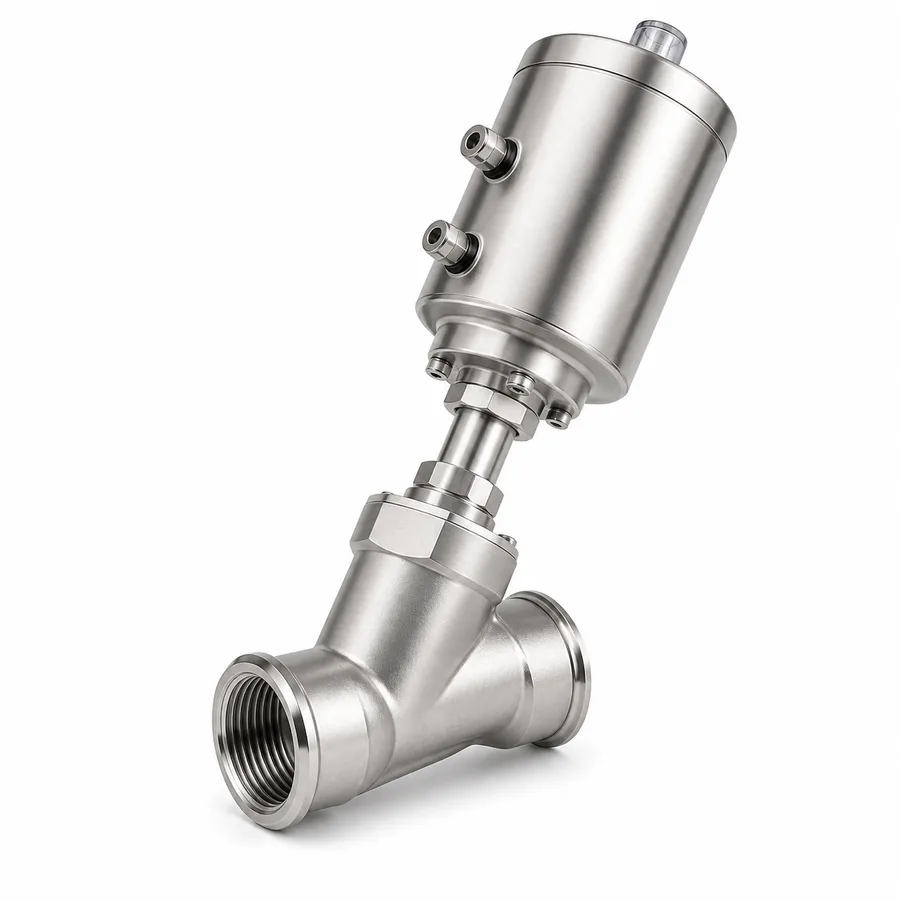
The stainless steel angle seat valve in the TECTUL catalog: 45° seat body, linear plug with a PTFE seal and a double-acting or spring-return pneumatic piston actuator. Its advantage over a conventional globe valve of the same nominal size is a significantly higher Cv: the fluid turns only once, not twice, as it passes through the angled seat, reducing turbulence and head loss. This sheet publishes that comparison, the actuator's pilot pressure, the normally closed (NC) and normally open (NO) configurations depending on the flow mounting direction — under the seat or over the seat —, with their direct effect on closing torque and maximum admissible pressure, the self-adjusting packing that withstands intensive cycling, the admissible temperature per seal (up to around 180 °C with PTFE), and its application in washdown, CIP and filling equipment.
Important: Before using these data in engineering, design or installation decisions on systems exposed to mechanical, pressure, rupture, fatigue, impact or water-hammer risk, it is essential to read the technical notice and limitation of liability at the end of this sheet.
SKU VT-valvula-asiento-inclinado-inoxidable · stainless steel angle seat valve, pneumatic piston actuator
1. Technical specifications
Construction
| Body | Stainless steel, 45° angle seat geometry (angle-globe pattern) |
| Plug | Linear stem driven by the actuator, perpendicular to the angled seat |
| Seat seal | PTFE, to withstand temperature and intensive cycling (section 4) |
| Stem packing | Self-adjusting, designed to sustain intensive cycling with no progressive leakage (section 4) |
| Actuator | Pneumatic piston, double-acting or spring-return depending on NC/NO configuration (section 3) |
| Ends | Threaded or weld, depending on size; exact datum per size confirmed on quotation |
| Usual fluids | Cold and hot water, low-to-medium pressure steam, compressed air, and process fluids compatible with stainless steel and PTFE |
Reference framework and supply conditions
| Valve type | Angle seat valve, linear actuation, pneumatic piston actuator |
| Rating system | Working pressure and actuator pilot pressure, both from the manufacturer — not an ASME class value nor a WOG/CWP rating; see sections 2 and 3 |
| Actuator pilot pressure | Approximately 3 to 8 bar (43-116 psi), typical range for the pneumatic-piston angle seat valve category; the exact range per size and model for this reference is confirmed on quotation |
| Factory configuration | Normally closed (NC) or normally open (NO) depending on the flow mounting direction (section 3) — confirmed on quotation |
| Operating cycles | Designed for intensive cycling thanks to the self-adjusting packing; the exact manufacturer-guaranteed cycle figure is confirmed on quotation (section 4) |
| Temperature | Up to around 180 °C with a PTFE seal, subject to manufacturer confirmation for this reference (section 4) |
Sizes, face-to-face dimensions and the actual Cv per size of this reference are not published on the commercial sheet: they are confirmed on quotation with the factory sheet. The pilot pressure, cycle and temperature ranges in this section are general reference for the pneumatic angle seat valve category, not a certified datum exclusive to this unit — as stated in each cell.
⚠ Important: this technical data sheet is a reference guide to the product's properties; it is not a quality certificate for the product you are buying. Heats vary from one another and may differ from the values stated here, or even depart from the standards. If your application requires compliance with a standard, always check the quality certificate (mill certificate) of the lot you are buying. If in doubt, ask one of our technical advisors →
2. Why the 45° seat gives much more Cv than a globe valve of the same DN
A conventional globe valve forces the fluid to make two full turns to pass through it: it enters, rises or descends to go around the plug, and turns again to exit in line with the pipe. Each turn dissipates energy through turbulence and friction, and that is the origin of the globe valve's characteristic head loss — the trade-off for its good throttling control.
The angled seat removes one turn
In the angle seat valve, the seat is machined at 45° relative to the pipe axis, and the plug moves in line with the actuator, not across the fluid's path. The result is that the fluid turns only once, not twice, to pass through the open valve: a nearly straight geometry compared to a globe valve. That one-turn reduction is what significantly reduces turbulence and lets the valve deliver a much higher Cv at the same nominal diameter than a conventional globe valve.
| DN | Illustrative Cv for the angle seat category | Qualitative comparison vs. a conventional globe valve of the same DN |
|---|---|---|
| DN 50 (2″) | ≈8 to 12, depending on manufacturer and model | Significantly higher: a globe valve of the same DN loses more pressure at the same flow rate |
| DN 100 (4″) | ≈25 to 35, depending on manufacturer and model | Significantly higher, same geometric reason |
The Cv values in this table are illustrative of the pneumatic angle seat valve category in general, taken from manufacturer technical literature for the type — they are not this TECTUL reference's certified Cv, which is confirmed on quotation. The qualitative comparison (higher Cv, same single-turn geometric reason) does apply generally to the whole category versus a conventional globe valve of the same nominal diameter.
Why this matters in steam and hot water
A higher Cv at the same nominal diameter means less pressure loss at the same flow rate — a critical datum in steam, where every unnecessary psi of drop across a shut-off valve reduces the energy available downstream for the process, and in high-turnover hot water (industrial washdown, filling), where the fast open-close cycle repeats thousands of times per shift and the per-valve head loss accumulates in the line's energy balance.
3. NC/NO per flow direction: under the seat or over the seat
Two ways to mount the same valve
An angle seat valve can be installed in two ways relative to the flow direction, and that choice is not indifferent: it changes the torque the actuator must exert to close and the valve's maximum admissible pressure.
| Flow over the seat (usual configuration) | Flow under the seat | |
|---|---|---|
| How the fluid reaches the plug | From above, pushing the plug towards the seat | From below, pushing the plug towards opening |
| Effect on closing | Line pressure helps close: improves sealing and reduces the effort required of the actuator to hold closure | Line pressure opposes closing: the actuator must overcome it entirely, and it characteristically reduces the valve's maximum admissible working pressure, typically on the order of 50% versus the flow-over-seat configuration |
| Behaviour under water hammer | Weaker protection against an abrupt closure: a controlled or cushioned closure is advisable if the process requires it | Reduces closing water hammer, while lowering maximum admissible pressure |
| Typical use | Steam, air and medium-to-high pressure liquids, where using line pressure for sealing is an advantage | Low-to-medium pressure systems where cushioning water hammer matters more than maximum pressure |
The reduction in maximum admissible pressure under the flow-under-seat configuration (on the order of 50% versus flow over the seat) is a general criterion of the angle seat valve category, documented in manufacturer technical literature for the type — the exact figure for this reference per size is confirmed with the manufacturer before installing it in the flow-under-seat direction.
Normally closed (NC) or normally open (NO)
Regardless of the flow direction, the pneumatic piston actuator is factory-configured as normally closed (return spring closes the valve with no control air; energised with air to open) or normally open (the spring keeps it open; control air closes it). The choice depends on the process's fail-safe criterion — what must happen if control air is cut —, the same principle as section 4 of this catalog's solenoid valve sheet. Fitting a stronger return spring allows working at higher line pressure, but requires a larger-diameter actuator to overcome that added force when opening.
4. Self-adjusting packing, seal temperature and intensive-cycling application
Why self-adjusting packing withstands intensive cycling
Conventional stem packing compresses with time and use, and requires periodic re-tightening to avoid dripping; on a valve that opens and closes thousands of times per shift, that wear accelerates and manual maintenance becomes impractical. This valve's self-adjusting packing compensates its own wear with no manual intervention — typically through internal preload that keeps sealing pressure constant on the stem as the material yields — sustaining tightness over a number of cycles significantly greater than manually re-tightened packing. Category designs with this type of packing report more than a million cycles, and some high-performance series document figures of 5 to 10 million cycles.
The exact guaranteed cycle figure for this reference — which depends on the actual packing model, working pressure and fluid — is not published on the commercial sheet and is confirmed on quotation with the manufacturer.
Admissible temperature per seal
The seat seal, not the stainless steel body, is what sets the valve's real temperature ceiling:
- Standard elastomeric seal (NBR/EPDM type): temperature ceiling on the order of 80-100 °C, suited to cold and lukewarm water.
- PTFE seal: temperature ceiling on the order of 180-200 °C, the one suited to low-to-medium pressure steam and hot process water.
This reference is specified with a PTFE seal, consistent with its declared use in steam and hot water; the exact maximum continuous temperature for this unit is confirmed with the manufacturer, because it also depends on the actuator and its own pneumatic seals, not just the seat.
Application in washdown, CIP and filling equipment
The combination of high Cv (section 2), fast closure via pneumatic piston actuation and intensive cycling with self-adjusting packing is exactly the profile demanded by industrial washdown, clean-in-place (CIP) and filling equipment: lines where the valve opens and closes in fractions of a second, many times per shift, with hot sanitation water or steam, and where high head loss on every cycle penalises process time. It is also why this valve replaces a quarter-turn actuated ball valve when the process demands a finer linear closure and a more predictable cycle life than a spherical seal under the same regime.
5. Frequently asked questions
Why does this valve have more Cv than a globe valve of the same diameter?
Because the fluid turns only once, not twice. The 45° angled seat leaves an almost straight path compared to a conventional globe valve, which forces two full turns; that geometry reduces turbulence and allows a significantly higher Cv at the same nominal diameter (section 2).
What is the difference between mounting it with flow over the seat and under the seat?
With flow over the seat, line pressure helps close and improves sealing. With flow under the seat, line pressure opposes closing, reduces closing water hammer but also reduces the valve's maximum admissible working pressure, typically on the order of 50% (section 3). The mounting direction is decided at the project stage, not on site.
Is it normally closed or normally open?
It is factory-configured per the process's fail-safe criterion: normally closed if a control-air cut must stop the flow, normally open if it must let it through. Both configurations exist for this valve; which one suits the actual installation is confirmed on quotation (section 3).
How many cycles does this valve withstand?
Category designs with self-adjusting packing report more than a million cycles, and some high-performance series document 5 to 10 million. The exact guaranteed figure for this unit depends on the actual packing model and service conditions, and is confirmed on quotation (section 4).
Is it suitable for steam?
Yes, provided the seal is PTFE (the one specified for this reference), with a temperature ceiling on the order of 180-200 °C; a standard elastomeric seal limits the application to cold or lukewarm water, on the order of 80-100 °C (section 4).
How is it different from a stainless ball valve with a pneumatic actuator?
The angle seat valve actuates a linear plug and tolerates frequent cycling with more predictable service life thanks to its self-adjusting packing; the actuated ball valve is quarter-turn, intended for fast straight-through shut-off rather than intensive open-close cycling.
6. Application notes
Feasibility
It covers cold and hot water, low-to-medium pressure steam and compressed air, with a PTFE seal up to around 180 °C, in intensive-cycling applications: industrial washdown, CIP and filling equipment. It is not the choice when straight-through quarter-turn shut-off with minimal head loss in occasional service is needed (an actuated ball valve is simpler for that case), nor for steam or process pressures exceeding the actuator and seal rating without checking with the manufacturer. For critical, certified sanitary or safety applications, consult our technical team before specifying.
Installation
Confirm the mounting direction relative to flow (over or under the seat) against the actual line pressure before installing, because it changes the maximum admissible pressure and the torque required of the actuator (section 3). Check the available control air pressure against the actuator's pilot range and the fail-safe position (NC/NO) the process requires. Leave physical space to remove the actuator without taking the body out of the line. On steam or hot water service, verify the seal is PTFE and not a standard elastomer before commissioning.
Design
Take advantage of this geometry's higher Cv to reduce head loss versus a conventional globe valve of the same nominal diameter (section 2), but confirm the actual Cv of the reference with the manufacturer before calculating the line — the values in this sheet are illustrative of the category. Define the mounting direction (over or under the seat) and the fail-safe position (NC/NO) at the project stage, not on site, because both affect maximum admissible pressure and actuator sizing. If the duty cycle is intensive (several times per minute, thousands of cycles per shift), specify the self-adjusting packing and require the manufacturer's guaranteed cycle figure at the project's actual pressure and temperature point.
7. Technical notice and limitation of liability
The Cv, pilot pressure, cycle and temperature values in this sheet combine the few data TECTUL publishes on the product page (stainless material, pneumatic actuator, declared applications) with general technical literature from manufacturers of the pneumatic angle seat valve category (Bürkert, Parker and equivalents, cited as evidence of the type, not as the brand of the TECTUL product). None of those figures is a certified datum exclusive to this unit: they are confirmed on quotation with the reference's actual manufacturer.
The reduction in maximum admissible pressure when mounted with flow under the seat (section 3) and the cycle life with self-adjusting packing (section 4) are criteria documented for the product category, not a certified table for this reference. The mounting direction, the NC/NO fail-safe position and the actuator torque must be verified against the factory sheet before installing.
These values must not be used as the sole criterion in critical, certified sanitary, high-pressure steam or safety applications, where valve failure may compromise people, property, the process or the environment: in such cases the design belongs to the project's responsible engineer, using the Cv curve, the pressure-temperature rating and the cycle life certified by the actual manufacturer. Before deciding with these data, consult our technical team.
Sources
- Tameson.com — "Angle Seat Valve - Operation Principle": geometría de asiento a 45°, mecanismo de accionamiento lineal y ventaja de Cv frente a globo convencional
- FOKCA Valve — "Angle Seat Valve Installation Direction: Flow Under Seat vs Flow Over Seat Explained": efecto del sentido de montaje del flujo sobre la presión máxima admisible y el golpe de ariete
- FOKCA Valve — "Angle Seat Valve Pressure Drop & Cv Kv Calculation Guide": método de cálculo de Cv/Kv y valores ilustrativos por DN de la categoría
- Bürkert — Type 2300 (nota técnica de fabricante): empaquetadura autoajustable ("self adjusting packing gland") y vida en ciclos de la categoría de válvulas de asiento inclinado
- Fluid Power Journal — "High Cycle-Life Angle Valve": cifras de ciclos de diseños de alto rendimiento de la categoría (millones de ciclos)
- Tameson.co.uk / Electricsolenoidvalves.com — guías de material de sello: rangos de temperatura de referencia de elastómeros estándar (NBR/EPDM) y PTFE
- Parker — PA Series, Pneumatically Actuated Angle Seat Valves (catálogo de fabricante): rango típico de presión de pilotaje de actuadores neumáticos de pistón de la categoría
- Ficha de producto TECTUL (tectul.com): Válvula de Asiento Inclinado Inoxidable — fuente de material de cuerpo, tipo de actuador y aplicaciones declaradas, agosto 2026
This data sheet is the property of TECTUL, part of the Industrias IMR group. Reproduction without attribution is prohibited. Original document and updates: tectul.com/en/conduccion-de-fluidos/valvulas/ficha-tecnica-valvula-asiento-inclinado-inoxidable.html.