 TECTULby IMR
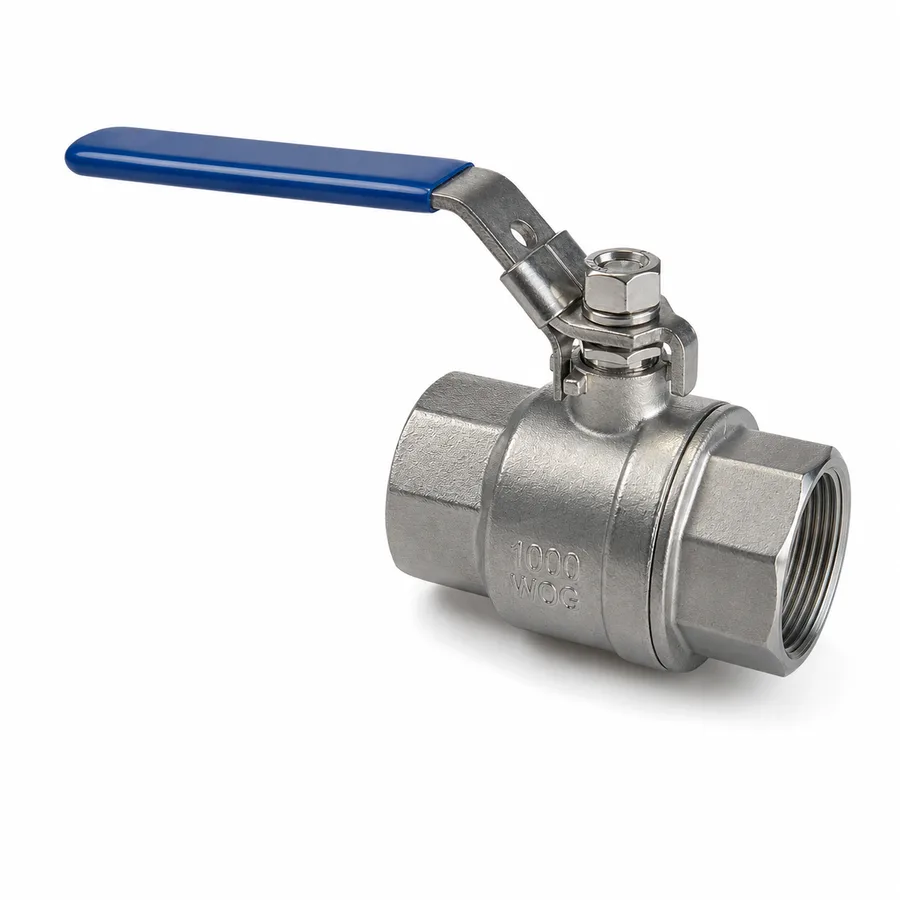
CF8M stainless steel ball valves — 1000 WOG (CWP) per MSS SP-110
TECTUL · Dispatch across Colombia · Exports to Central & South America
Ball valves with body and ball investment-cast in ASTM A351 grade CF8M —the cast equivalent of AISI 316, with Cr 18–21 %, Ni 9–12 %, Mo 2–3 % and C ≤0.08 %— and a reinforced PTFE seat. The line's working rating is 1000 WOG/CWP (68.9 bar) at ≤38 °C per MSS SP-110: a manufacturer-certified cold pressure, not an ASME Class. This sheet covers the five stainless constructions in the TECTUL catalog —two-piece, four-bolt, six-bolt, high pressure and three-way— plus the sanitary version with ISO 2852 clamp ends, together with the in-line maintainability criterion, flow capacity (Cv 36 on 1″ full port) and diversion versus mixing on three-way bodies.
Important: Before using these data in engineering, design or installation decisions on systems exposed to mechanical, pressure, rupture, fatigue, impact or water-hammer risk, it is essential to read the technical notice and limitation of liability at the end of this sheet.
SKU VT-59181 (stainless two-piece ball valve) · 6 CF8M stainless steel references, 1/4″–4″ · sold by the unit
1. Technical specifications
Materials by component
| Component | Material | Designation | Remark |
|---|---|---|---|
| Body and cap | Investment-cast austenitic stainless steel | ASTM A351 grade CF8M | Cast equivalent of AISI 316; molybdenum gives it the chloride pitting resistance CF8 (the 304 equivalent) lacks |
| Ball | Stainless steel | ASTM A351 CF8M | Mirror-polished to seal against the reinforced PTFE seat |
| Stem | Stainless steel, usually austenitic bar | ASTM A276/A479 — exact grade confirmed on quotation | Blowout-proof assembly from inside the body |
| Seat and seals | Reinforced PTFE (RPTFE) | PTFE compound with 15–25 % glass fiber | Sets the valve's real thermal limit: −45 °C to +232 °C |
| Body bolting | Stainless steel | Confirmed on quotation | Present on the 4 and 6-bolt constructions |
CF8M chemical composition per ASTM A351
| Carbon (C) | 0.08 % max. |
| Chromium (Cr) | 18.0 – 21.0 % |
| Nickel (Ni) | 9.0 – 12.0 % |
| Molybdenum (Mo) | 2.0 – 3.0 % |
| Wrought equivalent | AISI 316 / UNS S31600 — CF8M is its cast form, not a lower-grade substitute |
TECTUL catalog references in stainless steel
| Reference | Construction | Catalog diameters |
|---|---|---|
| Stainless two-piece ball valve (VT-59181) | Two pieces threaded together, full port | 1/4″ · 3/8″ · 1/2″ · 3/4″ · 1″ · 1-1/4″ · 1-1/2″ · 2″ · 2-1/2″ · 3″ · 4″ (11 diameters) |
| Stainless four-bolt ball valve | 4-bolt body, maintainable in line | 1/4″ · 3/8″ · 1/2″ · 3/4″ · 1″ · 1-1/4″ · 1-1/2″ · 2″ · 2-1/2″ · 3″ (10 diameters) |
| Stainless six-bolt ball valve | 6-bolt body | 4″ (only catalog diameter) |
| Stainless three-way ball valve | Three-way, L-port or T-port ball depending on configuration | 1/4″ · 3/8″ · 1/2″ · 3/4″ · 1″ (5 diameters) |
| Stainless high-pressure ball valve | Reinforced wall, rating above the line's | Confirmed on quotation |
| Stainless sanitary clamp ball valve | ISO 2852 clamp ends instead of NPT thread | Confirmed on quotation |
IMPORTANT
This data sheet is a reference guide to the properties of this product type. The measurements, dimensions and physical or geometric characteristics of the product actually supplied may vary by manufacturer and lot, and may even fall outside the cited standards. If any of these figures is critical to your design or build, it is essential to verify it with one of our advisors against the physical product, so you can be fully certain of what you are buying. · Original data sheet: tectul.com/en/conduccion-de-fluidos/valvulas/ficha-tecnica-valvula-bola-inoxidable-dos-piezas.html
The high-pressure and sanitary clamp references are published in the catalog with no diameter list: their dimensional scope and rating are confirmed on quotation.
General specifications
| Product | CF8M stainless steel ball valves for on-off shutoff service, in 2, 4 and 6-bolt constructions, plus three-way, high-pressure and sanitary clamp versions |
| Material | Investment-cast ASTM A351 CF8M body and ball · stainless steel stem (ASTM A276/A479, exact grade confirmed on quotation) · RPTFE seat and seals |
| Ends | Female NPT thread per ASME B1.20.1 on the line references; ISO 2852:1993 clamp ends on the sanitary reference |
| Rating | 1000 WOG (CWP) at ≤38 °C, the line's working value conforming to MSS SP-110 — not an ASME B16.34 Class. The high-pressure reference declares a higher rating, confirmed on quotation |
| Flow capacity | Cv 36 (≈ Kv 31.1) on 1″ full port, a manufacturer catalog value for the two-piece line |
| Commercial range | 1/4″–4″ by reference; 6 active stainless references in the TECTUL catalog |
| Sale | By the unit, per reference and diameter — |
| Applicable standards | MSS SP-110-2010 (ball valves threaded, socket-welding, solder joint, grooved and flared ends) · ASME B1.20.1-2013 (R2018) (NPT thread) · ASTM A351 (CF8M body and ball) · ASTM A276/A479 (stem) · ISO 2852:1993 (clamp ends on the sanitary reference) |
IMPORTANT
This data sheet is a reference guide to the properties of this product type. The measurements, dimensions and physical or geometric characteristics of the product actually supplied may vary by manufacturer and lot, and may even fall outside the cited standards. If any of these figures is critical to your design or build, it is essential to verify it with one of our advisors against the physical product, so you can be fully certain of what you are buying. · Original data sheet: tectul.com/en/conduccion-de-fluidos/valvulas/ficha-tecnica-valvula-bola-inoxidable-dos-piezas.html
⚠ Important: this technical data sheet is a reference guide to the product's properties; it is not a quality certificate for the product you are buying. Heats vary from one another and may differ from the values stated here, or even depart from the standards. If your application requires compliance with a standard, always check the quality certificate (mill certificate) of the lot you are buying. If in doubt, ask one of our technical advisors →
2. 1000 WOG rating and flow capacity: CF8M and Cv
What 1000 WOG means on a stainless valve
The 1000 WOG figure is the line's Cold Working Pressure (CWP): the maximum allowable pressure with water, oil or non-flammable gas (Water-Oil-Gas), measured cold, between −29 °C and +38 °C (−20 °F to 100 °F). WOG and CWP are the same value. It is not an ASME B16.34 Class: a class is a full pressure-temperature table by material group, with a different value at each thermal step; WOG is a single number the manufacturer certifies cold. MSS SP-110 requires each valve to declare its "Pressure-Temperature Ratings" section, but publishes no mandatory derating table common to the whole standard — hence 1000 WOG is the line's working value, verified against market practice, and the full curve is requested from the manufacturer of the quoted reference.
Why stainless reaches 1000 while bronze stops at 600
The difference is not one of standard but of material: CF8M has appreciably higher strength and yield than cast copper alloys, so at equivalent wall thicknesses the austenitic body sustains a higher cold rating. Add to that investment casting, which produces uniform wall thickness and a smooth internal surface without the porosity typical of sand-cast bronze. The seat, however, is the same RPTFE in both families: that is why the thermal ceiling does not improve when moving to stainless, only the pressure ceiling.
CF8M composition and behavior
CF8M is the cast equivalent of AISI 316. Its distinguishing feature against CF8 (the 304 equivalent) is molybdenum 2–3 %, which raises resistance to pitting and crevice corrosion in the presence of chlorides: chlorinated process water, dilute brines, marine environments, food lines. Carbon ≤0.08 % keeps the material within the standard austenitic range; if the process involved prolonged exposure to the sensitization range (approx. 425–870 °C) —which does not happen in a ball valve with a PTFE seat, because the seat would fail long before— a low-carbon grade would be specified. In this family's normal service, the seat is always the limiting factor.
Flow capacity: the line's Cv
The manufacturer catalog for the two-piece stainless line publishes Cv 36 for the 1″ full-port size. Cv is the water flow rate, in gallons per minute (US gpm), passing through the fully open valve with a 1 psi pressure drop. Its metric equivalent is Kv, in m³/h with a 1 bar drop: Kv ≈ Cv / 1.156 = 31.1. The working relationship is:
ΔP = SG × (Q / Cv)², with ΔP in psi, Q in US gpm and SG the fluid's specific gravity (1.0 for water).
- Data: Cv 36 (manufacturer catalog, 1″ full port), flow Q = 20 US gpm (≈ 4.5 m³/h), water at ambient temperature, SG = 1.0.
- Applying the formula: ΔP = 1.0 × (20 / 36)² = (0.556)² = 0.31 psi.
- Conversion: 0.31 psi = 0.021 bar ≈ 0.21 m of water column.
- Reading: a loss of 0.21 m.w.c. is of the order a short straight run of the same pipe would produce. That is the practical meaning of full port: the open valve disappears from the hydraulic calculation.
- Contrast: if the same line were solved with a reduced-port body, the effective Cv falls and the loss grows with the square of that reduction. That is why full port is specified on pump suctions and networks where head loss enters the calculation.
Cv 36 corresponds to the 1″ size of the reference line. The Cv of the remaining diameters and of the three-way and high-pressure constructions is confirmed on quotation: a three-way ball's Cv is appreciably lower than a two-way ball of the same size, because the fluid turns inside the ball.
Thermal limit: set by the seat, not by CF8M
The CF8M body retains its properties well above the temperature at which the seat stops sealing. What governs is the polymer:
| Seat | Typical catalog thermal range |
|---|---|
| Virgin PTFE | Approx. −20 °C to +180 °C (valve industry seat selection guides) |
| RPTFE (15–25 % glass fiber) | −45 °C to +232 °C (−50 °F to 450 °F) |
IMPORTANT
This data sheet is a reference guide to the properties of this product type. The measurements, dimensions and physical or geometric characteristics of the product actually supplied may vary by manufacturer and lot, and may even fall outside the cited standards. If any of these figures is critical to your design or build, it is essential to verify it with one of our advisors against the physical product, so you can be fully certain of what you are buying. · Original data sheet: tectul.com/en/conduccion-de-fluidos/valvulas/ficha-tecnica-valvula-bola-inoxidable-dos-piezas.html
Above these ranges PTFE loses its sealing elasticity (creep) long before the stainless body fails from pressure. Choosing stainless raises the pressure ceiling and corrosion resistance, not the temperature ceiling: for that you would have to change the seat (PEEK, metal-to-metal), which is already a different valve family.
3. Construction: 2, 4 and 6 bolts, three-way and clamp ends
2, 4 and 6 bolts: what changes in maintainability
The bolt count indicates how the cap joins the body, and that determines whether the valve can be repaired without dismantling the pipe.
| Construction | Body-cap joint | Seat and ball maintenance | Catalog reference |
|---|---|---|---|
| Two-piece | Body and cap threaded together | The valve must be removed from the line, or unions installed upstream and downstream | Stainless two-piece ball valve, 1/4″–4″ |
| Four-bolt | Body bolted with 4 through bolts | The body opens without touching the pipe: in-line maintenance | Stainless four-bolt ball valve, 1/4″–3″ |
| Six-bolt | Body bolted with 6 through bolts | Same as the four-bolt, with load distribution suited to the larger diameter | Stainless six-bolt ball valve, 4″ |
Beyond a certain diameter the cap flange needs more clamping points to spread the gasket load evenly: that is why the catalog moves from four to six bolts exactly at 4″, the line's largest diameter. The trade-off of the bolted body is a wider and costlier assembly than the two-piece threaded one.
The three-way valve: diversion and mixing, not simple shutoff
The three-way reference (1/4″ to 1″) is not an on-off shutoff valve: it is a flow routing element. Everything depends on the geometry of the ball bore:
| Ball type | Bore geometry | What it does | Typical use |
|---|---|---|---|
| L-port ball | Right-angle channel, connects two of the three ports at a time | Diversion: sends the inlet to one outlet or the other, and shuts off in certain positions | Selection between two tanks, two pumps or two filters; switching from service line to standby line |
| T-port ball | T-shaped channel, can connect all three ports simultaneously | Mixing or splitting: joins two streams into one, or divides one into two | Blending two fluids; feeding two branches simultaneously from a single line |
The L or T configuration and the handle's rest position must be specified on quotation: two three-way valves of the same diameter and material behave differently depending on the ball inside. A three-way ball's Cv is lower than a two-way ball of the same size, because the fluid turns inside the ball.
Sanitary clamp ends (ISO 2852)
The sanitary reference replaces NPT ends with clamp ends per ISO 2852:1993 (clamp couplings for the food industry): the same joint system used by the sanitary stainless tubing line. The advantage over threading is not pressure but hygiene and intervention time: the clamp opens and closes by hand, leaves no thread where product can accumulate, and lets the valve be removed for cleaning without tools. The dimensions, tolerances and clamp/gasket system of that end live in data sheet FT-TC-TUB-INOXSAN-001 (sanitary stainless tubing) — this sheet does not repeat them: here the clamp reference enters as one more construction of the CF8M family, with its usual body and seat.
The high-pressure reference
The stainless high-pressure ball valve is a reinforced-wall body declaring a rating above the line's 1000 WOG. The catalog currently publishes it with no diameter list, so its exact rating, dimensional scope and construction (two or three piece) are confirmed on quotation with the real supplier. Do not specify it assuming the two-piece line's 1000 WOG: the correct number is whatever its manufacturer declares.
Blowout-proof stem and installation
The stem is fitted from inside the body, with a shoulder that bears against the body before reaching the packing: even if the packing fails or the gland nut loosens, internal pressure cannot eject it outward. When threading NPT, use PTFE tape or a compatible sealant and always hold the valve by the hex of the end being threaded, never by the handle — torque applied to the handle transmits to the stem and can misalign the ball.
4. Frequently asked questions
Is CF8M the same as 316 stainless steel?
It is its cast equivalent. AISI 316 (UNS S31600) is the designation for wrought or rolled material; CF8M of ASTM A351 is the casting specification with the same composition family: Cr 18–21 %, Ni 9–12 %, Mo 2–3 % and C ≤0.08 %. It is not a lower grade or a substitute: it is how that steel reaches a valve body, obtained by investment casting rather than bar machining.
How much pressure does a 1″ stainless ball valve withstand?
The line's working value is 1000 WOG (CWP): 1000 psi, 68.9 bar, with water, oil or non-flammable gas, cold (up to 38 °C). That figure applies equally to the two-piece and four-bolt line sizes. Above 38 °C you must come down the pressure-temperature curve of the quoted reference's manufacturer; MSS SP-110 publishes no common derating table.
When is the four-bolt version preferable to the two-piece?
When the valve sits at a point in the installation where removing it means stopping the line or cutting pipe. The bolted body opens in place to change seat and ball without touching the pipe; the two-piece threaded body is cheaper but forces dismantling. On a line with unions nearby, the two-piece usually suffices; on a welded or embedded assembly, the four-bolt pays for itself on the first intervention.
What is the difference between an L-port and a T-port three-way ball?
The L ball has a right-angle channel and connects two of the three ports at a time: it is for diverting flow to one outlet or the other. The T ball has a T-shaped channel and can connect all three ports at once: it is for mixing two streams or splitting one into two branches. Which one is needed must be stated on quotation, because from the outside the two valves look identical.
Does the sanitary clamp valve withstand the same pressure as the threaded one?
The body is the same CF8M, but the limiting factor stops being the body and becomes the joint system: an ISO 2852 clamp end with its clamp and gasket has its own rating, generally far below the 1000 WOG of the threaded body. Do not transfer the threaded line's number to the sanitary one: the allowable pressure of that reference is confirmed on quotation, along with the rating of the chosen clamp and gasket.
Is a CF8M stainless ball valve suitable for seawater?
CF8M's molybdenum greatly improves chloride pitting resistance over CF8, which is why it is the grade specified for chlorinated water, dilute brine and marine environments. For continuously circulating seawater, however, cast 316 is at the edge of its range and selection depends on temperature, fluid velocity and stagnation time: that analysis belongs to the line designer, and may end in a higher grade (duplex or superaustenitic) outside the scope of this sheet.
5. Application notes
Feasibility
The CF8M stainless line covers NPS 1/4″ to 4″ in the threaded constructions of this sheet; above 4″ the threaded ball is no longer the usual solution and the market shifts to flanged ball valves. CF8M is the grade of choice when chlorides, sanitary requirements or corrosion rule out bronze; do not specify it as an automatic substitute where temperature is the limiting factor, because the RPTFE seat is the same one the bronze line carries and does not raise the thermal ceiling. The high-pressure and sanitary clamp references are currently published without diameters and require scope confirmation before being specified.
Installation
Seal the NPT thread with PTFE tape or a fluid-compatible sealant and always hold the valve by the hex of the end being threaded, never by the handle: torque applied to the handle transmits to the stem and can misalign the ball. Operate the valve fully open or fully closed — MSS SP-110 covers on-off service valves and partial opening erodes the RPTFE seat. On the four and six-bolt constructions, respect the bolting torque and cross-tightening sequence when closing the body again after maintenance; uneven tightening deforms the seat and causes body leakage. On the three-way reference, mark each port's position in the field before installing: the handle position alone does not indicate which ports are connected.
Design
This line's rating is the manufacturer's WOG/CWP at ≤38 °C, not an ASME B16.34 Class: for higher design temperatures, request the reference's full pressure-temperature curve before specifying it, because MSS SP-110 publishes no common derating table. On the sanitary clamp reference, the limiting factor stops being the CF8M body and becomes the clamp-gasket assembly, with its own rating. On the three-way one, state the L or T configuration and the rest position. Final selection of rating, material and end type is the responsibility of the line designer per the project code (ASME B31.3, B31.1, the applicable NTC or other) and its current edition.
6. Technical notice and limitation of liability
The 1000 WOG (CWP) rating in this sheet is the stainless line's working value, verified against the market pattern for valves conforming to MSS SP-110-2010, and the Cv 36 on 1″ full port is a manufacturer catalog figure. Both guide selection and are not a certificate of conformance for any lot. MSS SP-110 issues no single pressure-temperature table for the whole standard: each reference's exact P-T curve is certified by its real manufacturer, and TECTUL confirms it on quotation.
Certifying a lot requires the manufacturer's MTC per ASTM A351 for body and ball —with the heat analysis evidencing Cr 18–21 %, Ni 9–12 %, Mo 2–3 % and C ≤0.08 %— and legible valve marking on the body. Final selection of rating, material and end type is the responsibility of the line designer per the project code (ASME B31.3, B31.1 or other) and its current edition.
Sources
- MSS SP-110-2010 (incluye fe de erratas del 23-ago-2010) — Ball Valves Threaded, Socket-Welding, Solder Joint, Grooved and Flared Ends (alcance NPS 1/4″–4″; aceros inoxidables entre los materiales cubiertos; estructura de la norma: Scope, Pressure-Temperature Ratings, Materials, Design, Dimensions, Marking, Testing)
- ASTM A351/A351M — Standard Specification for Castings, Austenitic, Austenitic-Ferritic (Duplex), for Pressure-Containing Parts (grado CF8M: C 0,08 % máx., Cr 18,0–21,0 %, Ni 9,0–12,0 %, Mo 2,0–3,0 %; equivalente fundido del AISI 316)
- ASTM A276/A276M — Standard Specification for Stainless Steel Bars and Shapes (barra austenítica del vástago; grado exacto según fabricante)
- ASTM A479/A479M — Standard Specification for Stainless Steel Bars and Shapes for Use in Boilers and Other Pressure Vessels (alternativa de especificación de barra para el vástago en equipos a presión)
- ASME B1.20.1-2013 (R2018) — Pipe Threads, General Purpose, Inch (rosca NPT de los extremos)
- ASME B16.34-2020 — Valves — Flanged, Threaded, and Welding End (referencia de contraste: las Clases ASME son tablas presión-temperatura completas por grupo de material, a diferencia del número único WOG/CWP)
- ISO 2852:1993 — Stainless steel clamp pipe couplings for the food industry (edición retirada pero de uso comercial vigente para el sistema de extremos clamp de la referencia sanitaria)
- NIBCO INC. — Two-Piece Stainless Steel Ball Valve T-585-S6-R-66-LL, ficha de catálogo (catalog.nibco.com, consultada 04-ago-2026): cuerpo, bola y vástago de acero inoxidable, asiento y sellos RPTFE, Cv 36 en 1″ paso total
- LINS Valve — Ball Valve Seat Material Guide: PTFE vs RPTFE vs PEEK vs Metal (rango térmico de catálogo del asiento RPTFE con 15–25 % de fibra de vidrio: −50 °F a 450 °F / −45 °C a 232 °C)
This data sheet is the property of TECTUL, part of the Industrias IMR group. Reproduction without attribution is prohibited. Original document and updates: tectul.com/en/conduccion-de-fluidos/valvulas/ficha-tecnica-valvula-bola-inoxidable-dos-piezas.html.