 TECTULby IMR
Threaded gate valve in ASTM A351 CF8M cast stainless steel — 200 WOG
TECTUL · Dispatch across Colombia · Exports to Central & South America
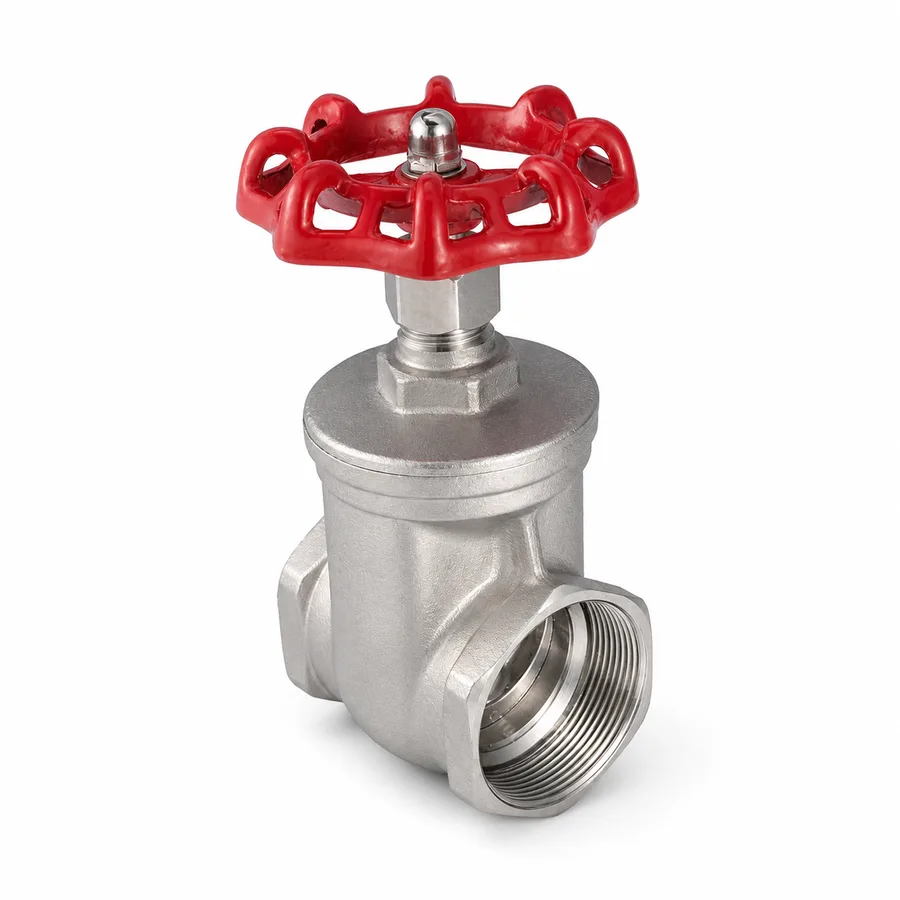
NPT threaded gate valve in ASTM A351 grade CF8M cast stainless steel, the cast equivalent of 316 stainless (Cr 18–21 %, Ni 9–12 %, Mo 2–3 %, C ≤0.08 %). Six sizes from 1/2″ to 2″ (DN 15 to DN 50), tapered NPT threaded ends per ASME B1.20.1, solid wedge, asbestos-free PTFE packing and stainless steel or ASTM A536 ductile iron handwheel depending on the figure. The reference rating of the TECTUL stainless line is 200 WOG, declared by the manufacturer on the globe line of the same material. This sheet develops the real selection criterion: the molybdenum in CF8M buys resistance to chlorides and chemicals, not additional pressure.
Important: Before using these data in engineering, design or installation decisions on systems exposed to mechanical, pressure, rupture, fatigue, impact or water-hammer risk, it is essential to read the technical notice and limitation of liability at the end of this sheet.
SKU VT-59208 (stainless gate valve) · 1 reference, 6 sizes from 1/2″ to 2″, all 6 variants active
1. Technical specifications
Materials by component
| Component | Material | Designation / standard |
|---|---|---|
| Body and bonnet | Cast austenitic stainless steel for pressure-containing parts, grade CF8M (Cr 18–21 %, Ni 9–12 %, Mo 2–3 %, C ≤0.08 %) — cast equivalent of 316 | ASTM A351/A351M, grade CF8M |
| Closure member (solid wedge) | Stainless steel, same family as the body; one-piece wedge sealing against both seats | ASTM A351 CF8M or equivalent stainless bar |
| Stem / screw | Stainless steel, manufacturer grade | Austenitic stainless steel, grade to be confirmed |
| Gland | Stainless steel | Austenitic stainless steel |
| Stem packing | PTFE, asbestos-free | PTFE packing |
| Handwheel | Ductile iron or stainless steel, depending on the figure | ASTM A536 (ductile iron) or stainless |
| Seat | Integral to the body or with a renewable ring, depending on the figure; metal-to-metal closure | Machined on the body |
| Ends | Female tapered NPT thread on both ends | ASME B1.20.1 |
Composition and CF8M↔316 equivalence per ASTM A351/A351M. The exact stem grade, the handwheel material and the presence of a renewable seat ring are manufacturer data per figure: confirmed on quotation or in the PDF sheet attached to the product.
Standards and service framework
| Body material standard | ASTM A351/A351M — Castings, Austenitic, for Pressure-Containing Parts, grade CF8M |
| Reference rating | 200 WOG (13.8 bar) cold, ≤38 °C — value of the catalog's stainless line (see section 2) |
| Ends | Tapered NPT threads, ASME B1.20.1 |
| Closure member | Solid wedge, travelling perpendicular to the flow axis |
| Service function | Full shutoff (open or closed); not suitable for flow regulation |
| Typical fluids | Treated and brackish water, chloride-bearing solutions, process chemicals, coastal-environment lines, services requiring material traceability |
| Practical thermal limit | The PTFE stem packing, far below the metallurgical limit of CF8M |
Size equivalence
| Nominal | 1/2″ | 3/4″ | 1″ | 1-1/4″ | 1-1/2″ | 2″ |
|---|---|---|---|---|---|---|
| Metric DN | DN 15 | DN 20 | DN 25 | DN 32 | DN 40 | DN 50 |
IMPORTANT
This data sheet is a reference guide to the properties of this product type. The measurements, dimensions and physical or geometric characteristics of the product actually supplied may vary by manufacturer and lot, and may even fall outside the cited standards. If any of these figures is critical to your design or build, it is essential to verify it with one of our advisors against the physical product, so you can be fully certain of what you are buying. · Original data sheet: tectul.com/en/conduccion-de-fluidos/valvulas/ficha-tecnica-valvula-compuerta-inoxidable.html
Stainless gate reference in the TECTUL catalog
| Reference | Sizes offered | Active variants |
|---|---|---|
| Stainless gate valve (SKU VT-59208) | 1/2″ · 3/4″ · 1″ · 1-1/4″ · 1-1/2″ · 2″ (6 sizes) | 6 of 6 |
IMPORTANT
This data sheet is a reference guide to the properties of this product type. The measurements, dimensions and physical or geometric characteristics of the product actually supplied may vary by manufacturer and lot, and may even fall outside the cited standards. If any of these figures is critical to your design or build, it is essential to verify it with one of our advisors against the physical product, so you can be fully certain of what you are buying. · Original data sheet: tectul.com/en/conduccion-de-fluidos/valvulas/ficha-tecnica-valvula-compuerta-inoxidable.html
The stainless line reaches 2″: for threaded 2-1/2″, 3″ and 4″ the catalog offers the bronze gate valve (own data sheet), and above 4″ or for flanged stainless ends there are separate lines. Face-to-face dimensions, height and weight by size are manufacturer data and are confirmed on quotation or in the attached factory PDF sheet.
⚠ Important: this technical data sheet is a reference guide to the product's properties; it is not a quality certificate for the product you are buying. Heats vary from one another and may differ from the values stated here, or even depart from the standards. If your application requires compliance with a standard, always check the quality certificate (mill certificate) of the lot you are buying. If in doubt, ask one of our technical advisors →
2. The rating of the stainless line: 200 WOG on a CF8M body
Unlike threaded bronze — rated with the dual SWP/WOG classes of MSS SP-80 — the catalog's cast stainless threaded valve line is identified by the WOG declared by the manufacturer on an ASTM A351 CF8M body. The confirmed reference value on this line is 200 WOG: the manufacturer publishes it on the 200 Psi stainless globe valve, of the same material and the same size family.
What a WOG is, exactly, and what it is not
| What it means | WOG = Water-Oil-Gas: maximum allowable pressure cold and non-shock, with water, oil or gas |
| Temperature range in which it applies | From −29 °C to 38 °C (−20 °F to 100 °F). Outside that range the figure is no longer valid |
| What it is NOT | It is not an ASME B16.34 class. No "class 200 WOG" exists in that standard: the figure is declared by the manufacturer under the MSS SP-80 framework |
| What it does NOT include | Water hammer, start-stop transients, piping loads and moments: these are load cases of the project's design code |
| Equivalence with the dual class | 200 WOG corresponds to Class 125 of the MSS SP-80 dual system, whose pair is 125 psig SWP with saturated steam at ≈178 °C |
IMPORTANT
This data sheet is a reference guide to the properties of this product type. The measurements, dimensions and physical or geometric characteristics of the product actually supplied may vary by manufacturer and lot, and may even fall outside the cited standards. If any of these figures is critical to your design or build, it is essential to verify it with one of our advisors against the physical product, so you can be fully certain of what you are buying. · Original data sheet: tectul.com/en/conduccion-de-fluidos/valvulas/ficha-tecnica-valvula-compuerta-inoxidable.html
200 WOG in bar and in real service
| Quantity | Imperial value | SI value | Condition |
|---|---|---|---|
| WOG declared on the stainless line | 200 psi | 13.8 bar | Non-corrosive fluid, non-shock, ≤38 °C |
| Equivalent SWP of the associated dual class (Class 125) | 125 psig | 8.6 bar | Saturated steam, ≈178 °C |
| Service temperature of the CF8M body | Far above those ranges from a metallurgical standpoint | But the valve is limited earlier by the PTFE stem packing | |
IMPORTANT
This data sheet is a reference guide to the properties of this product type. The measurements, dimensions and physical or geometric characteristics of the product actually supplied may vary by manufacturer and lot, and may even fall outside the cited standards. If any of these figures is critical to your design or build, it is essential to verify it with one of our advisors against the physical product, so you can be fully certain of what you are buying. · Original data sheet: tectul.com/en/conduccion-de-fluidos/valvulas/ficha-tecnica-valvula-compuerta-inoxidable.html
The manufacturer publishes 200 WOG for the catalog's stainless globe line. For this stainless gate reference the figure does not appear on the product page: 200 WOG is taken as the line's reference value and the specific rating is confirmed on quotation against the factory certificate or PDF sheet. A higher value must not be assumed just because the material is stainless steel — the reason is explained in section 4.
3. When to move from bronze to CF8M: molybdenum decides
The bronze gate valve and the CF8M gate valve share the same design — solid wedge, NPT threaded ends, PTFE packing — and differ only in the body and trim metal. That difference is not about pressure: it is about the chemistry of the fluid and of the environment. The element that explains it is molybdenum.
The four criteria that justify the change
| Criterion | What happens | Decision |
|---|---|---|
| Chlorides | Chloride ions locally break the passive chromium oxide layer and cause pitting and crevice corrosion. The 2–3 % molybdenum in CF8M is precisely the element that stabilizes that layer against the chloride ion — the same thing that distinguishes 316 from 304 | Brackish water, diluted seawater, brines, chlorinated process water → CF8M |
| Process chemicals | The copper in bronze is attacked by ammonia and its compounds, by oxidizing acids and by several ammoniacal solutions; austenitic CF8M withstands a far broader spectrum of industrial chemicals | Any fluid other than water, air or non-corrosive oils → check compatibility and, when in doubt, CF8M |
| Coastal environment | Corrosion does not always come from inside: salt mist attacks the outside of the valve, the bolts and the handwheel. In a plant a few kilometres from the sea, the stainless assembly ages far better | Coastal installation or salt-spray exposure → CF8M, even if the internal fluid is water |
| Sanitary or food traceability | C83600 bronze contains 4–6 % lead (it is part of the 85-5-5-5 alloy, which improves machinability and casting tightness). Where the project demands absence of lead or material traceability for food or potable water contact, CF8M resolves the documentary requirement | Sanitary, food or low-lead requirement → CF8M with heat certificate |
And the three criteria that do NOT justify the change
- More pressure. No: the rating is set by the class, not by the metal. See section 4.
- More temperature. On these threaded valves the practical ceiling is set by the PTFE stem packing, which is the same in both subfamilies. CF8M metallurgically withstands much more, but the complete valve does not.
- Dezincification. A frequent and misdirected fear. ASTM B62 C83600 bronze contains only 4–6 % zinc, far below the threshold (~15 % Zn) at which selective zinc loss becomes significant in copper-zinc alloys. That is why valve bronze — unlike some yellow brasses used in plumbing fittings — does not usually require a DZR grade, and dezincification is not a valid reason to move to stainless.
Direct comparison: B62 bronze ↔ CF8M
| Aspect | ASTM B62 C83600 bronze | ASTM A351 CF8M stainless |
|---|---|---|
| Dominant composition | 84–86 % Cu, 4–6 % Sn, 4–6 % Pb, 4–6 % Zn | Cr 18–21 %, Ni 9–12 %, Mo 2–3 %, C ≤0.08 %, Fe base |
| Resistance mechanism | Nobility of copper and a copper-tin oxide layer | Passive chromium oxide layer, stabilized against chlorides by molybdenum |
| Potable water and compressed air | Adequate, at the lowest cost in the family | Adequate, at a premium |
| Chlorides and marine environment | Limited | Its home ground |
| Ammonia and ammoniacal compounds | Attack the copper | Resists |
| Lead in the alloy | 4–6 % (part of the 85-5-5-5 design) | None |
| Threaded sizes in the TECTUL catalog | 1/2″ to 4″ (9 sizes, 2 references) | 1/2″ to 2″ (6 sizes, 1 reference) |
- Is the fluid cold or hot water, compressed air, or non-corrosive oil/gas, and is the installation indoors or inland? → bronze, at lower cost and with more sizes available (up to 4″).
- Are there chlorides, brine, process chemicals, ammonia, a coastal environment or a documentary sanitary requirement? → CF8M, within 1/2″ to 2″.
- Is the reason for asking for stainless "so it takes more pressure"? → review the criterion: what is needed is a higher MSS SP-80 class, not a different metal.
4. Why stainless does not withstand more pressure than bronze of the same class
This is the most common confusion at quotation time: stainless is requested expecting a jump in pressure, and what arrives is a valve of the same rating at more than twice the cost. The reason is methodological, not metallurgical.
1. The rating is not a property of the metal, it is a declaration about the complete figure
The WOG figure or the MSS SP-80 class does not come from the mechanical strength of the material in isolation. It comes from the assembly: casting wall thickness, body and bonnet geometry, seat area, stem cross-section, and above all from the pressure test of the figure that the manufacturer declares. Two valves of the same class carry the same rating even if one is bronze and the other CF8M, because the manufacturer sized each one to meet that same class.
2. Manufacturers design to the same commercial step
Threaded bronze and stainless lines are offered within the same class scale (125/150/200/300 in the dual system). In the TECTUL catalog, the only rating published by the manufacturer on the stainless line is 200 WOG, which corresponds to Class 125 — the lowest step of the dual system, not the highest. A Class 300 bronze valve (600 WOG) carries three times the rating of that 200 WOG stainless line. The metal does not rule; the class rules.
3. What the metal does change
| What CF8M does improve | What CF8M does not improve |
|---|---|
| Resistance to chloride pitting (2–3 % molybdenum) | The cold allowable pressure (WOG) of the figure |
| Resistance to process chemicals and ammoniacal compounds | The steam allowable pressure (SWP) of the figure |
| Behaviour against salt mist on the outside of the valve | The real thermal ceiling, set by the PTFE stem packing |
| Absence of lead and heat traceability for sanitary requirements | Tolerance to water hammer, which is a load case of the line design |
| Seat erosion resistance in fluids carrying fine solids | Suitability for throttling: a gate valve does not throttle, whatever its metal |
- Wrong framing: "the line runs at 350 psi of cold water and the bronze one fell short, send me the stainless". The stainless gate valve in this sheet has a 200 WOG reference: at 350 psi it falls further short than a Class 300 bronze gate valve (600 WOG).
- Correct framing — pressure: "I need 350 psi of cold water, non-shock" → look for a figure whose WOG exceeds 350 psi. In threaded bronze, Class 300 (600 WOG) covers it. If the fluid also carried chlorides, you would need a stainless figure of an equivalent class, not the 200 WOG line.
- Correct framing — corrosion: "I run 120 psi with brackish water in a coastal plant" → 120 psi is covered even by Class 125 (200 WOG); what decides is the chloride, and there the CF8M gate valve in this sheet is the right answer.
- Conclusion: the material is chosen by chemistry; the class, by pressure and temperature. They are two independent decisions and must be taken separately.
5. Frequently asked questions
Does the stainless gate valve withstand more pressure than the bronze one?
Not by virtue of being stainless. The rating is set by the class the manufacturer declares for that figure, not by the metal. In the TECTUL catalog the published rating of the stainless line is 200 WOG (equivalent to Class 125 of the dual system), whereas a Class 300 bronze gate valve reaches 600 WOG. Stainless is chosen for the chemistry of the fluid and the environment, not for pressure.
What is CF8M and how does it relate to 316?
CF8M is the cast austenitic stainless grade defined in ASTM A351/A351M for pressure-containing parts: Cr 18–21 %, Ni 9–12 %, Mo 2–3 % and C ≤0.08 %. It is the cast equivalent of wrought 316; what is called 316 in bar or sheet is called CF8M in a casting. Molybdenum is what distinguishes it from CF8 (the equivalent of 304).
When do I have to move from bronze to stainless?
When there are chlorides (brackish water, brines, chlorinated waters), process chemicals or ammoniacal compounds that attack copper, a coastal environment with salt mist, or a documentary sanitary or low-lead requirement. If the fluid is water, compressed air or non-corrosive oils and the installation is inland, bronze does the job at less than half the cost.
Does bronze dezincify, and is that why I should buy stainless?
It is not a valid reason. ASTM B62 C83600 bronze contains only 4–6 % zinc, far below the threshold (~15 % Zn) at which dezincification becomes significant in copper-zinc alloys; that is why valve bronze does not usually require a DZR grade. The decision to move to CF8M should rest on chlorides, fluid chemistry, environment or traceability — not on dezincification.
Up to what size does the threaded stainless gate valve go?
Up to 2″ (DN 50) in the TECTUL catalog, with six active sizes: 1/2″, 3/4″, 1″, 1-1/4″, 1-1/2″ and 2″. For threaded 2-1/2″, 3″ and 4″ the catalog option is the bronze gate valve; above 4″ or with flanged ends a different line applies.
Can it throttle the flow because it is stainless?
No. A gate valve is a full-shutoff device, whether bronze or CF8M: at partial opening the jet erodes the seat and the wedge edge, and the wedge vibrates against its guides. To throttle, use a globe valve, which this catalog also offers in CF8M.
6. Application notes
Feasibility
The ASTM A351 CF8M gate valve is the right choice when the criterion is chemical: chlorides, brines, chlorinated waters, process chemicals, ammoniacal compounds that attack copper, coastal environments with salt mist, or documentary sanitary and low-lead requirements. It is not viable as a substitute for a higher class: its reference rating in the catalog is 200 WOG, below a Class 300 bronze gate valve (600 WOG). Nor is it viable for throttling — that is what the globe valve is for, also available in CF8M — or above 2″ in the threaded version, where the catalog continues with the bronze gate valve up to 4″ or with flanged lines.
Installation
The NPT thread (ASME B1.20.1) seals by tapered metal-to-metal interference; with a stainless body, PTFE tape or paste also performs a key lubricating role: stainless threaded against stainless is prone to galling during make-up, and a dry assembly can cold-weld the helices and ruin the joint. Apply the sealant on the male thread, never on the female, and tighten continuously without backing off. Always hold with a wrench on the hexagonal body flats, never by the handwheel or the bonnet. A gate valve has no flow direction; stem vertical and upward is preferred, with clear height for the full travel. Flush the line before seating the wedge for the first time.
Design
Always separate the two decisions: the material is chosen by the chemistry of the fluid and the environment; the class or WOG, by design pressure and temperature. Asking for stainless to "gain pressure" leads to a valve of lower rating and higher cost. The 200 WOG reference of the stainless line applies to non-shock conditions between −29 °C and 38 °C: water hammer, start-stop transients and piping loads and moments are not included and belong to the project's design code (ASME B31.1, B31.3 or the applicable one). In chloride services above roughly 60 °C, chloride stress corrosion cracking of austenitic steels must also be evaluated — a mechanism the pressure rating does not cover. Manual handwheel torque grows with size and differential pressure.
7. Technical notice and limitation of liability
The materials and sizes in this sheet come from the data TECTUL publishes on the product page (August 2026). The 200 WOG value is the rating the manufacturer declares for the catalog's stainless line, published on the 200 Psi stainless globe valve of the same material; for this gate reference the figure does not appear on the product page and must not be assumed: it is confirmed on quotation against the factory certificate or PDF sheet.
Face-to-face dimensions, overall height and weight by size are not fixed by a single standard for threaded cast stainless valves — each manufacturer defines its own pattern. The bronze↔CF8M comparison in section 3 describes the general behaviour of the two alloy families; compatibility with a specific fluid must be verified against a chemical compatibility table or with the chemical supplier, not by analogy.
These values must not be used as the sole criterion in critical, safety, fire-protection or sanitary applications, or wherever valve failure may compromise people, property or the environment: in such cases the design belongs to the project's responsible engineer under the applicable code (ASME B31.1/B31.3 for process piping, and the sanitary regulations in force where applicable), with the design temperature and load cases of the actual service. Before deciding with these data, consult our technical team.
Sources
- ASTM A351/A351M — Standard Specification for Castings, Austenitic, for Pressure-Containing Parts, grado CF8M (Cr 18–21 %, Ni 9–12 %, Mo 2–3 %, C ≤0,08 %, equivalente fundido del 316) — cuerpo, bonete y cuña
- ASME B1.20.1 — Pipe Threads, General Purpose, Inch (roscas NPT cónicas de los extremos)
- MSS SP-80 — Bronze Gate, Globe, Angle and Check Valves: marco de las clases duales SWP/WOG (125/150/200/300) empleado como referencia de equivalencia del 200 WOG declarado por el fabricante para la línea inoxidable
- ASME B16.34 — Valves: Flanged, Threaded and Welding End: norma de clases de válvulas en la que no existe una «clase 200 WOG», lo que confirma que el número WOG es una declaración del fabricante y no una clase normalizada
- ASTM A536 — Standard Specification for Ductile Iron Castings — volante en las figuras que lo llevan en hierro dúctil
- Tablas de vapor saturado (propiedad termodinámica agua/vapor, fuente tipo NIST/ASME Steam Tables) — temperatura de saturación de 178 °C a 125 psig, asociada a la Clase 125 equivalente del 200 WOG
- ASTM B62 — Standard Specification for Composition Bronze or Ounce Metal Castings, aleación C83600 — citada únicamente como término de comparación en la sección 3 (composición 85-5-5-5, con 4–6 % Pb y 4–6 % Zn)
- Fichas de producto TECTUL (tectul.com): Válvula Compuerta Inoxidable (SKU VT-59208) — diámetros publicados, con ficha PDF de fábrica adjunta; y Válvula Globo Inoxidable 200 Psi — fuente primaria del rating de referencia de la línea inoxidable
- Curaduría interna TECTUL (data/etapas/etapa-1-conduccion-de-fluidos/curaduria.json) — diámetros por referencia, agosto 2026
This data sheet is the property of TECTUL, part of the Industrias IMR group. Reproduction without attribution is prohibited. Original document and updates: tectul.com/en/conduccion-de-fluidos/valvulas/ficha-tecnica-valvula-compuerta-inoxidable.html.