 TECTULby IMR
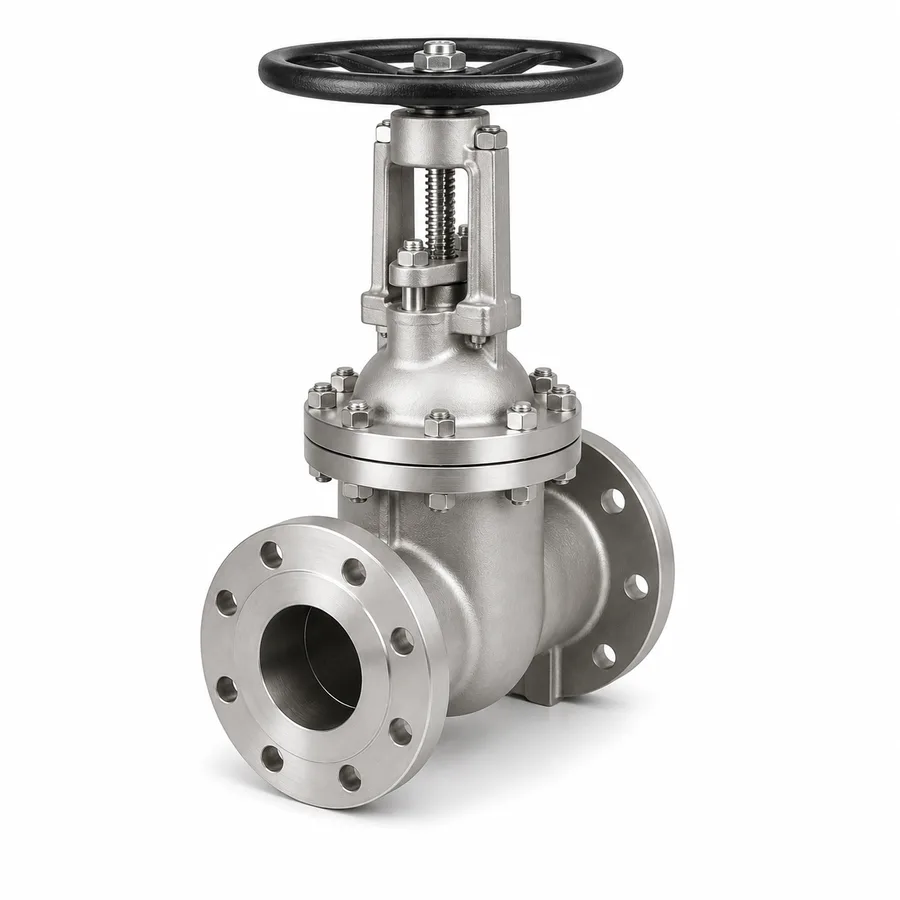
Cast stainless steel gate valve ASTM A351 CF8M/CF8 — class 150 flanged ends, API 603 framework
TECTUL · Dispatch across Colombia · Exports to Central & South America
Cast stainless steel gate valve in ASTM A351 CF8M (cast equivalent of 316, with molybdenum) or CF8 (cast equivalent of 304, without molybdenum) from the TECTUL catalog, with class 150 flanged ends per ASME B16.5. Its design framework is API 603 — Corrosion-resistant, Bolted Bonnet Gate Valves — the API 600 version specifically intended for corrosion-resistant materials: the same solid-wedge, bolted-bonnet, OS&Y-stem concept, but with tolerances and scope adjusted to stainless castings instead of carbon steel. The class 150 working pressure in the austenitic material group of ASME B16.34 is 275 psig (19 bar) at 38 °C, practically the same as a class 150 carbon steel gate valve in this same series: the reason to choose stainless is corrosion resistance, not extra pressure.
Important: Before using these data in engineering, design or installation decisions on systems exposed to mechanical, pressure, rupture, fatigue, impact or water-hammer risk, it is essential to read the technical notice and limitation of liability at the end of this sheet.
SKU VT-valvula-compuerta-inoxidable-bridada · class 150 flanged stainless gate valve, 2″ to 12″
1. Technical specifications
Materials and construction
| Body and bonnet | Cast austenitic stainless steel ASTM A351 CF8M (cast equivalent of 316: Cr 18–21 %, Ni 9–12 %, Mo 2–3 %, C ≤0.08 %) or CF8 (cast equivalent of 304: Cr 18–21 %, Ni 8–11 %, no molybdenum, C ≤0.08 %), depending on reference |
| Wedge | Solid wedge, in the same material as the body or in 300-series stainless steel |
| Stem | 300-series stainless steel, outside-screw-and-yoke (OS&Y) — visual position indication and a thread shielded from the process fluid, the same reasoning as the carbon steel construction in this family |
| Seat | Integral with the body or a renewable stainless steel ring, depending on the manufacturer's design |
| Stem packing | PTFE or graphite, asbestos-free, depending on service temperature |
| Ends | Flanged, class 150 per ASME B16.5 |
| Sizes | 2″ to 12″ (DN 50–DN 300) |
| Design framework | API 603 (Corrosion-resistant, Bolted Bonnet Gate Valves — Flanged and Butt-welding Ends): solid wedge or OS&Y, bolted bonnet, non-rising handwheel spindle, for NPS 1/2″ to 24″, classes 150, 300 and 600 |
| Pressure-temperature rating | ASME B16.34, material group 2.2 for CF8M or 2.1 for CF8 |
| Face-to-face dimensions | ASME B16.10, class 150 gate pattern — the same dimensional pattern as the carbon steel gate valve in this family, since the F2F standard does not distinguish by material |
| Tests | Seat and shell per API 598 |
Pressure-temperature table — class 150, CF8M (B16.34 material group 2.2)
| Temperature | Allowable pressure |
|---|---|
| −29 to 38 °C (−20 to 100 °F) | 275 psig (19.0 bar) |
| 93 °C (200 °F) | 235 psig (16.2 bar) |
| 149 °C (300 °F) | 215 psig (14.8 bar) |
| 204 °C (400 °F) | 195 psig (13.4 bar) |
| 260 °C (500 °F) | 170 psig (11.7 bar) |
| 316 °C (600 °F) | 140 psig (9.7 bar) |
| 427 °C (800 °F) | 80 psig (5.5 bar) |
IMPORTANT
This data sheet is a reference guide to the properties of this product type. The measurements, dimensions and physical or geometric characteristics of the product actually supplied may vary by manufacturer and lot, and may even fall outside the cited standards. If any of these figures is critical to your design or build, it is essential to verify it with one of our advisors against the physical product, so you can be fully certain of what you are buying. · Original data sheet: tectul.com/en/conduccion-de-fluidos/valvulas/ficha-tecnica-valvula-compuerta-inoxidable-bridada.html
Values from Table 2-2.2 of ASME B16.34 for material group 2.2 (CF8M/316). Group 2.1 (CF8/304) starts from the same 38 °C anchor point (275 psig) but falls somewhat faster at high temperature due to the absence of molybdenum; at ambient and moderate process temperature (up to ≈200 °C) both groups behave practically identically in allowable pressure. Note that the stainless class 150 (275 psig) is slightly lower than the carbon steel WCB class 150 (285 psig at 38 °C, group 1.1): the class is the same, but the exact rating also depends on the material group, not just the class number.
Face-to-face dimensions — class 150 (ASME B16.10, gate pattern)
| Size | Face-to-face (RF) |
|---|---|
| 2″ | 178 mm |
| 3″ | 203 mm |
| 4″ | 229 mm |
| 6″ | 267 mm |
| 8″ | 292 mm |
| 10″ | 330 mm |
| 12″ | 356 mm |
IMPORTANT
This data sheet is a reference guide to the properties of this product type. The measurements, dimensions and physical or geometric characteristics of the product actually supplied may vary by manufacturer and lot, and may even fall outside the cited standards. If any of these figures is critical to your design or build, it is essential to verify it with one of our advisors against the physical product, so you can be fully certain of what you are buying. · Original data sheet: tectul.com/en/conduccion-de-fluidos/valvulas/ficha-tecnica-valvula-compuerta-inoxidable-bridada.html
Identical to the carbon steel gate valve table in this family: ASME B16.10 sets the face-to-face by valve type and class, not by body material. Weight does change with material and is confirmed on quotation.
⚠ Important: this technical data sheet is a reference guide to the product's properties; it is not a quality certificate for the product you are buying. Heats vary from one another and may differ from the values stated here, or even depart from the standards. If your application requires compliance with a standard, always check the quality certificate (mill certificate) of the lot you are buying. If in doubt, ask one of our technical advisors →
2. API 603 versus API 600: the standard built for stainless castings
Why a separate standard exists for stainless
API 600 was written around carbon and alloy refinery steel, with wall thicknesses and tolerances designed for those materials. When the industry began asking for the same construction — solid wedge, bolted bonnet, OS&Y stem — but in corrosion-resistant castings (austenitic stainless, duplex, nickel alloys), API published API 603 as an independent standard instead of forcing API 600's same thicknesses onto a different material: cast stainless steel has different casting behavior, repair-weldability and strength than carbon steel, and a dedicated standard allows adjusting wall tolerances and casting acceptance criteria to that material without diluting either standard's requirements.
What the two standards share and what sets them apart
| Material scope | API 600: carbon and alloy steel (WCB, WC6, WC9, C5, C12...). API 603: corrosion-resistant materials — austenitic stainless (CF8, CF8M, CF3, CF3M), duplex and special alloys. |
| Sizes | API 600: NPS 1/2″ to 60″. API 603: NPS 1/2″ to 24″ — a narrower range, consistent with the typical use of stainless castings in medium sizes. |
| Pressure classes | API 600: up to class 2500. API 603: classes 150, 300 and 600 — the pressure range where demand for process stainless valves concentrates. |
| Construction | Both: solid wedge or OS&Y, bolted bonnet, flanged or butt-weld ends. The design concept is the same; minimum wall thickness and casting tolerances adjusted to the material change. |
| F2F, rating and flanges | Both refer to ASME B16.10 (F2F), ASME B16.34 (rating by material group) and ASME B16.5 (flanges) — the common dimensional framework of this whole sheet family. |
In practice, specifying "API 603" on a stainless valve order is more precise than specifying "API 600 in stainless": the latter phrase describes the design but not the actual manufacturing standard that applies to the material, and can lead to a different interpretation of tolerances between suppliers.
3. Corrosion, sensitization and why stainless rather than bronze or iron
The reason is corrosion, not pressure
As shown in section 1, the class 150 rating in CF8M (275 psig at 38 °C) is practically the same as in carbon steel WCB (285 psig at 38 °C): the rating is set by the ASME B16.34 class and material group, not by a structural superiority of stainless steel. The real reason to move from bronze, cast iron or carbon steel to cast stainless steel is corrosion resistance in a service that attacks those materials:
| Chlorides and brackish or seawater | The molybdenum in CF8M (2–3 %) improves chloride pitting resistance over molybdenum-free CF8. A common comparative index is PREN (Pitting Resistance Equivalent Number, PREN = %Cr + 3.3 × %Mo + 16 × %N): CF8M falls roughly between 25 and 31, versus 18–21 for molybdenum-free CF8 — an indicative index for comparing alloys, not a standard requirement nor a guaranteed service limit. |
| Moderate acidic or oxidizing environments | Chemical processes, dilute acids and solutions where cast iron or carbon steel oxidize or dissolve quickly; stainless steel's passive chromium film resists that attack far better. |
| Sanitary, pharmaceutical or food traceability | When the specification requires declared stainless material and a heat certificate, bronze or iron are ruled out by specification even if they technically withstand the pressure. |
| Coastal or aggressive industrial environment | External corrosion from salinity or industrial atmospheres attacks an uncoated cast iron or carbon steel body first; CF8M keeps the body sound and the stem operable where one of those materials pits and seizes. |
Sensitization: the weak point of cast stainless steel
Austenitic stainless steel is not immune to everything. Between roughly 425 °C and 870 °C, the alloy's carbon precipitates as chromium carbides at the grain boundaries — a phenomenon known as sensitization — depleting chromium in the zone adjacent to the grain boundary and leaving it susceptible to intergranular corrosion in the presence of a corrosive medium. It is relevant mainly in the heat-affected zone of casting repair welds, not in ambient-temperature service. When the project requires repair welding or prolonged service in that temperature range, a low-carbon grade (CF3/CF3M, equivalent to 304L/316L) or a post-weld solution heat treatment should be specified, neither of which is included by default in this sheet.
Chloride stress corrosion cracking
Austenitic stainless steel, including CF8M, is susceptible to chloride stress corrosion cracking (SCC) in hot chlorides — typically above ≈60 °C, in the simultaneous presence of chlorides, mechanical stress (residual or applied) and dissolved oxygen. This combination appears in hot seawater, concentrated brines or condensates with residual chlorides. In that scenario, "switching to stainless" does not solve the problem: duplex or superaustenitic alloys are required, and the selection belongs to the project engineer.
Flange finish and gasket compatibility
This valve's class 150 flanges follow the standard finish of ASME B16.5: raised face with concentric or spiral serrated finish, within the standard's roughness range, suitable for reinforced fiber, flexible graphite or spiral-wound gaskets. When the gasket is soft (elastomer or unreinforced pure PTFE), a finer finish than the standard serrated one is advisable so the concentric grooves do not cut into the gasket material — confirmed with the flange and gasket manufacturer on quotation. The gasket material must also be chemically compatible with the process fluid, a criterion independent of face finish.
4. Frequently asked questions
How much pressure does the flanged stainless gate valve take?
275 psig (19 bar) at 38 °C in class 150, per ASME B16.34 material group 2.2 (CF8M). It falls to 235 psig at 93 °C and 80 psig at 427 °C. It is a figure practically identical to a class 150 carbon steel gate valve (285 psig): the class, not the metal, decides the pressure.
Does stainless steel take more pressure than carbon steel?
Not for being stainless. Both are class 150 and their ratings are nearly equal (275 psig versus 285 psig at 38 °C); the difference between the two materials is marginal in pressure and decisive in corrosion resistance. The reason to choose stainless is never extra pressure.
What is the difference between API 600 and API 603?
API 600 was written for carbon and alloy steel; API 603 is the equivalent standard for corrosion-resistant castings (stainless, duplex, special alloys), with wall thickness and casting tolerances adjusted to that material, in sizes 1/2″ to 24″ and classes 150 to 600. The construction concept — solid wedge, bolted bonnet, OS&Y — is the same in both.
Are CF8M and CF8 the same thing?
No. CF8M carries 2–3 % molybdenum and is the cast equivalent of 316; CF8 has no molybdenum and is the cast equivalent of 304. Molybdenum improves chloride pitting resistance. Both share practically the same pressure rating at moderate temperature; they differ in chemical resistance, not in pressure.
Does this valve work for hot seawater or concentrated brine?
Not without further evaluation. CF8M is susceptible to chloride stress corrosion cracking in hot chlorides above ≈60 °C. That scenario requires duplex or superaustenitic alloys, and the selection belongs to the project engineer.
Can I weld repairs on the body without risk?
With caution: the heat-affected zone of a repair weld can become sensitized (425–870 °C) and susceptible to intergranular corrosion. If repair welding or prolonged service in that range is anticipated, a low-carbon grade (CF3/CF3M) or post-weld heat treatment should be specified, neither included by default.
5. Application notes
Feasibility
The valve covers moderately corrosive service — chlorides and brackish water, chemicals and condensates, coastal or aggressive industrial environment, or a material traceability requirement — in 2″ to 12″, class 150 (275 psig at 38 °C, CF8M). It is not the answer when the problem is pressure rather than corrosion: the fix there is moving up a class, not a material. Out of scope: hot seawater or concentrated brines, where CF8M is susceptible to chloride stress corrosion cracking and duplex or superaustenitic alloys must be specified; and service with repair welding or prolonged temperature between 425 and 870 °C without a low-carbon grade or heat treatment. If the fluid is potable water, compressed air or non-corrosive oils with no stainless traceability requirement, the carbon steel construction in this same family is the appropriate choice. For critical or safety applications, consult our technical team before specifying.
Installation
Check the flange face finish against the gasket type (section 3) before tightening: a soft gasket on a standard serrated finish may require a different face treatment. Align flanges before bolting and tighten in a cross-pattern, staged sequence (general bolted flange joint practice, ASME PCC-1). Avoid prolonged direct contact with uninsulated carbon steel in humid environments, to prevent galvanic corrosion at the joint. Install fully open or fully closed in normal operation — the gate valve is not a throttling device.
Design
Specify CF8M versus CF8 by the real fluid, not by habit: if chlorides are present, CF8M's molybdenum justifies its higher pitting resistance. Check the design temperature against the section 1 pressure-temperature table (group 2.2), not just the cold point. If the project includes casting repair welding or prolonged service between 425 and 870 °C, specify a low-carbon grade (CF3/CF3M) or solution heat treatment, since the standard CF8M does not include it by default. In hot chlorides above 60 °C with mechanical stress and dissolved oxygen, do not use this material: evaluate duplex or superaustenitic alloys with the project engineer.
6. Technical notice and limitation of liability
The pressure-temperature ratings in this sheet combine values published in ASME B16.34 (class 150, material groups 2.1 and 2.2) with the API 603 design framework. They are nominal reference values; they are not a certificate of conformity for any production lot nor an independent test of the TECTUL catalog reference.
The PREN index quoted in section 3 is a comparative indicator between alloys, not a standard requirement nor a guaranteed service limit: CF8M improves on CF8 against chlorides, but it is not immune to pitting, to chloride stress corrosion cracking in hot chlorides, or to sensitization in the heat-affected zone of repair welding between 425 and 870 °C.
These values must not be used as the sole criterion in critical, safety, certified potable-water applications, or wherever valve failure may compromise people, property or the environment: in such cases material selection and design belong to the project's responsible engineer under the applicable code. Before deciding with these data, consult our technical team.
Sources
- API Standard 603 — Corrosion-resistant, Bolted Bonnet Gate Valves — Flanged and Butt-welding Ends: marco de diseño de esta ficha, alcance de material y diámetros frente a API 600
- ASTM A351/A351M — Standard Specification for Castings, Austenitic, for Pressure-Containing Parts: grados CF8 (Cr 18–21 %, Ni 8–11 %) y CF8M (Cr 18–21 %, Ni 9–12 %, Mo 2–3 %), equivalentes fundidos del 304 y 316
- ASME B16.34 — Valves — Flanged, Threaded, and Welding End: Tabla 2-2.2, grupo de material 2.2 (CF8M) y grupo 2.1 (CF8)
- ASME B16.10 — Face-to-Face and End-to-End Dimensions of Valves: patrón de compuerta clase 150, 2″ a 12″
- ASME B16.5 — Pipe Flanges and Flanged Fittings: bridas clase 150 y acabados de cara estándar (serrado concéntrico o en espiral)
- API Standard 598 — Valve Inspection and Test
- ASME PCC-1 — Guidelines for Pressure Boundary Bolted Flange Joint Assembly: secuencia de apriete en cruz por etapas
- Índice PREN (Pitting Resistance Equivalent Number, PREN = %Cr + 3,3 × %Mo + 16 × %N) — criterio comparativo habitual de resistencia a la picadura por cloruros entre aceros inoxidables, calculado aquí a partir del rango de composición de ASTM A351
- Metalurgia general del acero inoxidable austenítico: rango de sensibilización por precipitación de carburos de cromo (≈425–870 °C) y agrietamiento por corrosión bajo tensión en cloruros calientes (típicamente >60 °C con tensión y oxígeno disuelto) — comportamiento documentado en manuales de metalurgia de aceros inoxidables (tipo ASM Handbook)
This data sheet is the property of TECTUL, part of the Industrias IMR group. Reproduction without attribution is prohibited. Original document and updates: tectul.com/en/conduccion-de-fluidos/valvulas/ficha-tecnica-valvula-compuerta-inoxidable-bridada.html.