 TECTULby IMR
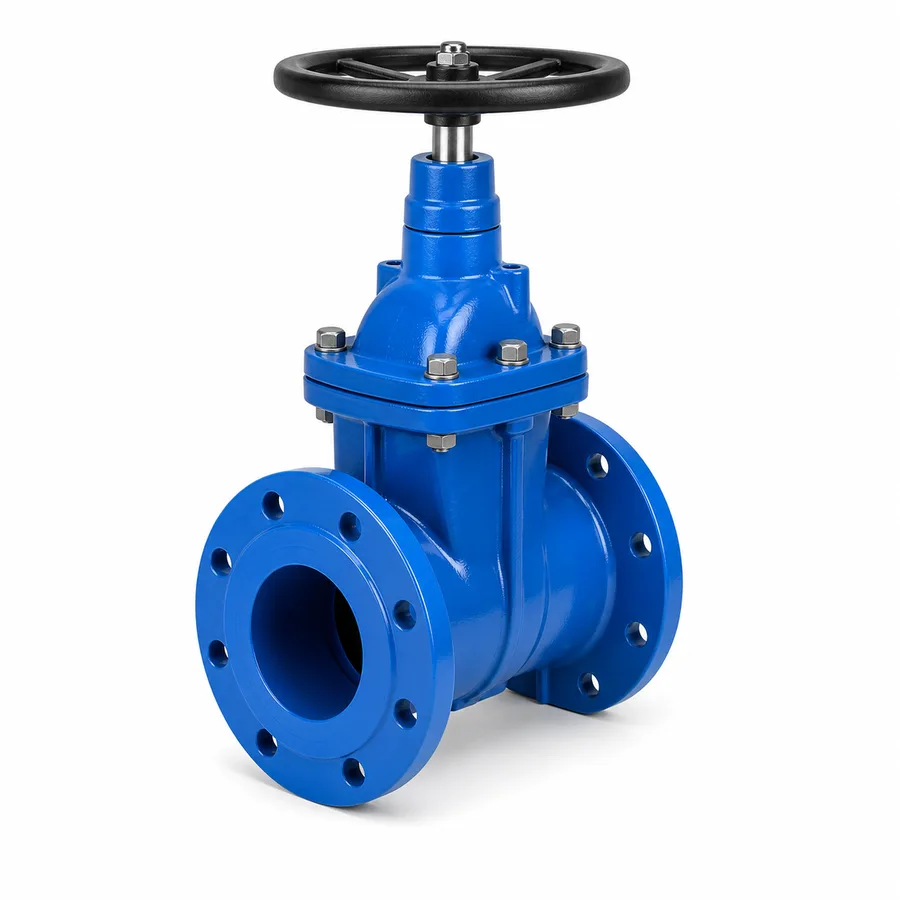
Resilient-seated ductile iron gate valve, AWWA C509/C515 — flanged, plain end, quick joint and restrained (tiger-claw) joint
TECTUL · Dispatch across Colombia · Exports to Central & South America
TECTUL's line of resilient-seated ductile iron gate valves for waterworks, distribution and pump-station networks, standardized under AWWA C509/C515: flanged (demountable chambers and stations), plain end for mechanical joint, quick joint and restrained tiger-claw joint for direct coupling to PVC or PE pipe. All four share the same body, the same EPDM-encapsulated wedge and the same non-rising stem (NRS); only the end connection changes, and this sheet is their common data sheet: working pressure by size with its test pressure, the difference between C509 (solid wall) and C515 (reduced wall), and buried operation with a non-visible stem.
Important: Before using these data in engineering, design or installation decisions on systems exposed to mechanical, pressure, rupture, fatigue, impact or water-hammer risk, it is essential to read the technical notice and limitation of liability at the end of this sheet.
SKU VT-valvula-compuerta-sello-elastico-bridada · line of 4 references by end type (flanged, plain end, quick joint, tiger-claw joint)
1. Technical specifications
Materials by component
| Component | Material | Designation / function |
|---|---|---|
| Body and bonnet | Ductile iron | ASTM A536 (grade 65-45-12 typical of the type) |
| Wedge (gate) | Ductile iron ASTM A536 core, fully vulcanized in EPDM | The elastomer covers the whole wedge — core, guides and periphery — not just the sealing face: hence the bubble-tight closure with no sediment pocket at the bottom of the body |
| Stem | Stainless steel | Grade 420 or 300-series depending on reference — manufacturer data, confirmed on quotation |
| Stem nut | Bronze or high-strength brass | Acme thread for the non-rising stem (NRS) mechanism |
| Interior and exterior coating | Fusion-bonded epoxy (FBE) | Per AWWA C550; standard minimum thickness 6 mils (152 µm), common commercial practice 8–16 mils (203–406 µm) — the certified thickness per lot is confirmed on quotation |
| Stem packing | EPDM or NBR o-rings | Multiple seal, replaceable without removing the valve from the line in most designs |
| Bonnet fasteners | Coated carbon steel or stainless steel | Manufacturer data |
EPDM and NBR composition per AWWA practice for elastomers in contact with potable water (NSF/ANSI 61 certification per reference, confirmed on quotation). The exact stainless steel grade of the stem, the certified coating thickness and the NSF certificate per lot are manufacturer data: confirmed on quotation.
End matrix: the four TECTUL catalog references
| Reference | End type | Standard / pattern | Typical application |
|---|---|---|---|
| Resilient-Seated Gate Valve, Flanged | Flanged on both ends | ASME B16.1 class 125 (iron) / ISO 7005 per project | Valve chambers, pump stations, treatment plants and any run where the valve must be fully removable without cutting pipe |
| Resilient-Seated Gate Valve, Plain End | Plain end (no bell or thread) | For AWWA C111/A21.11-type mechanical joint with gasket ring and bolted gland | Direct connection to ductile iron or PVC pipe with a mechanical-joint adapter; allows a small angular deflection in assembly |
| Resilient-Seated Gate Valve, Quick Joint | Push-on joint with a pre-compressed gasket ring | Push-on bell profile per AWWA C111/A21.11 | Fast trench assembly with no bolts or gland — the pipe is pushed into the bell up to the insertion mark |
| Resilient-Seated Gate Valve, Tiger-Claw Joint | Mechanical restrained joint (claw-type jaws on the pipe) | Manufacturer's restrained joint, for direct coupling to PVC or PE pipe | PVC/PE lines where the hydraulic thrust must be anchored in the joint itself, with no concrete thrust blocks |
All four references share the body, wedge and non-rising stem (NRS); the end connection is the only variable in this matrix. The exact dimensional pattern of each joint (bell diameter, number and type of tiger-claw jaws, insertion length) is manufacturer data and is confirmed on quotation.
Regulatory framework
| Valve type | Resilient-seated gate valve, manual handwheel operation |
| Product standard | AWWA C509 (solid wall, gray or ductile iron) or AWWA C515 (reduced wall, ductile iron only) — see section 3 |
| Coating | AWWA C550, fusion-bonded epoxy interior and exterior |
| Flanged ends | ASME B16.1 class 125 (iron pattern) or ISO 7005 per project specification |
| Mechanical and push-on joints | AWWA C111/ANSI A21.11 (rubber-gasketed joints for ductile iron pipe) |
| Usual sizes of the type | 2" to 12" (DN 50–300) in this line's commercial references; the AWWA product type covers up to 48" from manufacturers who offer it |
| Stem | Non-rising (NRS), suitable for buried installation — see section 4 |
| Fluid | Potable water, treated water and raw water compatible with EPDM |
⚠ Important: this technical data sheet is a reference guide to the product's properties; it is not a quality certificate for the product you are buying. Heats vary from one another and may differ from the values stated here, or even depart from the standards. If your application requires compliance with a standard, always check the quality certificate (mill certificate) of the lot you are buying. If in doubt, ask one of our technical advisors →
2. AWWA rating system: working pressure by size
The resilient-seated gate valve is not specified with an ASME class or a WOG number: it uses its own system, the AWWA design working pressure, declared by diameter rather than by a universal class. It is a third rating system, different from the one used by the steel valves and the threaded bronze valves in this same sheet series.
| Size range | AWWA minimum design pressure (standard) | Usual TECTUL catalog design pressure (manufacturer) |
|---|---|---|
| DN 50–300 mm (2"–12") | 200 psi (13.8 bar) — minimum required by AWWA C509/C515 | 250 psi (17.2 bar) — usual commercial rating of this ductile-iron C515 line |
| DN 350–600 mm (14"–24") | 150 psi (10.3 bar) — minimum required by AWWA C509 in this range | 200 psi (13.8 bar) — usual commercial rating |
| DN >600 mm (>24") | 150 psi (10.3 bar) | 150 psi (10.3 bar) |
IMPORTANT
This data sheet is a reference guide to the properties of this product type. The measurements, dimensions and physical or geometric characteristics of the product actually supplied may vary by manufacturer and lot, and may even fall outside the cited standards. If any of these figures is critical to your design or build, it is essential to verify it with one of our advisors against the physical product, so you can be fully certain of what you are buying. · Original data sheet: tectul.com/en/conduccion-de-fluidos/valvulas/ficha-tecnica-valvula-compuerta-sello-elastico-bridada.html
The AWWA standard sets a minimum design pressure per size range, not a ceiling: each manufacturer certifies its own rating equal to or above that minimum for its line. The exact rating of each reference in this catalog (250 psi at DN 2"–12" is the usual value for the C515 ductile-iron line per standard-manufacturer catalogs) is confirmed on quotation with the factory PDF sheet. Valid for cold water without hydraulic shock; the network's water hammer is a project calculation.
Factory test pressure
- Hydrostatic shell test: with the valve open, at a pressure not lower than 150 % of the lot's working pressure, with no leakage through the body walls or the bonnet.
- Seat test: with the valve closed, at the nominal working pressure, drop-tight (zero visible leakage) for a minimum time specified by the manufacturer — this is the test that validates the wedge's resilient seal against the body.
- Both tests are repeated with the valve in the intended installation orientation when the project requires it.
For a valve certified at 250 psi working pressure, the shell test is then performed at no less than 375 psi (25.9 bar). The per-lot test certificate (MTC) is arranged upon request.
3. C509 versus C515: solid wall and reduced wall
C509 and C515 are two different AWWA standards for the same valve type, and the difference is not one of performance but of how the body wall thickness was calculated.
| AWWA C509 — solid wall | AWWA C515 — reduced wall | |
|---|---|---|
| Admitted material | Gray iron or ductile iron | Ductile iron only |
| Basis for wall thickness | Thickness sized on gray iron properties (more brittle, requires more wall for the same rating) | Thickness recalculated by finite element analysis on the real properties of ductile iron (stronger and more ductile than gray) |
| Relative weight | Higher, at the same size and rating | Lower: the reduced wall on ductile iron reaches the same rating with less material |
| Minimum design pressure | 200 psi (DN 2"–12"), 150 psi (DN 14"–36") | 200 psi across the standard's covered range |
The physical reason is simple: ductile iron has strength and ductility far superior to the gray iron that originated the C509 thickness formula. A valve made of ductile iron under the C509 wall formula ends up over-designed — it more than meets the rating, but weighs more than necessary. C515 leverages that strength reserve of ductile iron to reduce wall thickness without lowering the rating, validated by finite element analysis and testing. Result: at equal design pressure, a C515 ductile iron valve weighs less than a C509 ductile iron valve, which translates into less weight to lift, lighter supports and easier handling in the trench.
Both standards coexist in the market because C509 remains valid for gray iron (where the C515 saving does not apply) and because many waterworks bid specifications still cite C509 out of habit even when the product offered is reduced-wall ductile iron under C515. Verify which one the specification requires before quoting.
4. Non-rising stem (NRS) and buried operation
All four references in this sheet use a non-rising stem (NRS): the stem rotates on its own internal nut and does not travel upward when opening, unlike a rising stem (OS&Y) that visibly rises out of the body. It is the mandatory design for buried valves: there is no exposed stem that needs clearance above the valve or that would hang inside a deep chamber.
How a buried gate valve is operated
- Valve box and extension: the valve is buried directly in the trench, with a telescoping box reaching floor or pavement level and an extension (T-rod) connecting the stem's operating nut to the surface.
- T-wrench: the operator works the valve from the surface with a T-wrench that engages the square or pentagon nut on the stem, with no excavation.
- Position indicator: with no visible stem, the open/closed position cannot be verified at a glance — unlike the OS&Y gate valve in this catalog's companion sheet, intended for machine rooms rather than burial. In waterworks networks this is accepted because the operator logs turn counts or uses a locator; in applications where visual verification is mandatory (for instance, certain fire network isolation valves) the OS&Y is the correct choice, not this line.
Turns to open
AWWA gate valve operating practice follows an approximate rule, widely used by waterworks operators and manufacturers in their operation and maintenance manuals: number of turns ≈ 3 × nominal size in inches + 2 to 3 turns, turning clockwise to close (standard North American convention, widely adopted in Colombia). It is a field rule, not a fixed normative figure: the actual value depends on the manufacturer's thread pitch.
| DN | Nominal size | Approximate turns (3×+2 to 3 rule) |
|---|---|---|
| DN 50 | 2" | ≈ 8 to 9 turns |
| DN 100 | 4" | ≈ 14 to 15 turns |
| DN 150 | 6" | ≈ 20 to 21 turns |
| DN 200 | 8" | ≈ 26 to 27 turns |
| DN 300 | 12" | ≈ 38 to 39 turns |
The exact operating torque per size is not published by the manufacturer for this line and is confirmed on quotation: it depends on the stem nut design, seal condition and how long the valve has gone without operation. It is recommended to fully cycle every buried valve at least once a year to prevent it from seizing due to sediment or corrosion.
5. Frequently asked questions
What is the difference between AWWA C509 and AWWA C515?
C509 admits gray or ductile iron with wall thickness calculated on gray iron properties (more wall, more weight); C515 is exclusive to ductile iron with thickness recalculated by finite element analysis, reaching the same rating with less material. At equal design pressure, a C515 valve weighs less than a C509 valve made of the same ductile iron. The minimum pressure rating of both is similar (200 psi at medium sizes); the difference is thickness and weight, not pressure.
What working pressure does this valve have?
The AWWA normative minimum is 200 psi (13.8 bar) at DN 2"–12" and 150 psi (10.3 bar) at larger sizes; the usual commercial rating of this ductile-iron C515 line is 250 psi (17.2 bar) at DN 2"–12". The exact rating of each reference is confirmed on quotation with the factory sheet.
Which end connection should I choose: flanged, plain end, quick joint or tiger-claw?
Flanged for chambers and stations where the valve must be fully removable; plain end for bolted mechanical joint with a small deflection tolerance; quick joint for fast trench assembly with no bolts; tiger-claw joint to couple directly to PVC or PE pipe and anchor the hydraulic thrust in the joint itself, with no thrust blocks. All four share the same body and wedge — only the end connection changes.
Why doesn't this valve have a visible stem like the OS&Y?
Because it uses a non-rising stem (NRS), intended for buried installation: the stem rotates on its internal nut without rising, so it needs no clearance above the body and is not exposed at the bottom of a deep chamber. The trade-off is that the open/closed position cannot be verified at a glance; where the code requires that visual verification, an OS&Y valve is the right choice (this catalog's companion sheet).
How many turns do I need to open or close the valve?
Approximately 3 turns per inch of nominal size plus 2 to 3 additional turns — for example, about 20 to 21 turns on a 6" valve. It is a field rule widely used by waterworks operators; the exact value depends on the manufacturer's thread pitch and is confirmed on quotation.
Why did the resilient seat replace the traditional metal seat?
Because the EPDM-coated wedge seals by elastic contact against the body, with no need for a precision metal-to-metal fit, and its straight-through bore leaves no pocket at the bottom of the body where a traditional metal seat accumulates sediment over time. The result is a bubble-tight closure even with fine solids in the water and lower long-term seat maintenance.
6. Application notes
Feasibility
The line covers waterworks networks, treated water distribution and pump stations at DN 2"–12" (this commercial line's usual sizes), with design pressure of 200 to 250 psi depending on size and AWWA C509/C515 standard. It is the natural choice where the valve must close bubble-tight with fine solids in the water and not accumulate sediment, and where the project needs to freely choose between flanged (removable chambers), plain end or quick joint (ductile iron) or tiger-claw joint (PVC/PE) without changing body or wedge. It is not the choice for fire networks requiring UL/FM-certified visual position indication (see this catalog's OS&Y sheet) nor for pressures outside the AWWA range without checking against the manufacturer's catalog. For critical or safety applications, consult our technical team before specifying.
Installation
Install on a firm bedding and with a concrete thrust block at flanged, plain-end and quick-joint ends (the tiger-claw joint restrains the joint and may not need a thrust block, depending on the manufacturer's design). Leave the valve box and extension with clear vertical access to the surface for the T-wrench. Verify the clockwise closing direction and log the turn count of the installed valve. Fully cycle every valve at least once a year to prevent seizing. Perform the line's leak test before backfilling the trench.
Design
Specify size, end type (flanged, plain end, quick joint or tiger-claw), the exact AWWA standard the specification requires (C509 or C515) and the network's design pressure. Check the flange bolt pattern (ASME B16.1 class 125 or ISO 7005) against the project's pipe counterpart. For buried installation, size the valve box depth and extension length from the network design, not on site. Operating torque and the NSF/ANSI 61 certificate are confirmed on quotation.
7. Technical notice and limitation of liability
The pressures, dimensions and materials in this sheet combine AWWA C509, AWWA C515 and AWWA C550 with standard-manufacturer catalog evidence for the cold-water-without-shock reference point. The 250 psi rating at DN 2"–12" is the usual commercial value for the ductile-iron C515 line; the AWWA normative minimum is 200 psi in that range. The certified rating of each reference, the exact stainless steel grade of the stem and the per-lot coating thickness are confirmed on quotation with the factory certificate or PDF sheet.
The end matrix in section 1 (flanged, plain end, quick joint, tiger-claw) describes the general pattern of each joint type per AWWA C111/A21.11 and ASME B16.1/ISO 7005 practice; the exact dimensional pattern of each manufacturer (bell diameter, number of tiger-claw jaws) is proprietary data and is confirmed on quotation. The turns-to-open rule in section 4 is a field operating practice, not a fixed normative figure, and the exact operating torque per size is not published.
These values must not be used as the sole criterion in critical, safety, certified potable-water applications, or wherever valve failure may compromise people, property or the environment: in such cases the design belongs to the responsible engineer of the project, with the network's real water hammer and the weakest element of the system. Before deciding with these data, consult our technical team.
Sources
- AWWA C509-15 — Resilient-Seated Gate Valves for Water Supply Service: presión mínima de diseño 200 psi (DN 2"–12") y 150 psi (DN 14"–36"), hierro gris o dúctil, pared calculada sobre propiedades de hierro gris
- AWWA C515-2015 — Reduced-Wall, Resilient-Seated Gate Valves for Water Supply Service: exclusiva de hierro dúctil, pared reducida validada por elementos finitos, presión mínima 200 psi
- AWWA C550 — Protective Interior Coatings for Valves and Hydrants: recubrimiento epóxico fusionado, espesor mínimo normativo 6 mils (152 µm) para válvulas de compuerta
- ASTM A536 — Standard Specification for Ductile Iron Castings: grado 65-45-12 habitual del cuerpo, bonete y cuña de este tipo de válvula
- AWWA C111/ANSI A21.11 — Rubber-Gasket Joints for Ductile-Iron Pressure Pipe and Fittings: perfiles de junta mecánica y junta rápida (push-on)
- ASME B16.1 — Gray Iron Pipe Flanges and Flanged Fittings: patrón de perforación clase 125 de los extremos bridados en hierro
- M&H Valve Company — AWWA C515 Resilient Wedge Gate Valves, submittal: rating comercial de 250 psi en DN 2"–12" y listados UL/FM de 200 psi para la línea de incendio, evidencia de catálogo de fabricante del estándar
- Mueller Co. / Clow Valve Company — manuales de operación y mantenimiento de válvulas de compuerta de sello elástico: regla de campo de vueltas de apertura (≈3× diámetro nominal en pulgadas + 2 a 3 vueltas) y prueba hidrostática de fábrica a 150 % de la presión de trabajo
- Valve Magazine — Interior Coatings for Waterworks Valves: espesor mínimo de norma (6 mils para válvulas de compuerta) frente a la práctica comercial habitual (8–16 mils)
- AWWA Journal / Valve Magazine — comparación técnica C509 vs C515: base de cálculo por elementos finitos y reducción de peso del hierro dúctil de pared reducida frente al de pared plena
This data sheet is the property of TECTUL, part of the Industrias IMR group. Reproduction without attribution is prohibited. Original document and updates: tectul.com/en/conduccion-de-fluidos/valvulas/ficha-tecnica-valvula-compuerta-sello-elastico-bridada.html.