 TECTULby IMR
Butterfly valve flanged on both faces — concentric elastomeric-seat and high-performance double-eccentric
TECTUL · Dispatch across Colombia · Exports to Central & South America
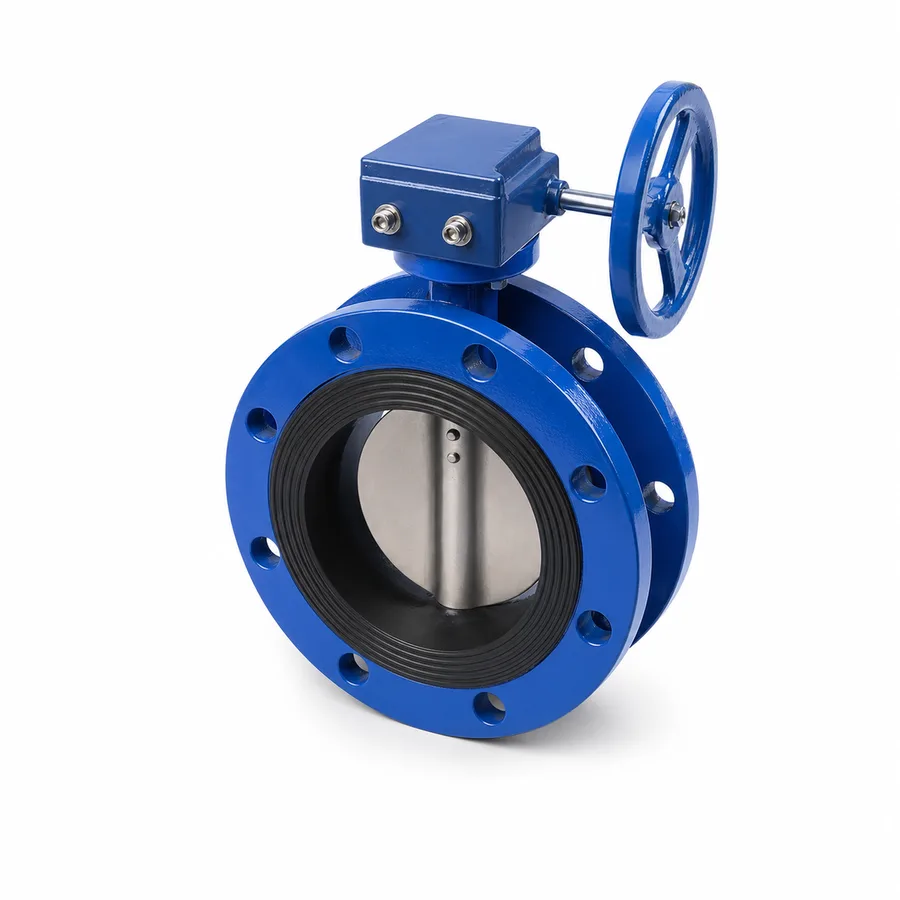
Butterfly valve flanged on both faces —unlike the wafer type, which has no flanges of its own—, offered in the TECTUL catalog in two very different designs: the concentric version, with an elastomeric seat and a disc centred on the valve axis, and the double-eccentric version, high-performance, with the shaft offset in two directions relative to the seat so the disc lifts off it within the first degrees of opening. That geometry is the real difference between the two: the concentric one classifies as API 609 Category A (cold working pressure —CWP— declared by the manufacturer, with no ASME B16.34 pressure-temperature table), while the double-eccentric one classifies as Category B (rated by ASME B16.34 class, with its own pressure-temperature table). This sheet publishes both categories, the class 150 group 1.1 rating table, the physics of why the double eccentric reduces friction and seat wear on every cycle, and the criterion for when the double eccentric's extra cost is worth it over the concentric one.
Important: Before using these data in engineering, design or installation decisions on systems exposed to mechanical, pressure, rupture, fatigue, impact or water-hammer risk, it is essential to read the technical notice and limitation of liability at the end of this sheet.
SKU VT-valvula-mariposa-bridada-concentrica · 2 double-flanged references: concentric (iron/elastomeric seat) and double eccentric (carbon steel, high performance)
1. Technical specifications
Materials by reference
| Body — concentric | Iron (ductile or cast depending on reference), flanged on both faces per the project's drilling standard (usually class 150) |
| Body — double eccentric | Carbon steel, flanged on both faces, class 150 (TECTUL catalog) |
| Disc | Stainless steel or coated carbon steel depending on reference; on the double eccentric, with the offset profile that defines its geometry (section 3) |
| Shaft | Stainless steel; on the double eccentric, offset in two directions relative to the seat plane and the pipe axis (section 3) |
| Seat — concentric | Elastomeric (EPDM or NBR depending on fluid), liner covering the body |
| Seat — double eccentric | Metallic or RPTFE (glass-fibre reinforced PTFE) depending on design pressure and temperature |
| Operation | Notched lever on smaller sizes; gear operator with handwheel on larger sizes; ISO 5211 preparation for an actuator on both references |
| Reference standards | API 609 (category A/B by design) · MSS SP-67 (general requirements) · ASME B16.34 (double-eccentric rating) · ASME B16.5 (flange drilling) · ASME B16.10 (face-to-face length) · ISO 5211 (actuator interface) |
The two flanged references in the TECTUL catalog
| Reference | Disc geometry | Body material | Class / connection standard |
|---|---|---|---|
| Concentric flanged butterfly valve | Concentric — disc and shaft centred on the seat | Iron | Class 150 (ANSI/ASME B16.5) |
| Double-eccentric butterfly valve | Double eccentric — shaft offset in two planes (section 3) | Carbon steel | Class 150 (ANSI/ASME B16.5) |
When the catalog states "ANSI 150" it should be read as the project's flange drilling standard (number and diameter of bolt holes, bolt circle per ASME B16.5), not as a single maximum pressure figure: the real pressure rating depends on the API 609 category of each design (section 2). Size and exact face-to-face length (ASME B16.10) by reference: confirmed on quotation.
⚠ Important: this technical data sheet is a reference guide to the product's properties; it is not a quality certificate for the product you are buying. Heats vary from one another and may differ from the values stated here, or even depart from the standards. If your application requires compliance with a standard, always check the quality certificate (mill certificate) of the lot you are buying. If in doubt, ask one of our technical advisors →
2. Rating system: API 609 category A versus category B
API 609 —the standard that defines the "butterfly" type in its general scope— splits valves into two categories with mutually incompatible rating logics, and confusing them is this family's most frequent specification error:
| Category A | Valves with a manufacturer-declared cold working pressure (CWP), usually with a concentric disc and seat. They carry no ASME B16.34 pressure-temperature table: the manufacturer's published CWP figure is the whole rating, with no standardized derating curve. This is the category of this sheet's concentric flanged butterfly valve. |
| Category B | Valves with a pressure-temperature rating, with an offset seat and an eccentric or concentric disc, whose body meets the ASME B16.34 pressure-temperature table by class and material group —although the seat may have its own limit lower than the body's—. This is the category of this sheet's double-eccentric butterfly valve. |
The distinction between categories, and the fact that Category A requires no B16.34 table while Category B does, is stable across API 609 editions; the exact size and class limits covered by each category have changed between editions of the standard (more recent editions extend the size scope compared with earlier ones), so the exact dimensional scope of each reference is confirmed against the current edition on quotation.
Class 150, material group 1.1 rating table (applies to the double eccentric)
| Temperature | Allowable pressure (WCB, group 1.1) |
|---|---|
| 38 °C (100 °F) and below | 285 psig (19.7 bar) |
| 93 °C (200 °F) | 260 psig (17.9 bar) |
| 149 °C (300 °F) | 230 psig (15.9 bar) |
| 204 °C (400 °F) | 200 psig (13.8 bar) |
| 260 °C (500 °F) | 170 psig (11.7 bar) |
IMPORTANT
This data sheet is a reference guide to the properties of this product type. The measurements, dimensions and physical or geometric characteristics of the product actually supplied may vary by manufacturer and lot, and may even fall outside the cited standards. If any of these figures is critical to your design or build, it is essential to verify it with one of our advisors against the physical product, so you can be fully certain of what you are buying. · Original data sheet: tectul.com/en/conduccion-de-fluidos/valvulas/ficha-tecnica-valvula-mariposa-bridada-concentrica.html
Pressure-temperature table from ASME B16.34 for class 150, material group 1.1 (WCB/A216 carbon steel), the same table that governs the carbon steel body of this sheet's double eccentric. On the double eccentric, the seat —metallic or RPTFE— may cut this limit before the body does: the lower of the two limits (body or seat) always governs, and the exact cutoff per seat is confirmed on quotation. Being Category A, the concentric one is not governed by this table: its CWP is declared directly by the manufacturer.
3. Double-eccentric geometry: why the disc lifts off the seat
Concentric: disc and shaft on the same axis as the seat
On a concentric butterfly valve, the disc shaft passes through the centre of the body and the centre of the seat. Geometric consequence: through the entire opening travel, from 0° to 90°, the disc edge rubs against the elastomeric seat, because the disc rotates describing an arc that never moves away from the seat plane. That continuous rubbing is what wears the seat in frequent-cycle service, and it is also the reason the concentric design needs a soft (elastomeric) seat that absorbs the friction without damaging the disc: a rigid metal seat would not tolerate that constant rubbing without wearing out in a few cycles.
Double eccentric: two offsets that lift the disc away
The double-eccentric butterfly valve offsets the disc shaft in two directions relative to the seat:
- First offset (shaft offset relative to the disc plane): the shaft does not pass through the disc's geometric plane, but is offset to one side.
- Second offset (shaft offset relative to the centre of the seat/pipe): the shaft also does not pass through the seat's geometric centre.
The combination of both offsets means that, on starting to open, the disc does not rotate describing an arc tangent to the seat as in the concentric design, but instead lifts away radially from it within the first degrees of rotation —a motion similar to a cam moving away from its bearing surface—. From that point, the disc rotates freely, without touching the seat, up to the fully open position, and on closing the motion reverses: the disc approaches only in the last few degrees and seats only at the very end of the travel, with brief contact instead of a continuous 90° rub.
Why that matters in practice
| Seat wear | With the disc-to-seat contact arc drastically reduced per cycle, friction wear drops in the same proportion: this is the main reason the double eccentric extends seat life over the concentric design in frequent-cycle service. |
| Operating torque | With the disc lifted off the seat through most of the travel, breakaway friction is lower than on a concentric valve of the same size —although torque still grows with size and ΔP, just as with any butterfly valve (ductile iron sheet, section 4)—. |
| Possible seat materials | Not requiring a soft seat to absorb continuous friction, the double eccentric accepts metallic or RPTFE seats with higher pressure and temperature resistance than an elastomer, enabling higher service classes and temperatures than the concentric design. |
| Closing tightness | Final contact is a controlled interference, not rolling friction: well executed, it gives a repeatable tight shut-off even with a metallic seat, something a metal-seated concentric valve could not achieve because of continuous rubbing. |
This description is the standard geometric and physical explanation of the double-eccentricity mechanism in high-performance butterfly valves, consistent with the design criterion that separates API 609 Category B from Category A.
4. Seat, operating torque and when the double eccentric is worth it
Seat materials by reference
| Elastomeric (concentric) | EPDM or NBR depending on fluid. Absorbs the continuous friction of concentric rubbing; temperature limit set by the elastomer itself (ductile iron sheet, section 2, seat range table). Lower cost, simple maintenance, economical replacement. |
| Metallic (double eccentric) | Corrosion-resistant alloy ring on the body seat. Withstands higher temperature and pressure than any elastomer, at the cost of slightly less tight shut-off than a new soft seat (tightness class depends on the design, confirmed on quotation). |
| RPTFE (double eccentric) | Glass-fibre reinforced PTFE: retains much of virgin PTFE's chemical inertness and low friction coefficient, with higher mechanical resistance to creep under continuous load than unreinforced PTFE. |
Operating torque: what makes it grow
On both geometries, operating torque combines disc-to-seat friction, shaft seal friction and the hydrodynamic torque the flow exerts on the disc, and all three grow with size and with the line's differential pressure (same principle as in the ductile iron sheet, section 4). The difference between concentric and double eccentric lies in the first component: with the disc-to-seat contact arc reduced, the double eccentric generally requires lower relative breakaway torque than an equivalent concentric valve, although running torque —once the disc is lifted off— can be similar. The exact torque value by size and class is manufacturer data and is confirmed on quotation together with the reference's ISO 5211 flange.
When the double eccentric is worth paying for
- Pressure and temperature above what an elastomeric-seat concentric valve gives. If the design point requires a class or a temperature the elastomer cannot withstand (section 2), the double eccentric —with a metallic or RPTFE seat— is the only option in this sheet that covers it.
- Frequent-cycle service. When the valve opens and closes many times per day or per hour, the accumulated wear from a concentric valve's continuous rubbing becomes a real maintenance cost; the double eccentric reduces it by design.
- Trunk lines in water utilities or high-availability process lines, where a leak or an unplanned shutdown from seat wear carries a high cost.
- When it is NOT worth it. For basic shut-off or regulation of water at moderate pressure and temperature, with infrequent cycles, the elastomeric-seat concentric valve does the job at lower acquisition and maintenance cost (the elastomeric seat is cheaper to replace than a metallic or RPTFE ring).
5. Frequently asked questions
What is the rating difference between the concentric and the double-eccentric valve?
The concentric valve is API 609 Category A: its cold working pressure (CWP) is declared directly by the manufacturer, with no pressure-temperature table. The double-eccentric valve is Category B: its carbon steel body is governed by the ASME B16.34 table —285 psig at 38 °C for class 150 group 1.1, decreasing with temperature—, and the metallic or RPTFE seat may cut that limit before the body does.
Why does the double eccentric last longer than the concentric one in frequent-cycle service?
Because the disc lifts radially off the seat within the first degrees of opening, instead of rubbing against it through the whole 90° travel as in the concentric design. Less contact arc per cycle means less accumulated seat wear.
Can I use a metallic seat on a concentric butterfly valve?
That is not this family's design practice: the concentric valve rubs the seat through its whole travel, and a rigid metallic seat would wear out in a few cycles from that continuous rubbing. A metallic or RPTFE seat is an option on the double eccentric, whose geometry avoids the constant rubbing.
What does "ANSI 150" on the catalog mean if it is not a pressure?
It is the flange drilling standard —number and diameter of bolt holes, bolt circle per ASME B16.5— that must match the line's mating part. The real working pressure depends on the API 609 category of each design (section 2), not on the number "150" alone.
When is it worth paying for the double eccentric instead of the concentric?
When the design pressure or temperature exceeds what an elastomeric seat gives, or when the service is frequent-cycle and concentric seat wear becomes a real maintenance cost. For basic water shut-off with infrequent cycles, the concentric valve does the job at lower cost.
6. Application notes
Feasibility
The concentric flanged valve covers shut-off and basic regulation of water and industrial services compatible with its elastomeric seat, within the CWP declared by the manufacturer (API 609 Category A). The double eccentric covers higher pressure and temperature, frequent-cycle service and trunk lines, within the ASME B16.34 class 150 group 1.1 table —and the limit of its own metallic or RPTFE seat— (Category B). Neither substitutes for a metal-seated valve with absolute zero-leakage shut-off in critical services; check or ball valve designs with certified metal seats exist for those cases. Always verify the correct API 609 category before comparing pressures between references. For critical or safety applications, consult our technical team before specifying.
Installation
Centre the valve between flanges compatible in drilling standard (ASME B16.5), checking that the disc opens without touching the piping or the adjacent flange. Tighten the bolts in a cross-pattern sequence and in stages (same ASME PCC-1 principle as in the ductile iron sheet, section 3). Leave access for the lever, the gear-operator handwheel or the actuator. On the double eccentric, verify the opening direction recommended by the manufacturer: the offset geometry means the correct rotation direction favours the disc lifting off, while the opposite direction can force it against the seat on start-up.
Design
First define the API 609 category that matches the design point —pressure, temperature and service— before comparing the concentric against the double-eccentric valve: they are two different rating systems, and directly comparing a pressure number without the category is a mistake. If the service is frequent-cycle, weigh seat maintenance over the service life, not just the initial selection. Always confirm the flange drilling standard against the project's drawings: it is the most expensive and most avoidable rework on site. If the valve will carry an actuator, define the ISO 5211 flange and the maximum required torque with margin before selecting it (ductile iron sheet, section 4).
7. Technical notice and limitation of liability
The categories and rating framework in this sheet combine API 609 (categories A and B) and ASME B16.34 (class 150 group 1.1 pressure-temperature table), ASME B16.5 and ASME B16.10 (flange drilling and face-to-face length) with the data TECTUL publishes on each product page (declared material and connection standard). They do not constitute a certificate of conformity for any production lot.
The exact dimensional scope (size and class range) covered by each API 609 category has changed between editions of the standard: this sheet describes the rating logic —stable across editions— and should not be read as a literal quote of one specific edition's size limits. The exact CWP value of the concentric valve, the metallic or RPTFE seat limit of the double eccentric, and the operating torque by size are not published generically by the manufacturer: they are confirmed on quotation with the manufacturer's data sheet or the corresponding certificate.
These values must not be used as the sole criterion in critical, safety, certified potable-water applications, or wherever valve failure may compromise people, property or the environment: in such cases the design belongs to the responsible engineer of the project, with the real design temperature and pressure and the transients of the line. Before deciding with these data, consult our technical team.
Sources
- API 609 — Butterfly Valves: Double-Flanged, Lug- and Wafer-Type: definición de categoría A (CWP declarado por el fabricante, disco/asiento concéntrico) frente a categoría B (rating presión-temperatura, asiento descentrado, disco excéntrico o concéntrico)
- MSS SP-67 — Butterfly Valves: requisitos generales de diseño, dimensiones y prueba de válvulas de mariposa
- ASME B16.34 — Valves — Flanged, Threaded, and Welding End: tabla de presión-temperatura clase 150, grupo de material 1.1 (WCB/A216): 285 psig a 38 °C, decreciendo con la temperatura
- ASME B16.5 — Pipe Flanges and Flanged Fittings: estándar de perforación de brida (número y diámetro de agujeros, círculo de pernos) clase 150
- ASME B16.10 — Face-to-Face and End-to-End Dimensions of Valves: longitud cara a cara de válvulas bridadas
- ISO 5211 — Industrial valves — Part-turn actuator attachments: interfaz de montaje de actuador
- Fichas de producto TECTUL (tectul.com): Válvula Mariposa Concéntrica Bridada y Válvula Mariposa Doble Excentricidad — fuente de material declarado y norma de conexión
- Principio de diseño de mariposas de alto desempeño ("high-performance butterfly valves"): geometría de doble excentricidad y su efecto en el desgaste del asiento — consistente con la lógica de categorización de API 609
This data sheet is the property of TECTUL, part of the Industrias IMR group. Reproduction without attribution is prohibited. Original document and updates: tectul.com/en/conduccion-de-fluidos/valvulas/ficha-tecnica-valvula-mariposa-bridada-concentrica.html.