 TECTULby IMR
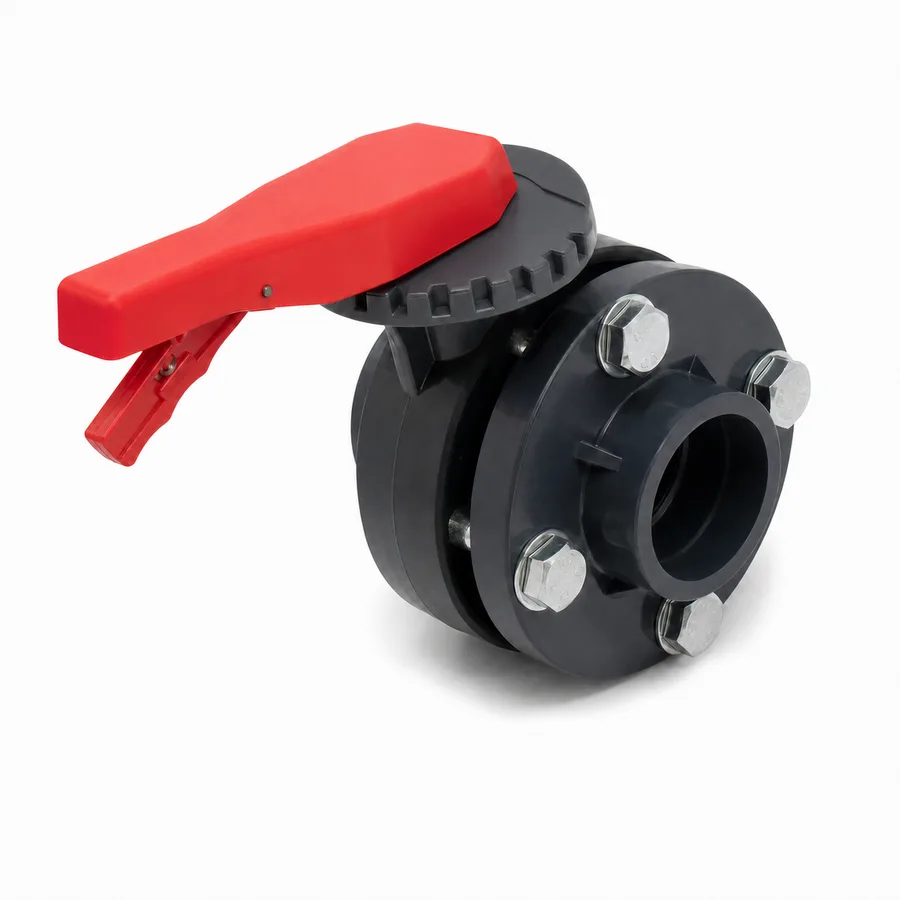
PVC butterfly valve mounted between flanges — 2″ to 8″, elastomeric seat, class 150
TECTUL · Dispatch across Colombia · Exports to Central & South America
Butterfly valve with a PVC body, PVC or POM disc and elastomeric seat and seals, mounted between class 150 flanges, in sizes from 2″ to 8″. Working pressure of 150 psi (10.3 bar) at 23 °C. The particularity no commercial sheet explains: a wafer butterfly valve has no standalone rating — it has no ends that seal on their own, it seals compressed between the two flanges by the through studs, so the assembly of flanges, studs and cross-pattern torque is part of the seal. Hence tightening is an engineering datum and not an installation detail: over-torquing deforms the elastomeric seat and ruins the valve closure. This sheet also publishes the temperature derating table on the 150 psi base, throttling use versus a ball valve, the growth of operating torque with size, and the comparison with a metallic stainless-disc butterfly valve.
Important: Before using these data in engineering, design or installation decisions on systems exposed to mechanical, pressure, rupture, fatigue, impact or water-hammer risk, it is essential to read the technical notice and limitation of liability at the end of this sheet.
SKU VT-87064 (PVC butterfly valve with flanges) · 5 catalog variants: 2″, 3″, 4″, 6″ and 8″
1. Technical specifications
TECTUL catalog variants and working pressure
| Size | Pressure @23 °C |
|---|---|
| 2″ | 150 psi (10.3 bar) |
| 3″ | 150 psi (10.3 bar) |
| 4″ | 150 psi (10.3 bar) |
| 6″ | 150 psi (10.3 bar) |
| 8″ | 150 psi (10.3 bar) |
IMPORTANT
This data sheet is a reference guide to the properties of this product type. The measurements, dimensions and physical or geometric characteristics of the product actually supplied may vary by manufacturer and lot, and may even fall outside the cited standards. If any of these figures is critical to your design or build, it is essential to verify it with one of our advisors against the physical product, so you can be fully certain of what you are buying. · Original data sheet: tectul.com/en/conduccion-de-fluidos/valvulas/ficha-tecnica-valvula-mariposa-pvc-era-con-bridas.html
The 150 psi pressure is at 23 °C and with the valve correctly mounted and torqued between the two flanges: outside the flanged assembly, the butterfly valve has no working pressure of its own (section 2). Value for water without hydraulic shock.
Materials, construction and standards
| Body | Injection-moulded PVC of wafer type, short face to face, with holes or guides for the through studs. It has no flanged ends of its own: it is inserted between the two line flanges. |
| Disc | PVC or POM depending on reference, with 1/4-turn rotation on the central shaft. The disc stays inside the bore even when fully open, which introduces a permanent head loss that a full-port ball valve does not have. |
| Seat | Elastomeric (EPDM for water or NBR depending on fluid), shaped as a liner covering the inside of the body and protruding on both faces. That protrusion is what seals against the flange faces when the studs are tightened: the seat acts as the valve seal and as the flange gasket. |
| Shaft and shaft seals | Through shaft retained in the body, with o-rings or sealing bushings; operation is manual with a notched lever in the smaller sizes and with a gear operator in the larger ones, depending on reference. |
| Mating flanges | Class 150 per ASME B16.5, supplied with the line. The valve requires through studs crossing the body from side to side. |
| Working pressure | 150 psi (10.3 bar) at 23 °C for water without shock, with the valve installed and torqued between flanges. |
| Maximum service temperature | 60 °C (140 °F), set by the PVC body. The seat elastomer tolerates more, but the lower of the two limits governs. |
| Applicable standards | ASME B16.5 class 150 (mating flanges, stud count and diameter, bolt circle) · ASTM D1784 (PVC compound of body and disc) · ASME PCC-1 (guidelines for pressure boundary bolted flange joint assembly: tightening sequence and stages). |
IMPORTANT
This data sheet is a reference guide to the properties of this product type. The measurements, dimensions and physical or geometric characteristics of the product actually supplied may vary by manufacturer and lot, and may even fall outside the cited standards. If any of these figures is critical to your design or build, it is essential to verify it with one of our advisors against the physical product, so you can be fully certain of what you are buying. · Original data sheet: tectul.com/en/conduccion-de-fluidos/valvulas/ficha-tecnica-valvula-mariposa-pvc-era-con-bridas.html
Studs of the flanged assembly by size — class 150 (ASME B16.5)
| Size | Number of studs | Stud diameter | Bolt circle |
|---|---|---|---|
| 2″ | 4 | 5/8″ | 4.75″ (120.7 mm) |
| 3″ | 4 | 5/8″ | 6.00″ (152.4 mm) |
| 4″ | 8 | 5/8″ | 7.50″ (190.5 mm) |
| 6″ | 8 | 3/4″ | 9.50″ (241.3 mm) |
| 8″ | 8 | 3/4″ | 11.75″ (298.5 mm) |
IMPORTANT
This data sheet is a reference guide to the properties of this product type. The measurements, dimensions and physical or geometric characteristics of the product actually supplied may vary by manufacturer and lot, and may even fall outside the cited standards. If any of these figures is critical to your design or build, it is essential to verify it with one of our advisors against the physical product, so you can be fully certain of what you are buying. · Original data sheet: tectul.com/en/conduccion-de-fluidos/valvulas/ficha-tecnica-valvula-mariposa-pvc-era-con-bridas.html
Data for the ASME B16.5 class 150 flange, which is the mating part of the installation. In the wafer version the studs are through studs: they run flange to flange, outside or through the body guides, and hold the valve by compression, not by threads in the body. The specific torque per size is set by the valve manufacturer according to the elastomeric seat and is confirmed on quotation (section 3).
⚠ Important: this technical data sheet is a reference guide to the product's properties; it is not a quality certificate for the product you are buying. Production lots vary from one another and may differ from the values stated here, or even depart from the standards. If your application requires compliance with a standard, always check the quality certificate (mill certificate) of the lot you are buying. If in doubt, ask one of our technical advisors →
2. The wafer butterfly valve has no standalone rating: the assembly is the seal
A wafer butterfly valve cannot be specified on its own
A threaded or solvent-weld ball valve has ends that seal by themselves: it can be pressurised on a bench with two plugs and its working pressure measured. A wafer butterfly valve has no ends. Its body is a short ring inserted between the two line flanges, and the seal against the fluid is made by the elastomeric liner that covers the inside of the body and protrudes on both faces. That protrusion is crushed against the flange faces when the through studs are tightened: the seat performs two functions at once — sealing the disc against the body and gasketing the flanged joint.
The consequence is direct: the catalog's 150 psi are not a property of the valve but of the assembly — class 150 flanges plus correct studs plus properly applied cross-pattern torque. If the flanges are not the right ones, if there are too few studs, if they are loose or unevenly tightened, the published figure ceases to apply, and the failure mode is not a cracked body but a leak at the flange face.
What must be verified in the assembly
- Flange class and standard. Class 150 per ASME B16.5, with the bolt circle and stud count from the section 1 table for each size. A flange of another class or another dimensional standard leaves the studs out of position.
- Flange face. It must be clean, flat and free of burrs and dents: the elastomer conforms to small irregularities, but a dent or a burr leaves a leak path that no extra tightening closes.
- Alignment and parallelism. Both flanges must be parallel and coaxial before the valve goes in. Closing a misalignment by pulling on the studs loads the PVC body in bending and cracks it.
- Stud length. They must be through studs of the correct length for the valve face to face plus the two flanges; short studs with few threads engaged in the nut do not develop the required load.
- Clearance for the disc. In large sizes the disc protrudes beyond the body when opening: verify it does not strike the inside diameter of the flange or the adjacent pipe, especially where the line has reducers or narrow-bore flanges.
This is also why a wafer butterfly valve must not be used as a temporary blind flange, removing the pipe on one side and leaving the valve closed as a plug: without the flange on the dismantled side, the seat loses half its compression and the valve is not in the condition in which its rating was tested.
3. Cross-pattern tightening and damage from over-torquing
Cross-pattern tightening sequence
The studs of a flanged joint are not tightened one after another around the circle: that tilts the flange and crushes the seat on one side only. They are tightened in a cross pattern and in stages, following the bolted pressure joint assembly practice set out in ASME PCC-1, so that load is distributed evenly around the whole perimeter of the elastomeric seat.
- Fit the valve between the flanges with the disc slightly open, without protruding beyond the faces: this keeps the seat unloaded by the disc while it is compressed, and prevents the disc edge from catching the flanges on the first rotation.
- Fit all studs and bring the nuts to contact by hand, checking that the valve is centred and the flanges are parallel.
- First stage: tighten in cross sequence (for 4 studs, diagonally; for 8, in a star pattern moving between consecutive opposite diameters) to about one third of the final torque.
- Second stage: repeat the same cross sequence to about two thirds of the final torque.
- Third stage: repeat the cross sequence to the final torque stated by the valve manufacturer for that size.
- Final circular pass: go around all nuts in order, at the final torque, to even out the load. The elastomer relaxes after tightening, so the torque should be rechecked after some time and before the hydrostatic test.
- Only then operate the disc for the first time and verify the full 90° rotation with no hard spots.
The final torque per size is not a generic value: it depends on the hardness and thickness of the elastomeric liner and is set by the valve manufacturer. It is confirmed on quotation. Using the torque for a metallic joint with a fibre gasket on a PVC butterfly valve with an elastomeric seat is a serious error: they are orders of magnitude apart.
Why over-torquing ruins the valve
On a conventional metallic flanged joint, over-tightening usually means a stretched stud or a crushed gasket, with no further functional consequence. On this valve, the elastomeric seat is also the disc seal: when compressed excessively, the elastomer flows towards the bore and deforms the diameter on which the disc seats. The symptoms are characteristic and appear together:
- Operating torque shoots up: the lever becomes very hard or the gear operator jams, because the disc rubs against a deformed seat.
- Accelerated wear of the seat and disc edge, with friction marks visible on dismantling.
- Leakage when closed, paradoxically: the deformation is not uniform and leaves a channel where the disc does not bear.
- Cracked PVC body in extreme cases, especially where flange misalignment was also present.
The damage is irreversible: an elastomer over-compressed for a long period loses elastic recovery and does not return to its original geometry even if loosened. That is why the tightening of a PVC butterfly valve is a documented engineering datum, not a matter of the fitter's feel.
4. Temperature derating, throttling and operating torque
Temperature derating applied to the 150 psi base
Like every PVC body, the butterfly valve has no single pressure: the 150 psi are a value at 23 °C and they fall from the first degree above that temperature, because the polymer's strength depends on how soft it is. The hydrostatic design basis (ASTM D2837) used to set the rating is measured on the same compound at 23 °C.
| °C | °F | Factor | Available pressure (psi) | Available pressure (bar) |
|---|---|---|---|---|
| 23 °C | 73 °F | 1.00 | 150 psi | 10.3 bar |
| 27 °C | 80 °F | 0.88 | 132 psi | 9.1 bar |
| 32 °C | 90 °F | 0.75 | 113 psi | 7.8 bar |
| 38 °C | 100 °F | 0.62 | 93 psi | 6.4 bar |
| 43 °C | 110 °F | 0.51 | 77 psi | 5.3 bar |
| 49 °C | 120 °F | 0.40 | 60 psi | 4.1 bar |
| 54 °C | 130 °F | 0.31 | 47 psi | 3.2 bar |
| 60 °C | 140 °F | 0.22 | 33 psi | 2.3 bar |
IMPORTANT
This data sheet is a reference guide to the properties of this product type. The measurements, dimensions and physical or geometric characteristics of the product actually supplied may vary by manufacturer and lot, and may even fall outside the cited standards. If any of these figures is critical to your design or build, it is essential to verify it with one of our advisors against the physical product, so you can be fully certain of what you are buying. · Original data sheet: tectul.com/en/conduccion-de-fluidos/valvulas/ficha-tecnica-valvula-mariposa-pvc-era-con-bridas.html
Factor table published by the standard's manufacturers for PVC (Westlake Pipe & Fittings / LASCO, Spears), consistent with the derating rule used for the catalog's PVC pressure fittings. 60 °C (140 °F) is the service ceiling of the PVC body: above that point the reference does not apply even if the seat elastomer tolerates more, because the lower of the two limits governs. Temperature also affects the seat in another way: a hot elastomer relaxes more and the flange bolt torque is lost sooner.
Shut-off and partial throttling: the difference from a ball valve
A ball valve is a shut-off device: open or closed. In intermediate positions, the jet passing the edge of the bore erodes the PTFE seat and leaves it dripping within weeks — which is why a ball valve is not used for throttling. A butterfly valve, by contrast, does accept partial throttling: the disc rotates within the flow and regulates the flow area progressively, without exposing a soft seat to a concentrated jet. It is the natural use of a butterfly valve on an irrigation or process line where flow must be adjusted without installing a control valve.
With two engineering caveats: at very small openings, around 10 to 20 %, local velocity rises sharply and cavitation and disc vibration become a risk, so fine throttling is not its territory; and the disc always stays inside the bore, even fully open, which introduces a permanent head loss that a full-port ball valve does not have. If the line is tight on available pressure, that detail must be accounted for.
Operating torque and why it grows with size
The torque needed to turn the disc has three components: disc friction against the elastomeric seat, friction of the shaft seals and the hydrodynamic torque the flow exerts on the disc. All three grow with size, and the hydrodynamic one grows with differential pressure as well. That is why small butterfly valves are operated with a notched lever and, above a certain size, move to a gear operator with a handwheel, which multiplies torque at the cost of more turns.
Practical design consequences: allow access and space for the handwheel or lever, do not operate the valve by hand with improvised extensions — a wrench on the lever can break the shaft or dislodge the disc — and bear in mind that abnormally high operating torque on a new valve almost always indicates over-torqued studs (section 3), not a valve defect. A fast quarter-turn closure on a large size also generates considerable water hammer: with a gear operator the closure is slow by construction, which helps.
5. Frequently asked questions
How much pressure does a PVC butterfly valve take?
150 psi (10.3 bar) at 23 °C, and mounted between class 150 flanges with the studs correctly torqued. Outside the flanged assembly it has no working pressure of its own, because the elastomeric seat seals compressed against the flange faces. That figure falls with temperature: 113 psi at 32 °C, 93 psi at 38 °C and 33 psi at 60 °C.
What torque do I use on the studs?
The torque the valve manufacturer states for that size, applied in a cross pattern and in three stages (one third, two thirds and final torque), with a final circular pass and rechecking before the hydrostatic test. Do not use the torque for a metallic joint with a fibre gasket: they are orders of magnitude apart. The exact value is confirmed on quotation.
Why did the lever become so stiff after installation?
Almost always because of over-torqued studs. When over-compressed, the elastomeric liner flows towards the bore and deforms the diameter on which the disc seats: the valve rubs, wears and ends up leaking when closed. The damage is irreversible because the elastomer loses elastic recovery, so it should be detected and the torque corrected before the line goes into service.
Can I throttle flow with a butterfly valve?
Yes, and it is one of its advantages over a ball valve, which serves only for shut-off because the jet erodes its PTFE seat in intermediate positions. The butterfly valve regulates progressively. Two caveats: at 10 to 20 % opening cavitation and disc vibration become a risk, and the disc introduces a permanent head loss even when fully open.
PVC butterfly valve or metallic stainless-disc butterfly valve?
PVC when the fluid is cold water with chemicals, brackish water or fertigation and weight matters: it does not corrode and weighs far less, which at 6″ and 8″ decides installation and supports. Metallic with a stainless disc when temperature exceeds 60 °C, design pressure is high, water hammer is severe, long life with frequent operation is required or there is external mechanical risk. Unit cost is higher for the metallic one, but it is the correct choice whenever any of those factors is present.
Can the butterfly valve be left closed as a temporary plug with the pipe removed on one side?
No. Without the flange on the dismantled side, the seat loses half its compression and the valve falls outside the condition in which its rating was tested. To isolate a run during construction, a blind flange is the correct part, not the butterfly valve.
6. Application notes
Feasibility
The reference covers cold water and aqueous solution service up to 60 °C (140 °F), in 2″, 3″, 4″, 6″ and 8″, at 150 psi (10.3 bar) at 23 °C. It is the right choice in chemically dosed water, brackish water and fertigation, where a metallic butterfly valve corrodes, and in installations where weight decides: at 6″ and 8″ the difference against the metallic option changes the supports and the lifting equipment. It is not the choice when temperature exceeds 60 °C, design pressure is high, water hammer is severe or long-life frequent operation is required. Always check the service temperature against the section 4 table before comparing with the design pressure. For critical or safety applications, consult our technical team before specifying.
Installation
Class 150 mating flanges per ASME B16.5, clean, flat, parallel and coaxial before the valve goes in; through studs of the count and diameter in the section 1 table and of the correct length. Fit with the disc slightly open, not protruding beyond the faces. Tighten in a cross pattern and in three stages — one third, two thirds and the manufacturer final torque — with a final circular pass and rechecking before the hydrostatic test, because the elastomer relaxes. Never close a misalignment by pulling on the studs: that cracks the PVC body. Operate the disc for the first time only after tightening is complete, verifying the 90° rotation with no hard spots.
Design
Specify the butterfly valve together with its flanged assembly: flange class, stud count and diameter, and tightening torque are part of the specification, not of the installation report. Size with the working pressure ALREADY multiplied by the service-temperature factor (section 4) and compare it against maximum static pressure plus the water hammer of the quarter-turn closure, which is considerable in large sizes. Account for the permanent head loss of the disc, which stays inside the bore even fully open, something a full-port ball valve does not have. If the point requires fine throttling below 20 % opening, expect cavitation and disc vibration risk: that is not a butterfly valve territory. Leave access and space for the lever or the gear operator handwheel.
7. Technical notice and limitation of liability
The pressures and temperatures in this sheet are nominal values published in the standards and sources cited (ASME B16.5, ASME PCC-1, ASTM D1784, ASTM D2837) or standard-manufacturer catalog evidence for the 23 °C (73 °F) reference point, with documented industry-practice derating factors. They guide selection; they are not a certificate of conformity for any production lot nor an independent test of the catalog reference.
The published rating corresponds to the valve installed and torqued between class 150 flanges. Flanges of another class, missing or incorrectly sized studs, damaged faces, misalignment or uneven tightening void that figure, and the final torque per size is set by the manufacturer according to the elastomeric seat. Certifying a reference requires the manufacturer documentation; TECTUL arranges it upon request.
These values must not be used as the sole criterion in critical, safety, certified potable-water applications, or wherever valve failure may compromise people, property or the environment: in such cases the design belongs to the responsible engineer of the project, with the real design temperature, the transients of the line and the weakest element of the system. Before deciding with these data, consult our technical team.
Sources
- ASME B16.5 — Pipe Flanges and Flanged Fittings, NPS 1/2 through NPS 24: clase 150, número y diámetro de espárragos y círculo de pernos de 2″ a 8″ (contraparte del montaje wafer)
- ASME PCC-1 — Guidelines for Pressure Boundary Bolted Flange Joint Assembly: secuencia cruzada, apriete por etapas, pasada circular final y reverificación por relajación de la junta
- ASTM D1784-11 — Standard Classification System and Basis for Specification for Rigid Poly(Vinyl Chloride) (PVC) and Chlorinated Poly(Vinyl Chloride) (CPVC) Compounds (compuesto del cuerpo y del disco)
- ASTM D2837 — Standard Test Method for Obtaining Hydrostatic Design Basis for Thermoplastic Pipe Materials (origen del rating a 23 °C y razón física del derating)
- ASTM F1970-19 — Standard Specification for Special Engineered Fittings, Appurtenances or Valves for use in PVC or CPVC Systems (marco de rating declarado por el fabricante para válvulas plásticas)
- Spears Manufacturing Company — Butterfly Valve technical data: 150 psi a 23 °C (73 °F) para la línea de mariposa en PVC y temperatura máxima de servicio 60 °C (140 °F) — evidencia de catálogo de fabricante del estándar, no norma
- Westlake Pipe & Fittings / LASCO Fittings — factores de derating por temperatura para PVC (1,00 / 0,88 / 0,75 / 0,62 / 0,51 / 0,40 / 0,31 / 0,22 a 23 / 27 / 32 / 38 / 43 / 49 / 54 / 60 °C), la misma tabla usada en la ficha de accesorios de PVC presión del catálogo TECTUL
- Crane Co. — Flow of Fluids Through Valves, Fittings and Pipe (Technical Paper No. 410): pérdida de carga de la válvula de mariposa según grado de apertura y comportamiento en estrangulación parcial
This data sheet is the property of TECTUL, part of the Industrias IMR group. Reproduction without attribution is prohibited. Original document and updates: tectul.com/en/conduccion-de-fluidos/valvulas/ficha-tecnica-valvula-mariposa-pvc-era-con-bridas.html.