 TECTULby IMR
Plastic-body air valves — K10 double-acting kinetic, PVC LD, polyamide triple-effect and wastewater air valve
TECTUL · Dispatch across Colombia · Exports to Central & South America
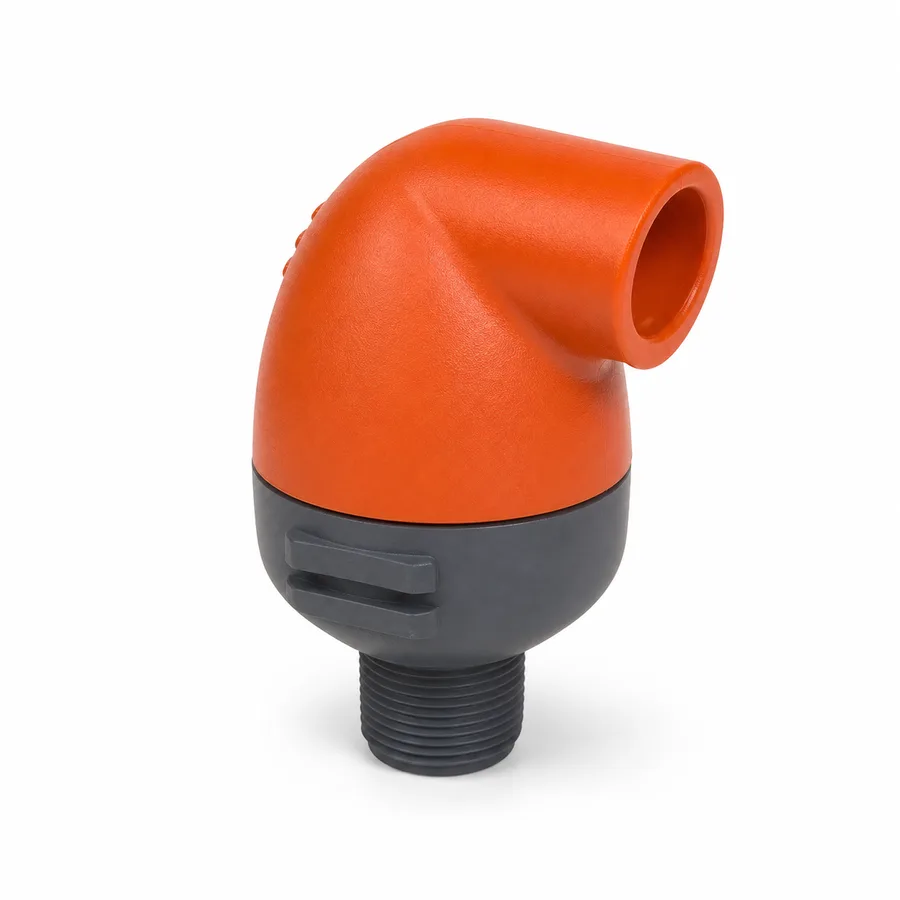
TECTUL's line of predominantly plastic-body air valves: the K10 double-acting kinetic air valve (high-strength PVC or polypropylene), the PVC LD air valve and the polyamide triple-effect air valve (SPP reference), intended for potable water, irrigation and non-corrosive liquids. Added as an alias of the same commercial family is the wastewater air valve, which unlike the previous three is actually ductile iron metallic — as reported by its own catalog sheet — and whose elongated body separates the float mechanism from the solids-laden fluid. This sheet publishes the difference between double action (kinetic) and triple effect (combination), each material's own rating system (plastic derating at 23 °C versus European PN versus AWWA for the metallic reference), and why an air valve is always mounted vertically, with an isolation valve underneath.
Important: Before using these data in engineering, design or installation decisions on systems exposed to mechanical, pressure, rupture, fatigue, impact or water-hammer risk, it is essential to read the technical notice and limitation of liability at the end of this sheet.
SKU VT-178892 (K10 kinetic air valve) · line of 4 references: K10 double-action, PVC LD, SPP triple-effect (polyamide) and wastewater (ductile iron)
1. Technical specifications
The four TECTUL catalog references
| Reference | Actual material | Function | Connection | Catalog sizes |
|---|---|---|---|---|
| K10 Plastic Double-Action Kinetic Air Valve | High-strength PVC or polypropylene | Double action (kinetic): air/vacuum on filling and draining + operating release | Threaded or quick coupling | 3/4" · 1" · 2" |
| PVC LD Air Valve | Low-density (LD) PVC | Double action: releases accumulated air and admits water as pressure is restored | Threaded | 3/4" · 1" · 1-1/4" · 1-1/2" · 2" |
| SPP Air Valve (triple effect) | High-strength polyamide | Triple effect (combination): air expulsion on filling, admission on draining and automatic release during operation | NPT thread | 3/4" · 1" · 1-1/2" · 2" |
| Wastewater Air Valve | Ductile iron — not plastic, unlike the previous three, as reported by the product's own catalog page | Triple function (filling, draining and release) adapted to solids-laden fluid | Threaded or flanged depending on reference — confirmed on quotation | No published variants: size confirmed on quotation |
The wastewater reference does not share material with the rest of this sheet. It is grouped here by function and commercial line (air valves), not by material: this sheet declares that rather than forcing a uniformity the catalog does not report. Sizes per TECTUL catalog, August 2026.
Materials by component
| Component | K10 / PVC LD / SPP (plastic) | Wastewater (metallic) |
|---|---|---|
| Body | Injection-molded PVC or high-strength polyamide | Ductile iron, elongated body |
| Float | Low-density plastic or hollow sphere, depending on reference | Float protected inside the elongated chamber, kept away from direct contact with solids and foam |
| Seat | Synthetic elastomer (NBR or EPDM depending on fluid) | Synthetic elastomer, manufacturer data |
| Connection | NPT thread or quick coupling depending on reference | Threaded or flanged, confirmed on quotation |
Regulatory framework
| Valve type | Air valve: double action, triple effect or combination, operates automatically by float |
| Plastic compound | ASTM D1784 (PVC/CPVC) for the PVC references; high-strength polyamide for the SPP, with no ASTM compound standard cited by the manufacturer |
| PVC line rating | psi-at-23-°C system with temperature derating, ASTM D2837 basis — see section 2 |
| SPP reference rating | PN10 / PN16 depending on variant, European nominal pressure system — see section 2 |
| Wastewater reference rating | AWWA C512 system, the same used by this catalog's metallic air valves (see that sheet for the system's detail) |
| Threads | NPT per ASME B1.20.1 |
⚠ Important: this technical data sheet is a reference guide to the product's properties; it is not a quality certificate for the product you are buying. Production lots vary from one another and may differ from the values stated here, or even depart from the standards. If your application requires compliance with a standard, always check the quality certificate (mill certificate) of the lot you are buying. If in doubt, ask one of our technical advisors →
2. Three rating systems in a single sheet
This sheet brings together four references that, by their own material, are specified under three different pressure systems. None is interchangeable with another without stating its reference temperature or standard — the same exactitude rule that separates WOG from ASME Class throughout this sheet series.
System 1 — PVC: psi at 23 °C with temperature derating (K10 and PVC LD)
Like every PVC body, the 150 psi rating of these two references is a value at 23 °C, measured on the ASTM D2837 hydrostatic design basis, and it falls with temperature:
| °C | °F | Factor | Available pressure |
|---|---|---|---|
| 23 °C | 73 °F | 1.00 | 150 psi · 10.3 bar |
| 32 °C | 90 °F | 0.75 | 113 psi · 7.8 bar |
| 38 °C | 100 °F | 0.62 | 93 psi · 6.4 bar |
| 49 °C | 120 °F | 0.40 | 60 psi · 4.1 bar |
| 60 °C | 140 °F | 0.22 | 33 psi · 2.3 bar |
IMPORTANT
This data sheet is a reference guide to the properties of this product type. The measurements, dimensions and physical or geometric characteristics of the product actually supplied may vary by manufacturer and lot, and may even fall outside the cited standards. If any of these figures is critical to your design or build, it is essential to verify it with one of our advisors against the physical product, so you can be fully certain of what you are buying. · Original data sheet: tectul.com/en/conduccion-de-fluidos/valvulas/ficha-tecnica-valvula-ventosa-cinetica-k10-plastica-de-doble-accion.html
Same derating table used in this catalog's PVC butterfly valve sheet (factors published by standard PVC manufacturers: Westlake Pipe & Fittings / LASCO, Spears). 60 °C (140 °F) is the usual service ceiling of a PVC body.
System 2 — European polyamide: PN (nominal pressure) at catalog temperature (SPP)
The SPP reference is published as PN10 or PN16 depending on variant — the European metric nominal pressure system, not the PVC line's psi@23 °C system:
| PN class | Nominal pressure (bar) | Approximate equivalent |
|---|---|---|
| PN10 | 10 bar | ≈ 145 psi |
| PN16 | 16 bar | ≈ 232 psi |
IMPORTANT
This data sheet is a reference guide to the properties of this product type. The measurements, dimensions and physical or geometric characteristics of the product actually supplied may vary by manufacturer and lot, and may even fall outside the cited standards. If any of these figures is critical to your design or build, it is essential to verify it with one of our advisors against the physical product, so you can be fully certain of what you are buying. · Original data sheet: tectul.com/en/conduccion-de-fluidos/valvulas/ficha-tecnica-valvula-ventosa-cinetica-k10-plastica-de-doble-accion.html
The PN system is defined at a manufacturer reference temperature (usually 20 °C for thermoplastics in European catalogs) not specifically stated for this reference; confirmed on quotation. It must not be averaged with or directly compared to the PVC line's psi@23 °C: they are two different design standards, even though both measure a thermoplastic's hydrostatic pressure.
System 3 — AWWA ductile iron (wastewater reference)
The wastewater air valve, being metallic, uses neither of the two systems above: it is governed by AWWA C512, the same standard used by this catalog's metallic air valves (design pressure up to 300 psig, liquid between 0 °C and 52 °C, pH 6–12). See the metallic air valve sheet for that system's full detail.
Reading rule for this sheet: before comparing a pressure between two references, first check which system each belongs to (psi@23 °C with derating, European PN or AWWA) and at what temperature or condition it applies. No pressure figure in this sheet transfers from one reference to another without that check.
3. Double action versus triple effect
| Double action (kinetic) — K10, PVC LD | Triple effect (combination) — SPP | |
|---|---|---|
| Functions performed | 1. Air expulsion when filling the line. 2. Air admission when draining it to prevent vacuum | 1. Air expulsion when filling. 2. Air admission when draining. 3. Automatic release of dissolved air during normal operation, with the line full and pressurized |
| Mechanism | A kinetic float that uses the water's motion to open and close | Two mechanisms in the same body: the large-flow one for filling/draining and a small-orifice one for operating release |
| What it does NOT do | Does not continuously release dissolved air during normal pressurized operation — it only acts during filling and draining transients | Covers all three phases: the plastic line's most complete function |
| When double action is enough | Short or irrigation lines where remaining air during operation is tolerable and is bled manually during maintenance | — |
| When triple effect is worthwhile | — | Main conveyance lines, waterworks networks and processes where air accumulated during operation degrades flow or interferes with meters |
The difference is not one of quality but of functional scope: a properly sized double-action valve handles filling and draining, where the largest air volumes move; the triple-effect valve adds continuous release during operation, relevant on lines where air keeps releasing from the water after filling (for example, aerated water or water with microbubbles).
4. The wastewater reference's elongated body and vertical mounting
Why sewage service requires separating the mechanism from the fluid
A clean-water air valve places the float in near-direct contact with the fluid rising and falling inside the body. In a wastewater force main, that same design fails within weeks: grease in the sewage sticks to the float and the chamber walls, and suspended solids jam it open or closed. The most costly and frequent field error is installing a clean-water air valve on a wastewater line because of physical resemblance or matching diameter, without checking the internal design.
This catalog's Wastewater Air Valve solves the problem with an elongated body that moves the float away from the pipe level: the solids-and-foam-laden fluid stays at the bottom, while the float mechanism operates in an upper chamber relatively shielded from direct contact. It is also the reference in this sheet that turns out to be metallic (ductile iron) rather than plastic — see the note in section 1.
Mounting: always vertical, with an isolation valve underneath
All four references in this sheet share one installation rule with no exception: vertical mounting, with the air valve's body pointing upward, so the float travels correctly by gravity inside its chamber. Installed sideways or upside down, the float does not rise and fall as intended and the air valve stops releasing or sealing reliably.
- Isolation valve underneath, always: allows the air valve to be removed for maintenance, float cleaning or seat replacement without draining the line.
- High point of the line: just like this catalog's metallic air valves, the installation point is where air naturally accumulates — a profile crest, a grade change or the end of a long horizontal run.
- Access for inspection: on wastewater in particular, periodic review of the float and seat is more frequent than on clean water, due to the risk of grease buildup.
- Do not use with fluids incompatible with the plastic: the PVC and polyamide references are not suitable for highly corrosive fluids nor for temperatures above the derating limit in section 2.
5. Frequently asked questions
What is the difference between a double-action and a triple-effect air valve?
The double-action valve (K10, PVC LD) expels air when filling the line and admits air when draining it; the triple-effect valve (SPP) adds a third function: automatic release of dissolved air during normal operation, with the line full and pressurized. The triple-effect valve is the more complete choice for main lines; double action is enough on short or irrigation lines where remaining air is tolerable.
Is the wastewater air valve made of plastic like the others?
No. Unlike the other three references in this sheet, the Wastewater Air Valve is metallic, ductile iron, as reported by its own catalog sheet. It is grouped here by function (air valve) rather than material. It is governed by AWWA C512, not the plastic references' psi@23 °C system.
Why does sewage service need a different air valve from clean water?
Because the float of a clean-water air valve stays in near-direct contact with the fluid, and in wastewater the grease and suspended solids jam it within weeks. The elongated body of the wastewater reference separates the float mechanism from the loaded fluid, avoiding that direct contact.
What pressure do these air valves take?
It depends on each material's system: the PVC references (K10, PVC LD) publish 150 psi at 23 °C with temperature derating; the polyamide SPP is published as PN10 or PN16 (European system, ≈145 or ≈232 psi); the wastewater one, being metallic, follows the AWWA C512 system of up to 300 psig. The three systems are not directly comparable without stating their reference temperature or standard.
In what position is an air valve mounted?
Always vertical, with the body pointing upward, and with an isolation valve underneath allowing it to be removed for maintenance without draining the line. Installed sideways or upside down, the float does not travel correctly and the air valve stops operating reliably.
Can I use the PVC LD or K10 air valve on a wastewater line?
It is not recommended: they are designed for potable water, irrigation and non-corrosive liquids, with the float almost directly exposed to the fluid. For wastewater, this sheet's elongated-body reference is the right one, protecting the mechanism from contact with solids and grease.
6. Application notes
Feasibility
The PVC and polyamide references (K10, PVC LD, SPP) cover potable water, irrigation and non-corrosive liquids up to their rating system's temperature limit (60 °C for PVC; the manufacturer's catalog temperature for the PN10/PN16 SPP). The wastewater reference, being metallic ductile iron, covers sewage and sludge force mains under the AWWA C512 system. Do not mix references: a clean-water air valve on a wastewater line fails from grease and solids jamming within weeks. For critical or safety applications, consult our technical team before specifying.
Installation
Always mount vertically, body upward, with an isolation valve underneath allowing maintenance without draining the line. Seal the NPT thread with a fluid-compatible sealant. Locate at the high points of the line's profile. On the wastewater reference, plan for more frequent inspection access due to the risk of grease and solids sticking to the float.
Design
First check which rating system the reference belongs to (psi@23 °C with derating, European PN or AWWA C512) before comparing pressures between them. Size the working pressure with the real service-temperature factor on the plastic references. For lines with suspended solids or grease, specify the wastewater reference, not a plastic clean-water one. The material certificate and the elastomer's chemical compatibility with the real fluid are confirmed on quotation.
7. Technical notice and limitation of liability
This sheet combines three different rating systems depending on each reference's actual material: ASTM D2837/D1784 (psi at 23 °C with derating, PVC references), European PN (SPP polyamide reference, manufacturer catalog temperature) and AWWA C512 (wastewater reference, metallic). No pressure value from one reference should be applied to another without first checking its system and reference temperature.
The Wastewater Air Valve is metallic (ductile iron), not plastic, unlike the other three references in this sheet: it is grouped here by commercial function (air valve) rather than material, following what its own catalog sheet reports rather than forcing a nonexistent uniformity. Its sizes, connection and pressure class are not published generically and are confirmed on quotation.
These values must not be used as the sole criterion in critical, safety, certified potable-water applications, or wherever air valve failure may compromise people, property or the environment: in such cases the design belongs to the responsible engineer of the project, with the real service temperature and the fluid's chemical compatibility. Before deciding with these data, consult our technical team.
Sources
- ASTM D1784-11 — Standard Classification System and Basis for Specification for Rigid Poly(Vinyl Chloride) (PVC) and Chlorinated Poly(Vinyl Chloride) (CPVC) Compounds: compuesto del cuerpo de las referencias PVC
- ASTM D2837 — Standard Test Method for Obtaining Hydrostatic Design Basis for Thermoplastic Pipe Materials: origen del rating a 23 °C y razón física del derating por temperatura
- Westlake Pipe & Fittings / LASCO Fittings / Spears Manufacturing Company — factores de derating por temperatura para PVC, la misma tabla usada en la ficha de válvula mariposa PVC del catálogo TECTUL
- ASME B1.20.1 — Pipe Threads, General Purpose, Inch: rosca NPT de las referencias roscadas
- AWWA C512 — Air-Release, Air/Vacuum, and Combination Air Valves for Water and Wastewater Service, Metallic Body and Cover: sistema de rating de la referencia de aguas residuales (ver detalle en la ficha de ventosas metálicas de este catálogo)
- Práctica general de fabricantes europeos de válvulas termoplásticas — sistema de presión nominal PN (bar) a temperatura de catálogo, marco de lectura de la referencia SPP
- Catálogo de producto TECTUL (tectul.com) — Válvula Ventosa Cinética K10 Plástica de Doble Acción, Ventosa PVC LD, Ventosa SPP y Ventosa para Aguas Residuales: material real y diámetros, agosto 2026
This data sheet is the property of TECTUL, part of the Industrias IMR group. Reproduction without attribution is prohibited. Original document and updates: tectul.com/en/conduccion-de-fluidos/valvulas/ficha-tecnica-valvula-ventosa-cinetica-k10-plastica-de-doble-accion.html.