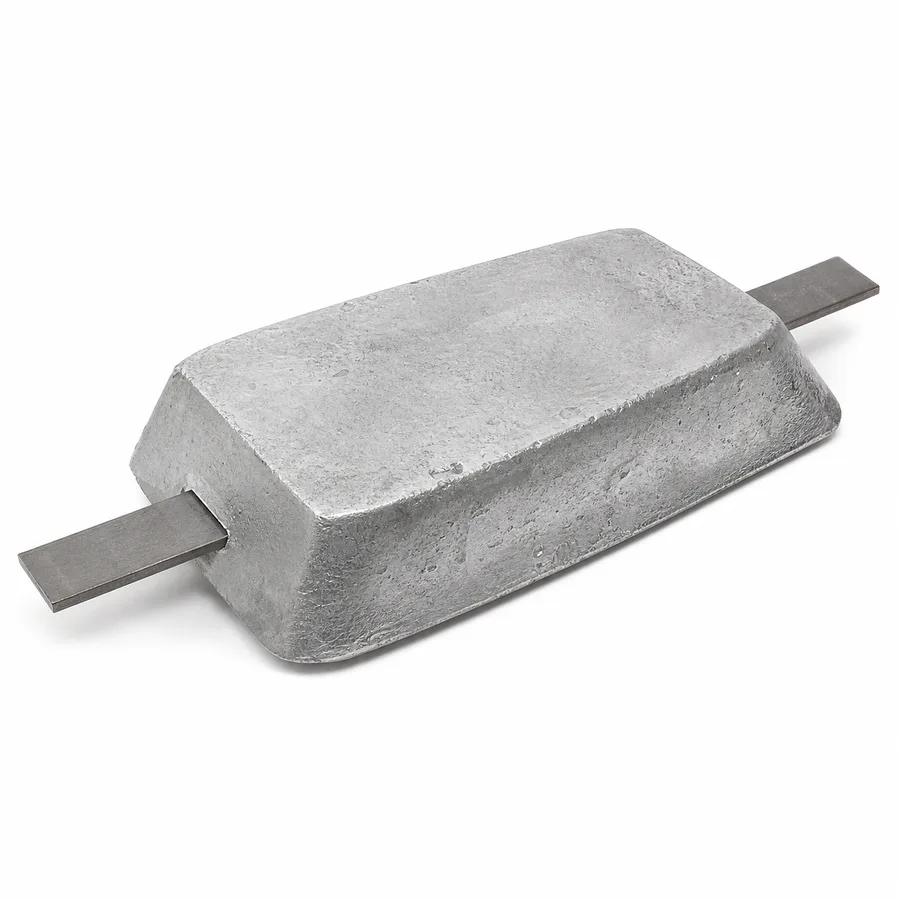
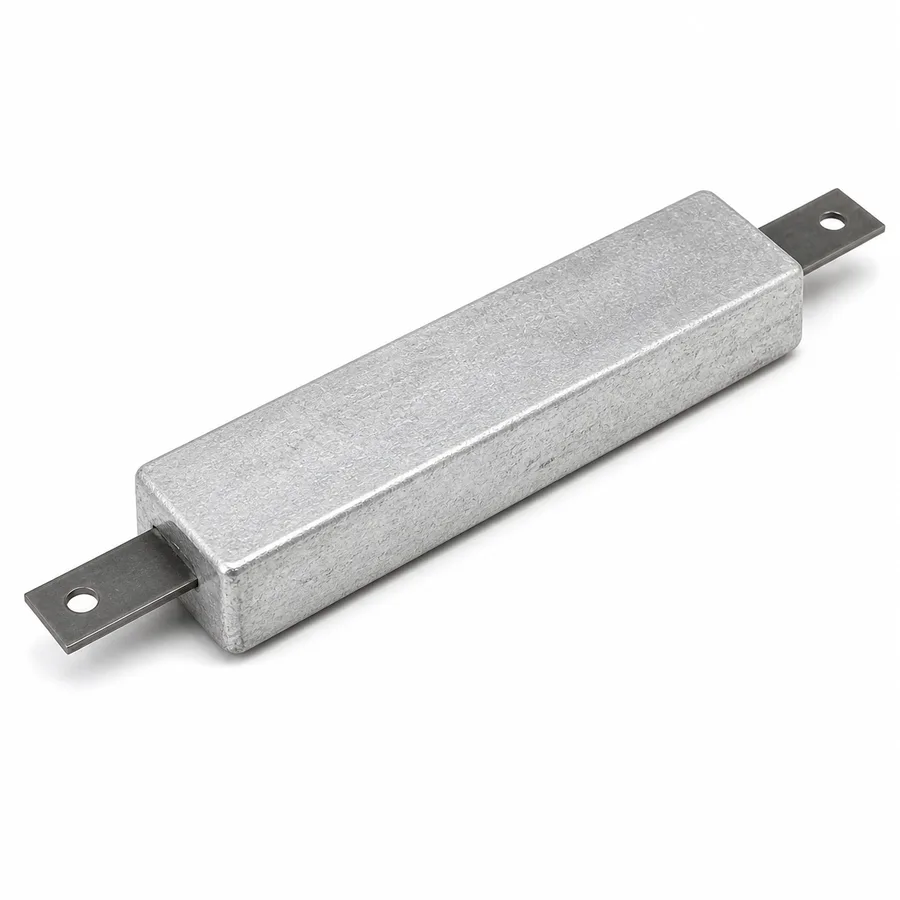
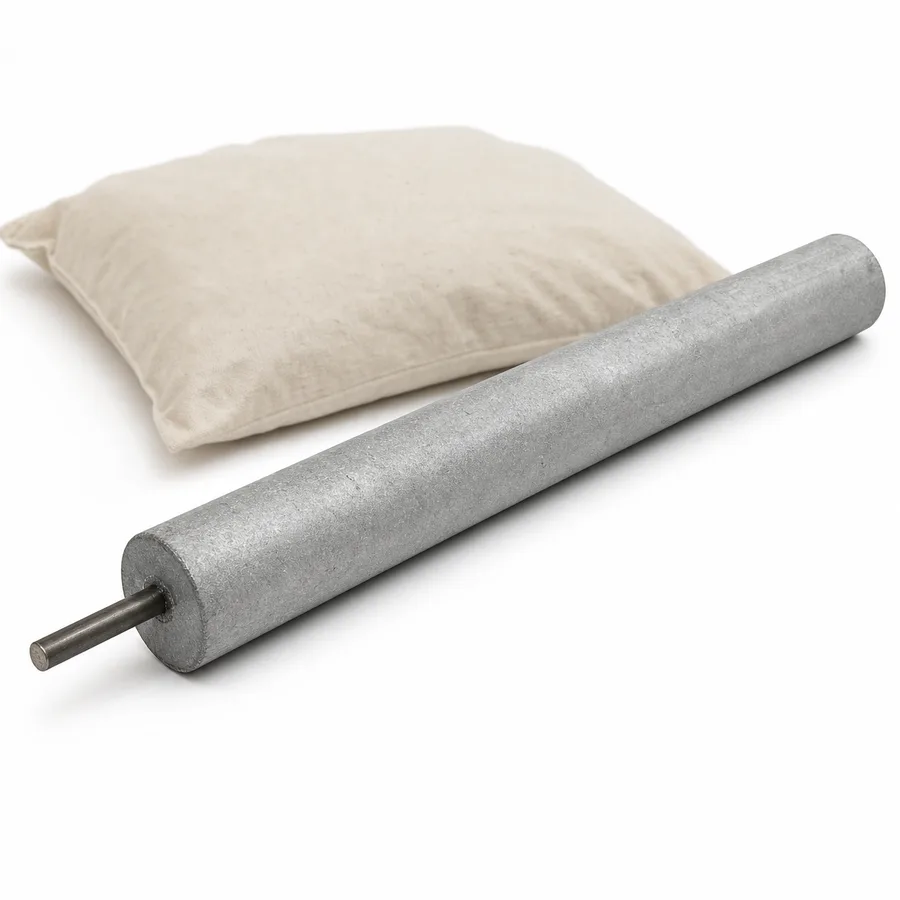
Verdict: for seawater use aluminum anodes (Al-Zn-In alloy, practical capacity near 2,300-2,600 Ah/kg) or zinc (≈780 Ah/kg); for fresh water and high-resistivity soils, above roughly 1,000 ohm·cm, use magnesium, which delivers the highest driving voltage thanks to its more negative potential (-1.55 to -1.75 V vs Cu/CuSO4). The governing criterion is not the brand or the nominal weight, but the resistivity of the electrolyte and the driving potential of the metal relative to steel.
A sacrificial anode protects by galvanic coupling: it is electrically connected to the structure and, being a metal more active than steel, it delivers current and is consumed in its place. TECTUL supplies zinc anodes, aluminum anodes and magnesium anodes. This guide explains how galvanic cathodic protection works, compares the three metals with figures traceable to standards, and shows how to size anode mass for design life.
Steel corrodes because its surface hosts anodic zones, where the metal dissolves, and cathodic zones. Cathodic protection shifts all of the steel toward cathodic behavior: if the structure potential is driven negative enough, the dissolution reaction slows. In a galvanic system that shift is produced by a sacrificial metal connected to the structure, with no external power source.
The reference acceptance criterion for buried or submerged steel is a structure-to-electrolyte potential of -850 mV (−0.85 V) or more negative, measured with a copper/copper sulfate (Cu/CuSO4) reference electrode, with the IR drop removed, per NACE/AMPP SP0169 and ISO 15589. The difference between the anode's natural potential and the steel's is the driving voltage, and in galvanic systems it is around 0.25 to 1.0 V depending on alloy and medium. That voltage must overcome the circuit resistance, which grows with electrolyte resistivity. That is why resistivity governs selection: in seawater (≈20-30 ohm·cm) almost any active metal delivers current; in soil of thousands of ohm·cm only magnesium, with its more negative potential, sustains enough current.
The following values are nominal references, traceable to ASTM B418 (zinc), ASTM B843 (magnesium), and DNV-RP-B401 and Al-Zn-In alloys (aluminum). Verify the mill certificate of your lot before using them in engineering calculations.
| Parameter | Zinc | Aluminum (Al-Zn-In) | Magnesium |
|---|---|---|---|
| Open-circuit potential | -1.03 to -1.05 V vs Ag/AgCl | -1.05 to -1.10 V vs Ag/AgCl | -1.55 to -1.75 V vs Cu/CuSO4 |
| Practical capacity | ≈780 Ah/kg | ≈2,300-2,600 Ah/kg | ≈1,100-1,230 Ah/kg |
| Recommended environment | Seawater and conductive brackish water | Seawater, brackish and offshore | High-resistivity soil and fresh water |
| Favorable resistivity | ≈20-150 ohm·cm | ≈20-200 ohm·cm | >1,000 ohm·cm (soil/fresh water) |
| Relative service life per kg | Medium | High (more Ah per kg) | Lower (higher self-consumption) |
| Standard or reference | ASTM B418; MIL-DTL-18001 | DNV-RP-B401; Al-Zn-In alloy | ASTM B843; NACE/AMPP SP0169 |
The key reading: aluminum offers the highest capacity per kilogram, so it protects longer or weighs less for the same current; zinc is stable and predictable in seawater with moderate current; magnesium has the most negative potential, essential when the high resistivity of soil or fresh water would starve zinc and aluminum.
In seawater resistivity is low (≈20-30 ohm·cm) and the circuit conducts easily. Al-Zn-In aluminum is the choice when installed weight and maintenance autonomy matter, thanks to its capacity near 2,300-2,600 Ah/kg. Zinc is preferred when a naval or shipyard specification requires it, or when stable behavior and low overprotection risk are sought on hulls, rudders and sea chests.
In fresh water and soils, resistivity rises to thousands of ohm·cm and zinc or aluminum would deliver little current. Magnesium, at -1.55 to -1.75 V vs Cu/CuSO4, provides the driving voltage needed to overcome that resistance in buried pipelines, tanks and storage water heaters. In very low-resistivity soils, below ~2,000 ohm·cm, magnesium can be consumed quickly; there it is worth evaluating zinc, more distributed anodes or impressed current.
| Electrolyte | Typical resistivity | Recommended metal |
|---|---|---|
| Seawater | ≈20-30 ohm·cm | Aluminum or zinc |
| Brackish water | ≈50-200 ohm·cm | Zinc or aluminum (check chlorides) |
| Fresh water | >1,000 ohm·cm | Magnesium |
| Soil | 2,000-10,000 ohm·cm | Magnesium (with backfill) |
Sizing has two steps: calculate the required current and, from it, calculate the anode mass for the design life.
Protection current is the bare steel area multiplied by the design current density: I = A × i. Current density depends on the medium and the coating; in bare seawater, values on the order of 0.100-0.150 A/m² are used depending on climatic zone and depth (DNV-RP-B401), and much lower on well-coated steel because only the area of pores and defects is protected. In soil, the current density per bare square meter is lower, but circuit resistance dominates the design.
Anode mass follows from the total charge it must deliver over the design life:
mass (kg) = (I × t × 8,760) / (C × u)
where I is the mean current in amperes, t the life in years, 8,760 the hours per year, C the capacity in Ah/kg and u the utilization factor (typically 0.80-0.90, because the anode is not consumed to 100 %). Illustrative example, applying the formula: to deliver 1 A for 10 years with aluminum (C = 2,500 Ah/kg, u = 0.85) requires (1 × 10 × 8,760) / (2,500 × 0.85) ≈ 41 kg; with zinc (C = 780 Ah/kg, u = 0.90) the same task needs (1 × 10 × 8,760) / (780 × 0.90) ≈ 125 kg. The mass difference explains why aluminum dominates offshore: it delivers the same charge at a fraction of the weight.
Beyond mass, you must verify the anode delivers the required instantaneous current: the anode-to-electrolyte resistance depends on geometry and resistivity, so an anode with sufficient mass but poorly sized in shape may not supply the peak current demanded. That is why design combines mass (for service life) with the number and shape of anodes (for current).
Define the electrolyte and its resistivity first, because that fixes the metal: seawater or conductive brackish water lead to aluminum or zinc; fresh water and soil lead to magnesium. To quote, provide the operating medium and temperature, exposed area and coating condition, design life in years, soil or water resistivity if available, required shape (plate, bar, bracelet, cored rod) and mounting method (welding or bolting). With that data TECTUL confirms metal, mass, shape and quantity; do not buy by nominal weight alone, because selection depends on the medium, the current and the service life, not on the cheapest kilogram.