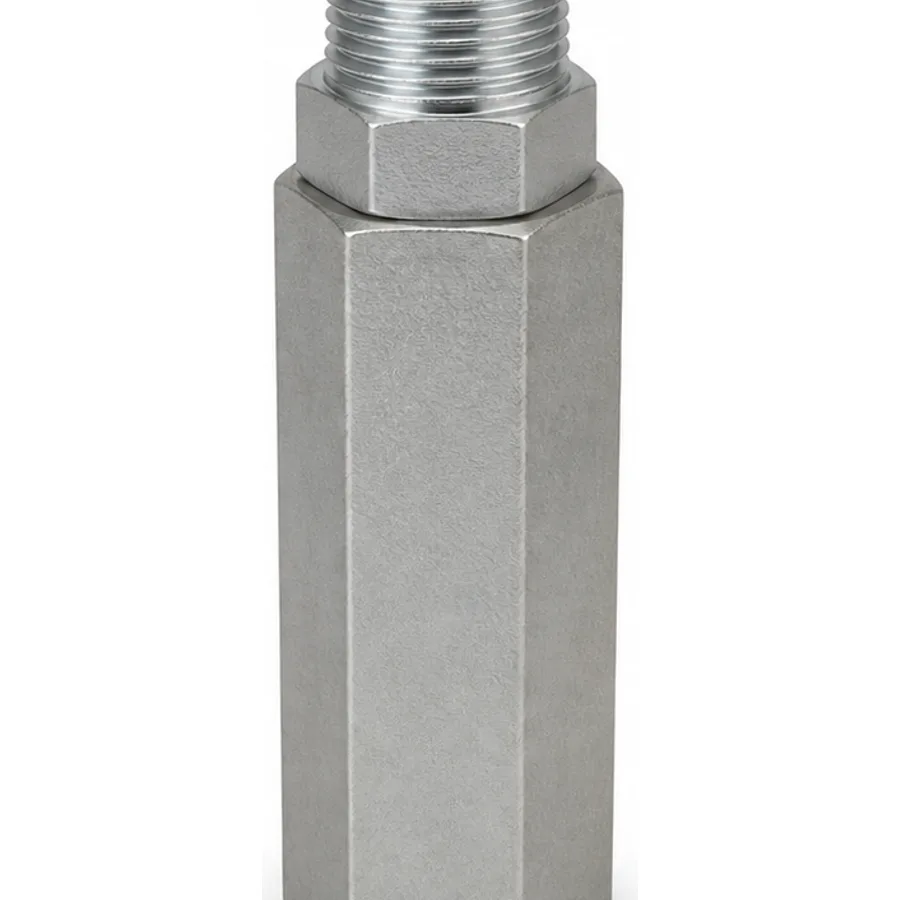
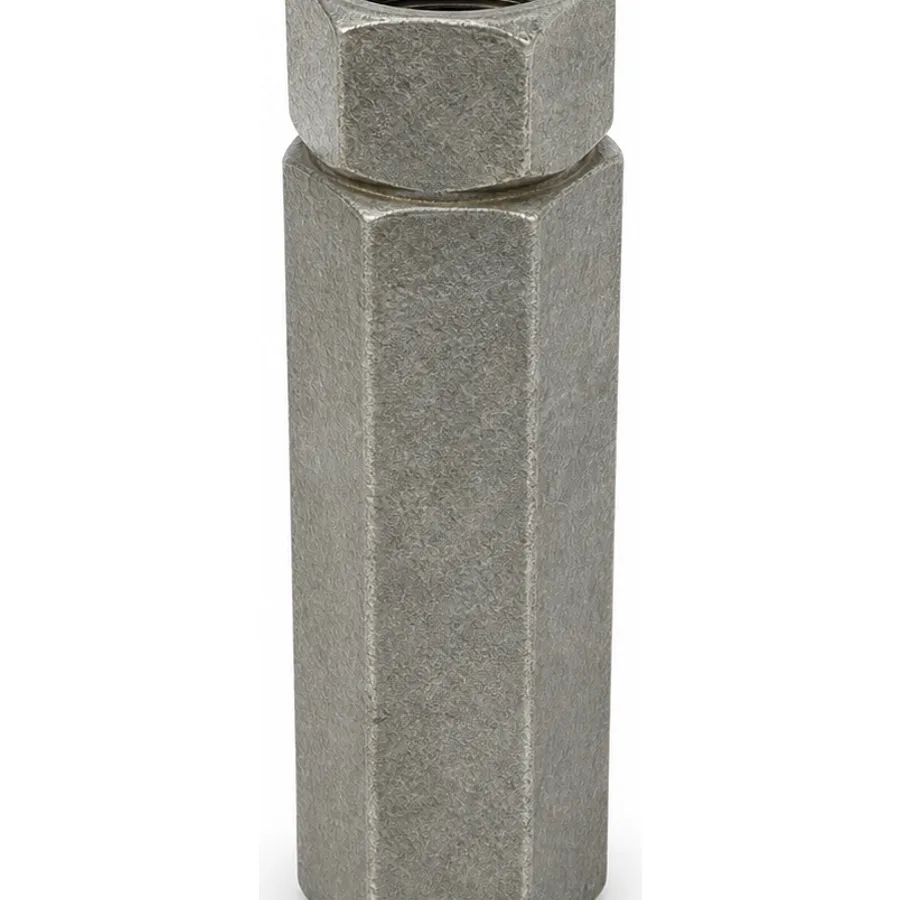
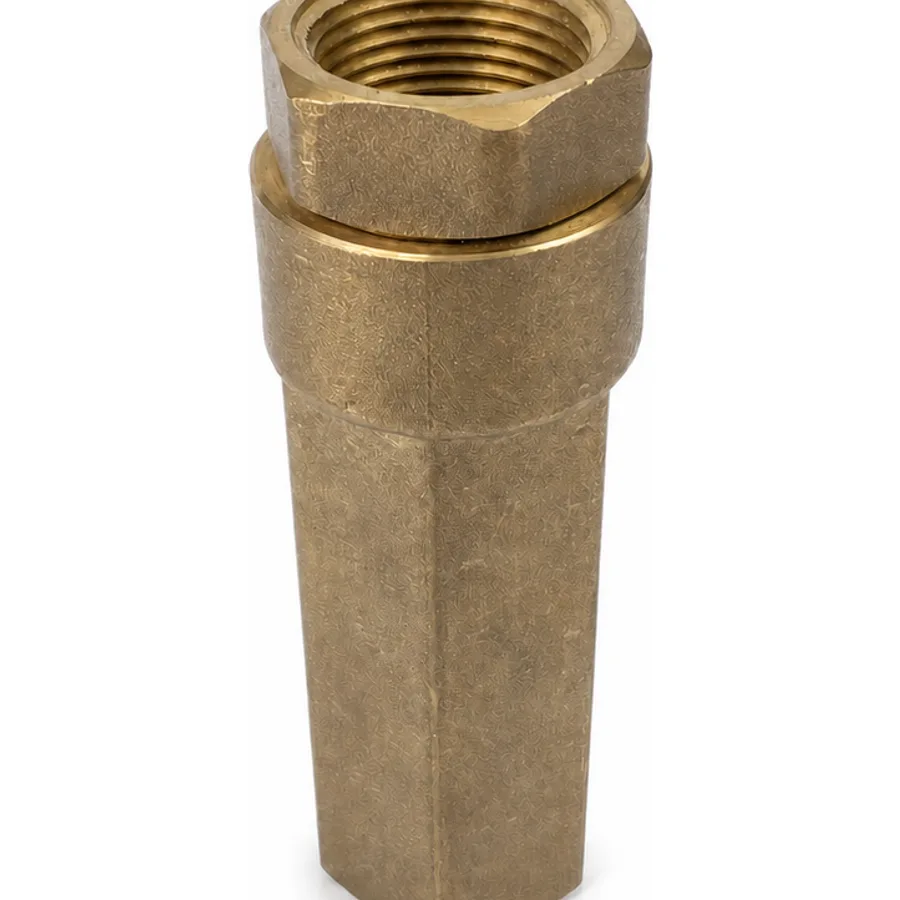
A gas riser (in Colombian Spanish, elevador para gas) is the fitting that makes the transition between buried plastic pipe and the metallic piping of a fuel gas installation. Colombian standard NTC 2505 (fourth update, 2006) defines it in clause 2.21 as the "mechanical element that allows the transition between plastic and metallic pipe or vice versa", and clause 4.2 requires it to comply with NTC 4534, Transition devices for use in gas supply installations (risers). In practice, the riser brings the polyethylene (PE) network — which by code may only run buried — up to the threaded metallic connection of the meter set or regulator, in typical sizes of 1/2, 3/4 and 1 inch.
The term has two meanings and they should be separated from the start: in gas supply installations, the riser is the polyethylene-to-metal transition device this guide covers (the factory-assembled anodeless riser, standardized by ASTM F1973-25); in the oil industry there is also the gas lift valve used for artificial lift, a downhole component unrelated to supply installations. Selection verdict for installations: for residential service lines use 1/2" or 3/4" risers to match the PE network diameter; for commercial and light industrial service, 3/4" to 1" or larger; choose a male or female outlet to match the metallic fitting it meets (valve, regulator or meter), and a bronze body where the point is exposed to a corrosive environment.
The polyethylene gas network is governed by NTC 1746, which covers thermoplastic pipes and fittings for gases under pressure (natural gas up to 7 bar), and NTC 2505 clause 4.1.1 states that plastic piping "shall be used only in buried installations". Therefore, at the point where the network must leave the ground — the meter set, the facade, the regulator cabinet — the standard requires a change to metallic pipe, and that change is made with the riser. Clause 5.1.1 of NTC 2505 further requires that when buried polyethylene gas pipe surfaces above floor level it must be protected by a sleeve or conduit of a permitted material up to the riser location.
Constructively, the riser is a factory-assembled set: the polyethylene run travels inside a metallic body or casing that protects it from impact and sunlight, and at the upper end a mechanical compression joint makes the seal and delivers a male or female NPT threaded outlet. In the anodeless construction standardized by ASTM F1973-25, the gas never touches the steel casing: it always flows through the inner PE, so the assembly needs no cathodic protection, and the joint to the buried network is made by butt fusion, electrofusion or a mechanical fitting depending on the system. Colombian manufacturers offer modular risers with bodies in electrolytically galvanized 12L14 steel; TECTUL stocks the male gas riser, the female gas riser and the bronze female riser.
| Nominal size | Sizing system | Typical use |
|---|---|---|
| 1/2" | CTS or IPS depending on the PE network | Individual residential service lines |
| 3/4" | IPS | Multifamily residential and small commercial |
| 1" | IPS | Commercial and light industrial |
| 2" | IPS | Higher-capacity commercial and industrial service lines (on request) |
Always verify the sizing system of the network: CTS (copper tube size) and IPS (iron pipe size) are different dimensional series of polyethylene gas pipe and are not interchangeable; Colombian catalogs offer 1/2" in both series and 3/4" through 2" in IPS. The TECTUL catalog covers 1/2", 3/4" and 1" in male and female outlets.
Piping materials accepted by chapter 4 of NTC 2505 for supply installations:
Express prohibitions and limits in the same standard:
For the buried run, the trench must give a minimum depth of 46 cm under areas with vehicle traffic and 30 cm in gardens or unloaded areas; crossings with other services require at least 10 cm of separation and parallel runs 20 cm; a warning tape at least 10 cm wide is placed 20 to 30 cm below floor level over the pipe, and the polyethylene is laid snaked to absorb contraction and expansion. All of the above operates under Colombia's Technical Regulation for Internal Fuel Gas Installations (Resolution 90902 of 2013 of the Ministry of Mines and Energy, amended by Resolutions 40120 of 2016 and 41385 of 2017), which sets the mandatory requirements and inspections for installations.
Before commissioning, every installation must pass the tightness test of clause 6.2.1 of NTC 2505, with these minimum pressures according to operating pressure:
| Pipe operating pressure | Minimum test pressure | Minimum hold time |
|---|---|---|
| Up to 13.8 kPa (2 psig) | 34.5 kPa (5 psig) | 15 min |
| Over 13.8 up to 34.5 kPa (2 to 5 psig) | 207 kPa (30 psi) | 1 h |
| Over 34.5 up to 138 kPa (5 to 20 psi) | 414 kPa (60 psi) | 1 h |
| Criterion | Rigid galvanized steel | Corrugated stainless steel tubing (CSST) |
|---|---|---|
| Product standard | NTC 3470 / ASTM A106, minimum schedule 40 | NTC 4579 |
| Joints | NPT threaded per NTC 332, allowed up to 4" | Fittings per NTC 4137 or NTC 4138 |
| Routing | Straight runs with threaded elbows and fittings at every change of direction | Bends on site; fewer joints per run |
| Mechanical resistance | Takes impact; in garages the standard still requires protection up to 1 m height | Needs protection against mechanical damage and puncture |
| Recommended use | Vertical mains, exposed runs and service connections | Indoor routes with many changes of direction |
Verdict: downstream of the riser, the vertical main and exposed runs are solved with heavy-type galvanized pipe and threaded galvanized fittings; the final connection to the appliance uses a gas-certified flexible connector such as the natural gas hose with couplings, never extending the hose as if it were piping.
Before ordering, confirm three items: the diameter and series (CTS or IPS) of the polyethylene network, the outlet type the meter set requires (male or female, NPT thread) and the body material. With that resolved, TECTUL ships across Colombia the male gas riser and the female gas riser in 1/2", 3/4" and 1", and the bronze female riser for corrosion-demanding points. Complete the service connection with heavy-type galvanized pipe for the vertical main, a yellow-handle ball valve as the gas-identified shutoff, a gas regulator and yellow PTFE tape for thread sealing. Installation and the tightness test must be carried out by qualified personnel under the current regulation.