Milling is chip-removal machining with a rotating multi-edge tool in which cutting is interrupted by nature: every edge enters and exits the workpiece on each spindle revolution. The right milling cutter is chosen through three chained decisions: first the operation (facing a surface, milling a 90° shoulder, cutting a slot or profiling a 3D surface), then the construction (solid carbide end mill or steel body with indexable inserts) and finally the combination of flute count, geometry and coating for the workpiece material, classified by its ISO 513 letter: P steel, M stainless, K cast iron, N non-ferrous, S superalloys and H hardened materials.
Selection verdict: for facing use an indexable face mill with a 45° lead angle; for walls and shoulders at 90°, a square-shoulder mill; for full slots, a 2- or 3-flute centre-cutting end mill; for 3D surfaces, ball nose for finishing and bull nose (toroidal) for roughing. For end mills, the material rule is direct: aluminium and non-ferrous alloys, 2 or 3 flutes with a wide flute space and a polished, uncoated edge; steel and stainless, 4 or more flutes with a TiAlN or AlTiN coating. And at the construction boundary: below about 20 mm diameter the solid carbide end mill dominates; from 25 to 32 mm upward, the indexable cutter is the economical option.
The operation defines the cutter geometry before any other variable: the lead angle (the angle between the main cutting edge and the workpiece surface) sets the direction of the cutting forces, the chip thickness and the permissible axial depth.
| Operation | Typical tool | Key geometry | When to use it |
|---|---|---|---|
| Face milling | Indexable face mill, typical diameters 50 to 160 mm | 45° lead angle (general use) or round insert (roughing) | Generating large flat faces; the 45° angle thins the chip and directs part of the force into the spindle, which reduces vibration |
| Shoulder milling | Indexable square-shoulder mill or 4-flute end mill | 90° lead angle | Wall and floor perpendicular in the same pass; mandatory when the drawing demands a square shoulder |
| Slot milling | 2- or 3-flute centre-cutting end mill; side-and-face cutter for deep, narrow slots | Wide chip-evacuation flutes | Full slotting: the cutter is engaged over 100 % of its diameter and must evacuate all the chips through its flutes |
| Profiling and 3D copy milling | Ball nose (finishing) and bull nose or toroidal (roughing and semi-finishing) | Spherical tip or corner radius | Sculptured surfaces, moulds, dies and floor radii |
Two application nuances: the 45° face mill is the first choice on low-power machines or long-overhang setups, because it splits the force between the radial and axial directions; the 90° cutter generates more radial force, so it is reserved for parts that require the square wall. For slots whose depth is several times their width, the side-and-face cutter (peripheral cutting, thin body) evacuates chips better than a long end mill.
The solid end mill is ground from a bar of sintered tungsten carbide, in diameters that catalogues typically cover between 1 and 25 mm (the dimensional reference standard for cylindrical shanks is ISO 1641-1). Being a single ground piece, it offers the best concentricity and surface finish of the two families, and it is the only practical option at small diameters.
The number of flutes (z) is a trade-off between productivity and evacuation: more flutes mean more millimetres of feed per revolution, but smaller flute spaces to hold and expel the chips.
Selection rule: aluminium, 2 or 3 flutes; steel, 4 or more. Slotting aluminium with a 4-flute cutter packs the chips into the flutes and usually ends in built-up edge or breakage.
The standard catalogue helix angle is 30°; high helices of 45° reduce the cutting force per edge and improve finish, so they dominate in aluminium and in finishing passes on steel; variable-helix and variable-pitch cutters desynchronize edge entry to damp self-excited vibration (chatter), as manufacturers' technical guides describe. At the tip there are three geometries: the sharp corner leaves the weakest edge and chips first; the corner radius or bull nose (for example a 0.5 to 2 mm radius on a toroidal cutter) reinforces the corner, extends tool life and leaves a floor radius at the shoulder, making it the roughing and 3D semi-finishing geometry; the ball nose carries a spherical radius equal to half the diameter and is the tool for 3D surface finishing, with one physical limitation: at its centre the cutting speed is close to zero, so it pays to tilt the tool or program toolpaths that do not cut with the centre of the sphere.
The indexable cutter separates the structural function (a steel body that lasts for years) from the cutting function (indexable carbide inserts that are rotated or replaced in minutes, without dismounting the body or recalibrating lengths). That architecture makes it the economical option in roughing: the cost per cutting edge of an insert is a fraction of that of an equivalent solid end mill, and a face-mill body reaches diameters no solid cutter can. Milling inserts follow the same ISO 1832 designation and the same ISO 513 grades as turning inserts —the position-by-position reading logic is explained in our guide to types of turning inserts—, with the difference that milling is dominated by shapes for 45° and 90° lead angles and by round inserts for roughing.
| Criterion | Solid carbide end mill | Indexable cutter | Practical threshold |
|---|---|---|---|
| Available diameter | 1 to 25 mm typical in catalogues | From about 10 to over 160 mm | Below 20 mm, solid; from 25-32 mm, indexable |
| Economics | High cost per tool; regrindable a limited number of times | Reusable body; low cost per edge | High-volume roughing: indexable |
| Finish and tolerance | Ground concentricity; the best finish | Radial runout between inserts marks the surface | Tight tolerances, thin walls and fine finishes: solid |
| Slotting and axial plunging | Centre cutting: slots, ramps and plunges | Limited by insert geometry | Full slotting: 2-3 flute solid end mill |
| Axial depth per pass | Up to 1 to 1.5 times the diameter in side milling | Limited by the insert edge length (on the order of 10-15 mm in shoulder milling; less in 45° facing) | Tall walls in one pass: long solid end mill; large faces: indexable face mill |
TiAlN (titanium aluminium nitride, deposited by PVD) is the general-purpose coating for milling steel, stainless and cast iron: when heated it forms a surface layer of aluminium oxide that, according to manufacturers' technical guides, keeps the coating hard up to temperatures on the order of 800 °C, allowing dry or minimum-coolant milling. AlTiN inverts the ratio: it contains more aluminium than titanium, withstands even higher temperatures (catalogues place it around 900 °C) and is the option for hardened steels in ISO group H, dry milling and high speeds. For aluminium and copper alloys the recommendation is the opposite: an uncoated cutter with a polished edge (or aluminium-free coatings such as ZrN or diamond-like coatings), because the aluminium in the workpiece has chemical affinity with the aluminium in a TiAlN/AlTiN coating and causes built-up edge; the polished, very sharp edge prevents chip adhesion.
Two formulas govern the programming of any milling cutter. The cutting speed relates diameter to spindle speed: vc = π · D · n / 1000, where vc is the cutting speed in m/min, D the cutter diameter in mm and n the spindle speed in rpm; solving for speed, n = 1000 · vc / (π · D). The table feed is built from the feed per tooth: vf = fz · z · n, where vf is the feed in mm/min, fz the feed per tooth in mm/tooth, z the number of flutes and n the rpm. Example: a 10 mm diameter, 4-flute end mill in 1045 steel at vc = 120 m/min turns at n = (1000 × 120) / (π × 10) ≈ 3,820 rpm; with fz = 0.05 mm/tooth, the feed is vf = 0.05 × 4 × 3,820 ≈ 764 mm/min.
The orientative starting ranges published in manufacturers' catalogues (Sandvik Coromant, Kennametal, Mitsubishi Materials) for carbide milling are as follows; the exact value is set by the specific cutter reference and the setup stability:
| Workpiece material (ISO 513 group) | Orientative vc, coated carbide (m/min) | Orientative fz, 10 mm end mill (mm/tooth) |
|---|---|---|
| Annealed carbon steel, e.g. 1020, 1045 (P) | 80 to 200 | 0.03 to 0.08 |
| Quenched-and-tempered alloy steel, e.g. 4140 (P) | 60 to 160 | 0.02 to 0.06 |
| Austenitic stainless 304/316 (M) | 40 to 150 | 0.02 to 0.05 |
| Grey cast iron (K) | 100 to 250 | 0.05 to 0.10 |
| Aluminium 6061 (N, uncoated cutter) | 200 to 1,000 | 0.05 to 0.15 |
| Bronze and brass (N) | 100 to 300 | 0.04 to 0.10 |
Two usual corrections to these values: in full slotting (100 % radial engagement) catalogues indicate reducing vc and fz relative to side milling, because the arc of contact and the heat per edge grow; and with long tool overhangs, reduce depth of cut before feed to stay out of chatter.
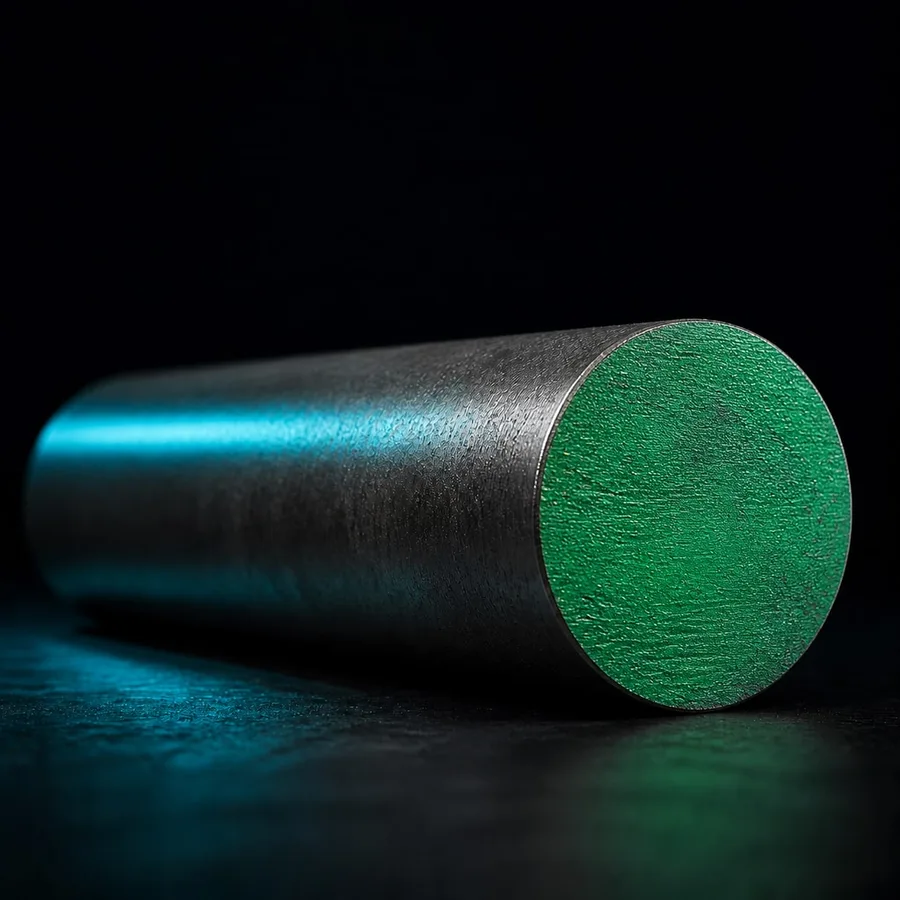
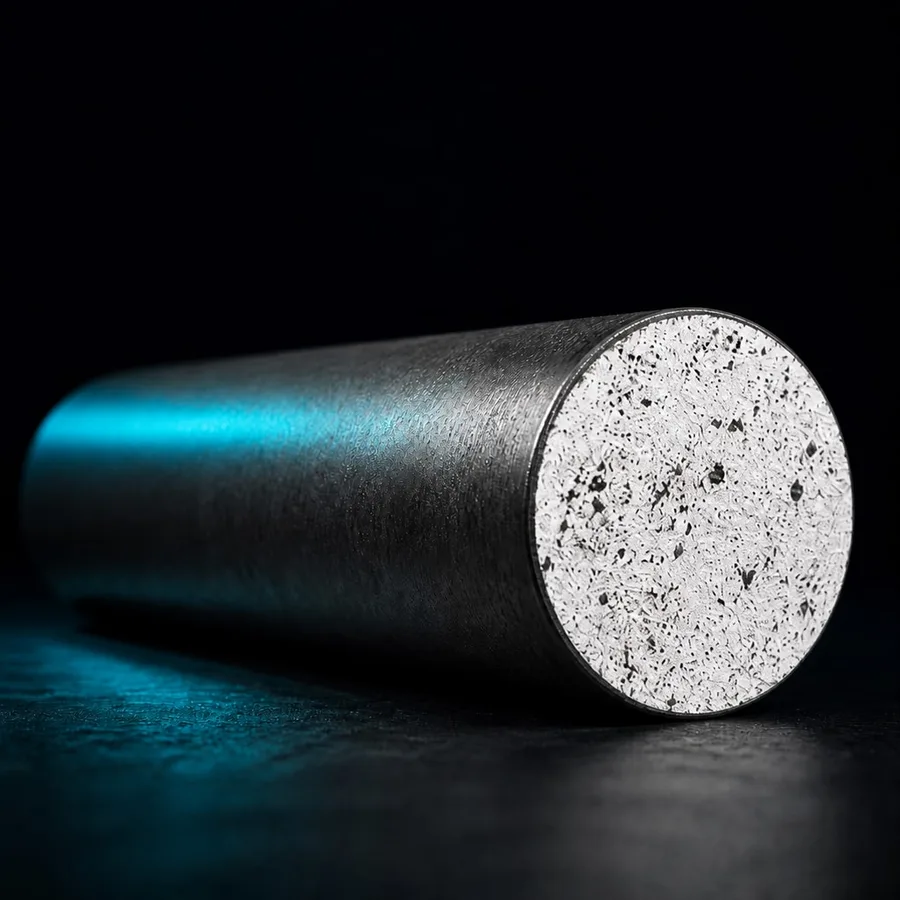
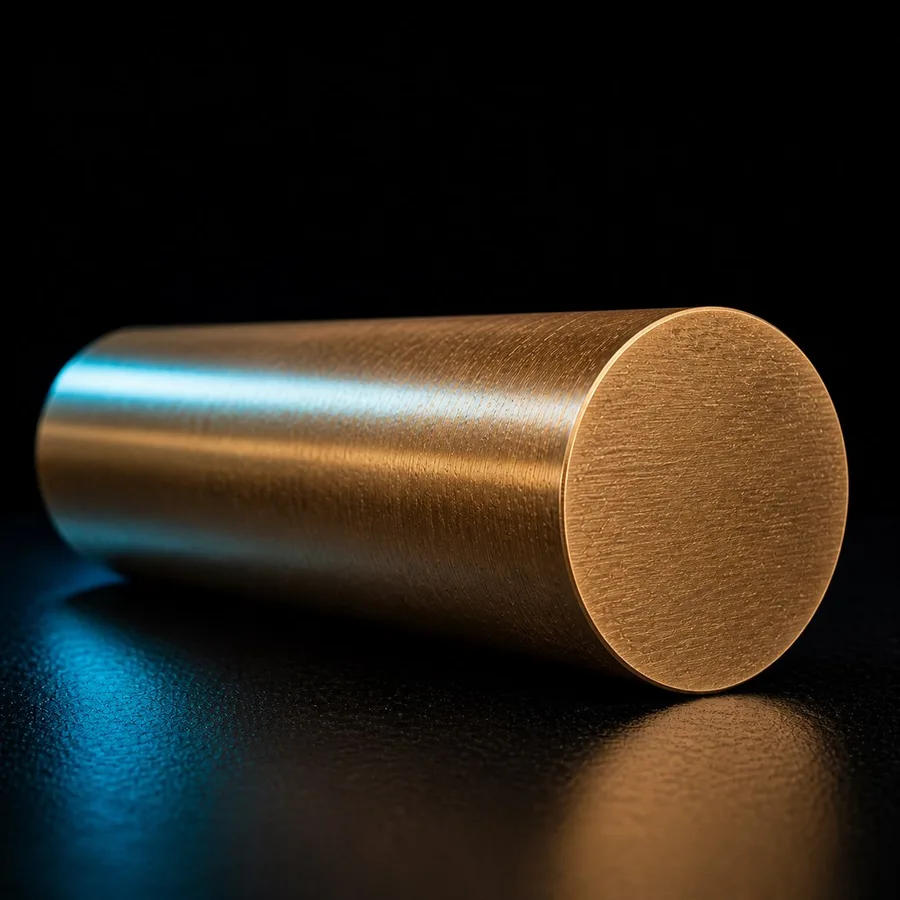
TECTUL supplies the bars these cutters machine every day in Colombian workshops: 1045 steel bar (ISO group P, shafts and machine plates), 4140 steel bar (group P, quenched-and-tempered high-duty components) and SAE 660 bronze bar (group N, bushings and bearings). If your workshop also needs solid end mills, face-mill bodies, inserts or other milling tools, TECTUL quotes them on request: write to us on WhatsApp with the operation (facing, shoulder, slotting or profiling), the diameter, the flute count and the material to be machined, and we will reply with availability and lead time.