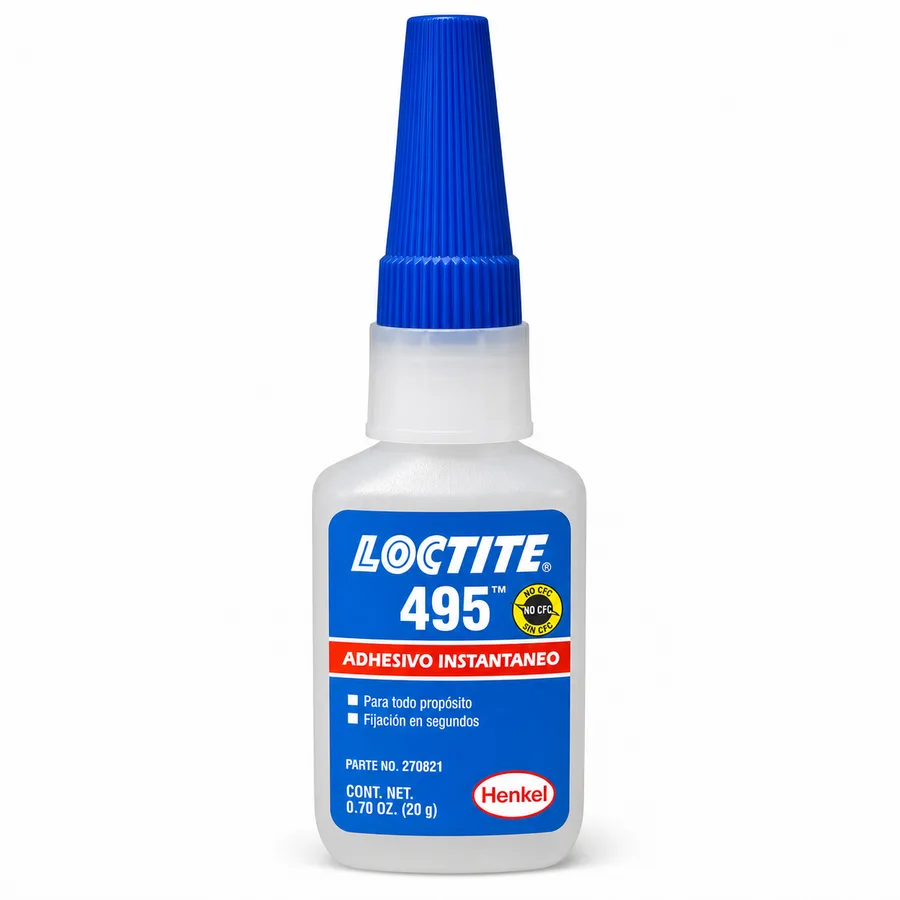
LOCTITE® 495 is a one-part, low-viscosity ethyl cyanoacrylate instant adhesive that cures with ambient humidity and is used for fast bonding of small, well-fitted parts. According to Henkel's technical data sheet, it is a general-purpose cyanoacrylate: it bonds plastics, rubbers and metals with no mixing or heating, with fixture times of a few seconds. It is the right adhesive when the assembly is small, the surfaces fit closely (gap below 0.05 mm) and the part must be handled in seconds, not minutes.
Quick verdict: use 495 when you are not sure which substrate you will bond or when the shop handles many different materials, because it is the all-rounder of the family. For specific needs (slightly larger gaps, elastomers that demand instant fixture, or joints that must resist peel) a specialized cyanoacrylate is better. TECTUL lists the data sheet and pack in Loctite 495 general-purpose instant adhesive.
The 495 is a transparent, colorless to straw-colored, low-viscosity liquid (20 to 45 mPa·s by cone and plate at 25 °C, per Henkel's TDS). With no separate solvent or catalyst, it cures in seconds from the moisture present on the surfaces and in the air. It is meant for small-area joints, with good fit and low fill demand: fixing magnets, stops, inserts, plastic components, seals and rubber parts, detail repair and fastenings where handling time must be minimal.
It is not a structural gap-filling adhesive or a sealant. Its strength lies in speed and in the variety of substrates it wets, not in filling large gaps or withstanding repeated impact. Understanding this avoids the most common mistake: using it in loose, dirty or peel-loaded joints, where any cyanoacrylate performs poorly.
Henkel's data sheet is explicit: for best performance, surfaces should be clean and free from grease. The correct procedure is short but strict:
Excess and drips can be dissolved with Loctite cleanup solvents, nitromethane or acetone, as the TDS itself states. Work with ventilation and avoid skin and eye contact: cyanoacrylates bond tissue in seconds.
The 495 wets most rigid plastics, rubbers and metals. It does not cure well on polyolefins and low-surface-energy plastics unless a primer is used. The table sums up the criterion:
| Group | Examples | Behavior with 495 |
|---|---|---|
| Metals | Steel, aluminum, brass, copper | Bonds; fixture from seconds to tens of seconds |
| Rigid plastics | ABS, PVC, polycarbonate, phenolics | Bonds well; PVC fixtures very fast |
| Rubbers and elastomers | Neoprene, nitrile (Buna-N) | Very fast fixture (under 5 s) |
| Polyolefins | Polyethylene (PE), polypropylene (PP) | Does not bond without primer; needs polyolefin primer (LOCTITE® SF 770) |
| Low energy / non-stick | PTFE, silicones | Not recommended without specific treatment |
| Porous / damp surfaces | Highly absorbent materials | Irregular cure; control excess and moisture |
Henkel also warns that the product is not recommended for pure oxygen or oxygen-rich systems, and should not be used as a sealant for chlorine or other strong oxidizers.
Fixture time is how long the joint takes to reach 0.1 N/mm² of shear; it is the moment you can release the part. It depends on the substrate. These values come from Henkel's TDS, measured per ISO 4587 at 22 °C and 50 % relative humidity:
| Substrate | Fixture time (s) |
|---|---|
| Aluminum (degreased) | under 5 |
| Mild steel (degreased) | 5 to 10 |
| Neoprene | under 5 |
| Nitrile rubber | under 5 |
| ABS | under 5 |
| PVC | under 5 |
| Polycarbonate | 10 to 15 |
| Phenolic | under 5 |
Fixture (handling) is a matter of seconds; full cure needs at least 24 hours to develop complete chemical and solvent resistance. Cure speed also rises with relative humidity and drops with larger gaps. When the gap is large and cure gets slow, applying an accelerator (activator) improves speed, but it can reduce ultimate strength; testing before adopting it in production is advisable.
Data from Henkel's official Technical Data Sheet (LOCTITE® 495, current-formulation TDS, February-2012):
| Property | Value | Standard / condition |
|---|---|---|
| Chemistry | Ethyl cyanoacrylate, one part | Humidity cure |
| Viscosity | 20 to 45 mPa·s (cone and plate) | 25 °C, 3,000 s⁻¹ |
| Specific gravity | 1.1 | 25 °C |
| Optimal gap | 0.05 mm | Directions for use |
| Shear on grit-blasted steel | 14.2 N/mm² (2,060 psi) | ISO 4587, 24 h |
Lap-shear strength (ISO 4587, after 24 h at 22 °C) varies with the material. These ranges help decide whether the 495 is enough for the expected load:
| Substrate | Shear (N/mm²) | Shear (psi) |
|---|---|---|
| Steel (grit blasted) | 14.2 | 2,060 |
| Aluminum (grit blasted) | 10.8 | 1,565 |
| Zinc dichromate | 5.9 | 855 |
| ABS | 6 to 20 | 870 to 2,900 |
| PVC | 6 to 20 | 870 to 2,900 |
| Polycarbonate | 5 to 20 | 725 to 2,900 |
| Neoprene / nitrile rubber | 1.0 to 1.3 (substrate failure) | 145 to 190 |
The 495 has three limitations worth being clear about before specifying it. First, the gap: it performs in thin joints (0.05 mm) and loses speed and strength as the separation grows; for larger gaps there are reinforced or gap-filling grades. Second, peel and impact: like any standard cyanoacrylate, its T-peel strength is low (under 0.50 N/mm per ISO 11339 on steel) and it is sensitive to knocks; it is not for joints working in bending or repeated shock.
Third, temperature: the current TDS documents heat aging (block shear on polycarbonate) with good retention up to about 80 °C and progressive loss between 100 and 120 °C after 1,000 hours. The hot-strength curve starts at −40 °C, so sub-zero cold is not the problem. For sustained service above 80 °C, Henkel recommends a cyanoacrylate formulated for high temperature.
Within the instant-adhesive family, the 495 is the low-viscosity all-rounder. Comparison with other references is qualitative because each grade has its own data sheet, but the selection logic is clear: general-purpose, very-low-viscosity cyanoacrylates (401/406 type) target plastics, elastomers and porous surfaces with fast fixture; penetrating very-low-viscosity types (420 type) are used for capillary action on already-assembled parts; and toughened or impact-resistant grades attack the main weakness of the standard ones, peel. The 495 is chosen when the shop needs a single product covering metal, plastic and rubber without switching reference by part.
Put another way: if the operation always repeats the same substrate and the same demand, a specialized grade will give a better result in that specific case. If the work is varied and you do not always know what you will bond, the 495 is the safe bet for substrate versatility.
Buy Loctite 495 as the reference cyanoacrylate for bench and maintenance work when you bond different materials (metal, rigid plastic, rubber) in small, well-fitted joints and need fixture in seconds. Always prepare a clean, dry surface, apply one drop, press and allow 24 hours for full load. Reserve a specialized grade for larger gaps, sustained high temperature or joints exposed to peel and impact; and use a polyolefin primer for PE or PP. Check availability and pack size in the Loctite 495 page at TECTUL.