Selecting an industrial lubricant comes down to three inputs: the type of lubrication point (bearing, gear, hydraulic system, thread or chain), the viscosity or consistency the equipment manufacturer specifies, and the service conditions: temperature, load, speed and water exposure. Quick verdict: for bearings and pillow blocks at low to medium speed, and for points that are hard to seal, use grease (the industrial standard is an NLGI 2 lithium grease); for gearboxes, hydraulic systems and any mechanism that must carry away heat or allow filtration, use oil in the ISO VG grade stated on the nameplate or in the equipment manual.
This guide covers the two classifications that govern the purchase —ISO VG viscosity for oils, per ISO 3448:1992, and NLGI consistency for greases, per ASTM D217—, the most common thickeners (lithium, lithium complex and calcium), specialty lubricants (anti-seize pastes, chain lubricants, high temperature and NSF H1 food grade) and bearing relubrication using the SKF catalogue quantity rule. It closes with a selection table by application.
A grease is a base oil held in a thickener matrix (usually a metallic soap) plus additives; the thickener keeps the oil at the lubrication point and acts as a barrier against dust and water. Oil, by contrast, flows: it lubricates, removes heat, carries contaminants to the filter and is replenished by level or by circulation. That physical difference drives the choice:
| Criterion | Grease | Oil |
|---|---|---|
| Mechanism speed | Low to medium | Medium to high |
| Heat removal | Limited: the lubricant does not circulate | High: oil circulates and can be cooled in the reservoir |
| Sealing of the point | The grease itself seals against dust and water | Requires tight housings, seals and reservoir |
| Maintenance | Metered replenishment through a grease fitting | Level control, scheduled changes, filtration |
| Point position | Vertical shafts and hard-to-reach points | Sumps, gearboxes, hydraulic power units |
| Leak risk | Low | Requires leak monitoring |
In practice: pillow blocks, motor bearings and points fitted with grease fittings run on grease; gear reducers, hydraulic systems and compressors run on oil. If the equipment has a grease fitting, the manufacturer already made the decision for you.
ISO 3448:1992 Industrial liquid lubricants — ISO viscosity classification (confirmed as current in 2023) defines 20 viscosity grades from 2 to 3 200 mm²/s, measured as kinematic viscosity at 40 °C. Each grade allows a tolerance of ±10 % around its midpoint: an ISO VG 46 oil, for example, must measure between 41.4 and 50.6 mm²/s at 40 °C (1 mm²/s = 1 cSt). The grade number is therefore the oil's nominal viscosity at 40 °C.
The correct viscosity is set by the equipment manufacturer on the nameplate or in the manual; the table below summarizes the highest-turnover industrial grades and their typical use according to lubricant manufacturers' catalogues:
| ISO VG grade | Viscosity at 40 °C (mm²/s) | Typical use |
|---|---|---|
| VG 32 | 28.8–35.2 | High-speed hydraulics, spindles, air-line lubricators (FRL) |
| VG 46 | 41.4–50.6 | Industrial and mobile hydraulic systems: the most used hydraulic grade |
| VG 68 | 61.2–74.8 | Hydraulics in hot environments, slideways and oil-lubricated bearings |
| VG 100 | 90.0–110 | Medium-speed bearings and gears |
| VG 220 | 198–242 | Industrial gear reducers: the most common gear grade |
| VG 320 | 288–352 | High-load, low-speed gear reducers |
Practical rule drawn from the catalogues: higher load and lower speed call for higher viscosity; higher speed and lighter load call for lower viscosity. In hot climates manufacturers often approve the next grade up; check the manual before switching.
The NLGI grade measures how firm a grease is — not its quality or its base-oil viscosity. It is determined by worked penetration at 25 °C after 60 strokes, per ASTM D217 Standard Test Methods for Cone Penetration of Lubricating Grease (current edition D217-21a): the less the cone penetrates, the higher the NLGI number and the firmer the grease. The full scale runs from 000 (semifluid) to 6 (block); industrial plants almost always use grades 0 to 3:
| NLGI grade | Worked penetration (0.1 mm) | Consistency | Typical industrial use |
|---|---|---|---|
| 0 | 355–385 | Very soft | Centralized lubrication systems, grease-filled reducers, low temperature |
| 1 | 310–340 | Soft | Long centralized-lubrication lines, cold service |
| 2 | 265–295 | Medium | Bearings and pillow blocks in general: the reference grade for grease fittings |
| 3 | 220–250 | Firm | Vertical shafts and points where grease must stay put without slumping |
If no specification is available, the industrial starting point is NLGI 2; go down to 1 or 0 only when the pumping system or start-up temperature demands it, and up to 3 when grease slumps out of the point.
The thickener defines the grease's service temperature, water resistance and pumpability. The ranges below are typical catalogue values from grease manufacturers; always confirm the technical data sheet (TDS) of the specific product:
| Thickener | Typical continuous service | Strength | Limitation |
|---|---|---|---|
| Lithium | ≈ −30 to 120 °C | General purpose: mechanical stability and adhesion at contained cost | Dropping point ≈ 180 °C: does not sustain prolonged thermal peaks |
| Lithium complex | ≈ −30 to 150 °C | Dropping point ≥ 260 °C: takes more temperature and load | Higher cost than simple lithium |
| Calcium | ≈ −20 to 60 °C (hydrated); anhydrous versions up to ≈ 110 °C | Does not wash out: for wet environments and frequent washdown | Low temperature ceiling in the conventional version |
Compatibility warning: never mix greases with different thickeners at the same point without purging the previous grease. Incompatible combinations (for example, lithium with certain calcium or polyurea greases) can soften the mixture until it loses consistency and leaves the bearing without a lubricant film.
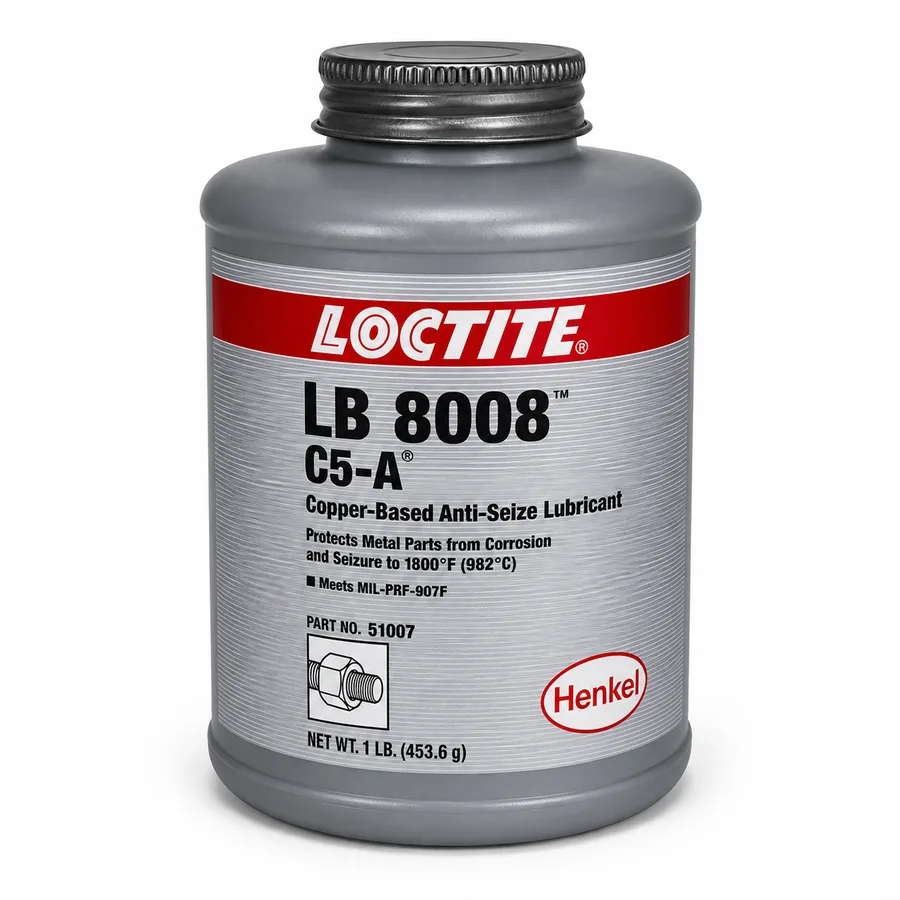
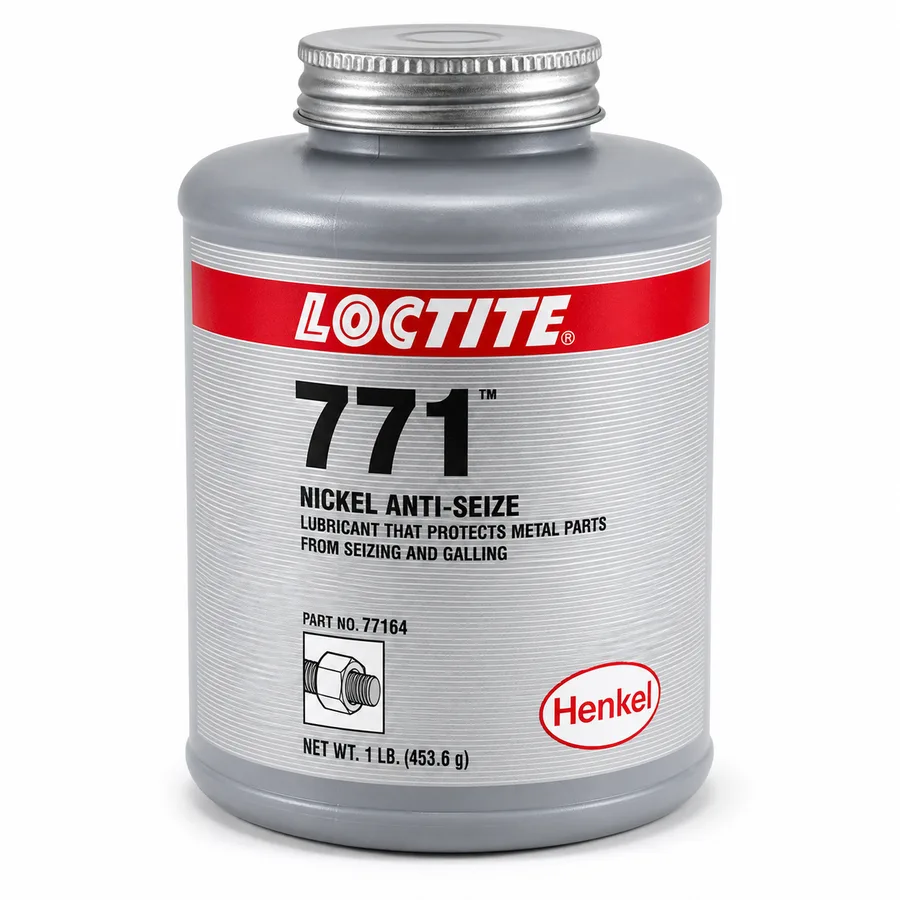
An anti-seize is a paste of metallic solids and graphite in a grease carrier, applied to threads and fits exposed to temperature, corrosion or galling-prone metals (cold welding), so the joint can be disassembled years later with normal torque. The two most used chemistries: copper-graphite based, such as LOCTITE LB 8008 C5-A (service up to 982 °C, NLGI 0 consistency per its TDS), for exhaust bolts, flange studs and general fasteners exposed to heat; and nickel based, such as LOCTITE LB 771 (service from −54 to 1 315 °C per its TDS), mandatory on stainless steel and passive metals, and wherever copper is banned by the process (ammonia, acetylene, vinyl monomers).
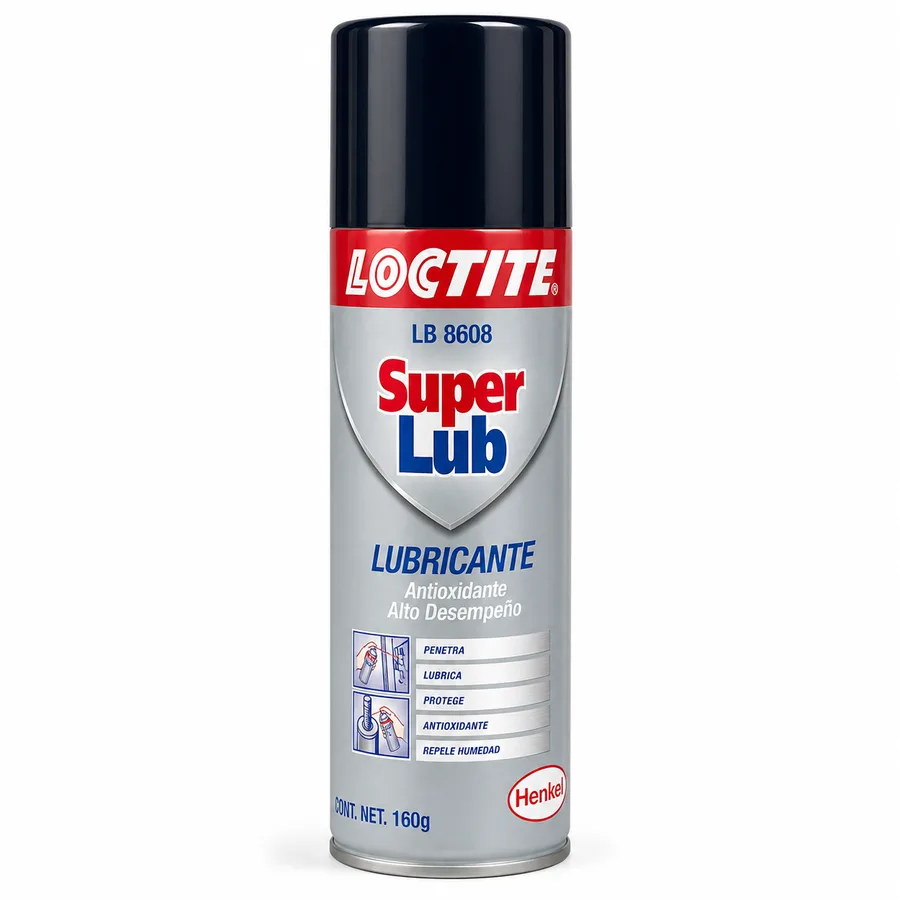
A roller chain wears from the inside: the film must reach the pin-bushing assembly, not just the plates. That is why the usual maintenance format is an aerosol, which penetrates the clearance and leaves a film after the carrier evaporates. TECTUL stocks LOCTITE Super Lub aerosol (Henkel reference LB 8608); its product page links the official Henkel TDS so you can verify compatibility with the application before buying.
Above 120 °C continuous, conventional lithium grease degrades and bleeds out its base oil. The thermal ladder according to manufacturers' catalogues: lithium complex up to ≈ 150 °C; synthetic greases (PAO, and perfluorinated PFPE at the top end) for higher continuous service; and for threads and static fits, anti-seize pastes with metallic solids, which cover up to 982 °C (copper) or 1 315 °C (nickel), where no conventional grease survives.
NSF H1 is the NSF registration category for lubricants with incidental food contact: formulated exclusively with ingredients permitted by the FDA under 21 CFR 178.3570 and acceptable up to a limit of 10 mg/kg (10 ppm) in the finished food. H2 identifies lubricants for zones with no possibility of contact, and ISO 21469 additionally certifies formulation and manufacturing hygiene. In a food plant, every lubrication point located above the product line must run a registered H1 lubricant.
The replenishment quantity is calculated, per the SKF rolling bearings catalogue, as Gp = 0.005 × D × B when greasing from the side of the bearing (Gp in grams; D = outside diameter and B = width, both in mm), and Gp = 0.002 × D × B when greasing through holes in the ring. Example: a 6208 bearing (D = 80 mm, B = 18 mm) takes 0.005 × 80 × 18 = 7.2 g per side replenishment.
The interval between replenishments depends on speed, bearing size, load and temperature, and is read from the manufacturer's catalogue diagrams; SKF's thermal rule: above 70 °C operating temperature, the interval is halved for every additional 15 °C. Excess grease also does damage: churning surplus grease raises bearing temperature, so respect the calculated quantity and the housing fill level stated in the catalogue.
| Application | Recommended lubricant | Deciding criterion |
|---|---|---|
| General-purpose bearings and pillow blocks | NLGI 2 lithium grease | Low-medium speed, point with grease fitting |
| Bearings under washdown or constant water | Calcium or additivated lithium-complex grease | Water washout resistance |
| Bearings between 120 and 150 °C | Lithium complex grease | Dropping point ≥ 260 °C |
| Hydraulic system | ISO VG 32, 46 or 68 oil | Nameplate grade adjusted for ambient temperature |
| Industrial gear reducer | ISO VG 220–320 gear oil | Gear train load and speed |
| Threads exposed to heat or corrosion | Copper anti-seize (up to 982 °C) or nickel anti-seize (up to 1 315 °C) | Peak temperature and joint metal (stainless → nickel) |
| Chains and hard-to-reach mechanisms | Aerosol lubricant | Penetration into the pin-bushing assembly |
| Food processing line | NSF H1 registered lubricant | Incidental contact allowed up to 10 ppm (21 CFR 178.3570) |
Buy in this order: (1) confirm the grade the equipment manufacturer specifies —ISO VG for oils, NLGI plus thickener for greases— before looking at brands; (2) never switch thickeners without purging the point; (3) for threads that will see heat or corrosion, add an anti-seize chosen by metal and temperature: copper-based LOCTITE LB 8008 C5-A for general fasteners up to 982 °C, or nickel-based LOCTITE LB 771 for stainless steel and service up to 1 315 °C; and (4) for chains and mechanisms, keep an aerosol such as LOCTITE Super Lub at hand. All three TECTUL product pages link the official Henkel TDS and let you request a quote online with delivery across Colombia.