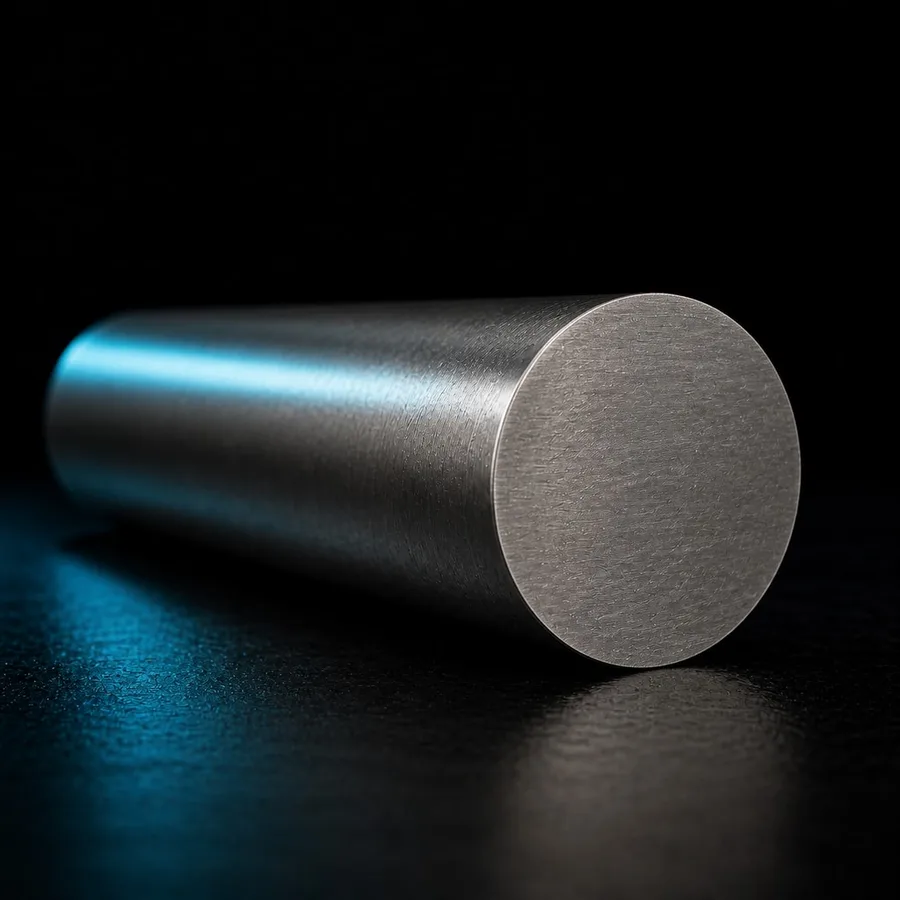
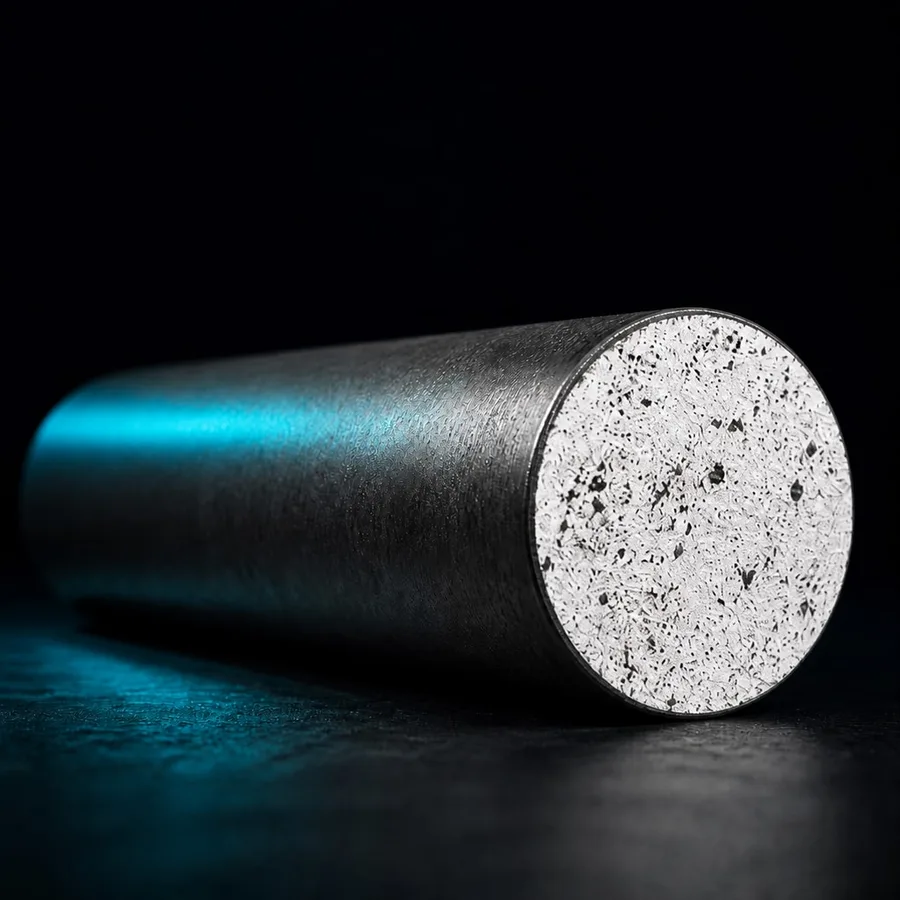
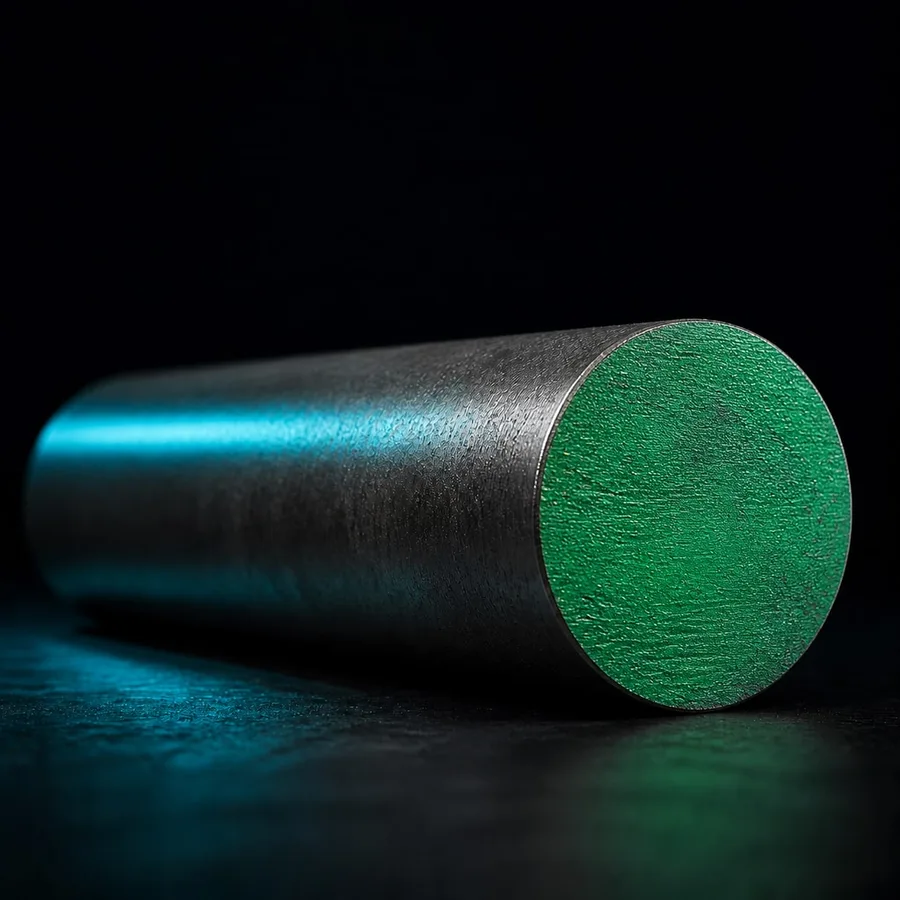
SAE 8620 is a nickel-chromium-molybdenum case hardening alloy steel with 0.18–0.23 % carbon. It is designed for parts that demand a hard surface and a tough core: carburized and quenched it reaches 58–62 HRC at the surface with a 30–40 HRC core. It is the standard steel for pinions, gears, splined shafts and pins in power transmission.
As a quick selection rule: use 8620 when the part combines surface wear with impact loading (gears, splines, chain pins); use 4140 when you need uniform strength through the whole section, with a typical hardness of 28–32 HRC in the quenched-and-tempered condition; and use 1045 when the mechanical requirement is moderate and material cost matters most. This guide covers the standardized composition, sourced mechanical properties, heat treatments and the direct comparison between the three grades.
The 8620 composition is defined by SAE J404 and carried into the bar specifications ASTM A29/A29M-23 and ASTM A322. It belongs to the 86xx series: nickel, chromium and molybdenum in low, complementary amounts.
| Element | Range (wt. %) | Role in the alloy |
|---|---|---|
| Carbon (C) | 0.18 – 0.23 | Deliberately low: keeps the core tough and lets carburizing provide the surface hardness |
| Manganese (Mn) | 0.70 – 0.90 | Increases hardenability and ties up sulfur |
| Silicon (Si) | 0.15 – 0.35 | Deoxidizer from the steelmaking process |
| Chromium (Cr) | 0.40 – 0.60 | Hardenability and wear resistance of the carburized case |
| Nickel (Ni) | 0.40 – 0.70 | Core toughness, especially at low temperature |
| Molybdenum (Mo) | 0.15 – 0.25 | Hardenability and resistance to temper embrittlement |
| Phosphorus (P) | max. 0.035 | Controlled impurity |
| Sulfur (S) | max. 0.040 | Controlled impurity |
The designation reads as follows: 86 identifies the nickel-chromium-molybdenum family and 20 the nominal mean carbon (0.20 %). Its UNS designation is G86200.
A case hardening steel is a low-carbon steel whose surface is enriched with carbon at high temperature so it can be quench hardened. At 0.18–0.23 % carbon, 8620 cannot be hardened appreciably by direct quenching; in the carburizing furnace the surface absorbs carbon up to about 0.8–1.0 % in a controlled layer, and after quenching that layer transforms into high-hardness martensite while the core, which keeps its original carbon, remains tough.
The result is a mechanical composite that is hard to obtain any other way: a 58–62 HRC surface that resists wear and contact fatigue (pitting on tooth flanks), over a 30–40 HRC core that absorbs impact and bending without fracturing. The effective case depth is specified per part; for power transmission gears the usual range is 0.75–2.0 mm (0.030–0.080 in).
Reference values from the ASM Handbook for 13–25 mm (½–1 in) round bar, in the two usual supply conditions:
| Property | Normalized (915 °C / 1675 °F) | Annealed (870 °C / 1600 °F) |
|---|---|---|
| Tensile strength | 635 MPa (92 ksi) | 536 MPa (78 ksi) |
| Yield strength | 360 MPa (52 ksi) | 385 MPa (56 ksi) |
| Elongation in 50 mm | 26 % | 31 % |
| Reduction of area | 60 % | 62 % |
| Brinell hardness | 183 HB | 149 HB |
| Izod impact | 98 J (72 ft·lb) | — |
General data: density 7.85 g/cm³ and modulus of elasticity 205 GPa (29,700 ksi), typical of carbon and low-alloy steels. Commercial bar is normally supplied hot rolled, normalized or cold finished; TECTUL's 8620 steel bar ships with the heat's composition certificate.
Gas carburizing is performed at 900–925 °C (1650–1700 °F) with a carbon potential of about 0.9 %; furnace time sets the case depth. It is followed by oil quenching —directly from the furnace or after recooling— and a low-temperature temper, typically 150–200 °C (300–390 °F), which relieves martensite stresses without sacrificing the 58–62 HRC surface hardness. Salt bath and plasma variants exist; the surface/core hardness sequence is the same.
8620 can be quenched without carburizing, but at a nominal 0.20 % carbon the resulting hardness stays in the range of the carburized core (30–40 HRC depending on section and quenchant). It is used when a strength step above the normalized condition is needed with no surface wear requirement; if the part needs more than 40 HRC through the whole section, the right grade is a through-hardening steel such as 4140 or 4340, not 8620.
8620 accepts gas nitriding at 500–565 °C (930–1050 °F) on previously quenched-and-tempered parts. Since there is no subsequent quench, distortion is minimal, which suits parts already ground to size; in exchange, the case is much thinner than a carburized one (tenths of a millimeter) and 8620 reaches lower case hardness than aluminum-bearing nitriding steels or higher-chromium grades. It is the option when the geometry cannot tolerate quench distortion.
Gear tooth flanks carry Hertzian contact stresses that fatigue the surface (pitting), while the tooth root carries alternating bending and start-up shocks. No uniform-hardness steel optimizes both at once; carburized 8620 does: a 58–62 HRC case against pitting and a tough core against root breakage. That is why it is the reference material for:
These are the three most requested machinery bar grades and they do not compete with each other: they solve different problems. For the decision between steel families (carbon, alloy, stainless) you can complement this with the guide carbon steel vs stainless steel.
| Criterion | SAE 8620 | SAE 4140 | SAE 1045 |
|---|---|---|---|
| Carbon | 0.18 – 0.23 % | 0.38 – 0.43 % | 0.43 – 0.50 % |
| Main alloying elements | Ni 0.40–0.70 %, Cr 0.40–0.60 %, Mo 0.15–0.25 % | Cr 0.80–1.10 %, Mo 0.15–0.25 % | Only Mn 0.60–0.90 % (carbon steel) |
| Typical treatment | Carburized + quenched + tempered | Quenched and tempered | Normalized; induction or flame surface hardening |
| Working hardness | 58–62 HRC surface / 30–40 HRC core | 28–32 HRC uniform (commercial pre-hardened supply) | Normalized ≈ 170–190 HB; up to 54–60 HRC surface by induction |
| Strength of the grade | Surface wear + impact toughness | Uniform strength in medium sections | Low cost with medium strength |
| Typical part | Pinion, gear, splined shaft, pin | Drive shaft, stud, stem, mold holder | Simple shaft, key, pin, general machining stock |
Practical rule: if the expected failure is surface wear or pitting with impact, carburized 8620; if it is bending or torsion through the whole section, quenched-and-tempered 4140 (or 4340 for large sections, thanks to its higher hardenability with Ni 1.65–2.00 %); if loading is moderate, 1045.
The machinability rating of hot rolled or cold drawn 8620 is 65 % taking AISI 1212 steel as the 100 % baseline (ASM Handbook). In practice the correct manufacturing flow is: machine in the soft condition (annealed or normalized, 149–183 HB), carburize and quench afterwards, and finish precision surfaces by grinding, because at 58–62 HRC the material can only be worked with abrasives or CBN tooling. Leave grinding stock to absorb quench distortion.
Yes, but the resulting hardness is limited: at 0.18–0.23 % carbon, direct quenching and tempering leaves the part in the range of 30–40 HRC depending on section. The 58–62 HRC hardness is only achieved by enriching the surface with carbon through carburizing before the quench.
The common equivalents are UNS G86200, the European 21NiCrMo2 (material number 1.6523, DIN/EN) and the Japanese JIS SNCM220. In aerospace bar it corresponds to AMS 6274. They are interchangeable in most carburizing applications, always checking the composition certificate.
Yes in the annealed or normalized condition: its 0.18–0.23 % carbon gives a moderate carbon equivalent that welds with standard precautions (preheat according to thickness and low-hydrogen filler). Do not weld over an already carburized and quenched area: the high-carbon case cracks in the heat-affected zone.
The H indicates guaranteed hardenability: 8620H is purchased against the Jominy hardenability band defined in SAE J1268, with hardness limits at standardized distances from the quenched end. It is specified when heat treatment demands heat-to-heat reproducibility, typical in series production of gears.
For gears, splines and pins, specify 8620 steel bar stating: diameter with machining and grinding stock, supply condition (normalized or cold finished), and —if heat treatment is critical— grade 8620H with a Jominy certificate. If your part does not require a hard case, compare price and lead time with 4140 and 1045. The TECTUL technical team can help you define grade, condition and sizes from your part drawing.