 TECTULby IMR
Forged stainless steel flanges ASTM A182 F304/F316 — ASME B16.5 Classes 150 and 300: same dimensions as carbon steel, a different rating table
TECTUL · Dispatch across Colombia · Exports to Central & South America
Forged austenitic stainless steel flanges ASTM A182 grades F304 and F316 (and their low-carbon versions F304L and F316L) in ASME B16.5 Classes 150 and 300, in the four types the TECTUL catalog publishes in stainless: slip-on, welding neck, blind and threaded, plus the two schedule 40 socket welds. The dimensions are identical to those of the carbon steel flange of the same class and size —B16.5 does not dimension by material— which is why this sheet does not repeat the dimensional table: it refers to FT-TC-BRI-AC-001. What does change, and is the backbone of this sheet, is the pressure-temperature table: stainless enters through material groups 2.1, 2.2 and 2.3, and cold it is rated for less pressure than carbon steel (275 psi against 285 psi in Class 150). Where it wins is at the top: at 538 °C a Class 300 in F316 retains 365 psi against the 85 psi of A105.
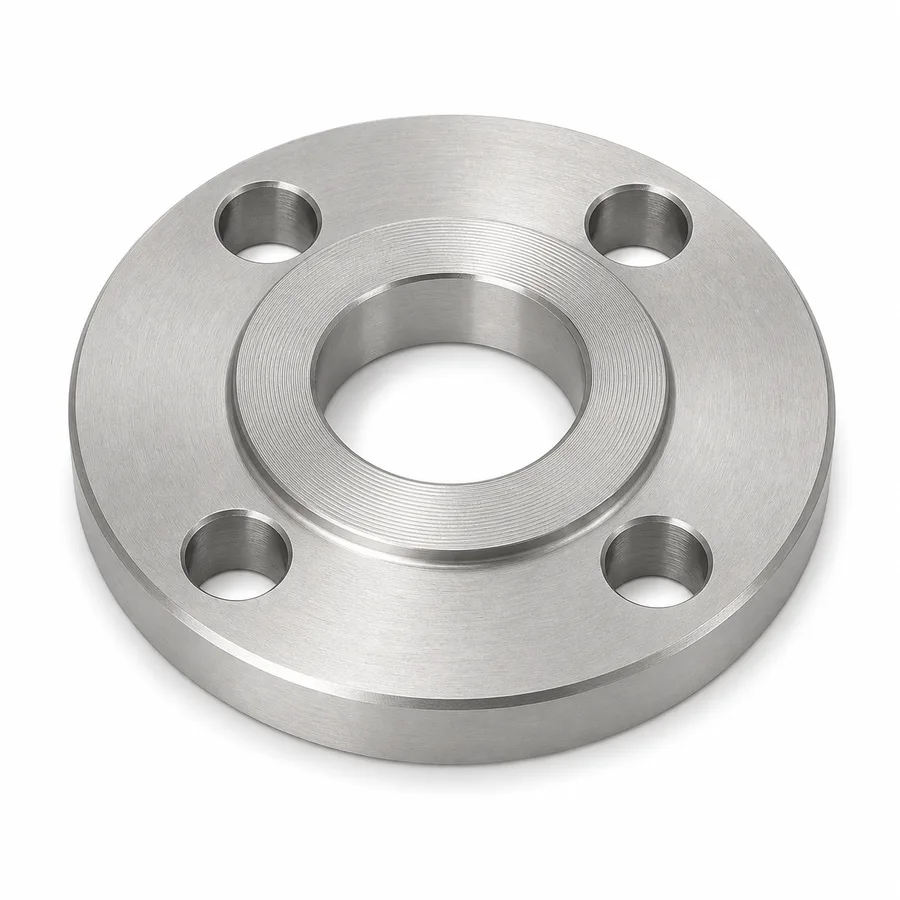
IMPORTANT: reference data — may differ from the physical product; verify with an advisor before buying.
SKU VT-86920 (stainless steel flange, Class 150, slip-on) · 6 stainless references: 5 in Class 150 and 1 in Class 300 · slip-on, welding neck, blind, threaded and socket weld types · 1/2″–12″ by reference · sold by the unit
1. Technical specifications: same dimensions, different material
First, what does NOT change: the dimensions
ASME B16.5 dimensions a flange by class and nominal size, not by material. A 4″ Class 150 flange in F316 stainless steel has exactly the same outside diameter, minimum thickness, bolt circle and eight holes as its A105 carbon steel twin: they bolt to each other and are dimensionally interchangeable. That is why this sheet does not repeat the dimensional table: the full table for Classes 150, 300 and 600 from 1/2″ to 12″, with outside diameter, thickness, hub, height, bore, bolt circle and drilling in millimetres and inches, is in data sheet FT-TC-BRI-AC-001 and serves this family equally.
What does change with the material is the rating group —and therefore the pressure-temperature table, which is section 2 of this sheet— and the compatible bolting, because of the galvanic couple in section 3.
Bolting for the two classes in the stainless catalog
| Flange NPS | Class 150 — qty × stud dia. | Class 150 — bolt circle dia. | Class 300 — qty × stud dia. | Class 300 — bolt circle dia. |
|---|---|---|---|---|
| 1/2″ | 4 × 1/2″ | 60.3 mm (2.38″) | 4 × 1/2″ | 66.7 mm (2.62″) |
| 3/4″ | 4 × 1/2″ | 69.9 mm (2.75″) | 4 × 5/8″ | 82.6 mm (3.25″) |
| 1″ | 4 × 1/2″ | 79.4 mm (3.12″) | 4 × 5/8″ | 88.9 mm (3.50″) |
| 1-1/4″ | 4 × 1/2″ | 88.9 mm (3.50″) | 4 × 5/8″ | 98.4 mm (3.88″) |
| 1-1/2″ | 4 × 1/2″ | 98.4 mm (3.88″) | 4 × 3/4″ | 114.3 mm (4.50″) |
| 2″ | 4 × 5/8″ | 120.7 mm (4.75″) | 8 × 5/8″ | 127.0 mm (5.00″) |
| 2-1/2″ | 4 × 5/8″ | 139.7 mm (5.50″) | 8 × 3/4″ | 149.2 mm (5.88″) |
| 3″ | 4 × 5/8″ | 152.4 mm (6.00″) | 8 × 3/4″ | 168.3 mm (6.62″) |
| 4″ | 8 × 5/8″ | 190.5 mm (7.50″) | 8 × 3/4″ | 200.0 mm (7.88″) |
| 6″ | 8 × 3/4″ | 241.3 mm (9.50″) | 12 × 3/4″ | 269.9 mm (10.62″) |
| 8″ | 8 × 3/4″ | 298.5 mm (11.75″) | 12 × 7/8″ | 330.2 mm (13.00″) |
| 12″ | 12 × 7/8″ | 431.8 mm (17.00″) | 16 × 1-1/8″ | 450.8 mm (17.75″) |
IMPORTANT
This technical data sheet is a reference guide to the properties of this product type; it is not a quality certificate for the product you are buying. The measurements, dimensions and physical or geometric characteristics of the product supplied may vary by manufacturer, heat and lot, and may even fall outside the cited standards. If any of these figures is critical to your design or build, verify it with one of our advisors against the physical product or the lot's mill certificate, so you can be fully certain of what you are buying. · Original data sheet: tectul.com/en/conduccion-de-fluidos/bridas-y-esparragos/ficha-tecnica-brida-acero-inoxidable-150lb-tipo-slip-on.html
Quantity, diameter and bolt circle from ASME B16.5, identical to those of the carbon steel flange of the same class. Stud lengths and the tightening torque table are in data sheet FT-TC-BRI-ESP-001; the stud material, however, is not the same as in a carbon steel joint: see section 3.
Material: ASTM A182/A182M, grades F304, F304L, F316 and F316L
| Grado | C | Mn | P | S | Si | Cr | Ni | Mo |
|---|---|---|---|---|---|---|---|---|
| F304 (UNS S30400) | 0.08 max. | 2.00 max. | 0.045 max. | 0.030 max. | 1.00 max. | 18.0 – 20.0 | 8.0 – 11.0 | — |
| F304L (UNS S30403) | 0.030 max. | 2.00 max. | 0.045 max. | 0.030 max. | 1.00 max. | 18.0 – 20.0 | 8.0 – 13.0 | — |
| F316 (UNS S31600) | 0.08 max. | 2.00 max. | 0.045 max. | 0.030 max. | 1.00 max. | 16.0 – 18.0 | 10.0 – 14.0 | 2.00 – 3.00 |
| F316L (UNS S31603) | 0.030 max. | 2.00 max. | 0.045 max. | 0.030 max. | 1.00 max. | 16.0 – 18.0 | 10.0 – 15.0 | 2.00 – 3.00 |
| Grades | Minimum tensile Rₘ | Minimum yield Rₑ | Min. elongation | Min. reduction of area | B16.5 material group |
|---|---|---|---|---|---|
| F304 y F316 | 515 MPa (75 ksi) | 205 MPa (30 ksi) | 30 % | 50 % | 2.1 (F304) y 2.2 (F316) |
| F304L y F316L | 485 MPa (70 ksi) | 170 MPa (25 ksi) | 30 % | 50 % | 2.3 (los dos) |
The reading that settles the specification is in the last column. Grades F304 and F316 are groups 2.1 and 2.2; the low-carbon grades F304L and F316L are group 2.3, a different group with its own pressure-temperature table. The reason is mechanical and plain to see: dropping carbon from 0.08 % to 0.030 % —which is what the "L" does— costs 35 MPa of yield (from 205 to 170 MPa) and 30 MPa of tensile strength. That loss of strength is the metallurgical trade-off for immunity to sensitization in the weld heat-affected zone. If the supplier delivers a flange with dual F304/F304L marking —very common, because a low-carbon heat can meet both specifications— the flange meets both and the designer may specify it as F304 and use the group 2.1 table, provided the certificate evidences the mechanical properties of the non-L grade.
When 304 and when 316
The chemical difference is molybdenum: F316 carries 2.00–3.00 % and F304 carries none. That molybdenum is what gives resistance to pitting corrosion from chlorides, and it is quantified by the PREN index, which this series develops in the stainless pipe sheet FT-TC-TUB-INOX-001 and does not repeat here. The short selection rule: water, air, clean steam and non-chlorinated chemicals accept F304; seawater, brine, pool water, coastal environments, bleaches and any chloride-bearing fluid demand F316. In pressure and temperature the difference between the two is marginal —group 2.2 yields between 2 and 5 psi more than 2.1 in Class 150— and is not a selection criterion: you choose by corrosion, not by rating.
The 6 stainless steel references this sheet covers
| Class | Type | Face / end | Sizes published in the catalog |
|---|---|---|---|
| 150 lb | Slip-on (SKU VT-86920) | Raised face, inner and outer fillet weld | 1/2″ · 3/4″ · 1″ · 1-1/4″ · 1-1/2″ · 2″ · 2-1/2″ · 3″ · 4″ · 6″ · 8″ · 12″ (12 variants) |
| 150 lb | Welding neck | Raised face, butt weld with bevel | 1/2″ · 3/4″ · 1″ · 1-1/4″ · 1-1/2″ · 2″ · 3″ · 4″ · 6″ (9 variants) |
| 150 lb | Blind | Raised face, no bore: closes the end | 1/2″ · 3/4″ · 1″ · 1-1/4″ · 1-1/2″ · 2″ · 2-1/2″ · 3″ · 4″ · 6″ · 8″ (11 variants) |
| 150 lb | Threaded | Female NPT thread per ASME B1.20.1 | 1/2″ · 3/4″ · 1″ · 1-1/4″ · 1-1/2″ · 2″ · 2-1/2″ · 3″ · 4″ · 6″ (10 variants) |
| 150 lb | Socket weld SCH 40 | Socket weld, schedule 40 bore | Confirmed on quotation |
| 300 lb | Socket weld SCH 40 | Socket weld, schedule 40 bore | Confirmed on quotation |
IMPORTANT: reference data — may differ from the physical product; verify with an advisor before buying.
General specifications
| Product | Forged austenitic stainless steel flanges for bolted pipe joints, in four Class 150 types (slip-on, welding neck, blind and threaded) plus schedule 40 socket weld in Classes 150 and 300 |
| Material | ASTM A182/A182M grades F304 or F316 (18Cr-8Ni and 16Cr-12Ni-2Mo), or their low-carbon versions F304L and F316L. Exact grade per reference: confirmed on quotation |
| Dimensional and rating standard | ASME B16.5-2025, Pipe Flanges and Flanged Fittings: NPS 1/2 Through NPS 24 Metric/Inch — current edition, mandatory from 1 January 2026 |
| B16.5 material group | 2.1 for F304 · 2.2 for F316 · 2.3 for F304L and F316L. Each group has its own pressure-temperature table — see section 2 |
| Cold allowable pressure | 275 psi (19.0 bar) in Class 150 and 720 psi (49.6 bar) in Class 300, between −29 and 38 °C, in all three austenitic groups |
| Dimensions | Identical to the carbon steel flange of equal class and size (ASME B16.5 does not dimension by material). Full table in data sheet FT-TC-BRI-AC-001 |
| Face | Raised face (RF) as the family standard |
| Bolting | ASTM A193 grade B8 (type 304) or B8M (type 316) with A194 grade 8 or 8M nuts, to avoid the galvanic couple with a carbon steel stud — see section 3. Quantity, diameter and bolt circle in the table above |
| Scope of this sheet | 1/2″ to 12″ (DN 15 to DN 300) in Class 150 by type; Class 300 in socket weld only |
| Sale | By the unit, per class, type and size |
| Applicable standards | ASME B16.5-2025 (dimensions, pressure-temperature rating by material group, marking) · ASTM A182/A182M (austenitic forgings) · ASME B1.20.1 (NPT thread) · ASTM A193/A194 (austenitic B8/B8M bolting and grade 8/8M nuts) · ASME B16.20 and ASME B16.21 (gaskets) · ASME PCC-1-2022 (assembly and tightening) |
IMPORTANT: reference data — may differ from the physical product; verify with an advisor before buying.
2. The stainless pressure-temperature table: three groups, not one
The double error this section corrects
Two false statements circulate about a Class 150 stainless flange at the same time. The first is the usual one: that "Class 150" means 150 psi —it does not: it means 275 psi (19.0 bar) cold—. The second is more specific to stainless and more expensive: assuming that, being stainless, the flange withstands more pressure than the carbon steel one. It does not. In Class 150 and cold, carbon steel is rated 285 psi and stainless 275 psi: 10 psi less. Stainless is not specified for pressure; it is specified for corrosion and for high temperature.
Class 150 — allowable pressure by material group
| Temperature | Group 1.1 A105 (carbon steel) | Group 2.1 A182 F304 | Group 2.2 A182 F316 | Group 2.3 A182 F304L / F316L |
|---|---|---|---|---|
| −29 to 38 °C (−20 to 100 °F) | 285 psi (19.6 bar) | 275 psi (19.0 bar) | 275 psi (19.0 bar) | 275 psi (19.0 bar) |
| 93 °C (200 °F) | 260 psi (17.9 bar) | 230 psi (15.9 bar) | 235 psi (16.2 bar) | 215 psi (14.8 bar) |
| 204 °C (400 °F) | 200 psi (13.8 bar) | 190 psi (13.1 bar) | 195 psi (13.4 bar) | 195 psi (13.4 bar) |
| 316 °C (600 °F) | 140 psi (9.7 bar) | 140 psi (9.7 bar) | 140 psi (9.7 bar) | 140 psi (9.7 bar) |
| 427 °C (800 °F) | 80 psi (5.5 bar) | 80 psi (5.5 bar) | 80 psi (5.5 bar) | 80 psi (5.5 bar) |
| 538 °C (1000 °F) | 20 psi (1.4 bar) | 20 psi (1.4 bar) | 20 psi (1.4 bar) | 20 psi (1.4 bar) |
IMPORTANT: reference data — may differ from the physical product; verify with an advisor before buying.
Class 300 — allowable pressure by material group
| Temperature | Group 1.1 A105 (carbon steel) | Group 2.1 A182 F304 | Group 2.2 A182 F316 | Group 2.3 A182 F304L / F316L |
|---|---|---|---|---|
| −29 to 38 °C (−20 to 100 °F) | 740 psi (51.1 bar) | 720 psi (49.6 bar) | 720 psi (49.6 bar) | 720 psi (49.6 bar) |
| 93 °C (200 °F) | — | 600 psi (41.4 bar) | 620 psi (42.7 bar) | 560 psi (38.6 bar) |
| 204 °C (400 °F) | 635 psi (43.8 bar) | 495 psi (34.1 bar) | 515 psi (35.5 bar) | 515 psi (35.5 bar) |
| 316 °C (600 °F) | — | 435 psi (30.0 bar) | 450 psi (31.0 bar) | 450 psi (31.0 bar) |
| 427 °C (800 °F) | 410 psi (28.3 bar) | 405 psi (27.9 bar) | 420 psi (29.0 bar) | 420 psi (29.0 bar) |
| 538 °C (1000 °F) | 85 psi (5.9 bar) | 320 psi (22.1 bar) | 365 psi (25.2 bar) | 365 psi (25.2 bar) |
IMPORTANT: reference data — may differ from the physical product; verify with an advisor before buying.
ASME B16.5 material groups: 1.1 = A105 and A350 LF2 forgings, A216 WCB castings (carbon steel); 2.1 = A182 F304 and F304H, A351 CF3 and CF8 castings, A240 304 plate (18Cr-8Ni); 2.2 = A182 F316, F316H and F317, A351 CF3M, CF8M and CG8M castings, A240 316 plate (16Cr-12Ni-2Mo); 2.3 = A182 F304L, F316L and F317L and A240 304L and 316L plate (the low-carbon grades). Bar values are those tabulated by the standard where it publishes the metric series (19.6 bar for 285 psi and 51.1 bar for 740 psi) and, in the remaining cells, the exact conversion of the tabulated psi at 0.0689476 bar/psi. The two empty cells in Class 300 are group 1.1 rows this sheet does not publish for want of the tabulated value at hand: for carbon steel the reference sheet is FT-TC-BRI-AC-001, with its full table at −29/38 °C, 204 °C, 427 °C and 538 °C.
- Cold (38 °C), Class 150: A105 carbon steel is rated 285 psi (19.6 bar) and F304 is rated 275 psi (19.0 bar). Carbon wins by 10 psi. If pressure were the only variable, stainless would be the worse buy.
- At 93 °C (200 °F), Class 150: carbon 260 psi (17.9 bar), F304 230 psi (15.9 bar), F316 235 psi (16.2 bar), L grades 215 psi (14.8 bar). The gap widens in carbon's favour: 30 psi against F304, almost 12 %. This is the temperature range where most is lost by moving to stainless — and where most hot water and low-pressure steam lines live.
- At 316 °C (600 °F), Class 150: all four groups converge at 140 psi (9.7 bar). A tie. From here on carbon no longer has an advantage.
- At 538 °C (1000 °F), Class 300: A105 retains 85 psi (5.9 bar) and F316 retains 365 psi (25.2 bar): 4.3 times more. And carbon steel is by then outside its recommended service range anyway, because of graphitization risk.
- Conclusion: the stainless curve starts below the carbon one, crosses it around 316 °C and from there leaves it far behind. Choosing stainless "to get more pressure" is a mistake if the line runs cold or warm; choosing it to run at 400 °C or above, or in a fluid that attacks carbon, is the only option.
The L-grade trap: the group changes and the rating drops
This is the detail no distributor sheet publishes and that does decide a specification. Grades F304L and F316L are not in groups 2.1 and 2.2: they are in group 2.3, with its own table. The difference shows exactly where it matters:
| Table point | Group 2.1 (F304) | Group 2.2 (F316) | Group 2.3 (F304L / F316L) |
|---|---|---|---|
| Class 150 at 93 °C (200 °F) | 230 psi (15.9 bar) | 235 psi (16.2 bar) | 215 psi (14.8 bar) |
| Class 300 at 93 °C (200 °F) | 600 psi (41.4 bar) | 620 psi (42.7 bar) | 560 psi (38.6 bar) |
| Class 300 at 204 °C (400 °F) | 495 psi (34.1 bar) | 515 psi (35.5 bar) | 515 psi (35.5 bar) |
| Material minimum yield | 205 MPa (30 ksi) | 205 MPa (30 ksi) | 170 MPa (25 ksi) |
IMPORTANT: reference data — may differ from the physical product; verify with an advisor before buying.
Group 2.3 loses between 15 and 60 psi against 2.1 and 2.2 in the mid-temperature range, and the cause is in the last row: 35 MPa less yield. That is why a flange marked F316L only cannot be specified with the group 2.2 table. The practical and frequent way out is dual F316/F316L marking: a low-carbon heat whose mechanical properties also reach the non-L grade minimum, certified to both specifications. With that certificate you may use the 2.2 table. Without it, you drop to 2.3.
How to read the table, in three steps
- Identify the flange's real grade from the edge marking and the certificate, not from the commercial name: "304 stainless" may be F304 (group 2.1) or F304L (group 2.3), and they are not the same.
- Enter the corresponding group's table with the project design temperature, and interpolate linearly if the point falls between two tabulated steps.
- Choose the class whose cell sits above the design pressure — and then check the gasket, the pipe and the stud, which have their own limits and are usually the ones that govern.
3. Galvanic couple, face finish and why the L grade exists
The carbon steel stud eats itself to protect the flange
This is the most expensive assembly mistake in this family and it stays invisible until disassembly. A stainless steel flange bolted with A193 B7 carbon steel studs in the presence of moisture forms a galvanic cell: the two metals are in electrical contact and immersed in the same electrolyte, and the less noble one corrodes preferentially. In this pair the less noble one is the carbon steel, so the stud is the anode and it is sacrificed.
What makes the case worse is the area ratio: the stainless flange (cathode) has a vastly greater surface than the stud thread (anode), and in galvanic corrosion an unfavourable area ratio concentrates all the current in the small part. The result is not a "slightly rusty" stud: it is localized section loss on the thread flanks, exactly where the load is, with no sign visible from outside. The joint loses tightening and one day the stud fails, not the flange.
| Situation | Correct bolting | Why |
|---|---|---|
| Carbon steel flange and line | A193 B7 + A194 2H | Same metal on both sides: no galvanic couple. See data sheet FT-TC-BRI-ESP-001 |
| Stainless flange, dry indoors | A193 B8 or B8M + A194 grade 8 or 8M | Without moisture the couple does not activate, but B8/B8M removes the risk should condensation appear |
| Stainless flange, outdoors, damp or marine environment | A193 B8M + A194 grade 8M | The galvanic couple is active and the 316 of B8M also resists the environment's chlorides |
| Need to break a galvanic current in the line itself | Complete isolation kit (sleeve, insulating washers and gasket) | The stud material does not solve this: the joint's electrical continuity must be interrupted |
The trade-off with B8 and B8M is mechanical: in the usual supply condition they are weaker than B7, so the target preload and the tightening torque differ. The torque table in data sheet FT-TC-BRI-ESP-001 is calculated on B7 yield and does not apply to austenitic bolting. Austenitic material is also prone to thread galling, so assembly lubricant is not optional: it is mandatory.
Sealing face finish: the other figure that decides the gasket
A flange's raised face is not smooth. ASME B16.5 delivers it with a serrated finish, concentric or spiral, with a roughness of 3.2 to 6.3 µm Rₐ. That groove is not a machining defect: it is what gives a nonmetallic gasket something to bite so it does not extrude outwards under pressure. Two practical consequences:
- Nonmetallic gasket (flat gasket, ASME B16.21): the standard finish is the correct one. Polishing the face "so it seals better" makes the seal worse.
- Metallic or spiral-wound gasket (ASME B16.20): some require a different finish —finer, or with another pattern— and in that case it must be ordered: it is not what the standard supplies by default.
In stainless there is one extra detail: the face is softer against impact than people assume, and an austenitic flange whose face has been dented in transport will not seal no matter how much torque is applied. Check the face before fitting the gasket; recovering a dented face requires remachining, which reduces the thickness and may take the flange below the tabulated minimum.
Welding austenitic stainless: why the L grade exists
When welding a normal-carbon austenitic (F304 or F316, with up to 0.08 % C), the heat-affected zone passes through the temperature range in which carbon precipitates as chromium carbide at the grain boundaries. That process —sensitization— robs chromium from the matrix right around the grain boundary and leaves that band without the passive layer that makes the steel stainless: in corrosive service, the part corrodes along the grain boundaries. Dropping carbon to 0.030 % is what the L grades do, and with that the mechanism shuts down because there is not enough carbon to form the carbides.
Hence the decision that orders this family: on a slip-on, welding neck or socket weld flange —the ones that get welded— the L grade is the technical choice when service is corrosive. On a threaded or blind flange —which are not welded— sensitization is not a risk and the non-L grade, with its higher yield and its better rating group, is the reasonable choice. The cost of the L grade is tabulated in section 2: between 15 and 60 psi of rating in the mid-temperature range.
4. Frequently asked questions
Does a Class 150 stainless flange withstand 150 psi?
It withstands 275 psi (19.0 bar) between −29 and 38 °C, almost double what its name suggests. "Class 150" is not a pressure figure: it is the name of a column in the ASME B16.5 pressure-temperature table, and the value comes from crossing that column with the service temperature and with the flange's material group (2.1 for F304, 2.2 for F316, 2.3 for the L grades). That value drops with temperature: 230 psi at 93 °C in F304, 190 psi at 204 °C and 140 psi at 316 °C.
What is the difference between a Class 150 carbon steel flange and a stainless one?
The dimensions are identical and the ratings differ. ASME B16.5 dimensions by class and size, not by material: same outside diameter, same thickness, same bolt circle, same drilling, and they bolt to each other. What changes is the pressure-temperature table, because each material enters through its own group: cold, carbon steel is rated 285 psi and stainless 275 psi. And the compatible bolting changes: on a stainless flange a carbon steel stud forms a galvanic couple and corrodes.
Does stainless withstand more pressure than carbon steel?
No, and this is the family's most expensive confusion. In Class 150 and cold, carbon steel is rated 10 psi more (285 against 275), and at 93 °C carbon's advantage grows to 30 psi against F304 (260 against 230), almost 12 %. The curves cross around 316 °C, where all four groups meet at 140 psi. From there on stainless dominates: at 538 °C a Class 300 in F316 retains 365 psi against the 85 psi of A105. Stainless is specified for corrosion and for high temperature, never for cold pressure.
Can I use the F316 table if my flange is marked F316L?
No, unless it is dual marked and certified. F316L belongs to material group 2.3 and F316 to 2.2: they are different tables and 2.3 is rated for less pressure in the mid-temperature range (560 psi against 620 psi in Class 300 at 93 °C). The cause is yield strength: 170 MPa in the L grade against 205 MPa in the non-L grade. The usual way out is dual F316/F316L marking, a low-carbon heat whose mechanical properties also reach the non-L minimum and which is certified to both specifications: with that certificate you may use the 2.2 table.
When must 316 be specified instead of 304?
When there are chlorides. F316 carries 2.00–3.00 % molybdenum and F304 carries none, and that molybdenum is what gives resistance to pitting corrosion: seawater, brine, pool water, coastal environments, bleaches. In clean water, air, clean steam and non-chlorinated chemicals, F304 is enough. What is not a criterion for choosing between the two is pressure: in Class 150 group 2.2 yields between 2 and 5 psi more than 2.1, a difference of no practical significance. The PREN index, which quantifies that pitting resistance, is developed in data sheet FT-TC-TUB-INOX-001.
Can I bolt a stainless flange with B7 carbon steel studs?
They fit, technically, but it is a mistake as soon as moisture is present. The two metals in electrical contact form a galvanic cell in which carbon steel is the anode: the stud corrodes to protect the flange. And the area ratio makes it worse —the flange is enormous next to the stud thread—, so all the current concentrates in the small part and the section loss appears on the thread flanks, where the load is and where it cannot be seen. The correct bolting is A193 B8 or B8M with A194 grade 8 or 8M nuts. Watch the torque: B8 and B8M are mechanically weaker than B7 and the stud sheet's torque table does not apply.
Should the flange face be polished so it seals better?
No: it makes the seal worse. ASME B16.5 delivers the raised face with a concentric or spiral serrated finish of 3.2 to 6.3 µm Rₐ, and that groove is what gives a nonmetallic gasket something to bite so it does not extrude under pressure. With a B16.21 flat gasket the standard finish is the correct one. Only some B16.20 metallic or spiral-wound gaskets require a different finish, and in that case it must be expressly ordered. What must be checked is that the face has not arrived dented: a dented face will not seal no matter how much torque is applied.
What stainless grade does the catalog supply?
The catalog publishes the references as "stainless steel" without declaring the ASTM grade or the F304/F316 designation. Since the grade decides the rating group —and therefore the allowable pressure— and also decides chloride resistance, the exact grade is confirmed on quotation against the supplier's material certificate, with its heat number. This sheet publishes the tables for all three austenitic groups precisely so the decision can be made as soon as the grade is known.
5. Application notes
Feasibility
The A182 austenitic stainless flange is specified for two reasons and neither is cold pressure: corrosion resistance (potable water in permanent contact, sanitary service, chemicals, chlorides with F316) and high temperature, where from around 316 °C its rating exceeds that of carbon steel and at 538 °C quadruples it. Below that temperature and in non-corrosive fluids, the A105 carbon steel flange (data sheet FT-TC-BRI-AC-001) delivers equal or greater pressure with the same dimensions. What always changes is the bolting: on a stainless flange with moisture present, a carbon steel stud forms a galvanic couple and is sacrificed. For sanitary service with a clamp joint, the correct family is not the flange but the sanitary ferrule and clamp; that system's pipe is in data sheet FT-TC-TUB-INOXSAN-001.
Installation
Use austenitic A193 B8 or B8M bolting with A194 grade 8 or 8M nuts, and always lubricate: austenitic material galls at the thread and a galled stud gets cut off, not unbolted. Remember that the torque in data sheet FT-TC-BRI-ESP-001 is calculated on B7 yield and does not apply to B8/B8M. Check the raised face before fitting the gasket: a face dented in transport will not seal and remachining it reduces the thickness. Do not polish the 3.2 to 6.3 µm Rₐ serrated finish it comes with from the factory: that is what stops a flat gasket from extruding. Align and make the flanges parallel before inserting the first stud and tighten in a star pattern in passes with a circular closing pass (ASME PCC-1-2022). On flanges that get welded —slip-on, welding neck and socket weld— control heat input and consider the L grade if service is corrosive: sensitization in the heat-affected zone is this material's characteristic failure mechanism.
Design
Identify the real grade before entering the table: "304 stainless" may be F304 (group 2.1) or F304L (group 2.3), and group 2.3 is rated for up to 60 psi less in the mid-temperature range. The catalog does not declare the ASTM grade, so that figure comes from the supplier's certificate. Then cross design pressure and temperature in the group's table, interpolating linearly between tabulated steps and without extrapolating outside the range. Do not specify stainless expecting more pressure than carbon steel: cold, it is the other way round. Check the three elements the flange table does not cover —gasket, pipe and stud— and in this material add a fourth: the galvanic compatibility of the bolting. Final selection of class, grade, type, face, gasket and bolting is the responsibility of the line designer per the project code (ASME B31.3, B31.1, the applicable NTC or other) and its current edition.
6. Technical notice and limitation of liability
The pressure-temperature values in section 2 are those tabulated in ASME B16.5 by material group in psi; the bar figures are those tabulated by the standard where it publishes the metric series and, elsewhere, the exact conversion at 0.0689476 bar/psi. They guide specification and are not a certificate of conformance for any lot. The applicable group depends on the flange's real grade: 2.1 for F304, 2.2 for F316 and 2.3 for F304L and F316L. The catalog publishes these references as "stainless steel" without declaring the ASTM grade, so the group —and therefore the allowable pressure— is not determined until the supplier's certificate is known.
The dimensions are not published in this sheet because ASME B16.5 does not dimension by material: they are the same as the carbon steel flange of equal class and size and are in data sheet FT-TC-BRI-AC-001. The two empty cells in the Class 300 table are group 1.1 (carbon steel) rows whose tabulated value is not published here; the full carbon steel table is in that same sheet. The torque table in data sheet FT-TC-BRI-ESP-001 does not apply to this family's austenitic B8/B8M bolting: it is calculated on A193 B7 yield.
The composition and mechanical properties cited are the specification minima of ASTM A182/A182M; certifying a lot requires the manufacturer's material certificate with the grade, the heat number and the test results. Final selection of class, grade, flange type, face, gasket and bolting is the responsibility of the line designer per the project code (ASME B31.3, B31.1, the applicable NTC or other) and its current edition.
Sources
- ASME B16.5-2025 — Pipe Flanges and Flanged Fittings: NPS 1/2 Through NPS 24 Metric/Inch Standard (edición vigente: aprobada por ANSI el 10-abr-2025, obligatoria desde el 1-ene-2026 con transición hasta el 30-jun-2026). Dimensiones y taladrado por clase y diámetro nominal, independientes del material; rating presión-temperatura por grupo de material; acabado de la cara de sellado (aserrado concéntrico o en espiral, 3,2 a 6,3 µm Rₐ); requisitos de marcado
- ASME B16.5 — asignación de grupos de material: grupo 2.1 (18Cr-8Ni) forjas A182 F304 y F304H, fundiciones A351 CF3 y CF8, placas A240 304 y 304H; grupo 2.2 (16Cr-12Ni-2Mo y 18Cr-13Ni-3Mo) forjas A182 F316, F316H y F317, fundiciones A351 CF3M, CF8M y CG8M, placas A240 316, 316H y 317; grupo 2.3 forjas A182 F304L, F316L y F317L y placas A240 304L y 316L
- ASME B16.5 — tabla presión-temperatura, clase 150 en psi: grupo 1.1 = 285 (−20/100 °F), 260 (200 °F), 200 (400 °F), 140 (600 °F), 80 (800 °F), 20 (1000 °F); grupo 2.1 = 275, 230, 190, 140, 80, 20; grupo 2.2 = 275, 235, 195, 140, 80, 20; grupo 2.3 = 275, 215, 195, 140, 80, 20
- ASME B16.5 — tabla presión-temperatura, clase 300 en psi: grupo 1.1 = 740 (−20/100 °F), 635 (400 °F), 410 (800 °F), 85 (1000 °F); grupo 2.1 = 720, 600 (200 °F), 495 (400 °F), 435 (600 °F), 405 (800 °F), 320 (1000 °F); grupo 2.2 = 720, 620, 515, 450, 420, 365; grupo 2.3 = 720, 560, 515, 450, 420, 365
- ASTM A182/A182M — Standard Specification for Forged or Rolled Alloy and Stainless Steel Pipe Flanges, Forged Fittings, and Valves and Parts for High-Temperature Service: composición química de los grados F304 (UNS S30400), F304L (S30403), F316 (S31600) y F316L (S31603) y propiedades mecánicas mínimas — F304 y F316: tracción 515 MPa (75 ksi), fluencia 205 MPa (30 ksi), alargamiento 30 %, reducción de área 50 %; F304L y F316L: tracción 485 MPa (70 ksi), fluencia 170 MPa (25 ksi), alargamiento 30 %, reducción de área 50 %
- ASTM A193/A193M y ASTM A194/A194M — tornillería austenítica grado B8 (tipo 304) y B8M (tipo 316) con tuercas grado 8 y 8M, alternativa al B7 en unión bridada inoxidable por incompatibilidad galvánica
- ASME B16.20 — Metallic Gaskets for Pipe Flanges: Ring-Joint, Spiral-Wound, and Jacketed, y ASME B16.21 — Nonmetallic Flat Gaskets for Pipe Flanges (normas del empaque; algunos empaques metálicos exigen un acabado de cara distinto del que B16.5 suministra por defecto)
- ASME PCC-1-2022 — Guidelines for Pressure Boundary Bolted Flange Joint Assembly (montaje y apriete de la unión bridada)
- ASME B1.20.1 — Pipe Threads, General Purpose, Inch (rosca NPT de la brida roscada)
- Ficha técnica TECTUL FT-TC-BRI-AC-001 — Bridas de acero al carbón forjado ASTM A105: tabla dimensional completa de las clases 150, 300 y 600 de 1/2″ a 12″, válida para esta familia por ser independiente del material, y tabla presión-temperatura del grupo 1.1 para la comparación de la sección 2
- Ficha técnica TECTUL FT-TC-BRI-ESP-001 — Espárragos y tornillería de brida: cantidad, diámetro, longitud y par de apriete; la tabla de par está calculada sobre la fluencia del A193 B7 y no aplica a la tornillería austenítica de esta familia
- Ficha técnica TECTUL FT-TC-TUB-INOX-001 — Tubería de acero inoxidable: índice PREN de resistencia a picadura y criterio de selección entre 304 y 316 frente a cloruros (dato que esta ficha enlaza y no repite)
- Catálogo TECTUL, familia bridas y espárragos (consultado 05-ago-2026): 6 referencias en acero inoxidable — slip-on, con cuello, ciega, roscada y socket weld SCH 40 en clase 150 y socket weld SCH 40 en clase 300 — con sus diámetros publicados por referencia
This data sheet is the property of TECTUL, part of the Industrias IMR group. Reproduction without attribution is prohibited. Original document and updates: tectul.com/en/conduccion-de-fluidos/bridas-y-esparragos/ficha-tecnica-brida-acero-inoxidable-150lb-tipo-slip-on.html.