
Flexible silicone duct for very high temperature
TECTUL · Dispatch across Colombia · Exports to Central & South America
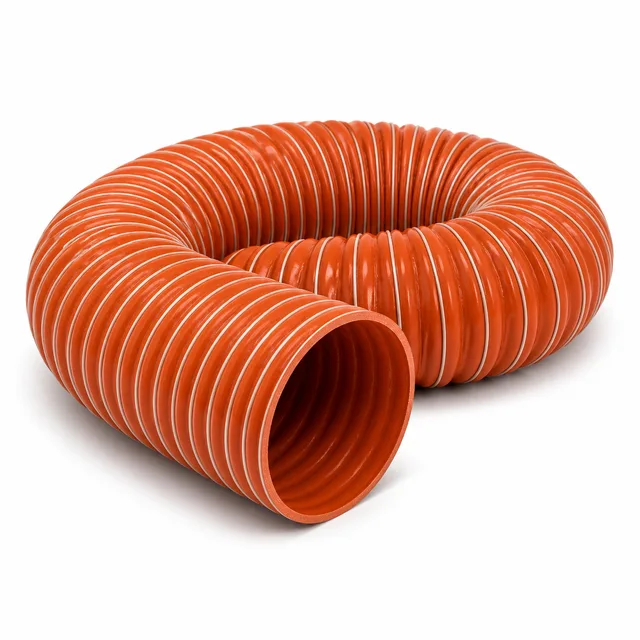
IMPORTANT: reference data — may differ from the physical product; verify with an advisor before buying.
SKU VT-142166 · 1 reference, 15 diameter variants · sold by 4 m roll
1. Technical specifications
General specifications
| Product | Flexible silicone duct/hose for engine exhaust systems, industrial ovens and very high-temperature applications requiring flexibility |
| Temperature range | -70 °C to 260 °C (-94 °F to 500 °F) |
| Working pressure/vacuum | Not a pressure pipe with a declared rating: it operates under the draft (positive or negative) generated by the equipment or exhaust system. The manufacturer declares "high resistance to pressure and tearing" in qualitative terms, with no maximum numeric value — confirmed on quotation |
| Construction | Flexible, thermoset silicone hose, resistant to UV radiation and ozone. The typical industry construction for this duct type is a fiberglass fabric coated with silicone rubber over a steel wire helix — the pattern described for Class 0 connectors in UL 181 and NFPA 90A/90B |
| Presentation | 4 m rolls, the shortest presentation in the family (the other four references come in 10 or 15 m rolls) |
| Intended use | Engine exhaust systems, industrial ovens and high-temperature applications requiring flexibility and heat resistance |
IMPORTANT
This technical data sheet is a reference guide to the properties of this product type; it is not a quality certificate for the product you are buying. The measurements, dimensions and physical or geometric characteristics of the product supplied may vary by manufacturer, heat and lot, and may even fall outside the cited standards. If any of these figures is critical to your design or build, verify it with one of our advisors against the physical product or the lot's mill certificate, so you can be fully certain of what you are buying. · Original data sheet: tectul.com/en/conduccion-de-fluidos/mangueras/ficha-tecnica-ducto-de-silicona-para-alta-temperatura.html
Dimensional table
| Nominal diameter (in) | Internal diameter (mm) | Internal diameter (in) |
|---|---|---|
| 1″ | 26 | 1.0 |
| 1-1/2″ | 38 | 1.5 |
| 2″ | 51 | 2.0 |
| 2-1/2″ | 63 | 2.5 |
| 3″ | 76 | 3.0 |
| 3-1/2″ | 90 | 3.5 |
| 4″ | 102 | 4.0 |
| 4-1/2″ | 115 | 4.5 |
| 5″ | 127 | 5.0 |
| 6″ | 152 | 6.0 |
| 6-1/2″ | 165 | 6.5 |
| 7″ | 178 | 7.0 |
| 8″ | 203 | 8.0 |
| 10″ | 254 | 10.0 |
| 12″ | 305 | 12.0 |
IMPORTANT: reference data — may differ from the physical product; verify with an advisor before buying.
Dimensions are nominal catalog values, for reference only, subject to the normal manufacturing tolerance; the exact diameter per lot is confirmed on quotation.
2. Silicone vs. fiberglass: same thermal range, different argument
El empate térmico con la fibra de vidrio
La ficha de fabricante de este ducto de silicona declara el mismo rango que la tela de fibra de vidrio pura de esta familia: -70 °C a 260 °C (-94 °F a 500 °F). Cuando dos construcciones empatan en temperatura, la elección pasa a otros criterios que sí distingue el fabricante: la silicona agrega resistencia a la radiación UV y al ozono —relevante en exteriores o cerca de equipos que generan ozono, como motores de combustión— y alta resistencia a la presión y al desgarro, mientras que la fibra de vidrio pura no declara esas propiedades adicionales. A cambio, la silicona se vende en rollos de 4 m frente a los 10 m de la fibra de vidrio, y su rango dimensional se detiene en 12″ frente a las 24″ de la fibra de vidrio.
Tabla comparativa de los 5 ductos de la familia TECTUL
| Referencia | Rango de temperatura | Diámetros | Presentación | Uso típico |
|---|---|---|---|---|
| Ducto flexible genérico (PVC) | -20 °C a 80 °C (-4 °F a 176 °F) | 4″–50″ (100–1270 mm) | Rollo de 10 m | Climatización y extracción de aire a temperatura ambiente |
| Poliéster para alta temperatura | -20 °C a 120 °C (-4 °F a 248 °F) | 2″–24″ (51–609 mm) | Rollo de 10 m | Extracción de humos y aire caliente moderado |
| TPR (manguera-ducto) | -40 °C a 150 °C (-40 °F a 302 °F) | 1″–12″ (25–305 mm) | Rollo de 15 m (10 m en 10″–12″) | Ventilación industrial y gases calientes, incluida intemperie fría |
| Fibra de vidrio con núcleo de aluminio | Hasta 150 °C (302 °F) | 2″–16″ (51–406 mm) | Rollo de 10 m | Ventilación/extracción de alta temperatura moderada con forma propia |
| Fibra de vidrio | -70 °C a 260 °C (-94 °F a 500 °F) | 2″–24″ (51–609 mm) | Rollo de 10 m | Extracción de gases calientes y aire de alta temperatura sostenida |
| Silicona (esta ficha) | -70 °C a 260 °C (-94 °F a 500 °F) | 1″–12″ (26–305 mm) | Rollo de 4 m | Escape de motores, hornos industriales, exposición a UV/ozono |
IMPORTANT: reference data — may differ from the physical product; verify with an advisor before buying.
Cómo decidir entre silicona y fibra de vidrio
- Si el tramo queda expuesto a intemperie, luz solar directa o cerca de un motor de combustión que genere ozono, la resistencia UV/ozono declarada favorece la silicona.
- Si se necesita diámetro mayor a 12″ o rollos más largos de una sola pieza, la fibra de vidrio pura es la única opción de este catálogo dentro del mismo rango térmico.
- Si el proceso no supera 150 °C, evalúe primero TPR o fibra de vidrio con núcleo de aluminio, de menor especificación y probable menor costo.
- Ninguna de las cinco referencias es tubería de presión clasificada: todas trabajan por el tiro de un ventilador, extractor o el propio motor/horno.
3. Installation: worm-gear clamp, sleeve overlap and minimum bend radius
Connection to the collar, spigot or exhaust outlet
Slide the duct onto the metal collar or outlet with an overlap of 50 to 100 mm (2″ to 4″) and secure it with a stainless steel worm-gear clamp 25 to 38 mm (1″ to 1.5″) wide, since service temperature can approach 260 °C and an ordinary carbon steel clamp degrades faster in that environment. Position the clamp directly over the collar, never over the free corrugated section.
Minimum bend radius
Do not bend the duct below one times its nominal diameter. In engine exhaust installations, where the run is usually short (4 m rolls) and has more bends per unit length than a ventilation duct, check that no bend falls below that minimum and that the material does not rub against additional hot surfaces not accounted for in the design (the engine itself, the manifold or the body).
Support and protection
Support the run with metal clamps that tolerate the duct's own service temperature —do not use plastic ties or ordinary adhesive tape near the exhaust zone—, and keep distance from cables, fuel hoses or other elements sensitive to heat radiated by the duct in operation.
These are general installation practices for high-temperature flexible ducts (not specific to a TECTUL lot), documented in installation guides conforming to UL 181 and NFPA 90A/90B; the manufacturer's manual may add its own requirements.
4. Frequently asked questions
How does the silicone duct differ from fiberglass if they share the same temperature range?
Both declare -70 °C to 260 °C (-94 °F to 500 °F), but silicone adds resistance to UV radiation and ozone, plus high resistance to pressure and tearing, which the fiberglass data sheet does not declare. In exchange, silicone reaches only 12″ in diameter and is sold in 4 m rolls, versus fiberglass's 24″ and 10 m rolls.
Is it suitable for a combustion engine's exhaust?
Yes, it is the main application the manufacturer declares along with industrial ovens, precisely because it combines the 260 °C range with resistance to the ozone combustion generates.
What maximum pressure does it withstand?
The manufacturer declares "high resistance to pressure and tearing" with no maximum numeric value. It is not rated as pressure pipe with a declared rating; the exact figure is confirmed on quotation according to the actual operating point.
Why is it sold in 4 m rolls instead of 10 m like the rest of the family?
That is the declared factory presentation for this reference; exhaust runs and oven installations typically need shorter lengths than a building ventilation duct, and the manufacturer packages silicone accordingly.
Can I bend the silicone duct as tightly as an engine bay requires?
No: respect a minimum radius of one times the nominal diameter, same as the rest of the family. A smaller radius chokes the inner cross-section and accelerates material fatigue, even in thermoset silicone.
5. Application notes
Feasibility
Specify this silicone duct when the real service temperature may approach 260 °C (500 °F) or drop to -70 °C (-94 °F) AND UV/ozone resistance or higher pressure/tear resistance than an uncoated fiberglass fabric is also needed. If the required diameter exceeds 12″, move to this family's plain fiberglass. It is not rated as pressure pipe with a declared rating.
Installation
Secure with a stainless steel worm-gear clamp over the metal collar or outlet, with a 50–100 mm overlap. Respect a minimum bend radius of one times the diameter. On exhaust installations, keep distance from cables and fuel hoses sensitive to radiated heat.
Design
Do not assume a numeric maximum pressure or vacuum value: the manufacturer only declares "high resistance to pressure and tearing" in qualitative terms. For diameters above 12″ within the same thermal range, specify this family's plain fiberglass. The typical construction of silicone over fiberglass fabric and a steel helix is the one described for Class 0 connectors in UL 181/NFPA 90A-90B; confirm the exact lot construction with the manufacturer before a critical application.
6. Technical notice and limitation of liability
The pressures, dimensions, weights and other characteristics in this sheet are theoretical calculation values obtained from nominal properties published in the standards cited (ASME B36.10-2022, ASME B31.3-2024, ASTM A106/A106M-19a, ASTM A53/A53M-24, API Spec 5L 46th ed.). They guide selection; they are not a certificate of conformity for any given lot.
The actual behavior of each lot varies with manufacturing — wall tolerance (up to −12.5%), out-of-roundness, residual stresses — and with the raw material — chemical composition within the ranges the standard allows, heat-to-heat differences. To certify a lot, the tests defined by its product standard are required: tensile test, flattening test and hydrostatic test, documented in the manufacturer's mill test certificate (MTC), which TECTUL supplies upon request; testing of the lot in an independent laboratory can also be arranged.
These values must not be used as the sole criterion in critical or safety applications, or wherever failure of the line may compromise people, property or the environment: in such cases the design belongs to the project's responsible engineer under the applicable code (ASME B31.3, B31.1 or the one governing the installation), with the design temperature, corrosion allowance and load cases of the actual service. Before deciding with these data, consult our technical team.
Sources
- Ficha técnica de fabricante «Ducto de silicona para alta temperatura» (TECTUL SAS, fichas-rescate/ft-ducto-de-silicona.pdf): rango de temperatura -70 °C a 260 °C (-94 °F a 500 °F), tabla dimensional NPS 1″–12″
- UL 181, Standard for Factory-Made Air Ducts and Air Connectors, Ed. 11-2013 (reafirmado 2021) — clasificación Clase 0 de conectores de aire con superficie de combustión cero, construcción típica de tela de fibra de vidrio recubierta de silicona
- NFPA 90A, Standard for the Installation of Air-Conditioning and Ventilating Systems, edición 2024 — requisitos de conectores flexibles de tela con índice de propagación de llama ≤25 y desarrollo de humo ≤50
This data sheet is the property of TECTUL, part of the Industrias IMR group. Reproduction without attribution is prohibited. Original document and updates: tectul.com/en/conduccion-de-fluidos/mangueras/ficha-tecnica-ducto-de-silicona-para-alta-temperatura.