
Twin-hose welding equipment hose — Grade R
TECTUL · Dispatch across Colombia · Exports to Central & South America
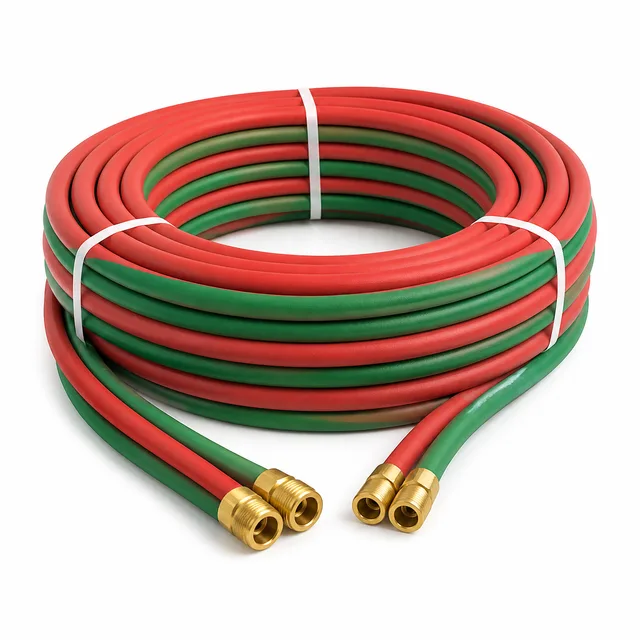
Grade R twin-hose for oxy-fuel cutting and welding equipment, with a synthetic rubber inner tube, polyester reinforcement and two bonded hose lines with distinct cover colors (red/green/blue) to identify each line's gas. Covers 3/16″ to 3/8″, with a constant 300 psi (20 bar) working pressure and 900 psi (60 bar) burst pressure across the range, 1:3 safety factor. Service range -25 °C to +75 °C. Ozone- and abrasion-resistant cover, compliant with BS, ISO, DIN and AS standards.
IMPORTANT: reference data — may differ from the physical product; verify with an advisor before buying.
VT-142221 · Grade R twin-hose, sold by meter/roll
1. TECHNICAL SPECIFICATIONS
| Nominal | ID mm (per line) | OD mm (per line) | W/P psi/bar | B/P psi/bar |
|---|---|---|---|---|
| 3/16″ | 5.0+5.0 | 12.0+12.0 | 300/20 | 900/60 |
| 1/4″ | 6.0+6.0 | 13.0+13.0 | 300/20 | 900/60 |
| 1/4″x3/8″ | 6.0+9.0 | 16.0+16.0 | 300/20 | 900/60 |
| 5/16″ | 8.0+8.0 | 15.0+15.0 | 300/20 | 900/60 |
| 5/16″x3/8″ | 8.0+9.0 | 16.0+16.0 | 300/20 | 900/60 |
| 3/8″ | 9.0+9.0 | 16.0+16.0 | 300/20 | 900/60 |
| 3/8″ (larger) | 10.0+10.0 | 17.0+17.0 | 300/20 | 900/60 |
IMPORTANT
This technical data sheet is a reference guide to the properties of this product type; it is not a quality certificate for the product you are buying. The measurements, dimensions and physical or geometric characteristics of the product supplied may vary by manufacturer, heat and lot, and may even fall outside the cited standards. If any of these figures is critical to your design or build, verify it with one of our advisors against the physical product or the lot's mill certificate, so you can be fully certain of what you are buying. · Original data sheet: tectul.com/en/conduccion-de-fluidos/mangueras/ficha-tecnica-manguera-bi-color-para-equipos-de-soldadura.html
| Parameter | Value |
|---|---|
| Inner tube | Synthetic rubber |
| Reinforcement | Polyester |
| Cover | Red/green/blue rubber (per-line/gas identification), ozone and abrasion resistant |
| Service temperature | -25 °C to +75 °C |
| Safety factor | 1:3 |
| Standards cited by manufacturer | BS, ISO, DIN, AS |
2. Why the twin construction and color code
Oxy-fuel cutting or welding equipment combines two gases in two independent lines that must stay separate up to the torch: a fuel (acetylene, propane or other) and an oxidizer (oxygen). The twin construction physically bonds both hoses into a single body for easier handling, but each line keeps its own tube, reinforcement and distinctive cover color — a common convention is red for fuel, blue or green for oxygen, though the exact color depends on the manufacturer and must be checked against the local or facility standard. Never cross-connect the lines: a gas mix-up at the torch is an explosion or flashback risk.
Mixed diameters (e.g. 1/4″x3/8″)
Some rows in the table combine two different diameters in the same twin hose (e.g. 1/4″ on one line and 3/8″ on the other); this reflects that fuel and oxygen consumption in the equipment does not always require the same flow per line.
3. FREQUENTLY ASKED QUESTIONS
Does red always correspond to fuel?
It is the most common convention, but this sheet's manufacturer does not declare a fixed color-to-gas assignment; check the hose's printed marking or the equipment manual before connecting.
What is the maximum working pressure?
300 psi (20 bar) across all diameters in the table, with 900 psi (60 bar) burst pressure, a 1:3 safety factor.
Can it be used outdoors?
The cover resists ozone and abrasion, but the manufacturer does not declare specific UV protection for prolonged sun exposure.
4. Application notes
Feasibility
Check each line's color marking against the equipment manual before installing; do not assume the red/blue convention without confirming.
Installation
Do not cross fuel and oxidizer lines; use left/right-hand thread connections as differentiated by the equipment standard to prevent physical connection errors.
Design
Do not exceed 300 psi working pressure; verify the specific gas's (acetylene, propane, oxygen) compatibility with the inner tube before commissioning.
5. Technical notice and limitation of liability
The pressures, dimensions, weights and other characteristics in this sheet are theoretical calculation values obtained from nominal properties published in the standards cited (ASME B36.10-2022, ASME B31.3-2024, ASTM A106/A106M-19a, ASTM A53/A53M-24, API Spec 5L 46th ed.). They guide selection; they are not a certificate of conformity for any given lot.
The actual behavior of each lot varies with manufacturing — wall tolerance (up to −12.5%), out-of-roundness, residual stresses — and with the raw material — chemical composition within the ranges the standard allows, heat-to-heat differences. To certify a lot, the tests defined by its product standard are required: tensile test, flattening test and hydrostatic test, documented in the manufacturer's mill test certificate (MTC), which TECTUL supplies upon request; testing of the lot in an independent laboratory can also be arranged.
These values must not be used as the sole criterion in critical or safety applications, or wherever failure of the line may compromise people, property or the environment: in such cases the design belongs to the project's responsible engineer under the applicable code (ASME B31.3, B31.1 or the one governing the installation), with the design temperature, corrosion allowance and load cases of the actual service. Before deciding with these data, consult our technical team.
Sources
- BS, ISO, DIN, AS (normas citadas por el fabricante para mangueras de soldadura Grado R)
- Ficha de fabricante «Manguera Para Equipos de Soldadura Grado R» (archivo interno)
This data sheet is the property of TECTUL, part of the Industrias IMR group. Reproduction without attribution is prohibited. Original document and updates: tectul.com/en/conduccion-de-fluidos/mangueras/ficha-tecnica-manguera-bi-color-para-equipos-de-soldadura.