
SAE 100 R1 hydraulic hose — single steel wire braid
TECTUL · Dispatch across Colombia · Exports to Central & South America
Thermoset single wire braid hydraulic hose under SAE 100 R1 / EN 853 1SN, with a mineral-oil-resistant synthetic rubber inner tube, one steel wire braid reinforcement and a weather- and abrasion-resistant synthetic cover. Covers 3/16″ to 2″, with working pressure from 390 to 3150 psi (27 to 217 bar) decreasing with diameter and a 4:1 burst ratio. Service range -40 °C to +121 °C. It is the single-braid construction, the most economical of the SAE 100 R1/R2 family; its double-braid sibling (SAE 100R2) lives on a separate sheet.
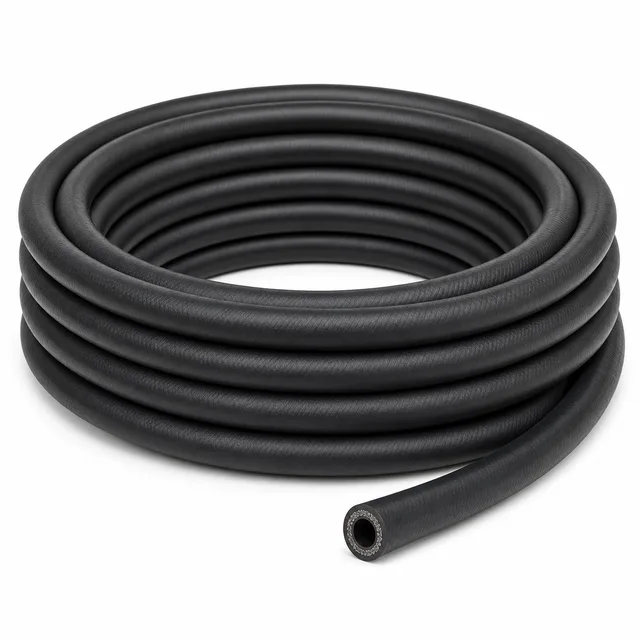
IMPORTANT: reference data — may differ from the physical product; verify with an advisor before buying.
VT-86961 · SAE 100 R1 hydraulic hose, sold by roll
1. TECHNICAL SPECIFICATIONS
| Nominal | ID mm | OD mm | W/P psi/bar | B/P psi/bar | Min. bend radius mm | Approx. weight kg/m |
|---|---|---|---|---|---|---|
| 3/16″ | 4.8 | 12.5 | 3150/217 | 12180/840 | 90 | 0.20 |
| 1/4″ | 6.4 | 13.6 | 2880/199 | 11165/770 | 100 | 0.25 |
| 5/16″ | 7.9 | 15.2 | 2650/183 | 10150/700 | 115 | 0.31 |
| 3/8″ | 9.5 | 17.6 | 2355/162 | 9135/630 | 125 | 0.36 |
| 1/2″ | 12.7 | 20.7 | 2100/145 | 8120/560 | 180 | 0.45 |
| 5/8″ | 15.9 | 24.0 | 1575/109 | 6090/420 | 205 | 0.52 |
| 3/4″ | 19.0 | 28.0 | 1305/90 | 5075/350 | 240 | 0.65 |
| 1″ | 25.4 | 36.0 | 1050/72 | 4060/280 | 300 | 0.91 |
| 1-1/4″ | 31.8 | 44.2 | 645/44 | 2538/175 | 420 | 1.3 |
| 1-1/2″ | 38.1 | 51.0 | 525/36 | 2030/140 | 500 | 1.7 |
| 2″ | 50.8 | 64.0 | 390/27 | 1523/105 | 630 | 2.0 |
| Parameter | Value |
|---|---|
| Inner tube | Oil-resistant synthetic rubber (NBR/SBR type) |
| Reinforcement | One high-tensile steel wire braid |
| Cover | Weather- and abrasion-resistant synthetic rubber |
| Service temperature | -40 °C to +121 °C (-40 °F to +250 °F) |
| Burst ratio | 4:1 over working pressure, per SAE J517 |
IMPORTANT
This technical data sheet is a reference guide to the properties of this product type; it is not a quality certificate for the product you are buying. The measurements, dimensions and physical or geometric characteristics of the product supplied may vary by manufacturer, heat and lot, and may even fall outside the cited standards. If any of these figures is critical to your design or build, verify it with one of our advisors against the physical product or the lot's mill certificate, so you can be fully certain of what you are buying. · Original data sheet: tectul.com/en/conduccion-de-fluidos/mangueras/ficha-tecnica-manguera-jason.html
2. R1 (single braid) vs. R2 (double braid)
SAE J517 defines R1 and R2 with the same tube and cover, but R2 adds a second steel braid over the first. That second braid is what separates the two families in pressure: at the same diameter, the R2 construction holds roughly double the working pressure of R1 (see the catalog's SAE 100R2-AT sheet for the full table). The practical consequence is one of selection, not quality: a low-pressure return line does not need to pay for the second braid, while a high-pressure line does, to avoid operating above the design factor. Use this R1 table when the system pressure, already with its safety margin, falls below the W/P of the matching row; if it does not, move up to R2.
Minimum bend radius
The table's minimum bend radius is the point where the steel braid starts kinking instead of flexing: installing tighter than that radius shortens the hose's fatigue life even if it never fails by pressure. At 1/2″ the minimum is 180 mm; at 2″ it rises to 630 mm.
3. FREQUENTLY ASKED QUESTIONS
What is the difference between this R1 hose and the catalog's R1-AT?
The R1-AT ("at temperature") is an SAE 100R1 variant with tube and cover compounds formulated for an extended thermal range; this sheet covers the standard single-braid R1 construction, -40 °C to +121 °C. Confirm with the supplier which construction the specific reference you are buying uses.
Can I use this hose for high-pressure return lines?
Only if the system's working pressure is below the table's W/P for that diameter. If the system operates above that, the two-braid construction (SAE 100R2) is required.
What standard sets this hose's safety factor?
SAE J517 (one- and two-wire-braid hydraulic hose) sets a minimum 4:1 burst ratio over the declared working pressure, which is the W/P-to-B/P relationship shown in the table.
4. Application notes
Feasibility
Select by the system's working pressure (with margin), not by burst pressure: B/P is a design limit, not a continuous-operation value.
Installation
Respect the table's minimum bend radius; do not twist the hose while fitting the end connection — the steel braid loses pressure capacity if it untwists in service.
Design
The crimp fitting must match the single-braid construction; a two-braid fitting does not seal correctly on this hose.
5. Technical notice and limitation of liability
The pressures, dimensions, weights and other characteristics in this sheet are theoretical calculation values obtained from nominal properties published in the standards cited (ASME B36.10-2022, ASME B31.3-2024, ASTM A106/A106M-19a, ASTM A53/A53M-24, API Spec 5L 46th ed.). They guide selection; they are not a certificate of conformity for any given lot.
The actual behavior of each lot varies with manufacturing — wall tolerance (up to −12.5%), out-of-roundness, residual stresses — and with the raw material — chemical composition within the ranges the standard allows, heat-to-heat differences. To certify a lot, the tests defined by its product standard are required: tensile test, flattening test and hydrostatic test, documented in the manufacturer's mill test certificate (MTC), which TECTUL supplies upon request; testing of the lot in an independent laboratory can also be arranged.
These values must not be used as the sole criterion in critical or safety applications, or wherever failure of the line may compromise people, property or the environment: in such cases the design belongs to the project's responsible engineer under the applicable code (ASME B31.3, B31.1 or the one governing the installation), with the design temperature, corrosion allowance and load cases of the actual service. Before deciding with these data, consult our technical team.
Sources
- SAE J517-2020 (Hydraulic Hose)
- SAE 100R1 / EN 853 1SN (designación de construcción de una trenza)
- Ficha de fabricante «Manguera SAE 100 R1» (archivo interno)
This data sheet is the property of TECTUL, part of the Industrias IMR group. Reproduction without attribution is prohibited. Original document and updates: tectul.com/en/conduccion-de-fluidos/mangueras/ficha-tecnica-manguera-jason.