
Textile-reinforced rubber hoses for air and water — mining 600/300 psi, multipurpose 360/200 psi and air-water 300/200 psi
TECTUL · Dispatch across Colombia · Exports to Central & South America
Rubber hose with polyester or textile mesh reinforcement, in six constructions covering general-purpose compressed air and heavy mining industry (600 and 300 psi, SBR tube/NBR cover), multipurpose applications with oil and fuel contact (360 and 200 psi, NBR tube and cover) and outdoor air/water discharge (300 and 200 psi, EPDM tube and cover). Diameters from 3/16″ to 4″ depending on construction; no single reference covers the full range and figures from each construction are not averaged together.
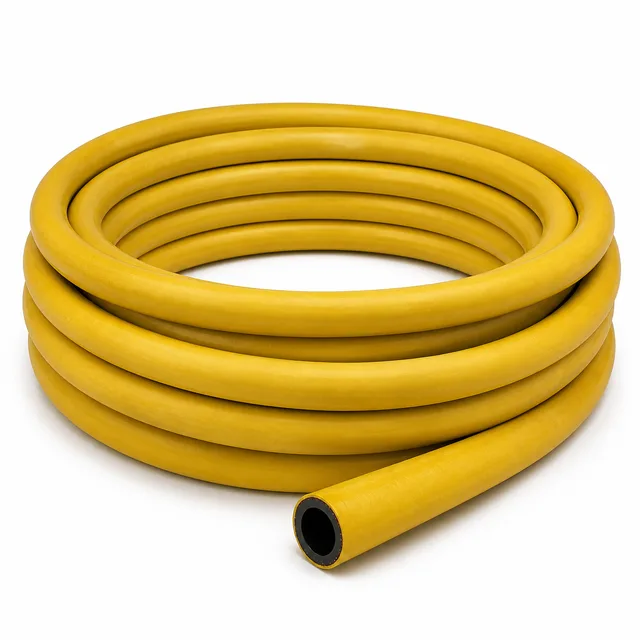
IMPORTANT: reference data — may differ from the physical product; verify with an advisor before buying.
SKU VT-142190 (mining air hose 600 psi) · 5 sibling constructions with their own data sheet + 1 commercial alias · sold by the meter or roll
1. Technical specifications
Materials by construction
| Construction (SKU/product) | Inner tube | Reinforcement | Cover | Source |
|---|---|---|---|---|
| Mining Air Hose 600 psi (VT-142190) — main reference of this sheet | Black SBR | High-tension polyester, 4 plies (6 plies at 3″–4″) | Orange NBR | Manufacturer data sheet Mining Air Hose 600 psi (TECTUL internal file) |
| Mining Air Hose 300 psi | Black SBR | High-tension polyester, 2 plies (1/2″–3/4″) or 4–6 plies on the rest | Yellow NBR | Manufacturer data sheet Mining Air Hose 300 psi (TECTUL internal file) |
| Multipurpose Hose Textile Cover | Nitrile (NBR) with high resistance to mineral oils | 1 ply + high heat-resistance textile mesh | Textile mesh | Manufacturer data sheet Multipurpose Hose Textile Cover (TECTUL internal file) |
| Multipurpose Hose 200 psi | NBR | High-tension polyester | NBR | Manufacturer data sheet Multipurpose Hose 200 psi (TECTUL internal file) |
| Air and Water Hose 300 psi | EPDM | High-tension polyester, 1 ply | EPDM | Manufacturer data sheet Air and Water Hose 300 psi (TECTUL internal file) |
| Air and Water Hose 200 psi | EPDM | High-tension polyester, 1 ply | EPDM | Manufacturer data sheet Air and Water Hose 200 psi (TECTUL internal file) |
IMPORTANT
This technical data sheet is a reference guide to the properties of this product type; it is not a quality certificate for the product you are buying. The measurements, dimensions and physical or geometric characteristics of the product supplied may vary by manufacturer, heat and lot, and may even fall outside the cited standards. If any of these figures is critical to your design or build, verify it with one of our advisors against the physical product or the lot's mill certificate, so you can be fully certain of what you are buying. · Original data sheet: tectul.com/en/conduccion-de-fluidos/mangueras/ficha-tecnica-manguera-para-aire-mineria-600-psi.html
The commercial reference "Milano/Gummi air hose" (alias of this sheet) has no dedicated manufacturer data sheet in the TECTUL internal archive; its exact construction within this family is confirmed on quotation.
Working and burst pressure by construction — not averaged across data sheets
| Construction | Diameter range | W/P (working) | B/P (burst) | Declared safety factor | Service temperature | Source |
|---|---|---|---|---|---|---|
| Mining Air Hose 600 psi | 1/2″–4″ (12.7–101.6 mm ID) | 600 psi / 41.3 bar | 1800 psi / 124 bar | Not declared on the manufacturer sheet — confirmed on quotation | Not declared on the manufacturer sheet — confirmed on quotation | Mining Air Hose 600 psi data sheet |
| Mining Air Hose 300 psi | 1/2″–4″ (12.7–101.6 mm ID) | 300 psi / 20 bar | 900 psi / 60 bar | Not declared — confirmed on quotation | Not declared — confirmed on quotation | Mining Air Hose 300 psi data sheet |
| Multipurpose Hose Textile Cover | 3/16″–1″ (4.8–25.4 mm ID) | 360 psi / 25 bar | 870 psi / 60 bar | 1:2:4 | −40 °C to +100 °C (−40 °F to 212 °F) | Multipurpose Hose Textile Cover data sheet |
| Multipurpose Hose 200 psi | 3/16″–2″ (4.8–50.8 mm ID) | 200 psi / 13.8 bar | 600 psi / 41.4 bar | 1:3 | −40 °C to +100 °C (−40 °F to 212 °F) | Multipurpose Hose 200 psi data sheet |
| Air and Water Hose 300 psi | 3/16″–2″ (4.8–50.8 mm ID) | 300 psi / 20 bar | 900 psi / 60 bar | 1:3 | −20 °C to +100 °C (−4 °F to 212 °F) | Air and Water Hose 300 psi data sheet |
| Air and Water Hose 200 psi | 3/16″–2″ (4.8–50.8 mm ID) | 200 psi / 13.8 bar | 600 psi / 41.3 bar | 1:3 | −20 °C to +100 °C (−4 °F to 212 °F) | Air and Water Hose 200 psi data sheet |
IMPORTANT: reference data — may differ from the physical product; verify with an advisor before buying.
Each row reproduces the values from ITS OWN manufacturer data sheet. Figures are not averaged or interpolated across constructions: a "Mining Air Hose 300 psi" does not inherit the temperature of the "Air and Water" line, or vice versa.
Dimensional table — Mining Air Hose 600 psi (main reference, VT-142190)
| Nominal [in] | ID mm | OD mm | Reinforcement (plies) | W/P psi/bar | B/P psi/bar | Approx. weight [kg/m] |
|---|---|---|---|---|---|---|
| 1/2″ | 12,7 | 24,7 | 4 | 600 / 41,3 | 1800 / 124 | 0,290 |
| 3/4″ | 19,0 | 31,1 | 4 | 600 / 41,3 | 1800 / 124 | 0,510 |
| 1″ | 25,4 | 36,0 | 4 | 600 / 41,3 | 1800 / 124 | 0,847 |
| 1-1/4″ | 31,8 | 44,0 | 4 | 600 / 41,3 | 1800 / 124 | 1,209 |
| 1-1/2″ | 38,1 | 50,0 | 4 | 600 / 41,3 | 1800 / 124 | 1,372 |
| 2″ | 50,8 | 65,0 | 4 | 600 / 41,3 | 1800 / 124 | 2,195 |
| 2-1/2″ | 63,5 | 79,0 | 4 | 600 / 41,3 | 1800 / 124 | 2,873 |
| 3″ | 76,2 | 92,0 | 6 | 600 / 41,3 | 1800 / 124 | 3,586 |
| 4″ | 101,6 | 124,0 | 6 | 600 / 41,3 | 1800 / 124 | 6,720 |
IMPORTANT: reference data — may differ from the physical product; verify with an advisor before buying.
Dimensional table — Mining Air Hose 300 psi
| Nominal [in] | ID mm | OD mm | Reinforcement (plies) | W/P psi/bar | B/P psi/bar | Approx. weight [kg/m] |
|---|---|---|---|---|---|---|
| 1/2″ | 12,7 | 24,7 | 2 | 300 / 20 | 900 / 60 | 0,290 |
| 3/4″ | 19,0 | 31,1 | 2 | 300 / 20 | 900 / 60 | 0,510 |
| 1″ | 25,4 | 36,0 | 4 | 300 / 20 | 900 / 60 | 0,847 |
| 1-1/4″ | 31,8 | 44,0 | 4 | 300 / 20 | 900 / 60 | 1,209 |
| 1-1/2″ | 38,1 | 50,0 | 4 | 300 / 20 | 900 / 60 | 1,372 |
| 2″ | 50,8 | 65,0 | 4 | 300 / 20 | 900 / 60 | 2,195 |
| 2-1/2″ | 63,5 | 79,0 | 4 | 300 / 20 | 900 / 60 | 2,873 |
| 3″ | 76,2 | 92,0 | 6 | 300 / 20 | 900 / 60 | 3,586 |
| 4″ | 101,6 | 124,0 | 6 | 300 / 20 | 900 / 60 | 6,720 |
IMPORTANT: reference data — may differ from the physical product; verify with an advisor before buying.
Dimensional table — Multipurpose Hose Textile Cover
| Nominal [in] | ID mm | OD mm | Reinforcement (plies) | W/P psi/bar | B/P psi/bar | Approx. weight [kg/m] |
|---|---|---|---|---|---|---|
| 3/16″ | 5,0 | 11,0 | 1 | 360 / 25 | 870 / 60 | 0,07 |
| 1/4″ | 6,0 | 12,7 | 1 | 360 / 25 | 870 / 60 | 0,09 |
| 5/16″ | 8,0 | 14,2 | 1 | 360 / 25 | 870 / 60 | 0,11 |
| 3/8″ | 10,0 | 16,0 | 1 | 360 / 25 | 870 / 60 | 0,13 |
| 1/2″ | 13,0 | 19,0 | 1 | 360 / 25 | 870 / 60 | 0,18 |
| 5/8″ | 15,8 | 23,0 | 1 | 360 / 25 | 870 / 60 | 0,28 |
| 3/4″ | 19,0 | 26,2 | 1 | 360 / 25 | 870 / 60 | 0,31 |
| 1″ | 25,4 | 32,0 | 1 | 360 / 25 | 870 / 60 | 0,34 |
IMPORTANT: reference data — may differ from the physical product; verify with an advisor before buying.
Dimensional table — Multipurpose Hose 200 psi
| Nominal [in] | ID mm | OD mm | Reinforcement (plies) | W/P psi/bar | B/P psi/bar | Approx. weight [kg/m] |
|---|---|---|---|---|---|---|
| 3/16″ | 5,0 | 11,0 | — | 200 / 13,8 | 600 / 41,4 | 0,14 |
| 1/4″ | 6,0 | 13,0 | — | 200 / 13,8 | 600 / 41,4 | 0,15 |
| 5/16″ | 8,0 | 16,0 | — | 200 / 13,8 | 600 / 41,4 | 0,20 |
| 3/8″ | 10,0 | 17,0 | — | 200 / 13,8 | 600 / 41,4 | 0,22 |
| 1/2″ | 13,0 | 20,0 | — | 200 / 13,8 | 600 / 41,4 | 0,30 |
| 5/8″ | 15,8 | 25,0 | — | 200 / 13,8 | 600 / 41,4 | 0,45 |
| 3/4″ | 19,0 | 28,0 | — | 200 / 13,8 | 600 / 41,4 | 0,50 |
| 1″ | 25,4 | 35,0 | — | 200 / 13,8 | 600 / 41,4 | 0,70 |
| 1-1/4″ | 31,7 | 44,0 | — | 200 / 13,8 | 600 / 41,4 | 1,20 |
| 1-1/2″ | 38,0 | 53,0 | — | 200 / 13,8 | 600 / 41,4 | 1,50 |
| 2″ | 50,8 | 66,0 | — | 200 / 13,8 | 600 / 41,4 | 1,90 |
IMPORTANT: reference data — may differ from the physical product; verify with an advisor before buying.
Dimensional table — Air and Water Hose 300 psi
| Nominal [in] | ID mm | OD mm | Reinforcement (plies) | W/P psi/bar | B/P psi/bar | Approx. weight [kg/m] |
|---|---|---|---|---|---|---|
| 3/16″ | 5,0 | 11,0 | 1 | 300 / 20 | 900 / 60 | 0,16 |
| 1/4″ | 6,0 | 13,0 | 1 | 300 / 20 | 900 / 60 | 0,15 |
| 5/16″ | 6,0 | 15,0 | 1 | 300 / 20 | 900 / 60 | 0,22 |
| 3/8″ | 10,0 | 17,0 | 1 | 300 / 20 | 900 / 60 | 0,25 |
| 1/2″ | 13,0 | 20,0 | 1 | 300 / 20 | 900 / 60 | 0,32 |
| 5/8″ | 15,8 | 25,0 | 1 | 300 / 20 | 900 / 60 | 0,47 |
| 3/4″ | 19,0 | 28,0 | 1 | 300 / 20 | 900 / 60 | 0,53 |
| 1″ | 25,4 | 35,0 | 1 | 300 / 20 | 900 / 60 | 0,73 |
| 1-1/4″ | 31,7 | 44,0 | 1 | 300 / 20 | 900 / 60 | 1,50 |
| 1-1/2″ | 38,0 | 53,0 | 1 | 300 / 20 | 900 / 60 | 1,70 |
| 2″ | 50,8 | 66,0 | 1 | 300 / 20 | 900 / 60 | 2,04 |
IMPORTANT: reference data — may differ from the physical product; verify with an advisor before buying.
Dimensional table — Air and Water Hose 200 psi
| Nominal [in] | ID mm | OD mm | Reinforcement (plies) | W/P psi/bar | B/P psi/bar | Approx. weight [kg/m] |
|---|---|---|---|---|---|---|
| 3/16″ | 5,0 | 11,0 | 1 | 200 / 13,8 | 600 / 41,3 | 0,16 |
| 1/4″ | 6,0 | 13,0 | 1 | 200 / 13,8 | 600 / 41,3 | 0,15 |
| 5/16″ | 6,0 | 15,0 | 1 | 200 / 13,8 | 600 / 41,3 | 0,22 |
| 3/8″ | 10,0 | 17,0 | 1 | 200 / 13,8 | 600 / 41,3 | 0,25 |
| 1/2″ | 13,0 | 20,0 | 1 | 200 / 13,8 | 600 / 41,3 | 0,32 |
| 5/8″ | 15,8 | 25,0 | 1 | 200 / 13,8 | 600 / 41,3 | 0,47 |
| 3/4″ | 19,0 | 28,0 | 1 | 200 / 13,8 | 600 / 41,3 | 0,53 |
| 1″ | 25,4 | 35,0 | 1 | 200 / 13,8 | 600 / 41,3 | 0,73 |
| 1-1/4″ | 31,7 | 44,0 | 1 | 200 / 13,8 | 600 / 41,3 | 1,50 |
| 1-1/2″ | 38,0 | 53,0 | 1 | 200 / 13,8 | 600 / 41,3 | 1,70 |
| 2″ | 50,8 | 66,0 | 1 | 200 / 13,8 | 600 / 41,3 | 2,04 |
IMPORTANT: reference data — may differ from the physical product; verify with an advisor before buying.
General specifications
| Product | Industrial rubber hoses with textile/polyester reinforcement, for conveyance and discharge of compressed air and water, in six distinct rating and material constructions |
| Presentation | Rolls: 30–60 m (mining), 50–100 m (multipurpose), 100 m (air and water) — varies by construction, see the corresponding manufacturer sheet |
| Ends | Bulk hose for coupling with barb, camlock or clamp fittings selected by the customer — fittings not included |
| Sale | By the meter or by the roll, per reference and diameter — |
| Standards cited as reference framework (not as certification of this reference) | ISO 2398:2024 (textile-reinforced rubber hoses for compressed air) — see section 2 |
2. How to choose the construction by service
The criterion is not "more psi is better": it is tube, cover and environment
These six constructions are not a single pressure scale: they are three material families with different selection logics. Choosing by the psi number alone, without looking at tube and cover, leads to buying a hose that fails from the wrong fluid before it fails from the wrong pressure.
SBR/NBR (Mining 600 and 300 psi line): abrasion first
The SBR tube with NBR cover prioritizes abrasion and weather resistance on site and underground — it declares no hydrocarbon resistance. It is the correct construction for general compressed air in heavy-duty work environments (drilling, pneumatic hammers, air cleaning) where mechanical wear from dragging the hose over rock and debris is the dominant risk, not oil contact.
NBR (Multipurpose 360 and 200 psi line): oil and fuel resistance
Nitrile (NBR) is the industry-standard choice when the fluid includes mineral oils, gasoline or petroleum derivatives at low-to-moderate concentration: by chemical structure it resists hydrocarbons far better than SBR or EPDM, at the cost of weaker weather and ozone resistance than EPDM. The manufacturer sheet for both multipurpose variants explicitly declares resistance to "oils, gasoline and petroleum derivatives" — that is the technical, not commercial, reason to choose this line over the air-and-water one whenever fuel lines are involved.
EPDM (Air and Water 300 and 200 psi line): weather and UV, oil only at low concentration
EPDM gives the best UV, ozone and weather resistance of the three families — that is why the manufacturer declares the cover "resistant to UV solar rays" only on this line — but its chemical limit is the opposite of NBR's: hydrocarbon exposure swells EPDM and degrades its mechanical integrity. The manufacturer itself limits the inner tube to "mineral oils in low concentration"; it is not the right construction for sustained fuel or pure oil discharge, though it is for compressed air and water outdoors.
Mining installation: the safety rule nobody in the Spanish SERP mentions
For the two mining constructions (600 and 300 psi), US mine safety regulation 30 CFR §56.13021 / §57.13021 requires safety chains or other suitable locking devices at connections of high-pressure hose lines 3/4″ inside diameter or larger to machines, where connection failure would create a hazard — or, alternatively, automatic shutoff valves. The "high-pressure" threshold used by the analogous section 30 CFR §75.1730(e) is 100 psi or more: all six constructions in this sheet exceed it across their full working range. Although this is a US-jurisdiction rule, the engineering principle — mechanically restraining every high-pressure air hose connection — applies equally in mines and industry in any country.
Contrast regulatory framework: ISO 2398:2024
ISO 2398:2024, "Rubber hoses, textile-reinforced, for compressed air — Specification", is the current international standard for textile-reinforced rubber hoses for compressed air: it defines three types, three classes and two categories, with a maximum working pressure of 2.5 MPa (25 bar) and a service temperature range of −40 °C to +70 °C depending on type and category. It is cited here as an industry classification framework, not as a certificate for this reference: none of the six constructions in this catalog declares explicit ISO 2398 conformance on its manufacturer sheet, and the exact type/class/category designation is confirmed on quotation.
3. Construction, chemical compatibility and installation
Why the inner tube governs chemical compatibility, not the cover
In a layered hose, the inner tube is the only surface in permanent contact with the conveyed fluid; the cover only protects against the outside environment (abrasion, UV, ozone, spilled oils). That is why two hoses with the same NBR cover (Mining and Multipurpose) have different uses: what changes is the tube (SBR vs NBR), and that is what decides whether the inner fluid is compatible.
| Elastomer | Hydrocarbon resistance (oils/fuels) | Ozone/weather/UV resistance | Typical use in this family |
|---|---|---|---|
| SBR (styrene-butadiene) | Low — no hydrocarbon resistance declared | Low-medium | Tube of both mining constructions: prioritizes mechanical abrasion, not oil contact |
| NBR (nitrile) | High — resists oils, gasoline and petroleum derivatives | Low — degrades with ozone and UV without additional protection | Tube and cover of both multipurpose constructions: fuel lines and general industrial applications |
| EPDM (ethylene propylene diene) | Low — swells and loses mechanical integrity with hydrocarbons; the manufacturer limits the tube to "mineral oils in low concentration" | Best of the three — the reference elastomer for UV, ozone and weather exposure | Tube and cover of both air-and-water constructions: outdoors, water discharge, air with oil traces |
General chemical behavior comparison of each elastomer, per hose and seal industry material compatibility guides (Parker Hose Chemical Resistance Guide; ERIKS O-Ring Technical Handbook — Basic Elastomers). It does not replace a specific compatibility test with the project's actual fluid and concentration.
Safety factor: why it is not the same across constructions
Both multipurpose lines and both air-and-water lines declare a 1:3 safety factor (burst pressure is 3 times working pressure), except the Multipurpose Hose Textile Cover, which declares 1:2:4 (likely manufacturer notation for a stepped margin; the exact reading is confirmed on quotation). Both mining constructions declare no safety factor on their sheet, although the observed W/P-to-B/P ratio in the table (600/1800 and 300/900) is also 1:3 — a coincidence with the rest of the family, not an explicit manufacturer statement.
Installation and handling
Do not exceed the declared working pressure (W/P) per construction; the burst pressure (B/P) is the material's failure limit, not an operating margin. Bleed the air line before disconnecting; a pressurized hose that comes loose suddenly is the typical cause of the accidents the mining regulation cited in section 2 seeks to prevent with safety chains. Store in rolls without sharp bends below the manufacturer's minimum bend radius, protected from direct UV rays if the construction is not EPDM, and verify the inner tube's chemical compatibility with the actual fluid before commissioning.
4. Frequently asked questions
Which of the six constructions works for a shop air compressor?
For general compressed air with no oil or fuel contact, the Air and Water line (200 or 300 psi, EPDM) or the Mining Air line (300 and 600 psi, SBR/NBR) are the technical candidates; the choice between them depends on whether the environment is outdoor/UV exposure (EPDM) or heavy mechanical abrasion on site or underground (SBR/NBR). For lines with oil or gasoline contact, the Multipurpose line (NBR) is the one that declares that resistance.
Can I use the Air and Water hose to discharge hydraulic oil?
Not for sustained service: the manufacturer limits the EPDM tube to "mineral oils in low concentration". A hydrocarbon at high or continuous concentration swells EPDM and degrades its mechanical integrity. For oil or fuel lines, use the Multipurpose construction with an NBR tube, which does declare resistance to "oils, gasoline and petroleum derivatives".
Why does the mining hose not declare a service temperature when the other five do?
Because the manufacturer sheet for both mining constructions (600 and 300 psi) does not publish that figure — unlike the other four constructions, which do declare it explicitly. It must not be assumed to share the −40 °C to +100 °C range of the multipurpose line or the −20 °C to +100 °C range of the air-and-water line: the figure is confirmed on quotation with the real manufacturer.
Is the "Milano/Gummi air hose" the same as the 600 psi mining hose?
Not necessarily. It is a commercial alias of this sheet because it belongs to the same family of reinforced rubber hoses for air, but its specific manufacturer sheet does not exist in the TECTUL internal archive: its exact construction (tube, cover, rating) among the six documented here is confirmed on quotation before assuming it shares figures with any of the other five.
What does it mean that the rating is "W/P" and "B/P" rather than a class or schedule?
W/P (working pressure) is the maximum continuous operating pressure recommended by the manufacturer; B/P (burst pressure) is the pressure at which the material fails in a destructive test, not an operating point. Unlike a pipe with a schedule or a valve with an ASME class, these hoses are specified directly by their declared W/P–B/P pair on the manufacturer sheet, with no published temperature-derating table — that is why the service range, when it exists, is declared as a single interval rather than a pressure-temperature curve.
5. Application notes
Feasibility
This family covers general-purpose compressed air and heavy mining industry (SBR/NBR), applications with oil or fuel contact (NBR) and outdoor air/water discharge (EPDM). It is not specified for continuous hydrocarbon service on the air-and-water line (EPDM), nor for prolonged outdoor exposure without additional protection on the multipurpose line (NBR). The mining construction declares neither service temperature nor safety factor on its manufacturer sheet and both figures are confirmed on quotation.
Installation
Do not exceed the declared working pressure (W/P) per construction. On mining installations, mechanically restrain every high-pressure hose connection of 3/4″ or larger with a safety chain or other locking device, per the 30 CFR §56.13021/§57.13021 criterion cited in section 2. Bleed the line before disconnecting and verify the inner tube's chemical compatibility with the actual fluid before commissioning.
Design
Select the construction by the contact fluid first and by pressure second: SBR/NBR for mechanical abrasion without hydrocarbons, NBR for oils and fuels, EPDM for outdoor/UV exposure with hydrocarbons only at low concentration. None of the six constructions declares explicit ISO 2398 conformance on its manufacturer sheet; if the project requires that standard, quote a reference that declares it explicitly. Final responsibility for rating, material and bend-radius selection rests with the system designer per the project's applicable code.
6. Technical notice and limitation of liability
The pressures, dimensions, weights and other characteristics in this sheet are theoretical calculation values obtained from nominal properties published in the standards cited (ASME B36.10-2022, ASME B31.3-2024, ASTM A106/A106M-19a, ASTM A53/A53M-24, API Spec 5L 46th ed.). They guide selection; they are not a certificate of conformity for any given lot.
The actual behavior of each lot varies with manufacturing — wall tolerance (up to −12.5%), out-of-roundness, residual stresses — and with the raw material — chemical composition within the ranges the standard allows, heat-to-heat differences. To certify a lot, the tests defined by its product standard are required: tensile test, flattening test and hydrostatic test, documented in the manufacturer's mill test certificate (MTC), which TECTUL supplies upon request; testing of the lot in an independent laboratory can also be arranged.
These values must not be used as the sole criterion in critical or safety applications, or wherever failure of the line may compromise people, property or the environment: in such cases the design belongs to the project's responsible engineer under the applicable code (ASME B31.3, B31.1 or the one governing the installation), with the design temperature, corrosion allowance and load cases of the actual service. Before deciding with these data, consult our technical team.
Sources
- Ficha técnica de fabricante Aire Minería 600 psi (archivo interno TECTUL, fichas-rescate/ft-mang-aire-mineria-600.pdf)
- Ficha técnica de fabricante Aire Minería 300 psi (archivo interno TECTUL, fichas-rescate/ft-mang-aire-mineria-300.pdf)
- Ficha técnica de fabricante Multipropósito Cubierta Textil (archivo interno TECTUL, fichas-rescate/ft-mang-multi-cub-textil.pdf)
- Ficha técnica de fabricante Multipropósito 200 psi (archivo interno TECTUL, fichas-rescate/ft-mang-multi-200.pdf)
- Ficha técnica de fabricante Aire y Agua 300 psi (archivo interno TECTUL, fichas-rescate/ft-mang-aire-agua-300.pdf)
- Ficha técnica de fabricante Aire y Agua 200 psi (archivo interno TECTUL, fichas-rescate/ft-mang-aire-agua-200.pdf)
- ISO 2398:2024 — Rubber hoses, textile-reinforced, for compressed air — Specification (tres tipos/clases/categorías, W/P máx. 2,5 MPa/25 bar, −40 °C a +70 °C; consultada vía iso.org, ago 2026)
- 30 CFR §56.13021 / §57.13021 — Mine Safety and Health Administration (MSHA), cadenas de seguridad o dispositivos de bloqueo en conexiones de manguera de alta presión ≥3/4″ ID (consultada vía arlweb.msha.gov, ago 2026)
- 30 CFR §75.1730(e) — MSHA, definición de "alta presión" como 100 psi o más (consultada vía arlweb.msha.gov, ago 2026)
- Parker Hannifin — Hose Products Division Chemical Resistance Guide (comportamiento general de NBR y EPDM frente a hidrocarburos, ozono e intemperie)
- ERIKS N.V. — O-Ring Technical Handbook, sección "Basic Elastomers" (rangos de temperatura y compatibilidad química de SBR, NBR y EPDM)
This data sheet is the property of TECTUL, part of the Industrias IMR group. Reproduction without attribution is prohibited. Original document and updates: tectul.com/en/conduccion-de-fluidos/mangueras/ficha-tecnica-manguera-para-aire-mineria-600-psi.