
Food-grade rubber suction and discharge hose — white EPDM/nitrile inner tube, 3/4″–5″
TECTUL · Dispatch across Colombia · Exports to Central & South America
Food suction and discharge hose with a white EPDM/nitrile inner tube —white is a hygiene choice: it lets residue, staining or tube wear be spotted at a glance—, polyester textile reinforcement with a steel helix and a nitrile cover resistant to mineral oils. Covers 3/4″ to 5″ in a 60 m roll, with two factory pressure steps: 175 psi (12.1 bar) working on 3/4″–2″ and 150 psi (10.3 bar) on 2-1/2″–5″, both at a 1:3 safety factor against burst. Service range −20 °C to +100 °C. It is the larger-diameter, higher-pressure of the two food hose sheets in the TECTUL catalog; its PVC sibling (smaller diameter, no steel reinforcement) lives on a separate sheet.
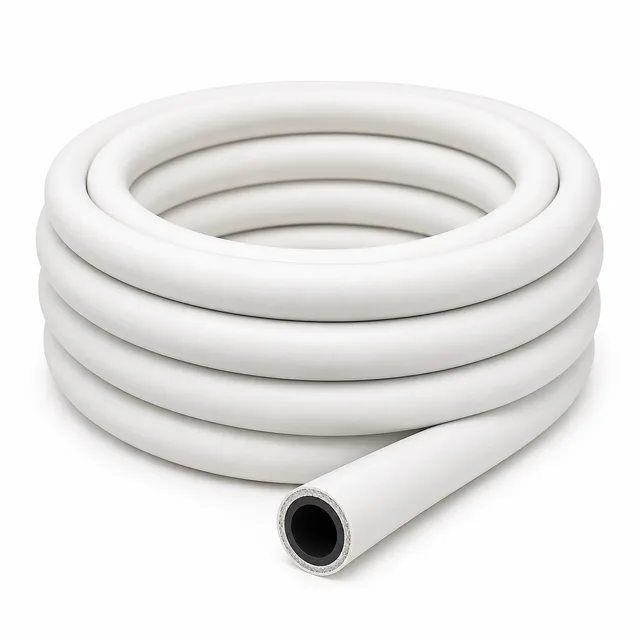
IMPORTANT: reference data — may differ from the physical product; verify with an advisor before buying.
SKU VT-142180 (rubber food hose) · 9 diameter references, 3/4″–5″ · sold by the 60 m roll
1. Technical specifications
Materials by component
| Component | Material | Function |
|---|---|---|
| Inner tube | White EPDM/nitrile | Food-contact surface; white lets staining, grease residue or tube wear be spotted at a glance |
| Reinforcement | High-tension polyester + steel helix | Resists vacuum collapse during suction and gives the hose permanent shape |
| Cover | Nitrile | Resistant to mineral oils and surface abrasion |
Dimensions and pressures by diameter (manufacturer data sheet)
| Nominal | ID mm (in) | OD mm | Reinforcements | Working (WP) | Burst (BP) | Approx. weight (kg/m) |
|---|---|---|---|---|---|---|
| 3/4″ | 19.0 (0.75″) | 30.5 | 2 | 175 psi (12.1 bar) | 525 psi (36.2 bar) | 0.72 |
| 1″ | 25.4 (1.00″) | 34.0 | 2 | 175 psi (12.1 bar) | 525 psi (36.2 bar) | 0.81 |
| 1-1/4″ | 31.8 (1.25″) | 42.0 | 2 | 175 psi (12.1 bar) | 525 psi (36.2 bar) | 1.02 |
| 1-1/2″ | 38.1 (1.50″) | 48.0 | 2 | 175 psi (12.1 bar) | 525 psi (36.2 bar) | 1.30 |
| 2″ | 50.8 (2.00″) | 63.0 | 2 | 175 psi (12.1 bar) | 525 psi (36.2 bar) | 2.09 |
| 2-1/2″ | 63.5 (2.50″) | 76.0 | 2 | 150 psi (10.3 bar) | 450 psi (31.0 bar) | 3.14 |
| 3″ | 76.2 (3.00″) | 91.0 | 2 | 150 psi (10.3 bar) | 450 psi (31.0 bar) | 3.26 |
| 4″ | 101.6 (4.00″) | 118.0 | 2 | 150 psi (10.3 bar) | 450 psi (31.0 bar) | 5.45 |
| 5″ | 127.0 (5.00″) | 143.0 | 4 | 150 psi (10.3 bar) | 250 psi (17.2 bar) | 6.00 |
IMPORTANT
This technical data sheet is a reference guide to the properties of this product type; it is not a quality certificate for the product you are buying. The measurements, dimensions and physical or geometric characteristics of the product supplied may vary by manufacturer, heat and lot, and may even fall outside the cited standards. If any of these figures is critical to your design or build, verify it with one of our advisors against the physical product or the lot's mill certificate, so you can be fully certain of what you are buying. · Original data sheet: tectul.com/en/conduccion-de-fluidos/mangueras/ficha-tecnica-manguera-para-alimentos-en-caucho.html
Note: the burst value the manufacturer sheet publishes for 5″ (250 psi / 17.2 bar) is lower than 3″ and 4″ (450 psi / 31.0 bar) despite carrying more reinforcement layers (4 versus 2), which breaks the 1:3 safety factor of the other sizes (250/150 = 1.7:1). This reference should not be specified at 5″ without confirming the figure directly with the manufacturer.
General specifications
| Product | Rubber hose for suction and discharge of liquid, oily and non-oily foods |
| Material | White food-grade EPDM/nitrile inner tube · polyester textile reinforcement with steel helix · nitrile cover |
| Presentation | 60 m roll (≈197 ft) · 9 diameters, 3/4″ to 5″ |
| Rating | 175 psi (12.1 bar) working on 3/4″–2″ · 150 psi (10.3 bar) on 2-1/2″–5″ · 1:3 safety factor declared by the manufacturer |
| Temperature | −20 °C to +100 °C (−4 °F to 212 °F) |
| Reference standards | FDA 21 CFR 177.2600 (rubber articles intended for repeated food contact use) · NSF/ANSI 51-2025 (food equipment materials) · Resolución 683 de 2012 (Minsalud/INVIMA, Colombia) · ASTM D380-94(2020) (rubber hose test methods) |
IMPORTANT: reference data — may differ from the physical product; verify with an advisor before buying.
2. Food-grade requirements
Why the inner tube is white
The white inner tube is not a cosmetic preference: it is the simplest visual hygiene inspection method available on a food suction hose. Any grease residue, staining, mold or compound wear is immediately visible against the light background, something a black tube hides. It is the same logic applied by this catalog's sister sanitary washing hose sheet.
Regulatory framework for rubber in food contact
FDA 21 CFR 177.2600 (United States) is the provision that specifically regulates rubber articles —including EPDM, nitrile and other elastomers— intended for repeated use in contact with food: it defines the permitted base elastomers, vulcanizing agents, accelerators, antioxidants and other additives, plus extractable limits. It is the correct contrast standard for this hose because the tube is rubber; it does not apply the same way to this catalog's PVC sister sheet, whose regulatory framework differs (see that sheet).
On a broader food-equipment level, NSF/ANSI 51-2025 (Food Equipment Materials) is the North American reference standard for food-contact equipment materials, hoses included. In Colombia, Resolución 683 de 2012 from the Ministry of Health and Social Protection (enforced by INVIMA) is the current technical regulation setting sanitary requirements for materials in contact with food and beverages.
The dairy/food sector additionally uses 3-A Sanitary Standard 18-03 (Multiple-Use Rubber and Rubber-Like Materials as Product Contact Surfaces in Dairy Equipment) as the chemical and thermal compatibility reference against cleaning cycles; it is cited here as an industry framework and does not imply this reference is certified under that mark — lot certification is confirmed on quotation.
What this sheet does NOT certify
None of the cited standards alone certifies the manufactured lot: they establish that the compound type is suitable for design with repeated food contact. Conformance of a specific lot is demonstrated with the manufacturer's certificate (FDA/NSF/INVIMA as applicable), which TECTUL supplies on request.
3. Hygiene, cleaning and storage
Between product batches
Flush the hose with potable water immediately after each use and before a product changeover (for example, between an oil and a dairy product), and inspect the white tube at both ends: any staining that persists after rinsing indicates the compound is retaining residue and its retirement should be evaluated.
Operating limits
- Do not exceed 175 psi (3/4″–2″) or 150 psi (2-1/2″–4″) working pressure; the 1:3 factor against burst is the manufacturer's design margin, not an additional operating margin.
- Respect the steel helix's bend radius: a sharp kink permanently deforms the reinforcement and creates a weak suction point.
- The coupling (camlock, threaded or other) must also be food grade; the coupling itself is not covered by this sheet and is confirmed on quotation.
Storage
Store the hose coiled, shielded from direct sunlight and ozone (both degrade rubber over time, even at rest) and away from heat sources. A hose that has been exposed outdoors for a long period should be inspected for surface cracking before returning to service.
4. Frequently asked questions
Is this hose suitable for direct food contact?
Yes: the inner tube is food-grade white EPDM/nitrile, whose reference regulatory framework is FDA 21 CFR 177.2600 (rubber articles intended for repeated food contact use). The specific lot certificate is confirmed on quotation.
What working pressure does it withstand?
175 psi (12.1 bar) on 3/4″–2″ and 150 psi (10.3 bar) on 2-1/2″–5″, both at the manufacturer's declared 1:3 safety factor against burst pressure. The 5″ reference has a published burst anomaly (250 psi instead of the expected ≈450 psi) that must be confirmed before specifying it.
Why is the inner tube white instead of black?
For hygiene: white makes any staining, greasy residue or compound wear visible that a black tube would hide, easing visual inspection between product batches.
How does it differ from the PVC food hose in the same catalog?
This one is rubber, covers larger diameters (up to 5″ versus 2″ on the PVC), carries a steel helix to resist vacuum collapse under suction, and withstands more pressure and temperature. The PVC one is lighter, with a smooth bore and a transparent reinforcing spiral, intended for gravity transfer or gentle pumping of food liquids, not high-vacuum suction.
5. Application notes
Feasibility
It is the right food suction/discharge hose when a large diameter (up to 5″), vacuum suction (hence the steel helix) or temperature up to 100 °C is required. It is not the right reference for light pumped transfer of food liquids in small diameters with a transparent-bore requirement for visual flow inspection: that is what the PVC sister sheet is for. Do not specify without confirming the lot's food-contact certificate.
Cleaning
Flush with potable water after each use and before every product changeover; inspect the white tube at both ends. Do not exceed 175/150 psi depending on diameter. Store shielded from sun and ozone.
Design
Specify by the diameter and pressure in the section 1 table, never by a single catalog pressure. Confirm before quoting: the lot's FDA/NSF/INVIMA certificate, coupling type and its food-contact compatibility, and the 5″ burst figure. The alias «manguera-succion-alimentos-x-rollo» lists 4 measures without specifying which; verify the exact diameter before assuming equivalence with this table.
6. Technical notice and limitation of liability
The values in this sheet are manufacturer catalog data (internal TECTUL data sheet) and contrast regulatory references (FDA 21 CFR 177.2600, NSF/ANSI 51-2025, Resolución 683 de 2012, ASTM D380-94(2020), 3-A 18-03); they guide selection and are not a certificate of conformance for any lot. The 5″ burst anomaly flagged in section 1 had not been resolved with the manufacturer as of this sheet's date.
Certifying a lot requires the manufacturer's certificate (FDA/NSF/INVIMA as applicable) and, if the project requires it, lot laboratory testing. Final selection of diameter, pressure and coupling type is the responsibility of the system designer.
Sources
- FDA 21 CFR 177.2600 — Rubber articles intended for repeated use (eCFR, consultado ago-2026)
- NSF/ANSI 51-2025 — Food Equipment Materials
- Resolución 683 de 2012 (Ministerio de Salud y Protección Social / INVIMA, Colombia) — Reglamento técnico sobre requisitos sanitarios para materiales en contacto con alimentos y bebidas
- 3-A Sanitary Standard 18-03 — Multiple-Use Rubber and Rubber-Like Materials as Product Contact Surfaces in Dairy Equipment (referencia de la industria; no implica certificación de esta referencia)
- ASTM D380-94(2020) — Standard Test Methods for Rubber Hose
- Ficha técnica de fabricante (archivo interno TECTUL) — Manguera Alimentos en Caucho / Rubber Food Hose
This data sheet is the property of TECTUL, part of the Industrias IMR group. Reproduction without attribution is prohibited. Original document and updates: tectul.com/en/conduccion-de-fluidos/mangueras/ficha-tecnica-manguera-para-alimentos-en-caucho.