
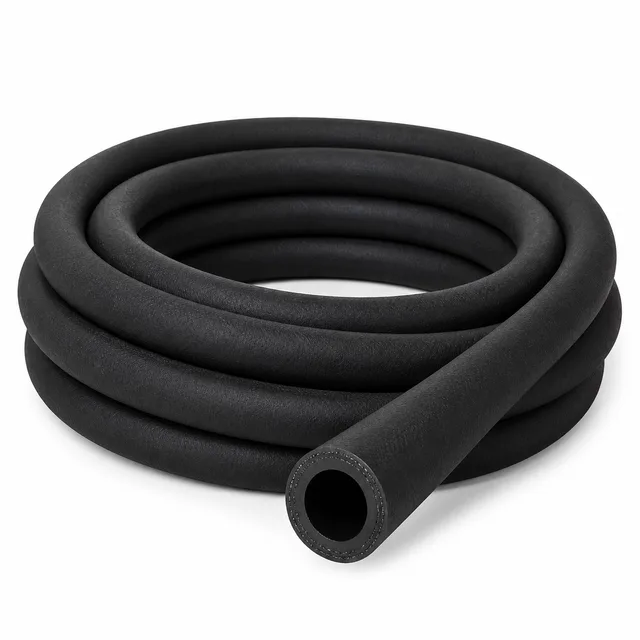
Sandblasting hose — polyester reinforcement and EPDM cover, 1/2"–2"
TECTUL · Dispatch across Colombia · Exports to Central & South America
Rubber hose reinforced with high-tension polyester (2 plies on 1/2"–1-1/4", 4 plies on 1-1/2"–2") and an EPDM rubber cover formulated to minimize static charge buildup during sand or other abrasive blasting. The manufacturer's declared rating is constant across the whole diameter range: 150 psi (10.3 bar) working pressure and 450 psi (31.0 bar) burst pressure, 1:3 safety factor, service between -30 °C and +85 °C. The sheet explains why the reinforcement ply count exactly doubles at the diameter step where the rating stays the same (circumferential/hoop-stress principle) and why static dissipation is not optional in this application: abrasive friction against the rubber generates triboelectric charge that, without a discharge path, exposes the operator to electric shock and can ignite flammable vapor or dust present when stripping coatings.
IMPORTANT: reference data — may differ from the physical product; verify with an advisor before buying.
SKU VT-142177 (sandblasting hose 1/2") · 6 diameters in the catalog, 1/2"–2" · 60 m roll
1. Technical specifications
Rubber hose for sandblasting and other abrasive blasting, with high-tension polyester textile reinforcement and an EPDM (ethylene propylene diene monomer) rubber cover formulated to reduce static charge buildup. TECTUL catalog reference with 6 diameters, all sharing the same manufacturer-declared pressure rating.
| Nominal diameter | Inner diameter | Outer diameter | Reinforcement plies | Working pressure (W/P) | Burst pressure (B/P) |
|---|---|---|---|---|---|
| 1/2" (12.7 mm) | 12.7 mm (0.500 in) | 26.6 mm (1.047 in) | 2 | 150 psi (10.3 bar) | 450 psi (31.0 bar) |
| 3/4" (19.1 mm) | 19.1 mm (0.752 in) | 38.1 mm (1.500 in) | 2 | 150 psi (10.3 bar) | 450 psi (31.0 bar) |
| 1" (25.4 mm) | 25.4 mm (1.000 in) | 47.6 mm (1.874 in) | 2 | 150 psi (10.3 bar) | 450 psi (31.0 bar) |
| 1-1/4" (31.8 mm) | 31.8 mm (1.252 in) | 48.0 mm (1.890 in) | 2 | 150 psi (10.3 bar) | 450 psi (31.0 bar) |
| 1-1/2" (38.1 mm) | 38.1 mm (1.500 in) | 60.0 mm (2.362 in) | 4 | 150 psi (10.3 bar) | 450 psi (31.0 bar) |
| 2" (50.8 mm) | 50.8 mm (2.000 in) | 72.6 mm (2.858 in) | 4 | 150 psi (10.3 bar) | 450 psi (31.0 bar) |
IMPORTANT
This technical data sheet is a reference guide to the properties of this product type; it is not a quality certificate for the product you are buying. The measurements, dimensions and physical or geometric characteristics of the product supplied may vary by manufacturer, heat and lot, and may even fall outside the cited standards. If any of these figures is critical to your design or build, verify it with one of our advisors against the physical product or the lot's mill certificate, so you can be fully certain of what you are buying. · Original data sheet: tectul.com/en/conduccion-de-fluidos/mangueras/ficha-tecnica-manguera-para-chorro-de-arena.html
General specifications
| Product | Rubber hose for sandblasting and abrasives, 60 m roll presentation |
| Material | EPDM rubber inner tube and cover · high-tension polyester reinforcement (2 plies on 1/2"–1-1/4", 4 plies on 1-1/2"–2") |
| Working pressure (W/P) | 150 psi (10.3 bar), constant across all 6 catalog sizes |
| Burst pressure (B/P) | 450 psi (31.0 bar), constant across all 6 sizes — 1:3 safety factor |
| Service temperature | -30 °C to +85 °C (-22 °F to 185 °F) |
| Presentation | 60 m roll · 6 diameters, 1/2"–2" |
| Reference standard | ISO 3861:2021 (rubber hoses and hose assemblies for sand and grit blasting) — see section 2 for the contrast with the manufacturer's declared rating |
2. Why reinforcement doubles without changing the declared pressure
The detail that stands out in the table
All six catalog sizes share exactly the same rating: 150 psi working, 450 psi burst. Yet the reinforcement ply count jumps from 2 to 4 right at the 1-1/4" to 1-1/2" step. This is not an error in the manufacturer's data sheet: it is the direct consequence of how the stress the reinforcement must resist grows with diameter at constant pressure.
The principle: circumferential (hoop) stress
In a thin-walled cylindrical body under internal pressure, the circumferential (hoop) tension the wall — or, in a hose, the textile reinforcement — must withstand is approximately T ≈ P · D / 2, where P is the internal pressure and D the inner diameter. At constant pressure, that tension grows linearly with diameter: a 2" hose must withstand roughly twice the hoop tension of a 1" hose, and about 4 times that of a 1/2" hose, purely from the geometric effect of diameter.
Worked example
- Inner diameters: 12.7 mm (1/2") and 50.8 mm (2") — the ratio is exactly 4:1.
- Relative tension (T ∝ P·D, with P constant): the 2" hose must sustain circumferential tension 4 times greater than the 1/2" hose, for the same 150 psi rating.
- Constructive consequence: to keep the same safety margin without indefinitely thickening a single ply, the manufacturer doubles the number of textile reinforcement plies on the 1-1/2" and 2" sizes (4 plies) versus the 1/2"–1-1/4" sizes (2 plies).
- Why it doesn't jump straight to 4 plies from 1/2": adding extra plies on the small diameters would needlessly raise cost and stiffness — the 2-ply margin already covers the expected hoop tension up to 1-1/4".
This is the same Barlow-formula logic that governs wall thickness in steel pipe: at constant pressure, the tension the reinforcement material must resist grows with diameter, and the manufacturer compensates by increasing resisting capacity (here, polyester plies) rather than lowering the rating.
3. Static control and coupling assembly
Why static control is a safety requirement, not an accessory
Sandblasting drives a solid abrasive at high velocity through a rubber hose: that abrasive-rubber friction continuously generates triboelectric charge. Without a discharge path, charge builds up on the hose and the metal nozzle, creating two concrete risks: electric shock to the operator on touching the nozzle or couplings, and the possibility that a static discharge ignites solvent vapor or combustible dust present when blasting is used to strip paint or coatings. That is why this reference's EPDM cover is formulated to minimize static, and why ISO 3861 (hoses for sand and grit blasting) requires the assembly to meet a verifiable electrical resistance requirement, tested per the ISO 8031 method (determination of electrical resistance and conductivity of rubber and plastics hoses).
Contrast with the baseline scope of ISO 3861
ISO 3861:2021 defines its reference scope up to 0.63 MPa (6.3 bar) maximum working pressure and a service temperature range of -25 °C to +70 °C. The rating declared by the manufacturer for this TECTUL reference (150 psi / 10.3 bar working, -30 °C to +85 °C) exceeds that regulatory floor — common when the manufacturer adds reinforcement beyond the base construction the standard requires. The manufacturer's data sheet is the source of the commercial figure; ISO 3861 supplies the construction, testing (including hydrostatic testing per ISO 1402 and a whip/bend test) and electrical resistance framework this hose type must meet.
Coupling assembly and handling
- Use sandblast-type couplings (threaded or quick-lock) designed for this hose, never generic clamps that do not seal against the declared working pressure.
- Secure every coupling with an independent whip-check safety cable: if the mechanical coupling fails under pressure, the cable keeps the hose from being launched.
- Verify the nozzle's electrical continuity to ground before starting the blast, especially indoors or with coatings that may release solvents.
- Inspect the inner wall periodically: continuous abrasive flow wears the inner tube from the inside, and that wear is not always visible from the outside.
4. Frequently asked questions
Why does the 2" hose carry twice the reinforcement plies of the 1/2" one if they share the same working pressure?
Because the hoop tension the reinforcement must resist grows with diameter at constant pressure (T ≈ P·D/2): at 150 psi, the 2" hose sustains roughly 4 times the tension of the 1/2" one. The manufacturer compensates for that jump by doubling the polyester plies (from 2 to 4) on the 1-1/2" and 2" sizes, rather than lowering the declared rating.
Why does it matter so much that this hose minimizes static?
Because the moving abrasive continuously generates triboelectric charge against the rubber wall. Without dissipation, that charge can shock the operator through the nozzle or ignite solvent vapor and combustible dust when blasting is used to strip paint or coatings. ISO 3861 requires a verifiable electrical resistance requirement for this hose type.
What does the 1:3 safety factor mean on this hose?
That the declared burst pressure (450 psi) is exactly 3 times the working pressure (150 psi) across all 6 catalog sizes. The working pressure already includes that margin: you should not operate above 150 psi assuming the gap to burst is usable cushion in normal service.
Can this hose be used at -30 °C without losing flexibility?
The manufacturer declares -30 °C as the lower service limit, but does not publish the low-temperature flexibility curve of the EPDM compound. For prolonged exposure near the cold limit, confirm with the supplier whether the compound retains enough flexibility for the installation's bend radius.
Does this sheet apply equally to all 6 catalog sizes?
Yes for pressure, temperature and material — the W/P/B/P rating and thermal range are identical across all 6 sizes. What changes is the reinforcement ply count (2 on 1/2"–1-1/4", 4 on 1-1/2"–2"), explained in section 2.
5. Application notes
Feasibility
This hose is specified for sand, grit and other dry or wet abrasive blasting, where internal abrasion resistance and static control are the priority. It is not the right reference for sustained-pressure fluid transport beyond its rating (150 psi W/P), nor for services requiring a specific electrical conductivity certification without first verifying the resistance value with the supplier.
Installation
Use sandblast-type couplings secured with a whip-check safety cable at every joint, verify electrical continuity to ground before operating, and do not exceed the 150 psi rating assuming the gap to burst as operating cushion. Inspect the inner wall periodically for abrasion wear, which is not always visible from the outside.
Design
The 150 psi W/P / 450 psi B/P rating is constant across all 6 catalog sizes; what changes with diameter is the reinforcement ply count (2 or 4), not the allowable pressure. For prolonged service near the declared thermal limits (-30 °C / +85 °C) or to certify the exact electrical resistance value required by ISO 3861, confirm with the actual manufacturer before specifying the reference on a project with flammable-atmosphere risk.
6. Technical notice and limitation of liability
The values in this sheet —working and burst pressure, temperature, reinforcement plies— come from the manufacturer's data sheet (TECTUL internal file) and the published scope of ISO 3861:2021; they guide selection and are not a certificate of conformance for any lot. The exact electrical resistance value required by ISO 3861 is not declared by the manufacturer in its data sheet and must be confirmed before specifying this hose in atmospheres with ignition risk.
Certifying a lot requires the manufacturer's quality certificate (MTC) and, for critical applications, laboratory testing of the lot's electrical resistance per ISO 8031. Final selection of this hose for a specific application is the user's responsibility based on actual service conditions (abrasive, presence of solvents, ambient temperature and duty cycle).
Sources
- ISO 3861:2021 — Rubber hoses and hose assemblies for sand and grit blasting — Specification (4th edition, cancels and replaces ISO 3861:2005; alcance base hasta 0,63 MPa / 6,3 bar y -25 °C a +70 °C, incluye requisito de resistencia eléctrica)
- ISO 8031:2020 — Rubber and plastics hoses and hose assemblies — Determination of electrical resistance and conductivity (método de ensayo de resistencia eléctrica referido por ISO 3861)
- ISO 1402:2021 — Rubber and plastics hoses and hose assemblies — Hydrostatic testing (metodología de ensayo de presión de trabajo y estallido)
- Ficha técnica de fabricante (archivo interno TECTUL): FT MANG CHORRO ARENA (fichas-rescate/ft-mang-chorro-arena.pdf) — rating W/P/B/P, capas de refuerzo, dimensiones y rango térmico por diámetro
- Página de producto TECTUL (catálogo): manguera-para-chorro-de-arena — SKU y diámetros comerciales
This data sheet is the property of TECTUL, part of the Industrias IMR group. Reproduction without attribution is prohibited. Original document and updates: tectul.com/en/conduccion-de-fluidos/mangueras/ficha-tecnica-manguera-para-chorro-de-arena.