
Pressure washer hose — nitrile tube and cover, 2 steel braids, 1/4″–3/8″
TECTUL · Dispatch across Colombia · Exports to Central & South America
High-pressure hose with a nitrile inner tube, 2 steel braid reinforcement and a nitrile cover, for conveying water from the pressure washer to the spray nozzle. Available in 1/4″, 5/16″ and 3/8″, with a constant working pressure of 4,000 psi (275 bar) and a burst pressure of 12,000 psi (827 bar) —1:3 safety factor—, resistant to abrasion and the chemicals commonly present in cleaning, in a −40 °C to 100 °C service range. Sold in 100-meter rolls.
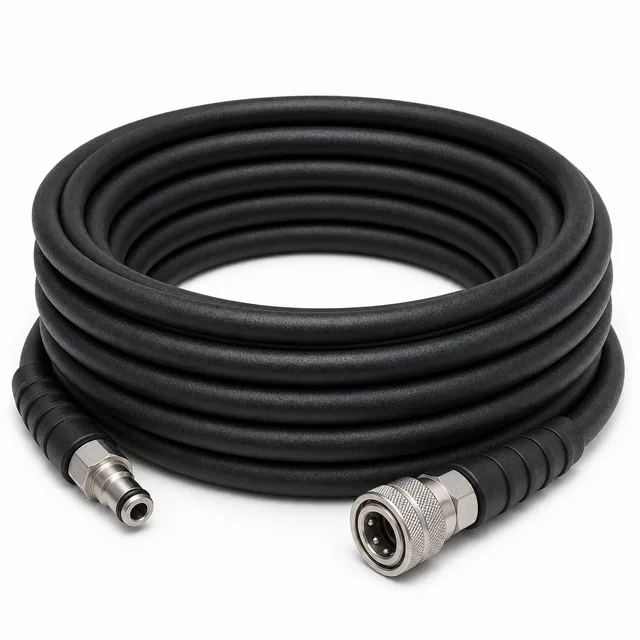
IMPORTANT: reference data — may differ from the physical product; verify with an advisor before buying.
SKU VT-manguera-para-hidrolavadora · pressure washer hose 1/4″–3/8″ · 100 m roll
1. Technical specifications
Dimensional and pressure table by size
| Nominal [in] | ID mm (in) | OD mm (in) | W/P psi (bar) | B/P psi (bar) | Min. bend radius mm (in) | Approx. weight kg/m (lb/ft) |
|---|---|---|---|---|---|---|
| 1/4″ | 6.4 (0.252) | 13.6 (0.535) | 4,000 (275) | 12,000 (827) | 95 (3.74) | 0.21 (0.141) |
| 5/16″ | 7.9 (0.311) | 15.2 (0.598) | 4,000 (275) | 12,000 (827) | 101 (3.98) | 0.25 (0.168) |
| 3/8″ | 9.5 (0.374) | 17.0 (0.669) | 4,000 (275) | 12,000 (827) | 115 (4.53) | 0.34 (0.228) |
IMPORTANT
This technical data sheet is a reference guide to the properties of this product type; it is not a quality certificate for the product you are buying. The measurements, dimensions and physical or geometric characteristics of the product supplied may vary by manufacturer, heat and lot, and may even fall outside the cited standards. If any of these figures is critical to your design or build, verify it with one of our advisors against the physical product or the lot's mill certificate, so you can be fully certain of what you are buying. · Original data sheet: tectul.com/en/conduccion-de-fluidos/mangueras/ficha-tecnica-manguera-para-hidrolavadora.html
W/P (working pressure) and B/P (burst pressure) are identical across all 3 sizes: 4,000 psi/275 bar and 12,000 psi/827 bar respectively — the manufacturer does not publish a per-diameter derating table.
General specifications
| Product | High-pressure hose for pressure washers, conveying water from the source to the spray nozzle |
| Construction | Nitrile inner tube · 2 steel braid reinforcement · nitrile cover |
| Working pressure (W/P) | 4,000 psi (275 bar), constant across all 3 sizes |
| Burst pressure (B/P) | 12,000 psi (827 bar) — declared 1:3 safety factor |
| Service temperature | −40 °C to 100 °C (−40 °F to 212 °F) |
| Declared resistance | Abrasion and chemicals present in cleaning (exact chemical not specified by the manufacturer) |
| Ends / connection | Not declared in the manufacturer data sheet — confirmed on quotation |
| Presentation | 100-meter rolls |
| Standard designation (SAE 100R, EN 853/854, etc.) | Not declared by the manufacturer — confirmed on quotation |
IMPORTANT: reference data — may differ from the physical product; verify with an advisor before buying.
2. Engineering criterion: what the 1:3 safety factor means
The safety factor, in one operation
The manufacturer declares W/P = 4,000 psi (275 bar) and B/P = 12,000 psi (827 bar) for all 3 sizes. The safety factor is SF = B/P ÷ W/P = 12,000 ÷ 4,000 = 3, i.e. 1:3. That means two different things worth not confusing: the hose must be operated continuously at 4,000 psi or less, and the 12,000 psi is the minimum pressure at which the manufacturer guarantees failure (burst) of the assembly, determined through a hydrostatic test to destruction of the type described in ISO 1402:2021 (Rubber and plastics hoses and hose assemblies — Hydrostatic testing). An intermediate proof test —typically at 1.5× W/P, i.e. about 6,000 psi/414 bar on this reference— is what is routinely applied to every manufactured length, not the operating pressure.
Worked example
- Starting data: 3/8″ reference (ID 9.5 mm), W/P 4,000 psi, B/P 12,000 psi.
- Factor calculation: SF = 12,000 / 4,000 = 3.
- Correct reading: the 3× margin is a manufacturing margin against burst, not an operating margin: it should not be read as the hose "withstanding up to 12,000 psi in use".
- Practical consequence: the pump or pressure washer connected to this hose must declare a working pressure at or below 4,000 psi for the size chosen; transient spikes from a sudden gun-trigger closure (water hammer) or a slow-reacting unloader valve are absorbed within the margin up to B/P, but repeated transients above W/P shorten the steel reinforcement's service life even without reaching burst.
The upper thermal limit (100 °C / 212 °F) is set by the nitrile compound of the tube and cover, not by the steel reinforcement: above that value the nitrile loses flexibility and adhesion to the braids before the steel would fail from pressure.
3. Recommended coupling fittings
What the manufacturer does not declare
The source data sheet does not specify the factory end type or connection of this hose — confirmed on quotation. In the professional pressure washer market it is common to use an M22×1.5 mm threaded connection at the gun/wand end and a quick coupler or 3/8″ NPT thread at the pump end; which of these ships on each roll of this reference is not documented.
Fitting compatibility by outer diameter
| Nominal [in] | Hose OD | Fitting consideration |
|---|---|---|
| 1/4″ | 13.6 mm (0.535 in) | Crimp ferrule sized exactly to the OD; a crimp diameter larger or smaller than specified by the fitting manufacturer voids the rated pressure even if the hose itself is undamaged |
| 5/16″ | 15.2 mm (0.598 in) | Same crimping criterion; check the fitting manufacturer's crimp chart for this specific OD |
| 3/8″ | 17.0 mm (0.669 in) | Same crimping criterion; on field repairs, use reusable fittings only if the fitting manufacturer certifies that size |
IMPORTANT: reference data — may differ from the physical product; verify with an advisor before buying.
Always respect the minimum bend radius (95–115 mm depending on size) near the fitting: bending the hose below that radius at the crimp point concentrates stress exactly where the steel reinforcement is already compressed by the ferrule, and is the most frequent premature fatigue failure point. Periodically inspect the ferrule for corrosion or loosening, especially with hot water or detergent use.
4. Frequently asked questions
What pressure does the pressure washer hose withstand?
It withstands a working pressure (W/P) of 4,000 psi (275 bar) across its 3 sizes (1/4″, 5/16″, 3/8″), with a burst pressure (B/P) of 12,000 psi (827 bar) — a 1:3 safety factor, per the manufacturer data sheet.
What is the difference between working pressure (W/P) and burst pressure (B/P)?
W/P is the maximum recommended continuous operating pressure; B/P is the minimum pressure at which the manufacturer guarantees the assembly will fail in a hydrostatic test to destruction. The ratio between the two (1:3 here) is a manufacturing margin, not a usage margin: the hose should not be operated near B/P.
Is this hose suitable for hot water?
Yes, within the manufacturer's declared range of −40 °C to 100 °C (−40 °F to 212 °F); above that value the nitrile compound loses flexibility before the steel reinforcement would fail from pressure, and the manufacturer does not publish a thermal pressure derating.
What minimum bend radius must the installation respect?
95 mm on 1/4″, 101 mm on 5/16″ and 115 mm on 3/8″, per the manufacturer data sheet; installing below that radius, especially near fittings, concentrates stress on the steel reinforcement and accelerates fatigue.
What factory connection does this hose ship with?
Not declared in the manufacturer data sheet — confirmed on quotation. The professional pressure washer market commonly uses M22×1.5 mm thread or 3/8″ quick couplers, but which applies to this reference is not verifiable from the source data sheet.
5. Application notes
Feasibility
Suitable for conveying high-pressure water in professional and domestic pressure washing, with declared resistance to abrasion and to the chemicals present in cleaning (exact chemical not specified). It is not documented for compressed air, gases or hydraulic fluids: those services require a hose with its own standard designation (SAE 100R or EN 853/854), which this reference does not declare.
Installation
Respect the minimum bend radius per size (95–115 mm) and avoid twisting the hose during installation: the 2-steel-braid reinforcement loses burst pressure if installed under torsion. Do not drag the hose over sharp edges even though the cover is abrasion resistant. Verify that the fitting is crimped to the exact outer diameter of the size before placing it in service.
Design
Select the hose whose W/P (4,000 psi/275 bar) equals or exceeds the pump's or pressure washer's actual maximum pressure, not just its marketing figure. Account for friction pressure loss over long runs (100 m rolls) when sizing the system. Do not continuously exceed the 100 °C service limit. Final selection of diameter, connection and chemical compatibility is the responsibility of the installer or the engineer responsible for the system.
6. Technical notice and limitation of liability
The pressures, temperatures and dimensions in this sheet are values published in the manufacturer's data sheet (internal TECTUL file) and guide selection; they are not a certificate of conformity for any given lot nor the result of an independent test performed by TECTUL.
The actual behavior of each length varies with manufacturing and the rubber lot. For critical applications, request the manufacturer's quality certificate and, if the project requires it, arrange hydrostatic testing of the length at an independent laboratory per ISO 1402:2021 before placing it in service.
Final selection of diameter, working pressure and chemical or thermal compatibility is the responsibility of the user or the engineer responsible for the system. Before deciding with these data, consult our technical team.
Sources
- Ficha técnica de fabricante (archivo interno TECTUL) — Manguera Para Hidrolavadora / Pressure Washer Hose
- ISO 1402:2021 — Rubber and plastics hoses and hose assemblies — Hydrostatic testing (terminología y metodología de ensayo de presión de trabajo, de prueba y de estallido)
This data sheet is the property of TECTUL, part of the Industrias IMR group. Reproduction without attribution is prohibited. Original document and updates: tectul.com/en/conduccion-de-fluidos/mangueras/ficha-tecnica-manguera-para-hidrolavadora.