
Water suction and discharge hose — EPDM rubber-canvas with steel spiral, 1″–8″
TECTUL · Dispatch across Colombia · Exports to Central & South America
Rubber-canvas hose with EPDM inner tube and cover, high-tension polyester reinforcement combined with an embedded steel spiral, for suction and discharge of water and drilling mud in oil fields. Working pressure of 12 bar (175 psi) on 1″–2″ and 10 bar (150 psi) on 2-1/4″–8″, with burst pressure of 36 bar (525 psi) and 18–30 bar (250–450 psi) respectively. This sheet also documents two sibling references: a discharge-only version with the same EPDM construction but no steel spiral (not suitable for suction), and a water suction version in transparent PVC with a rigid PVC spiral, lower pressure range and no published burst figure. A fourth reference, a heavy-duty flat discharge hose, is declared without verifiable technical data.
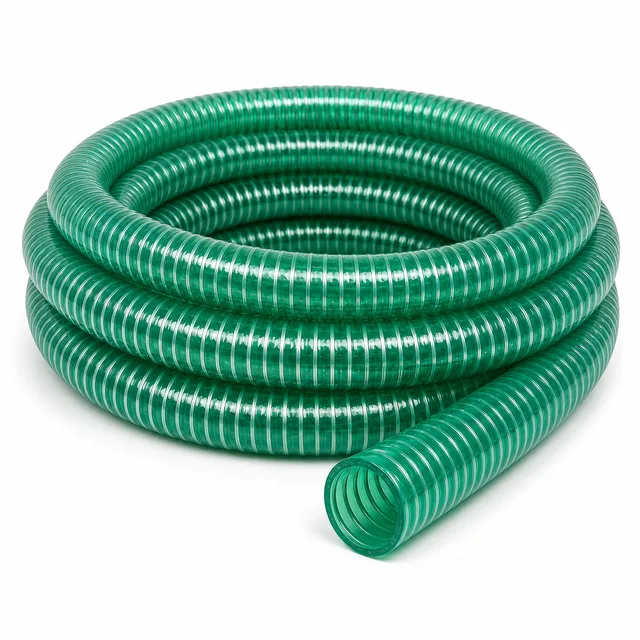
IMPORTANT: reference data — may differ from the physical product; verify with an advisor before buying.
SKU VT-142199 (water suction and discharge) · 4 references under this sheet, 1″–8″ · sold by the roll
1. Technical specifications
Dimensional and pressure data — main reference (suction and discharge, EPDM rubber-canvas + steel spiral, SKU VT-142199)
| Nominal size [in] | ID mm (in) | OD mm (in) | Reinforcement | Working pressure | Burst pressure | Approx. weight |
|---|---|---|---|---|---|---|
| 1″ | 25.4 (1.00) | 34 (1.34) | 2 plies | 12 bar (175 psi) | 36 bar (525 psi) | 0.81 kg (1.79 lb) |
| 1-1/4″ | 31.8 (1.25) | 42 (1.65) | 2 plies | 12 bar (175 psi) | 36 bar (525 psi) | 1.02 kg (2.25 lb) |
| 1-1/2″ | 38.1 (1.50) | 48 (1.89) | 2 plies | 12 bar (175 psi) | 36 bar (525 psi) | 1.30 kg (2.87 lb) |
| 1-3/4″ | 44.5 (1.75) | 56 (2.20) | 2 plies | 12 bar (175 psi) | 36 bar (525 psi) | 1.42 kg (3.13 lb) |
| 2″ | 50.8 (2.00) | 63 (2.48) | 2 plies | 12 bar (175 psi) | 36 bar (525 psi) | 2.09 kg (4.61 lb) |
| 2-1/4″ | 57 (2.24) | 69 (2.72) | 2 plies | 10 bar (150 psi) | 30 bar (450 psi) | 2.61 kg (5.75 lb) |
| 2-1/2″ | 63.5 (2.50) | 76 (2.99) | 2 plies | 10 bar (150 psi) | 30 bar (450 psi) | 3.14 kg (6.92 lb) |
| 2-3/4″ | 70 (2.76) | 83 (3.27) | 2 plies | 10 bar (150 psi) | 30 bar (450 psi) | 3.66 kg (8.07 lb) |
| 3″ | 76.2 (3.00) | 91 (3.58) | 2 plies | 10 bar (150 psi) | 30 bar (450 psi) | 3.26 kg (7.19 lb) |
| 3-1/2″ | 88.9 (3.50) | 104 (4.09) | 2 plies | 10 bar (150 psi) | 30 bar (450 psi) | 4.88 kg (10.76 lb) |
| 4″ | 101.6 (4.00) | 118 (4.65) | 2 plies | 10 bar (150 psi) | 30 bar (450 psi) | 5.45 kg (12.02 lb) |
| 4-1/2″ | 114.3 (4.50) | 130 (5.12) | 4 plies | 10 bar (150 psi) | 18 bar (250 psi) | 6.81 kg (15.01 lb) |
| 5″ | 127 (5.00) | 143 (5.63) | 4 plies | 10 bar (150 psi) | 18 bar (250 psi) | 7.83 kg (17.26 lb) |
| 6″ | 152 (5.98) | 169 (6.65) | 6 plies | 10 bar (150 psi) | 18 bar (250 psi) | 8.33 kg (18.37 lb) |
| 8″ | 203.2 (8.00) | 221 (8.70) | 6 plies | 10 bar (150 psi) | 18 bar (250 psi) | 10.42 kg (22.97 lb) |
IMPORTANT
This technical data sheet is a reference guide to the properties of this product type; it is not a quality certificate for the product you are buying. The measurements, dimensions and physical or geometric characteristics of the product supplied may vary by manufacturer, heat and lot, and may even fall outside the cited standards. If any of these figures is critical to your design or build, verify it with one of our advisors against the physical product or the lot's mill certificate, so you can be fully certain of what you are buying. · Original data sheet: tectul.com/en/conduccion-de-fluidos/mangueras/ficha-tecnica-manguera-para-succion-y-descarga-de-agua.html
The manufacturer's published weight at 3″ (3.26 kg) is lower than at 2-3/4″ (3.66 kg) despite the larger diameter; this is reproduced exactly as it appears in the source sheet, uncorrected, and should be verified with the supplier when quoting that specific size.
Comparison of the 4 catalog references under this sheet
| Reference | Service | Tube / cover | Reinforcement | Diameter range | Presentation |
|---|---|---|---|---|---|
| Water suction and discharge, rubber-canvas (SKU VT-142199) | Suction and discharge | EPDM / EPDM | High-tension polyester + steel spiral | 1″–8″ | 60 m roll |
| Water discharge, rubber-canvas (manguera-para-decarga-de-agua-en-caucho) | Discharge only (positive pressure) | EPDM / EPDM | High-tension polyester, no steel spiral | 1″–8″ | 60 m roll |
| Water suction, PVC (manguera-para-succion-de-agua) | Suction | Transparent PVC | Rigid PVC spiral | 1″–6″ | 100 m roll |
| Heavy-duty water discharge, flat hose (manguera-para-descarga-de-agua-trabajo-pesado) | Discharge only | Confirmed on quotation | Confirmed on quotation | Confirmed on quotation | Confirmed on quotation |
The rubber-canvas discharge reference shares exactly the same dimensional, working-pressure and burst-pressure table as the main reference (same manufacturer EPDM/polyester family), but without the embedded steel spiral; the full table is therefore not repeated. The PVC reference publishes only working pressure (no steel spiral, no burst figure) and is detailed below.
Dimensional data — PVC reference (water suction, rigid PVC spiral)
| Nominal size [in] | ID mm (in) | OD mm (in) | Working pressure |
|---|---|---|---|
| 1″ | 25 (0.98) | 60 (2.36) | 12.4 bar (180 psi) |
| 1-1/4″ | 32 (1.26) | 60 (2.36) | 12.4 bar (180 psi) |
| 1-1/2″ | 38 (1.50) | 50 (1.97) | 10.3 bar (150 psi) |
| 2″ | 50 (1.97) | 50 (1.97) | 10.3 bar (150 psi) |
| 2-1/2″ | 65 (2.56) | 40 (1.57) | 8.3 bar (120 psi) |
| 3″ | 75 (2.95) | 40 (1.57) | 8.3 bar (120 psi) |
| 3-1/2″ | 88 (3.46) | 40 (1.57) | 8.3 bar (120 psi) |
| 4″ | 100 (3.94) | 40 (1.57) | 8.3 bar (120 psi) |
| 4-1/2″ | 114 (4.49) | 40 (1.57) | 8.3 bar (120 psi) |
| 5″ | 125 (4.92) | 40 (1.57) | 8.3 bar (120 psi) |
| 6″ | 150 (5.91) | 30 (1.18) | 6.2 bar (90 psi) |
IMPORTANT: reference data — may differ from the physical product; verify with an advisor before buying.
General specifications
| Product | EPDM rubber-canvas water suction and discharge hose with steel spiral, with siblings in discharge-only (EPDM, no spiral), PVC suction (rigid spiral) and flat discharge hose |
| Material | EPDM inner tube and cover · high-tension polyester reinforcement + steel spiral (main reference) · transparent PVC tube with rigid PVC spiral (PVC suction reference) |
| Ends | No permanent factory coupling; camlock, flanged or threaded unions are fitted per project — confirmed on quotation |
| Rating | Main reference: 12 bar/175 psi (1″–2″) and 10 bar/150 psi (2-1/4″–8″) cold, burst 36 bar/525 psi and 18–30 bar/250–450 psi. PVC reference: 6.2–12.4 bar (90–180 psi), no published burst figure |
| Commercial range | 1″–8″ depending on reference; 4 active references under this sheet |
| Sale | By the roll, per reference and diameter |
| Applicable standards | ASTM D380-94(2020) (rubber hose test methods) · ASTM D2000-18 (rubber compound classification; EPDM = type AA) |
IMPORTANT: reference data — may differ from the physical product; verify with an advisor before buying.
2. Engineering criterion: suction (vacuum) vs. discharge (positive pressure)
Why suction and discharge are not the same mechanical stress
The working pressure (W/P) and burst pressure (B/P) the manufacturer publishes describe the hose's resistance to internal positive pressure — the discharge case, where the fluid pushes the wall outward. Suction is the opposite case: a pump creates partial vacuum inside the hose and it is outside atmospheric pressure (1.013 bar / 14.7 psi at sea level) that pushes the wall inward. None of the figures in this sheet (W/P, B/P) directly measure that collapse resistance; resistance to suction comes from the rigid reinforcement geometry — the embedded steel spiral or the rigid PVC spiral — which acts as a ring preventing the wall from folding onto itself when internal pressure drops below external pressure.
Practical consequence: the sibling without a spiral cannot be used for suction
The discharge-only reference shares tube, cover and polyester textile reinforcement with the main reference, but carries no steel spiral. On the discharge side of a pump that is not a problem — pressure pushes the wall outward and the polyester contains it — but if installed on the suction side, the first time the pump draws vacuum the hose collapses and cuts off flow, even below its nominal discharge working pressure. That is why the TECTUL catalog separates the two references: the suction-and-discharge one (with spiral) can go on either side; the discharge-only one only downstream of the pump.
Worked example: how close is the hose to full vacuum
- Starting figure: sea-level atmospheric pressure = 1.013 bar (14.7 psi absolute).
- Typical vacuum of a self-priming centrifugal pump: on the order of 0.3 to 0.7 bar of vacuum (equivalent to an absolute pressure of 0.3 to 0.7 bar inside the hose), well above full vacuum (0 bar absolute).
- Comparison: even that partial vacuum already represents a pressure difference of several tenths of a bar pushing the wall inward along the whole suctioned length — of the same order of magnitude as the positive working pressure the hose is rated to resist outward.
- Conclusion: the margin against collapse under suction is not free or "automatic" from having a good discharge working pressure; it depends exclusively on the rigid reinforcement (steel or PVC spiral) being present and in good condition.
None of the three manufacturer sheets consulted publishes an admissible vacuum figure in inHg or mbar; see confirmarAlCotizar.
3. Materials, application and use limits
EPDM: why it is the tube/cover of the two rubber-canvas references
EPDM (ethylene propylene diene monomer, type AA under the ASTM D2000-18 classification) has good resistance to water, steam and weathering, and is economical compared with compounds with better hydrocarbon resistance. That is exactly why these two references are rated for water and aqueous drilling mud, and not for fuels, oils or solvents: EPDM swells and degrades under prolonged contact with hydrocarbons. For those fluids, TECTUL maintains a separate fuel hose sheet with a nitrile tube (see FT-TC-MAN-COMBUSTIBLE-001).
Transparent PVC: the light-duty suction reference
The PVC water suction reference uses a transparent tube with a rigid PVC spiral embedded in the wall, not steel. Transparency allows visual inspection of the flow (useful for detecting air, sediment or clogging), and the assembly is lighter than the equivalent rubber-canvas hose, in exchange for a lower working-pressure range (6.2–12.4 bar / 90–180 psi) and no burst pressure published by the manufacturer.
Application declared by the manufacturer
The main reference's sheet declares use in suction and discharge of water and drilling mud in oil fields, plus irrigation, drainage, pumping and construction projects handling water. The PVC reference's sheet declares use in vacuum pumps, agriculture, irrigation and industry in general. None of the three manufacturer sheets consulted certifies contact with potable water; if the project requires that certification, it must be confirmed separately.
What falls outside this sheet
- Fuels, oils and hydrocarbons — see FT-TC-MAN-COMBUSTIBLE-001.
- Aggressive chemicals, acids and solvents — see FT-TC-MAN-QUIMICOS-UHMW-001.
- Compressed air or ventilation — see FT-TC-MAN-SUCC-AIRE-001.
4. Frequently asked questions
What is the difference between the "suction and discharge" reference and the "discharge only" one?
The embedded steel spiral. Both share an EPDM tube, EPDM cover and polyester reinforcement, and the same working-pressure and burst-pressure table, but only the suction-and-discharge reference carries a steel spiral — the element that prevents wall collapse when the pump draws vacuum.
Can I use the rubber-canvas discharge hose (without a spiral) to suction water?
No. Without a steel spiral, the wall folds as soon as the pump creates partial vacuum, even if the discharge working pressure is high. Use the reference with a steel spiral (suction and discharge) or the PVC one with a rigid spiral on the suction side.
What working pressure does the PVC reference have?
Between 6.2 and 12.4 bar (90 to 180 psi) depending on diameter: 12.4 bar (180 psi) on 1″–1-1/4″, stepping down to 6.2 bar (90 psi) on 6″. The manufacturer publishes no burst pressure for this reference, so the working figure must not be exceeded.
Is this hose suitable for drilling mud in oil fields?
Yes, that is the explicit application the manufacturer declares for the main suction-and-discharge reference and its discharge-only sibling, both in EPDM construction.
What is the service temperature range?
For the two EPDM rubber-canvas references: -20 °C to +85 °C (-4 °F to 185 °F), with a manufacturer-declared safety factor of 1:3 (a figure that only holds on 1″–4″ diameters; on 4-1/2″–8″ the real burst-to-working ratio is 1.8:1). The PVC reference publishes no thermal range — confirmed on quotation.
5. Application notes
Feasibility
Specify the steel-spiral reference (suction and discharge) whenever the hose will work on the pump's suction side; reserve the discharge-only one for the downstream run. Both are valid for water, water with sediment and aqueous drilling mud; neither is rated for fuels, oils or aggressive chemicals. The PVC reference is a lighter alternative for clean-water suction at low-to-medium pressure (up to 180 psi), not for heavy duty. The flat discharge reference remains unspecified until its technical data is confirmed.
Installation
Fit camlock or flanged couplings sized to the diameter and compatible with the fluid; avoid bends tighter than the radius the spiral itself forms at rest, the point at which the hose can kink and collapse even without suction. Protect the transparent PVC hose from prolonged sun exposure, which degrades the compound faster than EPDM rubber. Check the condition of the spiral (steel or PVC) before every suction use: a deformed spiral loses its rigid-ring function and the hose collapses even if the rest of the wall is in good condition.
Design
Do not assume a 3:1 safety factor across the whole line: on 4-1/2″ to 8″ the real burst-to-working ratio is 1.8:1 per the manufacturer's own table, even though the sheet declares a blanket "1:3 safety factor". For the suction side, size to the pump's real vacuum capacity, not the hose's positive working pressure — none of the manufacturer sheets consulted publishes an admissible vacuum figure in inHg or mbar. If the project requires potable water contact, temperatures outside -20 °C to +85 °C, or hydrocarbon service, specify a different hose family.
6. Technical notice and limitation of liability
The pressures, dimensions, weights and other characteristics in this sheet are theoretical calculation values obtained from nominal properties published in the standards cited (ASME B36.10-2022, ASME B31.3-2024, ASTM A106/A106M-19a, ASTM A53/A53M-24, API Spec 5L 46th ed.). They guide selection; they are not a certificate of conformity for any given lot.
The actual behavior of each lot varies with manufacturing — wall tolerance (up to −12.5%), out-of-roundness, residual stresses — and with the raw material — chemical composition within the ranges the standard allows, heat-to-heat differences. To certify a lot, the tests defined by its product standard are required: tensile test, flattening test and hydrostatic test, documented in the manufacturer's mill test certificate (MTC), which TECTUL supplies upon request; testing of the lot in an independent laboratory can also be arranged.
These values must not be used as the sole criterion in critical or safety applications, or wherever failure of the line may compromise people, property or the environment: in such cases the design belongs to the project's responsible engineer under the applicable code (ASME B31.3, B31.1 or the one governing the installation), with the design temperature, corrosion allowance and load cases of the actual service. Before deciding with these data, consult our technical team.
Sources
- Ficha técnica de fabricante (archivo interno TECTUL): Manguera Para Succión y Descarga de Agua - Caucho Lona (fichas-rescate/ft-mang-succ-desc-cauch-lona.pdf)
- Ficha técnica de fabricante (archivo interno TECTUL): Manguera Para Descarga de Agua - Caucho Lona (fichas-rescate/ft-mang-succ-cauch-lona.pdf)
- Ficha técnica de fabricante (archivo interno TECTUL): Manguera Succión de Agua - PVC (fichas-rescate/ft-mang-succion-agua.pdf)
- ASTM D380-94(2020) — Standard Test Methods for Rubber Hose
- ASTM D2000-18 — Standard Classification System for Rubber Products in Automotive Applications (designación de polímero EPDM = tipo AA)
This data sheet is the property of TECTUL, part of the Industrias IMR group. Reproduction without attribution is prohibited. Original document and updates: tectul.com/en/conduccion-de-fluidos/mangueras/ficha-tecnica-manguera-para-succion-y-descarga-de-agua.